


Part IThe Story
The Bicycle Repairman's Dare
In February 2003, two weeks before the Geneva Motor Show — the annual rite where the world's automakers genuflect before journalists and oligarchs — the thatched roof of a heritage building in Margretetorp, Sweden, caught fire. The blaze started in a dishwasher, jumped to the hay-insulated roof, and swallowed the workshop whole. Forty firefighters from five departments converged on the scene. Inside were some of the rarest cars on earth: hand-built carbon fiber machines worth millions of kronor apiece, each one representing years of labor by a team so small it could fit in a restaurant booth. When it was over, the building was gone. So were Christian von Koenigsegg's childhood drawings, his earliest car sketches, the floppy disks containing designs he'd rendered in Microsoft Paint as a teenager on a Commodore 64. The archaeological record of a dream, incinerated.
But the cars survived. Staff had been working on a Saturday — this is not the kind of company where people punch clocks — and they dragged every vehicle, every engine, every critical piece of tooling out of the flames before the structure collapsed. Fourteen days later, Koenigsegg showed the CC8S at Geneva. The car was untouched.
The fire is a useful emblem for the man himself. Christian von Koenigsegg has spent three decades building a hypercar company from a country famous for safety-conscious Volvos and sensible Saabs, in a market that wasn't asking for his product, with no engineering degree, no automotive industry experience, no venture capital, and — for the first eight years — fewer than twelve employees. He has been told it was impossible so many times that he has adopted the word as a kind of talisman. "It was a stupid business idea, basically," he has said of his founding vision. "An impossible plan. And that's why I liked it."
What he built, from that impossibility, is something without real precedent in the modern automotive industry: a fully independent, family-controlled hypercar manufacturer that designs and fabricates nearly every major component in-house — engines, transmissions, electronics, carbon fiber monocoques, even the software — and whose products routinely embarrass machines from companies with fifty or a hundred times the headcount. As of 2025, Koenigsegg Automotive AB has produced roughly 300 cars in its entire existence. Ferrari makes that many in a week. And yet it is Ferrari, by Bloomberg's reckoning, that must contend with Christian von Koenigsegg.
By the Numbers
Koenigsegg Automotive AB
~300Total cars produced since founding (1994–2025)
~800Employees at Ängelholm headquarters
1,600 hpJesko engine output on E85 biofuel
277.9 mphAgera RS world speed record on public road (2017)
$2M–$3M+Approximate price per vehicle
30+Years as founder, CEO, and lead engineer
0Formal engineering degrees held by founder
A Noble Name and a Stop-Motion Film
Christian Erland Harald von Koenigsegg was born on July 2, 1972, in Stockholm, Sweden, into a family whose name traces back to the Swabia region of southwest Germany and a coat of arms granted by the Holy Roman Empire in the twelfth century. The lineage is aristocratic in the old European sense — it carries a "von" and a family crest — but the household was not an automotive one. His father, Jesko von Koenigsegg, was a successful entrepreneur who would later run an energy technology firm called JK Energiteknik. His mother, Brita Aasa, was a fashion designer. There was, as Christian would later put it, "no real car interest" in the family.
What there was, instead, was a five-year-old boy sitting in a cinema in the late 1970s, watching a Norwegian stop-motion animated film called Flåklypa Grand Prix — known in English as The Pinchcliffe Grand Prix. The plot is simple enough to be archetypal: a bicycle repairman named Reodor Felgen, working from a mountaintop workshop with a hedgehog and a magpie as his assistants, builds his own racing car from salvaged parts, enters a grand prix against established teams with corporate backing, and wins. The boy walked out of the theater and told his father what he was going to do with his life.
Nearly five decades later, a model of Reodor Felgen's car — Il Tempo Gigante, a contraption that looks like Chitty Chitty Bang Bang after a meth binge — still sits on a shelf in Christian von Koenigsegg's office in Ängelholm.
The childhood that followed was a sustained exercise in mechanical curiosity bordering on compulsion. At seven, his father gave him a soldering kit; he built his first radio-controlled car. By eight, his parents had bought him a small motorcycle, which he promptly tore apart, rebuilt, and sold — along with several more like it. He dismantled the family VCR, the toaster, the television, anything with an inner life he could interrogate. "My parents were very patient," he has said, with the faint smile of a man who knows his parents had no choice. He had stacks of car magazines in his room, meters high, bristling with posted notes flagging details he liked and didn't like. Why does the hinge look like that? Why are the brakes like that? Why did that car do it this way and this car do the same thing differently? The word "why," repeated with the relentlessness of a four-year-old, was the engine of his education.
At twelve, he got his first moped — a Suzuki K50 — and learned to tune it. He ground a cylinder head against the basement floor to shave it down, a technique whose elegance lies in its barbarism. By fifteen, he was the town's recognized moped tuner, running a stable of a dozen machines he would buy, improve, and flip. At sixteen, he acquired a 2.5-meter boat called Spitfire with a five-to-fifteen-horsepower motor; he strapped a thirty-five-horsepower engine onto it, added a stereo, some lanterns, and a horn, and sold that too. The pattern was already legible: acquire something, understand it at its deepest mechanical level, make it better than anyone thought reasonable, move on.
He attended a well-respected Swedish boarding school about 180 miles west of Stockholm, studied business, and at fourteen was already sure he wanted to build cars. Not drive them. Build them. The distinction matters. His first summer job was washing cars at a Suzuki dealership outside Stockholm. But the dealership was a means; the end was always the workshop.
Frozen Chickens and Misprinted Bags
At nineteen, in 1991, Christian von Koenigsegg founded a trading company — an import-export operation that would serve as the financial scaffolding for an ambition he was not yet ready to execute. The timing was exquisite, if unintentional. The Iron Curtain had just fallen. The former Soviet republics were ravenous for goods that the West treated as surplus. Von Koenigsegg saw the gap and filled it with whatever was available: frozen chicken, ballpoint pens, misprinted plastic bags. "I found a big batch of plastic bags that had been printed with a logo the wrong way," he recalled. "They were going to be thrown out. I bought them and sold them into Eastern Europe. They didn't care about the logo. They just needed the bags."
There is something almost comically appropriate about the origin story. The man who would build $3 million cars started by arbitraging waste. But the lesson was real: he learned to see value where others saw refuse, to match supply to demand across information asymmetries, and to bootstrap profits into the next venture without external capital. These are the instincts that would later allow him to sell his first car, use the proceeds to fund the second, sell that one, fund the third, and so on, in a cycle of self-financing so patient it makes Silicon Valley's blitzscaling look like a nervous tic.
He also had two ideas during this period that were ahead of their time in a way that must have been agonizing. The first was the Chip Player, conceived around 1991: a device that would store an entire CD's worth of music on a computer memory chip, offered as a cheaper alternative to compact discs. He conducted patent searches, found nothing like it, tried to sell the concept to electronics companies, and was met with indifference. A few years later, his idea became the norm — it was, essentially, the flash-based music player that would culminate in the iPod. The second was Click, a system for joining floorboards without adhesive or nails, where planks simply clicked together. He presented it to his father-in-law in Belgium, who ran a flooring factory and dismissed it, claiming someone would have invented it long ago if it were viable. Other manufacturers said the same. In 1995, a Belgian and a Swedish company patented the identical solution — even calling it Click. The innovation has since become a multi-billion-dollar industry.
Two ideas worth billions, abandoned before their time. Most people would have been devastated. Von Koenigsegg seems to have absorbed the lesson differently: his instincts were right, his timing was wrong, and the only way to guarantee capturing the value of a vision was to execute it himself, end to end. He would not make that mistake again.
The Impossible Plan
In 1994, bored by the trading company and chastened by the near-misses of the Chip Player and Click, Christian von Koenigsegg decided to follow his heart. He was twenty-two. Sweden was crawling out of a recession. The country's automotive identity was defined by Volvo's three-point seatbelt and Saab's wind-tunnel-tested practicality — not exactly the milieu for a hypercar startup. There were no known successful car-company startups at the time, the market wasn't asking for a Swedish supercar, and he had no engineering degree, no automotive industry experience, no factory, no team, and limited capital.
He founded Koenigsegg Automotive AB on August 12, 1994.
"Nobody was asking for it," he would later explain. "It was seemingly impossible. It was expensive. Nobody had ever come from nothing and done it successfully before. So it was a stupid business idea, basically. An impossible plan. And that's why I liked it."
He hired industrial designer David Craaford to translate his vision into a design concept — a mid-engined, two-seat supercar with a detachable roof, aerodynamics informed by Swedish fighter jets, and a carbon fiber monocoque chassis. He assembled a tiny team. The plan was to rival the McLaren F1, then the world's fastest production car, with its 386 km/h top speed. To achieve this from a small workshop in Olofström, in southern Sweden, with essentially no money, was — there is no other word for it — delusional. And he knew it.
The engine saga alone is a parable about persistence. Von Koenigsegg initially wanted to use Audi's 4.2-liter V8, a proven powerplant that Lamborghini was also eyeing. Audi was "surprisingly positive" about supplying engines — until von Koenigsegg mentioned he intended to tune them to 550–600 horsepower. Audi wouldn't support aftermarket modification. He nearly found a back-channel through a Danish industry supplier and even signed an engine supply contract, but Audi heard about it and shut it down. He could have sued. He didn't.
Then came Motori Moderni, the Italian firm that had built a flat-twelve engine for the Subaru-badged Minardi Formula 1 effort in the 1990 season. The engine hadn't been successful in racing, but von Koenigsegg saw potential. He began negotiations with founder Carlo Chiti to supply a modified version. Then Chiti died. The deal collapsed. Motori Moderni went bankrupt.
So he turned to Ford's 4.6-liter modular V8 as a base architecture, which Koenigsegg would re-engineer so extensively — forged pistons, connecting rods, dry-sump lubrication, centrifugal supercharger, reworked cylinder heads — that calling it a "Ford engine" was technically accurate but spiritually dishonest. It was, by the time Koenigsegg was finished with it, a 655-horsepower weapon in a carbon fiber body that weighed 1,175 kilograms. The CC8S, as the production version would be called, was conceived in a country with no supercar tradition, by a man with no engineering pedigree, using a donor engine block from the company that made the Ford Taurus.
Bread and Water and the Cannes Premiere
The years between 1994 and 2002 were, by von Koenigsegg's own account, a long tunnel. The first prototype — called simply CC — was driven publicly for the first time in 1996 at Anderstorp Raceway, piloted by Swedish touring car legend Rickard Rydell. Rydell, who had won the British Touring Car Championship in 1998 driving a Volvo S40 — a car so unlike a Koenigsegg that the juxtaposition borders on comedy — tested the prototype alongside drivers Picko Troberg and Calle Rosenblad. The concept worked. The car was spectacularly fast.
But a prototype is not a product. The CC needed to become road-legal, homologated for sale, crash-tested, refined. All of this cost money that Koenigsegg didn't have.
"It was a lot of bread and water for many years," von Koenigsegg told the BBC, "but I just had this relentless passion to get it done."
In 1997, he brought the prototype to the Cannes Film Festival — not to a motor show, where it would have been one curiosity among many, but to a film festival, where it had the field to itself. The media coverage was enormous. It was a shrewd piece of marketing from a man who understood, even then, that when you have no brand recognition, no heritage, and no country-of-origin advantage, you must create spectacle. You must be undeniable.
The team kept working. In 1999, they moved from their original workshop in Olofström to a new facility in Margretetorp, the heritage building with the thatched roof that would later burn. In 2000, the first production prototype debuted at the Paris Motor Show, featuring an early version of the 655-horsepower engine. And in 2002, the first CC8S — Competition Coupe, V8, Supercharged — was built and delivered at the Geneva Motor Show in March 2003. Only six would ever be made.
— Christian von KoenigseggThe most impossible car of all, even though it's the simplest one, was the CC8S because, on average, fewer than 12 people created it. In the first seven or eight years, only four people were working on it, and we had very little experience. That it turned out the way it did is unbelievable to me today.
The CC8S was awarded a Guinness World Record in 2002 for the world's most powerful production engine. It received a Red Dot Design Award. Jeremy Clarkson, Top Gear's famously corrosive critic, named it his favorite supercar of 2004. The same year, a driver in Texas earned the fastest speeding ticket ever recorded — 242 miles per hour in a Koenigsegg CC. The company had announced itself to the world not with a press release but with a police report.
The Ghost Squadron's Hangar
After the February 2003 fire consumed the Margretetorp factory, the Koenigsegg cars took refuge at a former Swedish Air Force base nearby — F10, just outside Ängelholm. The base had been home to the Johan Röd squadron, known as the Ghost Squadron: pilots who flew from dawn until dusk, their planes heard above the clouds but never seen. When the squadron decommissioned, the pilots offered Koenigsegg their fabled ghost insignia, asking only that it be placed on every car built at the site. It remains there today — the spirit emblem on the rear hood of every Koenigsegg, above the engine bay, a phantom from a military past presiding over a civilian future.
The move to Ängelholm was supposed to be temporary. It became permanent. The hangars that once housed JAS 39 Gripen fighter jets were refurbished: composite workshop, engine development, pre-assembly, final assembly, paint shop, R&D, vehicle storage. A former airfield runway became a test track. Customers could fly in on private jets and test their cars on the same tarmac that had launched interceptors. The facility has expanded multiple times since — by 2024, the company was planning a new Gemera factory, additional assembly lines, a customer lounge, a development center, and even a small private race track, bringing the total footprint to over 30,000 square meters.
But the symbolism of the location runs deeper than convenience. Christian von Koenigsegg had always said the CC was inspired by Swedish fighter jets — the aggressive aerodynamic profile, the canopy-like cockpit, the idea of a machine that compresses extraordinary capability into minimal volume. To build such cars in a fighter jet hangar, using the runway where Gripens once scrambled, was not an accident of circumstance. It was narrative made physical.
The Record Chase and the Problem of Being Unknown
The years following the CC8S were a relentless escalation. In 2004, the CCR was unveiled — an evolution of the CC8S, produced in fourteen examples, with enough power to enter the record books. In February 2005, the CCR set a world speed record of 387 km/h (240.5 mph) at Italy's Nardò Ring, dethroning the McLaren F1 as the world's fastest production car. The reign was brief — Bugatti's Veyron soon claimed the crown — but it established a pattern that would define Koenigsegg's public identity: the pursuit of measurable supremacy as a substitute for brand heritage.
"When I started the company, I said to myself, why would anyone buy one of my cars?" von Koenigsegg told AFP. "It is an unknown brand, by an unknown person, from a country not famous for sports cars. So I said to myself, they have to really stand out and be different and hopefully better in some ways than the competitors."
This was not ego. It was strategy. Ferrari had seventy years of racing pedigree. Lamborghini had Marcello Gandini's designs and the mythology of tractors and bulls. Bugatti had the ghost of Ettore. What did Koenigsegg have? A twenty-something Swede with a family crest and a dream. The only way to force the conversation was to be faster, more innovative, more technically audacious than anyone with ten times the budget. Speed records were the megaphone.
The CCX, launched in 2006, was the first Koenigsegg to achieve worldwide street-legal homologation, including the notoriously demanding U.S. market. The CCXR, introduced in 2007, ran on E85 biofuel and E100 ethanol — an early foray into sustainable fuels that was years ahead of the industry's environmental awakening. Forbes named it one of the world's most beautiful cars in 2009.
Then came the Agera in 2010, which won BBC Top Gear's Hypercar of the Year Award and began a lineage that would culminate in the Agera RS — the car that, on November 4, 2017, on a closed stretch of Nevada highway between Las Vegas and Pahrump, set five world records in a single session, including a top speed of 277.87 miles per hour on a public road. That record has since been challenged by the Bugatti Chiron Super Sport 300+, but von Koenigsegg is quick to note the asterisk: "They did it on a closed track and we did it on a public road... also, our record was with a production car while the Chiron was a pre-series prototype."
The Regera, or How Tesla Changed Everything
In 2013, Christian von Koenigsegg bought a Tesla Model S P85+. It is not an exaggeration to say this purchase altered the trajectory of his company.
He was impressed — genuinely, viscerally impressed — by the electric powertrain's ability to deliver power instantaneously, without waiting for a downshift or turbo spool. "The direct and intuitive experience provided by an electric car," he remarked, was "something even a Formula One car could not attain with a traditional internal combustion engine." The man who had spent two decades perfecting combustion engines was seduced by the feel of a motor that had none.
But von Koenigsegg is not a man who accepts tradeoffs. He wanted the Tesla's instantaneous response married to Koenigsegg's lightweight, high-power DNA. A pure electric car was out of the question — the batteries were too heavy, the emotional dimension of a screaming V8 too central to the brand. So he invented something entirely new: the Koenigsegg Direct Drive system, or KDD, which eliminated the traditional multi-speed gearbox entirely. In its place, a single-gear direct connection from the internal combustion engine to the rear wheels, supplemented by three electric motors and a 4.5 kWh battery pack, delivering 1,500 combined horsepower.
The result was the Regera — Swedish for "to reign" — introduced at the 2015 Geneva Motor Show. It was the first production car to produce one megawatt of power. It was also, paradoxically, a grand tourer: equipped with cup holders (rare in a megacar), soft-close doors, lush leather interiors, and an Autoskin system that operated all body closures automatically at the touch of a button. Eighty units were built. It was Koenigsegg's Jekyll and Hyde: a car that could obliterate most things on a race track and also be driven in something resembling comfort.
— Christian von KoenigseggA car with no gears is still a mind-bender for me. It was an absolutely wild execution that no other car company would ever have dared to do.
The Regera also catalyzed a deeper shift in von Koenigsegg's thinking about sustainability. Running on E85 biofuel, paired with an 800-volt battery system, it suggested a future where extreme performance and environmental responsibility were not antagonists but collaborators. The company began experimenting with synthetic fuels, ultra-high-voltage battery packs, and even — improbably — biofuels derived from volcanic emissions.
And then there is the footnote that reveals the man's financial instincts as clearly as any car reveals his engineering ones. Elon Musk, von Koenigsegg has said on Swedish podcast Framgångspodden, is his great idol. The day after Tesla's IPO in 2010, von Koenigsegg took his savings from the bank and invested them in Tesla shares at $23 apiece. Including the subsequent stock split, those initial shares appreciated to approximately $2,000 each. "As CEO of Koenigsegg," he admitted, "he could never have paid off that much money." The frozen-chicken arbitrageur had struck again.
A Love Letter to Jesko
In 2019, at the Geneva Motor Show, Koenigsegg introduced the Jesko. Named for Christian's father — Jesko von Koenigsegg, the entrepreneur who had given a seven-year-old boy a soldering kit, who had initially protested his son's plan to start a car company and then helped him pursue it anyway — the car was an act of filial devotion rendered in carbon fiber and titanium.
Jesko von Koenigsegg was in the audience when the car was unveiled. Christian, known for his composure, struggled to maintain it. The naming was not a marketing decision. It was a son saying thank you.
The car itself was an exercise in engineered extremism. Its 5.0-liter twin-turbocharged V8 produced 1,280 horsepower on gasoline and 1,600 horsepower on E85, fed by twin ceramic ball-bearing turbochargers force-fed with compressed air from a 20-liter carbon fiber tank — turbochargers fed by a compressor, in a kind of combustion centipede. The engine weighed 189 kilograms and featured what Koenigsegg claimed was the lightest production V8 crankshaft in the world: a flat-plane 180-degree unit weighing just 12.5 kilograms.
But the revolution was in the transmission. The Koenigsegg Light Speed Transmission — LST — was a nine-speed multi-clutch unit with seven wet multidisc clutches, weighing just 90 kilograms, capable of gear changes between any two gears in virtually zero time. Not adjacent gears — any gears. An eight-to-second downshift happened as fast as a seven-to-six. The LST was, in the words of the company, "a scale of evolution not seen since the development of modern dual-clutch technology at the turn of the century."
One hundred and twenty-five Jeskos were planned in two variants: the Attack, optimized for downforce (up to 1,400 kg), and the Absolut, optimized for top speed, with a drag coefficient of just 0.278 Cd and aspirations to breach 300 miles per hour. No production car has officially recorded a two-way 300-mph top speed. The Jesko Absolut is Koenigsegg's candidate to be the first. "How fast?" the company's website reads. "Time will tell."
Every car sold out before production began.
The Workshop as Watchmaker's Bench
To visit the Koenigsegg factory in Ängelholm is to confront a category error. This is not a car factory in any conventional sense. The engine assembly room, where six expert technicians hand-build three transmissions and engines per week, is environmentally controlled to standards typically associated with Swiss watchmaking, not automobile production. The carbon fiber monocoque — 21 layers of unidirectional and woven material with aluminum honeycomb spacing, weighing just 62 kilograms — is fabricated on-site. The TIG-welded Inconel exhaust manifolds, ceramic-coated and 0.8 millimeters thin, are made in-house. The software running the engine management system is written in-house. The electronic stability control system, the active suspension, the steering rack calibration — all in-house.
"People ask us, so why do you do all this stuff in-house when you can buy most of it?" von Koenigsegg told CarBuzz in 2025. "Well, we cannot do that if we just buy stuff from others. It's the cohesion of the complex system that we are lucky to be allowed and capable of developing together in-house, with a lot of extra effort, headaches, and sometimes complications that you need to overcome. But then, when it's all there and together, you can do some amazing stuff."
This vertical integration is not a matter of pride, though pride is certainly present. It is a competitive necessity. When you produce thirty-five cars a year, no tier-one supplier will tool up a custom transmission for you. No Bosch division will write bespoke engine management software for a production run of 125 units. The math doesn't work. So Koenigsegg became its own supplier — of nearly everything. The result is a degree of systems integration that larger manufacturers, constrained by their own supply chains and organizational inertia, simply cannot replicate.
It also produces a culture of invention that borders on the pathological. The "Rocket Cat" catalytic converter, invented by von Koenigsegg for the CC8S, dynamically bypassed backpressure at high RPM with no moving parts, adding nearly 100 horsepower over existing solutions. The dihedral synchro-helix door actuation system — the theatrical mechanism by which Koenigsegg doors rotate outward and upward simultaneously — was designed because conventional doors couldn't clear a curb and conventional gullwings couldn't work in a low-roofed garage. The Triplex suspension system uses a transverse shock absorber connecting the two rear wheels, allowing maximum comfort at low speeds and maximum stability at high ones. The Freevalve camless engine technology, developed by a Koenigsegg sister company, uses pneumatic actuators for variable valve timing, eliminating the camshaft entirely. Each of these innovations was born not from a corporate R&D budget but from a specific problem encountered during development and a founder who cannot resist solving problems from first principles.
— Christian von KoenigseggMy mindset has always been that it's not over until I give up, and if I never allow myself to give up that means it's never over.
The Saab Interlude and the Road Not Taken
In 2009, amid the global financial crisis, General Motors was shedding brands. Saab Automobile AB — the storied Swedish maker of idiosyncratic turbocharged sedans, once the car of choice for architects and college professors — was on the chopping block. A consortium called the Koenigsegg Group, led by Christian von Koenigsegg alongside Norwegian entrepreneur Bård Eker and a group of investors, signed a letter of intent with GM to acquire Saab.
Bård Eker was himself a remarkable figure: a Norwegian industrialist and car enthusiast who had collaborated with von Koenigsegg on various projects, bringing connections and capital from Scandinavia's wealthy industrial class. The Koenigsegg Group was named for the only recognizable name in the consortium, though the financial muscle came primarily from larger, unnamed investors behind the scenes.
The logic was characteristically von Koenigsegg: Saab had "fantastic and underutilized car development facilities." It needed "innovation and entrepreneurial help to survive." Koenigsegg had "many technologies" — suspension patents, turbo systems, reduced backpressure exhaust, FreeValve engine systems, aerodynamic expertise — that could be "quickly and efficiently integrated into the then-present lineup of Saab cars to make them more desirable and exciting." The goal was to acquire a good brand and a good factory at an affordable price, infuse it with the Koenigsegg way of working, and build volume cars in the 100,000-unit range with Audi-level pricing. Break-even was projected at roughly 100,000 vehicles per annum, down from Saab's own business plan of 125,000.
It was, in other words, the one time Christian von Koenigsegg considered becoming a mass-market manufacturer.
In November 2009, the Koenigsegg Group withdrew from negotiations. The Swedish media had been hostile, focusing on financial details and ignoring the strategic vision. The deal died. Saab would eventually be acquired by National Electric Vehicle Sweden, a Chinese-backed consortium, and then fade into near-irrelevance. "Many said it was an impossible undertaking," von Koenigsegg reflected. "Actually I fully agree. The fact is, I like impossible undertakings."
He returned to what he knew. The what-if lingers.
Gemera and the Four-Seat Heresy
For most of its existence, Koenigsegg had built two-seat, mid-engined machines designed for a single purpose: to be the most extreme expression of speed, power, and lightness that a road-legal car could be. The Gemera, unveiled in 2020 and entering production in 2025, was something else entirely: a four-seat grand touring hypercar with all-wheel drive, a 5.0-liter twin-turbo V8 producing 1,500 horsepower combined with an 800-horsepower electric motor system, for a total of 2,300 horsepower and 2,750 Nm of torque, capable of carrying a family of four at speeds that would blur the landscape beyond recognition. It was 4.98 meters long. It had rear seats.
The price: approximately €1.7 million. The concept: heresy, if Koenigsegg were a religion, which in some circles it functionally is.
But the Gemera was not a departure from the philosophy so much as an extension of it. Von Koenigsegg's central conviction — no compromises — now meant refusing to compromise on practicality. Why should owning the world's most powerful car require leaving your children at home? The engineering challenge was enormous: fitting a twin-turbo V8, three electric motors, an 800-volt battery system, all-wheel drive, and four seats into a package that could still exceed 400 km/h. The Light Speed Tourbillon Transmission — a further evolution of the Jesko's LST — replaced the reverse gear and starter motor with an electric motor for compactness. The result was a vehicle that collapsed the distinction between hypercar and GT in a way that no other manufacturer had attempted.
A new factory was being built specifically for Gemera production, adjacent to the main Ängelholm facility, with state-of-the-art manufacturing technology and capacity to produce thousands of cars per year. If realized, this would represent Koenigsegg's most dramatic scaling in three decades — from dozens of units annually to potentially several thousand. The expansion would bring total building area to over 30,000 square meters, with a second 11,000-square-meter factory already operational.
The CC850, or How to Make a Manual Transmission Out of a Robot
In 2022, to celebrate the twentieth anniversary of the CC8S, Koenigsegg introduced the CC850. Its tribute to the original was aesthetic — the clean, minimalist styling, the detachable roof — but its mechanical audacity was pure present-tense Koenigsegg.
The CC850 used the Light Speed Transmission, the nine-speed multi-clutch gearbox from the Jesko, but with an addition that seemed to violate the laws of physics and common sense: an Engage Shift System that allowed the driver, at the touch of a button, to switch the transmission from a nine-speed automatic to a six-speed manual with a physical clutch pedal and an H-pattern gate. The same transmission. Automatic or manual. The car didn't have two gearboxes; it had one gearbox that could pretend to be two.
The engineering behind this is so baroque that even von Koenigsegg, who conceived it, seemed slightly amazed. "It's like taking this extreme, never-before-seen technology, and then adding another extreme, never-before-seen addition around it," he said. "It's just skewing off on its own tangent in the car industry."
The CC850 produced 1,385 horsepower. It sold out immediately.
The Sold-Out Dilemma
As of late 2025, Koenigsegg faced a problem that would be enviable if it weren't also existential in a particular way: every car the company made was sold out years in advance. The Jesko, the CC850, the Gemera — spoken for long ago. The track-focused Sadair's Spear, revealed in 2025 and limited to thirty units, sold out two and a half years before its unveiling, after being shown to a select group of customers on an iPhone screen. At the 2025 Goodwood Festival of Speed, the Sadair's Spear set a new hill climb record of 47.14 seconds, beating the Czinger 21C's previous mark of 48.83 seconds.
If you walked into Koenigsegg's new showroom and customer lounge in Ängelholm — a handsome space adjacent to the factory, recently completed — and asked to buy a car, you would be offered coffee, perhaps a butterkaka pastry, a Koenigsegg-branded scarf, and a pair of ghost-themed socks. What you would not be offered is a new Koenigsegg. Your options would be limited to a pre-approved older model from a dealer or a build slot for a car that did not yet exist even as a design sketch. The waiting time, measured in industry-standard model cycles, would feel like an eternity.
This is the paradox of scaling a company whose identity is inseparable from scarcity. Von Koenigsegg has spoken of producing "hundreds" and eventually "thousands" of cars per year. The Gemera factory is being built for volume. But Koenigsegg's allure is partly a function of its rarity — fewer than 300 cars in three decades, each hand-built by a team of artisans who know the founder by name. Scaling threatens the very exclusivity that makes the product desirable. Ferrari navigated this tension by creating sub-brands and limited editions within its larger volume; Koenigsegg has no such apparatus. The question of how to grow without dissolving is, perhaps, the defining strategic challenge of the next decade.
Halldora and the Family Architecture
Koenigsegg Automotive is, in a meaningful sense, a family business. Halldora von Koenigsegg — née Halldóra Linda Tryggvadóttir, an Icelandic designer whom Christian married in 2000 — serves as Chief Operating Officer. "Without her, it wouldn't be possible," von Koenigsegg has said, and the statement does not appear to be spousal diplomacy. She manages operations, contributes to interior design, and provides the organizational counterweight to a founder whose instinct is to chase the next impossible thing. Their two sons, Sebastian and Samuel, have both been involved in the business; Sebastian works as a brand manager.
The company has no outside investors in the traditional sense — no venture capital, no private equity, no public shareholders demanding quarterly growth. Christian von Koenigsegg remains the majority owner through his holding company. When asked about the Quandt family's stewardship of BMW, he cites them as a model: long-term ownership, no exit strategy, generational commitment. In a world where most high-profile companies are either publicly traded or PE-backed, Koenigsegg's independence is an anomaly that enables its eccentricity. There is no board to overrule the founder's decision to build a manual-automatic hybrid transmission or invest years in volcanic biofuel research. The constraint is capital; the freedom is everything else.
Nearly 800 employees now work at Ängelholm — up from 97 at the end of 2015, from fewer than a dozen in the earliest years. The engineering department, once led solely by the founder, has grown to include dozens of engineers. But the culture remains identifiable. At a company outing in Monterey during Car Week, the team ordered extra desserts — mugs of ice cream and brownies, rhubarb tarts — and shared them. Christian sat in a company polo, jeans, and understated loafers, eating the extra rhubarb tart, calm and approachable, a man whose public persona is so unassuming that you might not guess he was the brains behind the world's fastest car.
When asked what car he drives in private life, he answered: a Saab 95. His dream car, besides his own creations: a 1960s Citroën DS convertible.
The Engine That Never Stops Asking Why
There is a quality to Christian von Koenigsegg's mind that resists categorization. He is not formally trained as an engineer, but the innovations that bear his name — Direct Drive, Light Speed Transmission, Freevalve, the Rocket Cat — are not the work of an enthusiastic amateur. They are systems-level breakthroughs that have required, in some cases, decades of iteration and hundreds of patents. He is not a businessman in the MBA sense — he has never taken outside capital, never pursued an exit, never optimized for growth metrics — but the company he has built is profitable, debt-free, and sold out years into the future. He is not a designer, but the aesthetic identity of every Koenigsegg traces directly to his sensibility.
What he is, perhaps, is the rarest thing in the automotive industry: a first-principles thinker with the patience to execute. The question "why" — the one he asked of every car magazine page as a child — has never stopped. Why does a car need a gearbox? (The Regera eliminated one.) Why can't a gearbox shift between any two gears instantly? (The LST does.) Why can't the same transmission be both automatic and manual? (The CC850 proved it could.) Why do valve trains need camshafts? (Freevalve says they don't.) Each question, posed with the naiveté of someone who never learned why things couldn't be done, leads to an answer that redefines what can be done.
"It is impossible to lead by following," reads the company's credo. "Therefore I am different."
On the wall of the Ängelholm factory, in the hangars where ghost-squadron fighter jets once waited for the dawn, the cars wait too — each one a refutation of every sensible argument for why they shouldn't exist. They are built by hand, in a country not famous for sports cars, by a company founded on a childhood memory of a stop-motion bicycle repairman who won the race despite the odds. The ghost on their engine covers watches the clouds and says nothing.
Part IIThe Playbook
Christian von Koenigsegg has built one of the world's most respected hypercar companies from nothing — no engineering degree, no automotive heritage, no venture capital, no market demand. The principles below are distilled from three decades of decisions, innovations, and near-catastrophes. They are not generic business advice dressed in automotive metaphor; they are the specific operating philosophy of a man who has treated impossibility as a job description.
The principles
- 1.Choose the impossible problem.
- 2.Bootstrap until the product speaks for itself.
- 3.Vertical integration is a competitive weapon, not a lifestyle choice.
- 4.Use measurable supremacy to compensate for missing brand heritage.
- 5.Ask "why" until the question becomes an invention.
- 6.Treat constraints as design briefs.
- 7.Never give up — but know the difference between persistence and stubbornness.
- 8.Build stepping stones, not standalone products.
- 9.Scale scarcity with extreme care.
- 10.Keep the family in the cockpit.
- 11.Let your obsession choose you.
- 12.Timing is wrong until you make it right.
Principle 1
Choose the impossible problem.
Von Koenigsegg did not stumble into difficulty. He selected it. In 1994, he could have started any number of businesses with his trading profits; he chose the one that, by his own assessment, "didn't make sense at the time." No demand, no precedent, no infrastructure, no expertise. He has since described the failed Saab acquisition as another impossible undertaking he was attracted to precisely because it was impossible. The pattern is consistent: he gravitates toward problems where the conventional wisdom says no, because the absence of competition on the other side of "impossible" is its own moat.
This is not recklessness. It is a deliberate filtering mechanism. If the problem is easy enough that someone else will solve it, the competitive advantage of solving it is low. If the problem is hard enough that no one else will attempt it, success creates a category of one. Koenigsegg does not compete with Ferrari. Koenigsegg competes with the laws of physics, and Ferrari has to deal with the fallout.
Tactic: When evaluating opportunities, weight difficulty as a positive signal — the harder the problem, the fewer competitors you'll face on the other side.
Principle 2
Bootstrap until the product speaks for itself.
For eight years, Koenigsegg operated without revenue. When the first CC8S finally sold, the proceeds funded the second car. The second funded the third. This cycle of self-financing — brutal, slow, capital-starved — is the opposite of the growth-at-all-costs model that dominates technology entrepreneurship. It is also the reason von Koenigsegg retains full ownership of his company three decades later.
The trading company that preceded Koenigsegg Automotive was itself a bootstrap: frozen chickens and misprinted bags funding the import-export profits that funded the car company. Each stage generated just enough capital to reach the next stage, without ceding equity or control. The cost was time — eight years from founding to first sale. The benefit was independence that no investor-backed competitor can match.
Tactic: Structure early operations so that each unit of output funds the next, even if growth is agonizingly slow — the ownership you preserve compounds over decades.
Principle 3
Vertical integration is a competitive weapon, not a lifestyle choice.
Koenigsegg builds its own engines, transmissions, monocoques, electronics, software, carbon fiber components, exhaust systems, and suspension systems. This is not a philosophical preference for self-reliance. It is a structural necessity created by scale: when you make thirty-five cars a year, no supplier will tool up custom components for you. The mass-market supply chain doesn't work at hypercar volumes.
But necessity has become advantage. Because Koenigsegg controls every subsystem, it can achieve a degree of systems integration — the "cohesion of the complex system," as von Koenigsegg puts it — that companies reliant on external suppliers cannot replicate. The Direct Drive system, the Light Speed Transmission, the Engage Shift System — none of these could have been developed by integrating off-the-shelf components. They required simultaneous optimization across engine, transmission, electronics, and software, all under one roof.
🔧
Koenigsegg's In-House vs. Industry Standard
What Koenigsegg builds internally versus what most hypercar makers outsource.
| Component | Industry standard | Koenigsegg approach |
|---|---|---|
| Engine | Sourced from partner (e.g., AMG, Cosworth) | Designed and assembled in-house |
| Transmission | Supplied by Getrag, Ricardo, etc. | Proprietary LST, Direct Drive, Engage Shift |
| Carbon fiber monocoque | Outsourced to specialist composites firms | Fabricated on-site in Ängelholm |
| Engine management software | Bosch or Continental systems | Proprietary Koenigsegg ECU |
| Stability control | Licensed from Bosch ESP | Koenigsegg Electronic Stability (KES) |
Tactic: If your production volume makes you unattractive to suppliers, treat that constraint as permission to own the full stack — the integration itself becomes your competitive moat.
Principle 4
Use measurable supremacy to compensate for missing brand heritage.
Ferrari has seven decades of Formula 1 victories. Lamborghini has Miura mythology. A twenty-two-year-old Swede had none of this. So von Koenigsegg made his brand legible through metrics: Guinness records for the most powerful production engine (2002), the world's fastest production car (2005, 2017), the quickest 0-250-0 mph time (Regera, 2019). Each record was a press release that required no brand equity to interpret. Speed is a universal language.
This strategy only works if the records are genuine — von Koenigsegg's insistence on using production cars on public roads, rather than pre-series prototypes on closed tracks, is central to the credibility of the claim. The strategy also carries diminishing returns as the brand matures; Koenigsegg no longer needs speed records to justify its existence. But as a bootstrapping tool for an unknown entrant in a heritage-obsessed industry, it was indispensable.
Tactic: When entering a market dominated by incumbents with intangible brand advantages, compete on objectively measurable dimensions that can be verified independently.
Principle 5
Ask 'why' until the question becomes an invention.
The child who filled car magazines with posted notes asking why does the hinge look like that? never stopped asking. The Direct Drive system began with the question: why does a car need a gearbox? The Light Speed Transmission began with: why can't a gearbox shift between any two gears instantly? The CC850's Engage Shift System began with: why can't a multi-clutch automatic also be a manual? Freevalve began with: why do engines need camshafts?
Each question sounds naïve until you realize that the answer — "because that's how it's always been done" — is not actually an answer. Von Koenigsegg's lack of formal engineering training may be the most underrated factor in his innovation. He never learned which questions were supposed to be settled. This is the advantage of the outsider: unencumbered by disciplinary consensus, free to interrogate assumptions that trained engineers have been socialized to accept.
Tactic: Cultivate genuine curiosity about why things are done the way they're done — the most valuable innovations often come from questioning assumptions that experts consider settled.
Principle 6
Treat constraints as design briefs.
The Rocket Cat catalytic converter was invented because emissions regulations and high performance were considered incompatible. The dihedral synchro-helix door was designed because conventional doors couldn't clear curbs and gullwings couldn't fit in low garages. The decision to use E85 biofuel was driven by environmental regulations — and yielded more power, because ethanol's cooling effect and higher octane rating allowed higher boost pressures. Each constraint that might have limited the car instead became the catalyst for an innovation that improved it.
Von Koenigsegg has described this as the Koenigsegg philosophy: "not tolerate compromise. Rather, we work with innovation in order to avoid compromise completely. Nothing is impossible." The distinction is subtle but critical. Compromise accepts that two desirable properties are mutually exclusive. Innovation finds a solution where both can coexist. The former is easier. The latter is Koenigsegg.
Tactic: When faced with an apparent tradeoff between two desirable outcomes, refuse to accept the tradeoff as given — the attempt to resolve it often produces breakthroughs.
Principle 7
Never give up — but know the difference between persistence and stubbornness.
"It's not over until I give up, and if I never allow myself to give up that means it's never over." This is von Koenigsegg's mantra, and it has carried him through a factory fire, engine-supplier collapses, financial near-death experiences, and a failed corporate acquisition. He has also said: "Don't give up when it's really miserable and dark, that's when you really need to keep working. Even though it's painful and looks impossible and you should stop everything and your body tells you you should stop."
But persistence is not the same as rigidity. He abandoned the Audi engine deal without suing. He walked away from the Saab acquisition when the terms deteriorated. He pivoted from the Chip Player and Click when the market wouldn't cooperate. The pattern is not blind stubbornness; it is relentless commitment to the mission paired with tactical flexibility about the method. The dream of building the world's greatest sports car never wavered. Everything else was negotiable.
Tactic: Commit irrevocably to the mission, but hold every specific plan loosely — the willingness to abandon a tactic without abandoning the goal is what separates persistence from foolishness.
Principle 8
Build stepping stones, not standalone products.
The evolution of Koenigsegg's transmission technology is a masterclass in iterative innovation. The Direct Drive (single-speed, no gearbox) was developed for the Regera. The Light Speed Transmission (nine-speed multi-clutch) was developed for the Jesko. The Light Speed Tourbillon (replacing reverse gear with an electric motor) was developed for the Gemera. The Engage Shift System (making the LST operate as a manual) was developed for the CC850. Each innovation was a stepping stone to the next, each building on the capabilities and learnings of its predecessor.
"How did this come to be?" von Koenigsegg asked rhetorically. "It's a stepping stone, so it's more understandable, but it's like taking this extreme, never-before-seen technology, and then adding another extreme, never-before-seen addition around it." The lesson is architectural: each product should not only serve its customers but also create the technical foundation for the product that follows.
2015
Direct Drive (Regera) — eliminates traditional gearbox
2019
Light Speed Transmission (Jesko) — 9-speed, any-gear-to-any-gear shifts
2020
Light Speed Tourbillon (Gemera) — electric motor replaces reverse/starter
2022
Engage Shift System (CC850) — same LST operates as 6-speed manual
2025
Sadair's Spear — proprietary LST with full bespoke components
Tactic: Design each product or innovation to serve as the foundation for the next — compound technical capabilities across generations rather than starting from scratch each time.
Principle 9
Scale scarcity with extreme care.
Koenigsegg's most delicate strategic challenge is the tension between growth and exclusivity. The Gemera factory is designed for volume production — potentially thousands of units per year, orders of magnitude above the company's historical output of thirty-five annually. Von Koenigsegg has spoken of competing with Ferrari in sales volume. But Koenigsegg's brand is built on rarity; fewer than 300 cars in thirty years. The Sadair's Spear sold out from an iPhone screen. Every current model is sold out years in advance.
The risk is that increasing volume dilutes the very scarcity that makes Koenigsegg desirable. Ferrari navigated this by creating a hierarchy of exclusivity — volume models subsidize limited-edition specials — but Ferrari had decades and a racing heritage to establish that architecture. Koenigsegg has neither. The path forward likely requires segmentation: the Gemera as a relatively high-volume (by Koenigsegg standards) entry point, while the two-seat megacars remain ultra-limited. But the margin for error is thin.
Tactic: When growth depends on a product whose value derives partly from scarcity, create multiple tiers of exclusivity rather than uniformly increasing volume.
Principle 10
Keep the family in the cockpit.
Halldora von Koenigsegg as COO. Sebastian von Koenigsegg as brand manager. The Jesko named for Christian's father. No external investors, no public shareholders, no board of directors with exit timelines. Von Koenigsegg cites the Quandt family's stewardship of BMW as his model: "long-term owners" with "no exit strategy."
This structure sacrifices access to growth capital — Koenigsegg has never had the billions that Ferrari's public listing or Bugatti's Volkswagen parentage provides. But it preserves the freedom to make decisions that no professionally managed company would approve: spending years on volcanic biofuel research, building a manual-automatic hybrid gearbox because it would be "quite exciting," naming a car for your father because gratitude matters more than marketing optimization.
The family structure is also the company's succession plan. If Koenigsegg Automotive is to outlast its founder — and the expansion to the Gemera factory suggests ambitions that extend well beyond one man's career — the family's involvement ensures continuity of culture, if not necessarily of technical genius.
Tactic: If your competitive advantage depends on unconventional decision-making, protect decision-making authority by resisting external capital structures that impose conventional governance.
Principle 11
Let your obsession choose you.
Von Koenigsegg did not decide to be interested in cars. He saw a stop-motion film at five and something irreversible happened. He did not decide to take apart the family VCR; he could not help himself. He did not decide to spend his weekly allowance on car magazines; there was, in his words, "no choice." The compulsion preceded the ambition. The ambition preceded the plan. The plan preceded the company. Each stage was powered by the one before it.
This is not a lesson that can be reverse-engineered. You cannot manufacture obsession. But you can learn to recognize it — in yourself, in potential hires, in founders you're considering backing. The quality von Koenigsegg exhibits is not passion in the motivational-poster sense. It is a specific, technical fascination so deep that it reorganizes an entire life around itself. The boy who ground a cylinder head against the basement floor is the man who invented the Light Speed Transmission. The continuity is absolute.
Tactic: Pay attention to what you can't stop thinking about, especially if it's specific and technical rather than abstract and aspirational — that specificity is the seed of differentiated expertise.
Principle 12
Timing is wrong until you make it right.
The Chip Player was the iPod, ten years early. Click flooring was a multi-billion-dollar industry that someone else patented. Von Koenigsegg's early inventions were right about the future and wrong about the present. He could have been bitter. Instead, he absorbed the meta-lesson: if you cannot control timing, you must control execution. The only way to guarantee capturing the value of a vision is to build the whole thing yourself, end to end, and wait.
Koenigsegg Automotive was founded in 1994. Its first car sold in 2002. Its first speed record came in 2005. Its direct competitor-level credibility arrived with the Agera RS record in 2017. The Gemera factory — the company's first true volume play — won't reach full capacity until the late 2020s. This is a thirty-year arc. In an era obsessed with speed-to-market and rapid scaling, von Koenigsegg's career is a reminder that some advantages can only be built slowly, and that the market's readiness matters less than the product's readiness.
"Luck comes to those who hang around to catch it," he has said. He has been hanging around for three decades now. The luck keeps coming.
Tactic: If you're early to a market, don't mistake rejection for refutation — focus on building the product, not the timing, and be prepared to wait years for the world to arrive at your position.
Free playbook
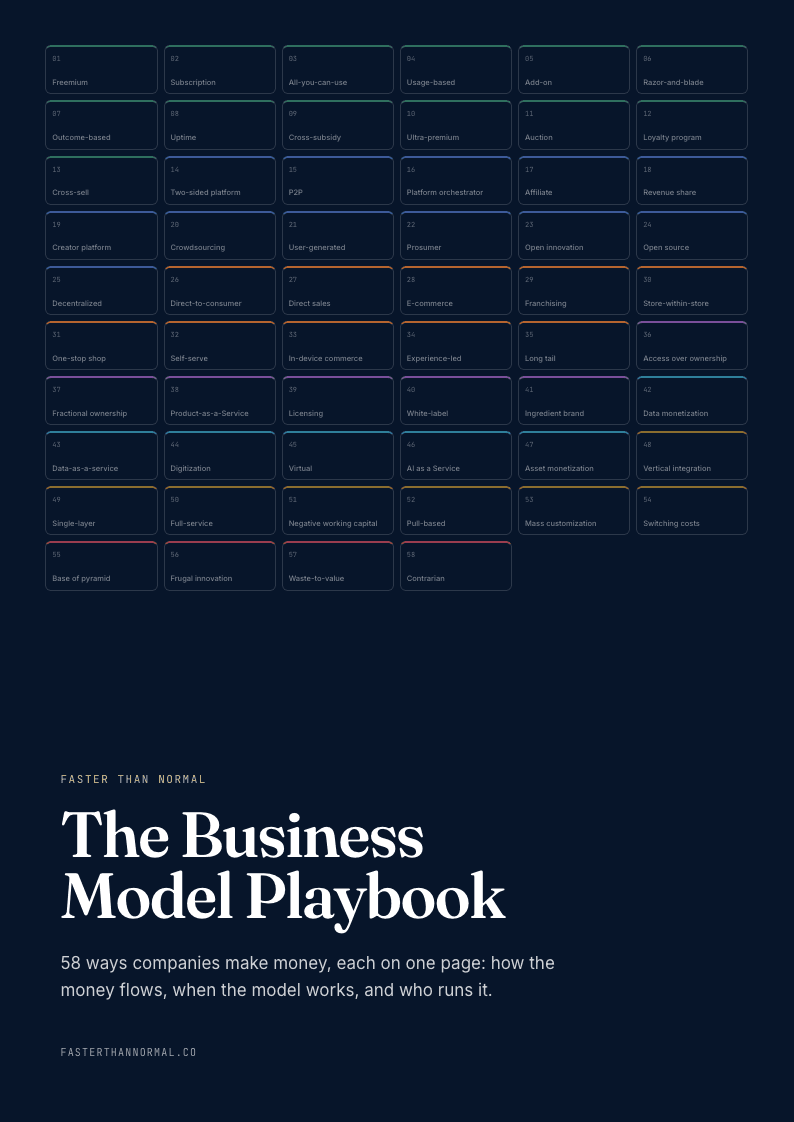
Get The Business Model Playbook
58 business models, one visual page each: how the money flows, the metrics that matter, and who runs it. Free when you join the Faster Than Normal email.
Free. No spam. Unsubscribe anytime.
Part IIIMaxims
-
Impossibility is a filter, not a barrier. The harder the problem, the fewer competitors you'll find on the other side of solving it.
-
Bootstrap the mission, not the ego. Selling misprinted plastic bags to fund a hypercar company is not humiliating; it's strategic patience in its purest form.
-
Own the full stack when no one will build it for you. Vertical integration born of necessity becomes the moat that well-funded competitors cannot cross.
-
Records are a language everyone speaks. When you have no heritage, no brand, and no country-of-origin advantage, measurable supremacy is the only credible introduction.
-
Never learn what's impossible. The lack of formal training in a field can be an asset — it means you never absorbed the consensus about which problems are unsolvable.
-
Constraints are invitations. Every regulation, limitation, or tradeoff that forces you to innovate leaves you with a capability your competitors chose not to develop.
-
Build stepping stones across products. Each generation's breakthrough should become the foundation for the next generation's impossibility.
-
Scarcity is a feature, not a bug — until you scale it away. Growth must be segmented to preserve the exclusivity that created demand in the first place.
-
Marry someone who can run operations. The romantic version of the founder story omits the COO; the real version cannot.
-
Hang around long enough to catch the luck. The difference between an early idea and a failed idea is often nothing more than the founder's willingness to wait.
In Their Own Words
It is impossible to lead by following – therefore I am different.
Keep both feet on the ground—staying realistic—but your head in the sky so you maintain your dream and your vision.— APEX ONE
There is, of course, no easy way to achieve your dreams; you have to be willing to grind for it.
I remember being quite scared to go there actually. I was there with friends and after driving it I felt like it was the best experience of my life and I couldn't think of anything else for weeks after.
The plan I had to build cars was pretty much the opposite of what people usually think is a smart business idea. Nobody was asking for it. It was seemingly impossible. It was expensive. Nobody had ever come from nothing and done it successfully before. So it was a stupid business idea, basically. An impossible plan. And that's why I liked it.— Christian von Koenigsegg
If I can give any advice, stay focused of course, and don't give up when it's really miserable and dark, that's when you really need to keep working. Even though it's painful and looks impossible and you should stop everything and your body tells you you should stop. That's when you really need to keep on working and pushing otherwise there is no chance.— Christian von Koenigsegg
People ask us, so why do you do all this stuff in-house when you can buy most of it? Well, we cannot do that if we just buy stuff from others. It's the cohesion of the complex system that we are lucky to be allowed and capable of developing together in-house, with a lot of extra effort, headaches, and sometimes complications that you need to overcome. But then, when it's all there and together, you can do some amazing stuff.— Christian von Koenigsegg
It's not over until I give up, and if I never allow myself to give up that means it's never over. This has given me the confidence to work through a lot of challenges.— Christian von Koenigsegg
Many said it was an impossible undertaking. Actually I fully agree. The fact is, I like impossible undertakings.— Christian von Koenigsegg, on the failed Saab acquisition


