


Part IThe Story
The Rule About Why
In 1994, speaking to students at the University of Southern California's business school, Charlie Munger paused a talk about worldly wisdom to tell a story about an engineer most of his audience had never heard of. Carl Braun, Munger said, had built a company that designed and built oil refineries, which is very hard to do, and had made them come in on time, run efficiently and not blow up. Braun, he went on, had a rule for every communication inside his company. Anyone issuing an instruction had to state who was to do what, where, when and why. Leave out the why once, and you could be fired. Leave it out twice, and you would be.
Munger told the story again the next year, in his celebrated Harvard talk on the psychology of human misjudgment, and it has been retold many times since. It is usually offered as an illustration of a psychological principle: people understand an instruction better, consider it more important and comply with it more readily when they are given a reason. But the rule was only one visible piece of a much larger system. Braun spent four and a half decades building one of the most respected process-engineering firms in the world, and he spent a remarkable share of that time writing, printing and distributing books to his own employees about how to think, write, lead and treat one another.
The details of his personal life are sparsely recorded. What survives in abundance is the institution he built and the words he wrote for it. Taken together, they portray an engineer who believed that the hardest technical problems in his industry were, at bottom, problems of communication and character, and who organized an entire company around that belief.
By the Numbers
C F Braun & Co.
$500Capital with which Braun and a few associates started the company in 1909
36 acresSize of the brick headquarters campus the company built in Alhambra, California
6,000+Employees during the 1950s
$100M+Annual revenues during the 1950s
250+Chemical and industrial plants the firm had built by the 1950s
5Ws required in every Braun directive: who, what, where, when and why
An Engineer from Oakland
Carl Franklin Braun was born in Oakland, California, in 1884, the son of California pioneers of Swedish and Danish descent. He studied mechanical engineering at Stanford University and graduated in 1907.
The California he entered was being transformed by oil. Discoveries in the Los Angeles basin and the San Joaquin Valley in the 1890s and early 1900s had made California one of the leading oil-producing states in the country, and refineries were multiplying to turn crude into kerosene, fuel oil and, increasingly, gasoline. The equipment that made those refineries work, the pumps, valves, heat exchangers and condensers, was a specialized and growing market.
Braun did not begin as a manufacturer. After Stanford, he spent about two years working as a manufacturer's agent, selling other companies' equipment. It was a practical education in what customers actually bought and why, and it gave him a salesman's instinct that the local historians who later wrote about him considered one of his defining traits, alongside engineering, book collecting, teaching and writing.
Five Hundred Dollars in San Francisco
In 1909, with a few associates and $500 in capital, Braun started his own engineering and manufacturing company in San Francisco. According to a history of the company prepared for the city of Alhambra, the early firm specialized in hydraulic valves, water pumps, water-treatment filters and condensers. These were unglamorous products, but they sat at the heart of industrial processes: moving fluids, cleaning them and exchanging heat.
The company grew through the 1910s. By the end of that decade Braun had concluded that the future lay less in selling individual components than in engineering the process plants that used them, particularly for the petroleum industry. Refineries were becoming larger and more complicated, and the companies building them needed firms that could design and supply entire systems. Rather than retrench when his original component business came under pressure, the Alhambra history records, Braun pushed toward petroleum processing.
That strategic turn created a practical problem. A company that designed and fabricated large process equipment needed space, and San Francisco's real estate was already expensive. Braun looked south, to a region with abundant oil production, nearby seaports, rail connections and what was plainly becoming a major city. He chose Alhambra, a small city east of downtown Los Angeles in the San Gabriel Valley, where land was still moderately priced.
A Campus in Alhambra
The company bought land at the corner of Fremont Avenue and Mission Road and moved its headquarters from San Francisco in the early 1920s; the local histories place the move in 1921 and the formal opening in late 1922. What Braun built there was unusual for an industrial company. The campus eventually covered about 36 acres, with 22 buildings arranged around a landscaped plaza behind high brick walls. All the brick came from a single San Francisco manufacturer, which gave the complex a coherent look even as it was expanded and modified over the following decades.
Inside, the offices were wood-paneled and, in the words of a company brochure quoted by the Alhambra Preservation Group, pleasingly appointed and well lighted. There was an engineering library, a women's lounge, a men's locker room, a medical office staffed by a physician, and a restaurant. Braun's stated goal, in the same brochure, was to provide comfortable and pleasant surroundings for workers of every class, so that they might have pleasure in their work and pride in their plant and product.
Braun was also, by the preservationists' account, an engineer's engineer about his buildings. He did not hesitate to move, modify or add structures when the work changed. The campus was a working tool, and it was maintained as one. The complex that survives today, renamed The Alhambra, still reflects that combination of practicality and care.
The move put Braun at the center of Southern California's oil boom of the 1920s, when strikes at Huntington Beach, Signal Hill and Santa Fe Springs made the Los Angeles basin one of the most productive oil regions on earth. Through the decade, according to the Alhambra history, the company developed new techniques in cast-iron fabrication and electric welding, and by the end of the decade it had expanded to Texas and New York. Patents assigned to C F Braun & Co in the 1930s covered heat-exchanger construction, one of the specialties that would define the firm.
Refineries That Did Not Blow Up
Munger's shorthand for what Braun's company did well, bringing refineries in on time, running efficiently and not blowing up, is a fair summary of how difficult the work was. A refinery or chemical plant is a dense web of vessels, heat exchangers, pumps, pipes and controls operating at high temperatures and pressures with flammable materials. Every piece must be designed for the conditions of every other piece. A mistake in one calculation, or a misunderstanding between two engineering groups, can cause delays costing millions or accidents costing lives.
That is why Braun's obsession with communication was not a management fad. In a process plant, the interfaces between departments are where things go wrong. The piping designer needs to know what the vessel designer changed. The purchasing group needs to know that a new tool has lifted a design limit. The construction crew needs to know that a schedule has moved. Braun's writings return again and again to this point: information has to flow in every direction, quickly and without distortion, or the project fails.
He also treated the customer as part of the system. In his 1948 book Management and Leadership, Braun wrote that on large projects the customer was a working partner with tasks of his own, and that the company should regard the customer as one of its own departments for purposes of communication. By policy, he explained, Braun & Co gave its customers practically everything it wrote to itself about aims, policies, principles and procedures, including his own letters to the organization. The logic was that the customer would ultimately hold Braun responsible for the result, whatever the cause of any delay, so Braun had better make sure the customer understood what it needed to do.
Throwing Out the Accountants
The second Braun story that Munger liked to tell concerned accounting. Braun, Munger said, looked at standard accounting as it was applied to building oil refineries and pronounced it asinine. He removed his accountants from the task, set his engineers to devise a system suited to the process, and in due course, Munger claimed, the accounting profession adopted a number of Braun's ideas.
Munger offered the story to make a point about the limits of accounting: that its conventions are approximations devised for general purposes, and that they can mislead badly when applied to an activity they were not designed to measure. A multi-year engineering and construction project, with costs incurred long before revenue is earned and with risk concentrated in design decisions, fits poorly into accounting categories built for manufacturing or trade. Braun's response was to insist that measurement fit the work rather than the other way round.
— Charlie Munger, A Lesson on Elementary, Worldly Wisdom, USC Business School, 1994His rule for all the Braun Company's communications was called the five W's—you had to tell who was going to do what, where, when and why.
Munger's regard for Braun was considerable; in the same talk he called him a very great businessman and a formidably willful and talented man. He also described him, with some affection, as the thorough Teutonic type, a man with many quirks. The two stories together, the five Ws and the accounting system, suggest the same temperament: a refusal to accept a convention merely because it was customary, and an insistence on reasons.
Letters to an Organization
The most distinctive thing about Braun as a chief executive was that he wrote books for his own employees, and had them printed in-house. Between the mid-1940s and the late 1950s the company published under his name a series of short volumes: Fair Thought and Speech, subtitled as a group of letters to an industrial organization; Team Spirit; Letter Writing in Action; Management and Leadership; Corporate Correspondence; and Presentation for Engineers and Industrialists, along with a general index to his companion books. Several went through multiple editions. The company's lithograph shop also printed other works; one surviving example is a 1951 reprint of a Lafcadio Hearn novel, a small sign of the bookish streak his contemporaries noted.
In Management and Leadership, Braun explained why the president of a large company should spend his time this way. Top management, he wrote, must lead in communicating, and must communicate to all employees, not a select few. In a company the size of his, that meant the top management had to write. He said the president accepted this responsibility and spent a reasonable portion of his time on what he called Letters to an Organization, which set out the company's principles, aims, thinking and methods, and explained and justified them where practicable. Management that works in a corner, he wrote, is bad management.
He extended the obligation to every department head. Each was expected to write about his department's procedures and working rules, especially those that affected other departments, in plain English rather than departmental jargon, and to send those writings to the departments whose work they touched. Borrowing a term from the semanticist Irving Lee, Braun called this time-binding: the human capacity to gather past experience, record it and transmit it so that others can begin where their predecessors left off. He told his leaders plainly that their capacity for time-binding through writing would be one of the chief measures by which the company judged them.
The books are not dry. They are full of homely analogies, biblical references, quotations from John Ruskin and Matthew Arnold, and blunt judgments. They read like the work of a man who had thought long about how organizations fail and wanted his people to avoid the same failures.
The Making of Men
Management and Leadership opens not with technique but with purpose. Braun argued that an industrial company has two legitimate purposes. The first is to serve society by making goods, which modern industry had done so well that it had raised living standards beyond anything imaginable a century earlier. The second, which he believed was not recognized to a thousandth part of its importance, is to provide a good way of life for the people who work in it. Every corporate enterprise, he wrote, is itself a social unit.
— Carl F. Braun, Management and Leadership, 1948Industrial leaders then, must keep ever before them, these two duties. The making of goods. And the making of men.
Profit, in Braun's account, was necessary but secondary. A company had to earn ample money for tools and development, because a company starved of tools could serve no one and was the worst possible place to work. Stockholders would not risk their savings without returns that matched the risk. But profit had to come as a byproduct of human service, and the first humans to be served were the company's own people. A company, he wrote, cannot rise above its people.
He attacked what he called the myth of economic man, the idea that people work mainly for money. Men think a good deal about money because they need it, he conceded, but money is a means, not the mainspring. People work as they feel like working, and they feel like working when they are interested. Leadership that gave people good wages and nothing else, he concluded, was bad leadership. He insisted too that leadership was not only the president's job. The foreman or group leader with five people under him was the leader of a basic social unit, and no plan of leadership could succeed unless those frontline leaders were part of it.
These ideas were not unique to Braun. He cited the Harvard industrial researchers Elton Mayo and Fritz Roethlisberger, whose studies had shown how much workers' attitudes and social relationships affected output, and he urged his leaders to read them. What was distinctive was the degree to which he turned the ideas into company policy and wrote them down in a form every employee could read.
Writing Instead of Meeting
Braun's views on meetings sound strikingly modern. In Management and Leadership he argued that formal meetings are an extraordinarily wasteful way to spread information. They require everyone to stop work at a time convenient for the boss, force people to sit through material they already know, miss whoever is sick or traveling, and usually leave no organized record. Frequent large meetings, he wrote, were a sure sign of poor written communication and of leaders who lacked the self-discipline to write.
— Carl F. Braun, Management and Leadership, 1948The next time any of us start to call a forty-manhour meeting, let's be sure that the job won't be done better if we'll shut our door and get out a four-manhour writing.
He distinguished these from meetings for genuine discussion, which he accepted as necessary, but even those, he warned, could waste a great deal of money if the chairman did not plan them and insist that participants arrive prepared. Decades later, Jeff Bezos would make a similar argument for replacing slide presentations with written narratives at Amazon.
Braun was equally insistent that written rules were not communication. Tomes of unexplained rules, he wrote, become idols of paper and instruments of what he called management by repression, because no one can discuss a rule intelligently if its reasons have been forgotten. It was the duty of leaders not only to proclaim but to prove. This is the root of the five Ws. The why was not a courtesy; it was what made a directive discussable, improvable and, as Munger noted, far more likely to be followed.
He applied the same logic to change. When a procedure, schedule, term or accounting method changed, everyone affected had to be told at once, or someone would keep going in the old direction and foul things up, like a football player who missed a changed signal. People who put new methods into effect without seeking wide advice, he wrote, were among the most dangerous people in a corporate group. And when an error occurred, it should be examined, its cause identified and the lesson circulated, so that the company would not pay for the same mistake twice.
In Fair Thought and Speech, he turned to the manner of communication. Its advice, much of it collected by the writer Shane Parrish, is practical and humane: question another man's information, reasoning and conclusions, but never his motives; offer advice as a reminder of something he had meant to do; give others credit for ideas; never try to prove anyone wholly wrong. Braun understood that clear logic is useless if it provokes resentment.
The Restaurant
One of Braun's more surprising convictions concerned lunch. The Alhambra campus included a company restaurant, and in Management and Leadership he described it as perhaps the best investment the company had ever made, purely as a channel of communication.
He was scornful of the typical industrial cafeteria, which he summed up in the phrase in-plant feeding: built cheaply, crowded, noisy, rushed, farmed out to caterers, treating employees like livestock to be fed. Braun's restaurant was designed as a club for employees. The food and surroundings were good, no one was rushed, and the company absorbed roughly a third of the cost, which he estimated at about thirty cents a day per person. Guests, including customers, suppliers and educators, averaged about twenty a day and mixed with many employees rather than a few executives.
The payoff, he argued, was that people from different departments met every day in changing groups, kept each other informed, helped each other and came to understand one another without the disruption of formal meetings. He urged employees not to lunch always with the same colleagues, and not to sort themselves by imagined social rank, because the value lay in the mixing. The restaurant, in other words, was infrastructure for the informal flow of information that no written system could fully capture.
War and the Postwar Peak
During the Second World War, C F Braun & Co worked around the clock on plants producing aviation-grade fuel and synthetic rubber, two of the most critical materials of the Allied war effort. The Alhambra history credits the company with developing new techniques for refining aviation fuel during the war. High-octane aviation gasoline and synthetic rubber both depended on complex catalytic and chemical processes, precisely the kind of work in which Braun's emphasis on precise design and coordination paid off.
After the war the company turned increasingly to petrochemical plants, which were being built across the United States and around the world. By the 1950s, according to the Alhambra history, it employed more than six thousand people, had annual revenues exceeding $100 million, and had built more than 250 chemical and industrial complexes worldwide. It had become one of the most formidable petrochemical engineering firms in the world.
The culture Braun had built was intense. A later employee, quoted in the Alhambra history, recalled that the Braun culture was intimidating when he first arrived and that he was petrified on his first day, before discovering that the people were very nice and that there was a mystique to working there. The books, the five Ws and the expectation of written clarity made the company distinctive long after the founder was gone.
Braun died of a heart attack in 1954, at sixty-nine, and several of his books appeared in later editions after his death. His son John Gilbert Braun, who had joined the company in 1934, became its president.
After Braun
The company remained in family hands until 1980, when it was sold to Santa Fe International, a company that was itself acquired by the Kuwait Petroleum Corporation soon afterward. Halliburton was its final owner, and in 1997 it closed the Alhambra offices and sold the campus to the Ratkovich Company, which restored the brick buildings and renamed the complex The Alhambra. Local historians who wrote about the company concluded that successive owners had slowly dismantled what Braun built, while acknowledging that the culture had continued to operate effectively well into the 1980s.
The family's philanthropy outlasted the firm. The LA Times reported that the Braun family's relationship with Caltech dated to 1926 and the founding of the Caltech Associates support group, and the Carl F. Braun Trust, managed by John Braun, later funded buildings at Caltech and the Braun Music Center at Stanford, Carl Braun's alma mater.
Braun's intellectual legacy traveled by a stranger route. His books were printed privately and never widely distributed, and they went out of print. It was largely through Munger's talks, collected in Poor Charlie's Almanack, that his name reached a new audience of investors and managers. Munger used Braun to illustrate what he called reason-respecting tendency, the human inclination to comply more readily when given a reason. The five Ws have since become a familiar framework in their own right.
What makes Braun worth studying today is less any single rule than the coherence of the whole. He believed that a complex engineering enterprise lives or dies by the quality of information flowing through it, and he acted on that belief in every part of the company: in the wording of directives, in the ratio of writing to meetings, in the design of the lunchroom, in the accounting system and in the treatment of customers. Few founders have written so explicitly, for their own employees, about how they wanted the company to think.
Part IIThe Playbook
Braun left something rare: a written operating philosophy, in his own words, addressed to the people who had to carry it out. The principles below are drawn from those books and from the company he built. They apply most directly to organizations doing complex, interdependent work, where a misunderstanding between two groups can cost more than any individual mistake.
The principles
- 1.Always tell people why.
- 2.Write it down instead of calling a meeting.
- 3.Make the measurement fit the work.
- 4.Treat the company as a social system.
- 5.Let profit follow service.
- 6.Build a workplace people are proud of.
- 7.Announce changed signals at once.
- 8.Circulate every error's lesson.
- 9.Run the customer as one of your departments.
- 10.Question conclusions, never motives.
- 11.Engineer the informal channels too.
- 12.Move toward where the next industry is growing.
Principle 1
Always tell people why.
Every directive at C F Braun & Co had to state who was to do what, where, when and why. Leaving out the why was a firing offense on the second occurrence. Munger explained the effect: people who are told the reason understand an instruction better, rate it as more important and are more likely to comply, even when they do not fully follow the reasoning.
There is a second benefit that Braun himself stressed. A directive with its reason attached can be discussed and improved. A rule without a reason becomes, in his phrase, an idol of paper, obeyed or evaded but never examined. In complex work, the person receiving an instruction often knows something the sender does not, and the why gives them the context to say so.
Tactic: Adopt a simple template for every task assignment or policy memo, with explicit fields for who, what, where, when and why. Reject drafts with the why left blank.
Principle 2
Write it down instead of calling a meeting.
Braun regarded formal meetings as the costliest imaginable way to spread information. They interrupt everyone's work at once, repeat what many already know, miss absentees and leave no organized record. He urged his leaders to replace a forty-manhour meeting with a four-manhour piece of writing whenever they could.
Writing forces the author to organize his thinking, lets readers take in the material at their own pace and creates a record that can be consulted later. Braun reserved meetings for genuine discussion, and even then insisted on preparation. He measured leaders partly by their ability to produce useful written material.
Tactic: Before scheduling any meeting whose main purpose is to inform, estimate its total cost in person-hours. If a memo would take less than a tenth of that time to write, send the memo and cancel the meeting.
Principle 3
Make the measurement fit the work.
According to Munger, Braun found standard accounting unsuited to the business of building refineries, removed his accountants from the task and had his engineers design a system that reflected how the work actually unfolded. Munger claimed the profession later adopted some of Braun's notions.
Every measurement system encodes assumptions about the activity it measures. When those assumptions do not fit, managers make decisions based on numbers that describe some other business. Braun's instinct was to start from the work and derive the measures, rather than force the work into existing categories.
Tactic: List the three numbers your team relies on most to judge performance. For each, ask whether it was designed for your kind of work or inherited from somewhere else, and whether a practitioner would design it the same way today.
Braun argued that every corporate enterprise is a social unit and that its second legitimate purpose, after serving customers, is to provide a good way of life for its people. He saw every leader, down to a group leader with five people, as responsible for a small workday community whose influence could rival that of home, school and church.
This framing changes what leaders pay attention to. Tools, techniques and methods, which Braun called the bright and shiny toys of industry, attract most management attention. The relationships, interests and feelings of people doing the work receive far less, even though, in his view, they determine whether the tools are used well.
Tactic: Give every frontline leader explicit responsibility, and time, for the morale and development of their immediate team, and include it in how they are evaluated.
Principle 5
Let profit follow service.
Braun insisted that a company must earn ample profit to fund tools and development and to reward shareholders for their risk. But he argued that profit had to be a byproduct of service, first to employees and then to customers, and that treating money as the main motive of industrial life degraded both leaders and workers.
The practical content of this principle is about sequence and emphasis. A company that pursues service and competence will usually earn good profits; a company that pursues profit directly often cuts the corners that destroy its service. Braun's firm, working on projects where failures could be catastrophic, could not afford to cut those corners.
Tactic: When evaluating a cost-cutting proposal, require an explicit statement of its effect on customer outcomes and employee working conditions alongside its financial benefit.
Principle 6
Build a workplace people are proud of.
The Alhambra campus had wood-paneled offices, an engineering library, a physician, lounges and a restaurant, and Braun explicitly aimed to give workers of every class pleasure in their work and pride in their plant and product. He spent money on surroundings that most industrial companies of his era would have considered frivolous.
Surroundings signal respect. They also affect whether talented people want to join and stay. Braun treated the campus as a working tool, modifying it constantly, but a tool designed with the people using it in mind.
Tactic: Walk through your workplace, physical or digital, as a new employee would. Identify the three things that most clearly signal that the company does not value the people working there, and fix them first.
Principle 7
Announce changed signals at once.
Braun required that any change in procedure, schedule, terminology, accounting or facilities be communicated immediately to everyone it might affect, even before a new tool was ready. Otherwise, he warned, someone would keep going in the old direction and foul things up, like a player who missed a changed play.
In interdependent work, the cost of a change is often borne by people far from the person who made it. Braun considered those who introduced new methods without seeking wide advice to be among the most dangerous people in a company, because they created confusion that spread through every connected department.
Tactic: Maintain a single change log that every team can see, and make an entry mandatory for any change in process, schedule or specification before the change takes effect.
Principle 8
Circulate every error's lesson.
Braun wrote that everyone errs, that the company pays for it, and that it should not have to pay twice. When an error occurred, he wanted it examined, its cause in methods identified and the lesson circulated broadly, with charity toward the individual involved.
This is an early statement of the blameless post-mortem. Most errors, Braun believed, came from faulty methods rather than faulty people. Covering them up, whether to protect a colleague, a department or one's own ego, denied others the warning they were entitled to.
Tactic: After any significant mistake, publish a short note describing what happened, why the method allowed it and what has changed, without naming individuals. Send it to everyone whose work could be affected by a similar error.
Principle 9
Run the customer as one of your departments.
On large projects, Braun wrote, the customer was a working partner with tasks of its own, and the company should communicate with it as if it were one or more internal departments. By policy, the firm shared with customers practically everything it wrote to itself about aims, policies and procedures.
The reasoning was hard-headed. The customer would hold the firm responsible for the result, regardless of whether delays originated on the customer's side. The only protection was to make sure the customer understood exactly what it needed to do and when.
Tactic: On any major client engagement, give the client a named counterpart for each of your internal teams, include them in the relevant internal communications, and share your project procedures with them at the outset.
Principle 10
Question conclusions, never motives.
In Fair Thought and Speech, Braun advised his employees to question another person's information, reasoning and conclusions freely, but never to impute bad motives. Once you attack someone's motives, he wrote, you lose any chance of influencing them, and you degrade yourself.
He paired this with a set of related habits: present advice as a reminder of something the other person meant to do, give others credit for ideas, and never try to prove anyone wholly wrong. The aim was to keep disagreement productive in an organization that depended on engineers challenging each other's work.
Tactic: In your next review of someone else's work, limit your objections to the facts, the logic and the conclusions. Before sending any critique, remove every sentence that speculates about why the other person made their choices.
Principle 11
Engineer the informal channels too.
Braun built a company restaurant designed as a club, subsidized about a third of its cost and urged employees to mix across departments and ranks at lunch. He called it perhaps the best investment the company had ever made, purely as a channel of communication.
Formal systems carry formal information. The knowledge that prevents problems, who is struggling, what another team is planning, which supplier is unreliable, often travels informally. Braun did not leave that to chance; he designed a place where it would happen daily.
Tactic: Identify one space or routine where people from different teams naturally meet, and invest in making it more inviting. If none exists, create one.
Principle 12
Move toward where the next industry is growing.
In the early 1920s Braun moved his company from San Francisco, where it had been founded and where land was expensive, to Alhambra, near the rapidly expanding oil fields of the Los Angeles basin, with ports, rail lines and room to grow. The move placed the firm at the heart of the petroleum and later petrochemical industries that would sustain it for decades.
Location decisions are strategic decisions. Braun chose to be close to the customers and industries he expected to matter most, not the ones that had mattered at his founding.
Tactic: Every few years, ask where your most important future customers, suppliers and talent will be concentrated, and whether your physical or organizational footprint is positioned to reach them.
Free playbook
Get The Business Model Playbook
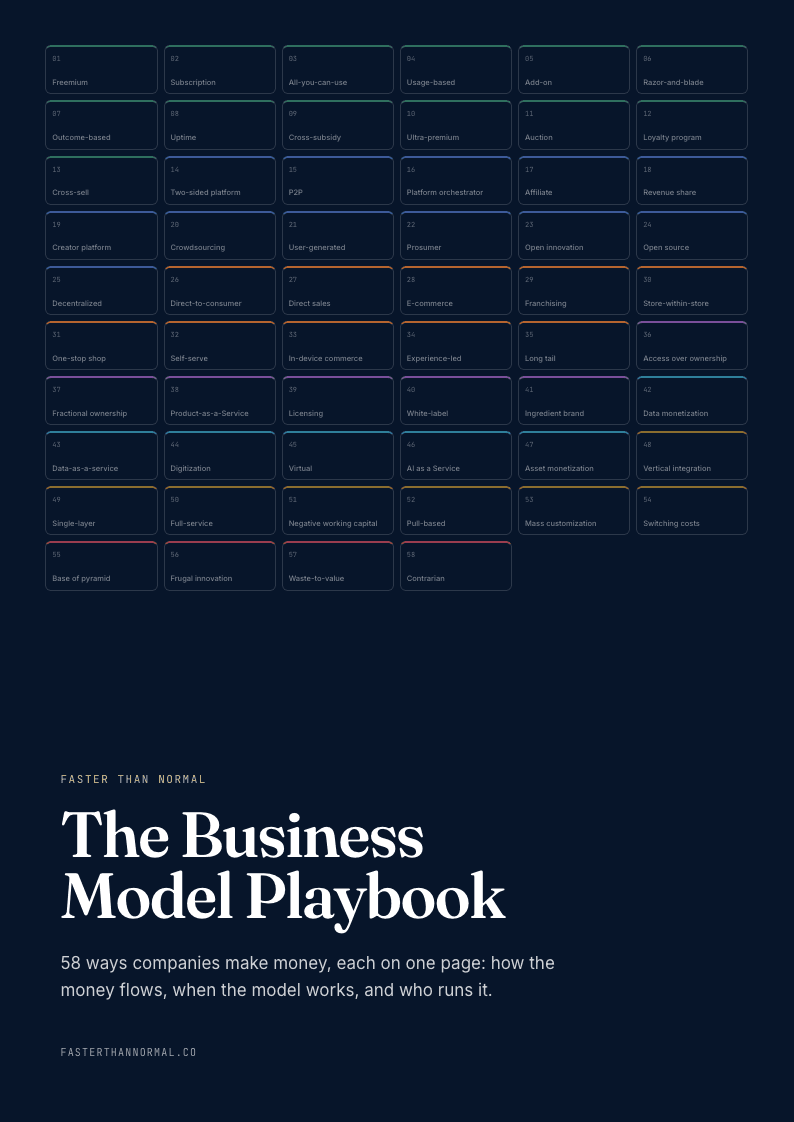
58 business models, one visual page each: how the money flows, the metrics that matter, and who runs it. Free when you join the Faster Than Normal email.
Free. No spam. Unsubscribe anytime.
Part IIIMaxims
- Clarity is a safety system. In work where mistakes can be catastrophic, the quality of communication matters as much as the quality of calculation.
- A leader who cannot write cannot scale. Braun judged his managers partly on their ability to record and transmit what they knew.
- Rules without reasons decay. Once people forget why a rule exists, they can neither defend it nor improve it.
- Conventions are defaults, not laws. Braun discarded standard practice, even in accounting, when it did not fit the work.
- The frontline leader is the whole system. Policies written at the top die unless the person supervising five people can explain them.
- Respect has to be visible. Braun wrote that consideration locked up inside a person helps no one; it must show in word and act.
- Spend where information flows. A subsidized lunchroom can be a better investment than a new machine if it keeps departments talking.
- Write for the whole team. It is better to tell a dozen too many people than to miss the one who could have contributed.
- A founder's words can outlive his company. Braun's firm was dismantled, but his books found readers through Munger decades later.
In Their Own Words
The difference between a good engineer and a great engineer is not technical knowledge—it's the ability to communicate that knowledge clearly and persuasively to those who must act upon it.— Carl F. Braun
You cannot manage what you cannot measure, and you cannot measure what you cannot define clearly.— Carl F. Braun
The engineer who cannot explain his work to a businessman is as useless as the businessman who cannot understand the engineer's explanation.— Carl F. Braun
A report that cannot be understood by its intended audience is not a report—it's an exercise in self-indulgence.— Carl F. Braun
Precision in language reflects precision in thinking. If you cannot express an idea clearly, you probably don't understand it yourself.— Carl F. Braun
Systems are not bureaucracy—they are the foundation of freedom. Good systems free competent people to focus on what matters most.— Carl F. Braun
The best managers are those who make themselves unnecessary through the systems they create and the people they develop.— Carl F. Braun
Delegation without systems is abdication. Systems without competent people are worthless. Success requires both.— Carl F. Braun
Excellence is not an accident. It is the inevitable result of systematic preparation, rigorous execution, and continuous improvement.— Carl F. Braun
Standards are not limitations—they are the foundation upon which true creativity and innovation can flourish.— Carl F. Braun
The cost of doing things right the first time is always less than the cost of doing them over.— Carl F. Braun
Competence is not a destination—it's a journey that requires constant learning and adaptation.— Carl F. Braun
A business built on systematic principles will outlast any individual, including its founder. That is the true test of success.— Carl F. Braun
The client who pays the least attention to cost is usually the one who can least afford mistakes.— Carl F. Braun
Conservative financial management is not about avoiding risk—it's about being able to take the right risks when they present themselves.— Carl F. Braun
The leader's job is not to have all the answers, but to create systems that help competent people find the right answers.— Carl F. Braun
Developing people is not an expense—it's the most important investment a company can make.— Carl F. Braun
Authority without competence is tyranny. Competence without authority is frustration. Leadership requires both.— Carl F. Braun
The best way to predict the future is to create systems that can adapt to whatever future emerges.— Carl F. Braun
Reputation is the only asset that cannot be purchased, only earned through consistent performance over time.— Carl F. Braun
Further reading
- Presentation For Engineers And Industrialists by Carl F Braun


