


Part IThe Story
The Church Where His Parents Were Married
The fire found him first by smell — not heat, not light, but the sweetish rot of burning flesh mingled with timber and kerosene and the particular acrid note of a city's commercial quarter going up at once. Aristotle Onassis was sixteen years old, maybe seventeen (he would spend a lifetime adjusting his age to suit circumstances), and he was trying to cross Smyrna from south to north, a distance of a few blocks that took hours because the Turkish patrols moved through the streets in systematic waves, and between them the flames closed corridors he'd been planning to use. He darted into doorways. He pressed himself flat behind rubble. Around him, Greek men were pulled from their homes and seated in rows in the street while soldiers moved methodically from one to the next, slitting throats — a technique that saved ammunition and, as Frank Brady noted in Onassis: An Extravagant Life, was "particularly excruciating." The wives and daughters of the dead men were raped. Those who resisted were killed immediately. At one point Aristotle hid in the bushes of a church. Nearby, a Greek priest was stripped, blinded with a red-hot sword, dragged to the church's great doors, and crucified with horseshoes nailed through his hands and feet. The priest died shortly after. And Aristotle realized — the recognition arriving with the quality of a dream that collapses into nightmare — that this was the same church where his mother and father had been married.
September 1922. The Great Fire of Smyrna, also called the Catastrophe, burned for nine days and displaced somewhere between 200,000 and 400,000 people. Onassis lost four uncles, an aunt, and a cousin — all incinerated inside a church where five hundred Christians had sought shelter. His father, Socrates, a prosperous tobacco merchant who had been the de facto head of the family, was imprisoned by the Turks and sentenced to death. Everything the Onassis family owned in Smyrna — the warehouses, the inventory, the houses, the social standing that comes from being established merchants in a cosmopolitan port city — evaporated in days.
This is where every biography of Aristotle Onassis begins, and with good reason. The catastrophe is the hinge. Before it, he was the clever, troublesome, multilingual son of a wealthy tobacco dealer in one of the most sophisticated cities in the eastern Mediterranean. After it, he was a stateless refugee with nothing but his languages — Greek, Turkish, English, Spanish — and a set of instincts forged in fire that would prove, over the next half century, to be worth more than any inheritance his father could have left him.
— Aristotle OnassisI don't oppose gambling. I understand it. My whole life has been a terrific gamble.
By the Numbers
The Onassis Empire
$500M+Estimated net worth at death (1975)
~85Companies controlled across 10+ countries
17Supertankers commissioned in 1954 alone
325 ftLength of the yacht Christina
23Surplus Liberty ships purchased post-WWII
$7MFine paid to U.S. government (1954)
$100Cash in his pocket arriving in Buenos Aires
The Night Shift and the Daytime Hours
He arrived in Buenos Aires in 1923 carrying less than $100 — some accounts say $60 — on a Nansen passport, the document invented by the League of Nations for people who no longer belonged to any country. He was, by every legal and practical definition, a nobody. He was also short, dark, and spoke no Spanish. The city, meanwhile, was booming: Argentina in the 1920s was one of the ten wealthiest nations on earth, a magnet for European refugees, a place where a man's past could be conveniently forgotten and his present reinvented on the strength of nerve alone.
Onassis falsified his age to get a work permit — he made himself six years older — and changed his birthplace from Smyrna to Athens because it "seemed more honorable." These were not the falsehoods of a con artist. They were the survival calibrations of someone who had watched the entire institutional framework of his world collapse in fire, who understood that documents were fictions enforced by power, and that power, at this particular moment, was something he did not possess.
He got a job as a night operator at the British United River Plate Telephone Company. The work was boring, the hours brutal, the pay negligible. It was also the best business school he ever attended. During the quiet stretches of the night shift, Onassis taught himself Spanish, read the business pages of Argentine newspapers, and — crucially — listened. The switchboard put the city's commercial conversations at his fingertips. He eavesdropped on business calls and used the information to set up deals of his own. One account holds that his first great idea came from overhearing a conversation about a new type of cigarette targeted at women. Whether or not this particular origin story is apocryphal hardly matters. What matters is the pattern it reveals: Onassis understood, from the very beginning, that information was the primary commodity. Everything else — tobacco, ships, oil — was secondary.
During his daytime hours, while other men his age slept off their night shifts, Onassis began importing Turkish tobacco — his family's old line of business, the one thing he knew. He knew the product, he knew the suppliers (his father, now free and back in Greece, could still arrange shipments), and he knew something the Argentine market didn't: that Oriental tobacco had a softer, more distinctive flavor than the Cuban varieties that dominated South America. Within two years, his commissions on tobacco sales reached $100,000. He launched his own cigarette brand, marketed specifically to women with pink-tipped filters and the endorsement of a famous opera singer he seduced by showing up at her dressing room with an enormous bouquet of flowers. By twenty-five, he had his first million dollars.
The Greek government noticed. In 1928 they tapped Onassis — still essentially a kid, a telephone worker moonlighting as a tobacco broker — to negotiate a trade agreement with Argentina. He was made consul general. Together with his close friend Costas Gratsos, a shipping scion, he alerted Athens to a looming port tariff war between Argentina and Greece that could have devastated an estimated 80 percent of the Greek steamship fleet dependent on the Atlantic grain trade. The crisis was averted. The diplomatic appointment was, in retrospect, the first time Onassis operated at the intersection of commerce and statecraft — a liminal zone he would inhabit for the rest of his life, sometimes brilliantly, sometimes disastrously.
Depression Purchases
In 1932, at the absolute nadir of the Great Depression, when global trade had contracted by two-thirds and cargo ships sat rusting in harbors around the world with no cargoes to carry, Aristotle Onassis bought six freight ships from the Canadian National Steamship Company for a fraction of their replacement value. Most accounts place the price at roughly $20,000 per vessel — ships that had cost hundreds of thousands of dollars to build. The sellers were desperate. The buyer was twenty-six years old and operating on the conviction that the depression could not last forever, that the world would need ships again, and that the time to buy was precisely when everyone else was selling.
This was not original wisdom. Every fortunes-from-crisis story follows the same arc. What distinguished Onassis was not the insight but the nerve. He had no shipping experience. He had no fleet management infrastructure. He had a tobacco business and a diplomatic title and an instinct — honed in the burning streets of Smyrna — that the worst possible moment is also, by a cruel symmetry, the best possible moment for someone willing to act. He proudly raised the Greek flag on his first vessels and named them after family members, in the time-honored tradition of Greek shipowners. But Onassis was not a traditional Greek shipowner. He had not grown up on ships. He had not apprenticed on his father's or uncle's vessel. He entered the industry as an outsider — a tobacco trader who happened to understand leverage, timing, and the psychology of distressed sellers.
By 1938, he had his first oil tanker built. Two more followed before the war. He was already thinking bigger than dry cargo. Oil was the future. He could feel it.
Other People's Money and Other People's Wars
The Second World War made Aristotle Onassis rich in the way that wars make certain people rich — not through combat, but through logistics. He leased his tankers and cargo vessels to the Allies, collecting steady charter income while the ships themselves appreciated in value as the global fleet was decimated by U-boats. There is a remarkable fact embedded in the Onassis war record: he never lost a single ship. Whether this was luck, shrewd routing, or something more complicated remains a subject of speculation. Some biographers have hinted at arrangements with both sides. No credible evidence supports the darkest version of this theory, but the ambiguity itself — the sense that Onassis moved through the war in a space that was neither fully Allied nor fully anything else — tells you something about the man's relationship to national allegiance. He was Greek by heritage, Turkish by birth, Argentine by formation, Panamanian by flag of convenience. His true nationality was commercial.
After the war, he bought twenty-three surplus Liberty ships from the United States government. This required navigating a regulation that prohibited non-citizens from purchasing military surplus vessels. Onassis found a way, striking a deal in which he offered reduced shipping rates on military equipment in exchange for favorable pricing on the surplus fleet. The arrangement was, depending on your perspective, either an ingenious workaround or a fraud — a question that would come back to haunt him.
The Liberty ships were a launching pad. Onassis used them to build cargo capacity while simultaneously pivoting to oil tankers. He understood — earlier and more viscerally than most of his competitors — that petroleum was about to reshape the world. The Middle East was an ocean of crude. Europe and America were thirsty. And between the oil and the thirst sat the sea, which needed ships. Big ships. The biggest ships anyone had ever built.
He registered his expanding fleet under flags of convenience — Panama, Honduras, Liberia — jurisdictions that offered low taxes, minimal regulation, and the kind of institutional flexibility that a man who had once forged his own birth documents could appreciate. By the mid-1950s, Onassis controlled more than sixty vessels under various flags, along with a whaling fleet and over thirty corporations scattered across four continents and fourteen countries. He held offices or residences in New York, Paris, Nice, Monte Carlo, Montevideo. He was, by any measure, a multinational enterprise housed inside a single personality.
The organizational structure was deliberately chaotic. Onassis was not an officer of any corporation, domestic or foreign. He was an owner, holding stocks that gave him control. The distinction is not merely legal; it is philosophical. He believed that titles conferred obligation, and obligation conferred vulnerability. Ownership without title meant control without exposure. As one biographer observed, he didn't have a strict schedule. He simply asked: what is the most important problem I need to solve right now? Then he solved it and moved on to the next one. His travel patterns were unpredictable — flights changed at the last minute, itineraries scrapped and redrawn based on where the most urgent crisis or opportunity had materialized. "Sailors are said to have a girl in every port," wrote Willi Frischauer in Onassis. "Ship owners and airline operators have a problem on every seaboard."
The Supertanker and the Saudi King
The supertanker was Onassis's great innovation — or, more precisely, his great bet. In the early 1950s, when most oil tankers measured around 16,000 to 20,000 deadweight tons, Onassis began commissioning vessels of dramatically larger scale. His first major tanker order, placed with the Gotaverken shipyards in Gothenburg, Sweden, was for a vessel of 15,000 tons — itself considered a giant by the standards of the day — but this was merely the opening salvo. By 1954, he had commissioned seventeen supertankers in a single year. The logic was brutal in its simplicity: larger ships carried more oil per voyage at a lower cost per barrel. Economies of scale, applied to the ocean. The supertanker was not a technological revolution so much as an economic one — a way to make the math of global petroleum transport work overwhelmingly in favor of the shipowner who thought biggest.
The timing was exquisite. During the Arab-Israeli wars of 1956 and 1967, when the Suez Canal was closed and tankers had to take the long route around the Cape of Good Hope, Onassis's oversized vessels earned immense profits. The longer the route, the greater the advantage of carrying more oil per trip. The wars he had no part in starting became, by the geometry of logistics, his most profitable business events.
But the most audacious play came earlier. In January 1954, Onassis signed an agreement with the Royal Saudi Arabian government that would have given him exclusive rights to transport Saudi oil. The deal, if implemented, would have fundamentally reorganized the economics of Middle Eastern petroleum — and it terrified the American government. The Arabian American Oil Company (Aramco), which held the dominant oil concession in Saudi Arabia, viewed the Onassis agreement as an existential threat. The U.S. State Department viewed it as a geopolitical provocation. On July 30, 1954, the American ambassador in Jidda, George Wadsworth, delivered a formal note to the Saudi government that amounted to a diplomatic ultimatum. The note, now declassified, warned of "wide and serious public resentment" and "retaliatory measures by other countries." It stated that the Onassis Agreement was "inconsistent with established world practice in the field of international commerce" and that the United States "could not acquiesce in the establishment of any such unfortunate precedent."
The agreement was never implemented. Onassis had overreached — he had tried to insert himself between a superpower and its oil supply, and the superpower had swatted him aside. The FBI opened a file on him. Federal investigators charged him with violations of shipping laws and fraud against the United States government for displaying American flags on vessels he was not legally entitled to flag. In 1954, Onassis pleaded guilty and paid a $7 million fine — an enormous sum, though one he could absorb. The episode revealed both the scale of his ambition and its limits. He could outmaneuver shipping rivals and charm European socialites, but he could not outmaneuver the United States government in its own sphere of influence.
— Aristotle Onassis, Town & Country, 1964My favorite country is the one that grants maximum immunity from taxes, trade restrictions, and unreasonable regulations.
The Monte Carlo Gambit
In 1953 — the same year he was negotiating with the Saudis — Onassis purchased a controlling interest in the Société des Bains de Mer, the company that owned the casino, the Hôtel de Paris, and most of the prime real estate in Monte Carlo. The principality of Monaco was, at that time, a sleepy Riviera enclave on the verge of bankruptcy. Prince Rainier III was struggling to modernize it. Onassis saw what others did not: that Monaco's tax-free status, its Mediterranean glamour, and its tiny size made it, essentially, a company town waiting for the right company to take it over.
He rivaled the prince for economic control of the country. This is not metaphor. Onassis, through the Société des Bains de Mer, effectively controlled the commercial infrastructure of a sovereign state. He was not its ruler, but he was something that in certain lights looked indistinguishable from one. The arrangement worked until it didn't — until Rainier grew tired of sharing sovereignty with a shipping magnate and eventually diluted Onassis's stake through new share issuances. But for years, Monte Carlo was Onassis's stage, the place where his yacht sat in the harbor like a floating palace, where Winston Churchill came to dine and Greta Garbo came to hide and the international press came to photograph them all doing it.
The Polymechanos and the Diva
A word the Greeks had for him: polymichanos. Master of many devices. The epithet was originally coined for Odysseus, and Town & Country, in a two-part profile published in February and March of 1964, applied it to Onassis with relish. "Today, in business, in social life, and in romance," the magazine wrote, "Aristotle Onassis stands as one of the greatest polymechanics since Ulysses."
The romance that defined the 1950s and early 1960s was with Maria Callas. They met in 1957 at a party in Venice hosted by the American gossip columnist Elsa Maxwell — a woman whose entire career was built on the principle that proximity to fame is itself a form of power. After their first encounter, Onassis reportedly commented to a friend: "There was just a natural curiosity; after all, we were the most famous Greeks alive in the world."
Callas was born Maria Cecilia Sophia Anna Kalogeropoulos in New York City in 1923, the daughter of Greek immigrants whose surname was shortened to Callas when their daughter started school. Her childhood was unhappy — a fat, bespectacled girl whose mother pushed her relentlessly into performing, who felt overshadowed by an elder sister she believed was their mother's favorite. She moved to Athens at fourteen, studied voice at the conservatory, and made her professional debut in Tosca in 1942, during the Nazi occupation, when Greece was occupied by the Axis powers and her mother allegedly forced her to entertain German and Italian soldiers for food and money. By the late 1940s she had transformed herself — physically, musically, temperamentally — into "La Divina," the most electrifying soprano of her generation, a woman who revived bel canto roles that had been dormant for decades and sang them with a dramatic intensity that Leonard Bernstein described as "pure electricity."
Callas and Meneghini — her husband, Giovanni Battista Meneghini, a wealthy Italian brick manufacturer twenty years her senior who had sold his business to become her manager — were guests aboard the Christina in 1959 when the affair with Onassis began. The yacht captain, Giorgos Zacharias, who served aboard the Christina for ten years, later recalled Callas rehearsing at the piano Onassis had installed for her. "Every evening we sat back being mesmerized by her voice," Zacharias said. "Maria had two puppies, from whom she was inseparable. When she was singing, the puppies barked as if they were singing in a trio."
The affair destroyed both marriages. Callas left Meneghini. Onassis's first wife, Athina — known as Tina — the daughter of shipping magnate Stavros Livanos, whom he had married in 1946 when she was seventeen and he was forty, sued for divorce in 1960. (Tina would later marry Onassis's great rival, Stavros Niarchos — a detail so perfectly operatic that it seems to have been scripted.) The relationship with Callas lasted nearly a decade. She wanted marriage. She wanted children. There were rumors of pregnancies that did not go to term. Onassis gave her neither marriage nor children. He gave her the yacht, the Mediterranean, the company of Churchill and Garbo and the international press, and then, in 1968, he gave her the worst kind of betrayal — not a younger woman, not a more beautiful woman, but a more famous one.
Zacharias remembered the end. "We were on the speedboat together and she turns, looks me deep in the eyes and says: 'Giorgo, this is my last day here.' After two days, they separated." Callas settled in Paris and became increasingly reclusive. She died of a heart attack in 1977, at fifty-three, alone.
Jackie, How Could You?
On October 20, 1968, Jacqueline Bouvier Kennedy — the most famous widow in the world, the woman who had held together a nation's grief in a blood-stained pink Chanel suit, the living symbol of Camelot — married Aristotle Onassis in a small Greek Orthodox ceremony on his private island of Skorpios, with approximately forty guests in attendance, including her children, Caroline and John Jr., who held the candles traditionally carried by Greek pages during a wedding.
New York was appalled. A retired bookkeeper told The New York Times: "To us, she was royalty, a princess, and I think she should have married a prince, or at least someone who looked like a prince." Headlines ranged from the incredulous ("Jackie, How Could You?") to the cruel ("Beauty and the Beast," "Toad Marries Princess"). A German newspaper announced: "America has lost a saint." An air force pilot told reporters he'd been "pulling for the prime minister of Canada."
Jackie's reasons were more complicated than the public would allow. In a handwritten letter to David Ormsby Gore — a former British ambassador to Washington and close friend of her late husband who had proposed marriage to her shortly before the Onassis wedding — she tried to explain. The letter, found decades later in locked red-leather cases at Ormsby Gore's family home in Wales, reads with an anguish that the tabloids could never have imagined:
"If ever I can find some healing and some comfort — it has to be with somebody who is not part of all my world of past and pain. I can find that now — if the world will let us."
And then, in a line that cuts to the marrow: "Please know — you of all people must know it — that we can never really see into the heart of another."
She described Onassis as "lonely and wants to protect me from being lonely. And he is wise and kind. Only I can decide if he can, and I decided." She wrote this from his yacht, on stationery bearing the ship's crest.
The marriage was, by most accounts, troubled from the start. Jackie spent much of her time in New York, where her children attended school. Onassis spent much of his time on the Christina, or in Paris, or in Athens, or wherever the next problem demanded his attention. Reports varied, but when he died in 1975, she inherited somewhere between $20 million and $26 million — a substantial sum, but a fraction of the estate, the bulk of which went to his daughter Christina.
What Onassis wanted from Jackie Kennedy was, in a sense, what he had always wanted from everything — the biggest, the most famous, the most impossible. He wanted the former First Lady of the United States on his arm. He wanted the polymichanos to have pulled off the ultimate acquisition. He got it. Whether he wanted the actual marriage — the quotidian reality of shared life with a woman whose grief and reserve and patrician remoteness were entirely unlike the volcanic temperament of Callas — is a question that his friends answered differently. "By 1968, according to a friend, he was passionately in love with Jackie Kennedy," TIME reported. But passion and love are not always the same thing, and neither survives indefinitely on an island.
The Christina and the Floating Court
The yacht Christina — a 325-foot rebuilt Canadian frigate, originally a wartime escort vessel, transformed by the German naval architect Caesar Pinnau into what was arguably the most opulent private vessel afloat — was Onassis's permanent residence, his floating office, and his most potent instrument of social control. The bathrooms were lined in Siena marble with gold-plated faucets. The bar stools were upholstered in whale-foreskin leather (a detail so grotesque it became legendary). There was a swimming pool whose floor could be raised hydraulically to become a dance floor. There was a piano for Callas to rehearse on. There was an operating theater, a laundry, and crew quarters for a staff of sixty.
The guest list was a compression of mid-century power. Winston Churchill was a regular — "a very weird person," according to Captain Zacharias, who "because of his weight, most of the time was sitting on a chair eating, sleeping or drinking. He emptied whole bottles of whisky while on board." Greta Garbo came aboard and was, even in advanced age, "still elegant and beautiful." (On one visit, anchored off Chalkida in Evia, Garbo offered a bottle of whisky to a local fisherman who had waved at the yacht. By morning, the man had drunk the entire bottle and drowned. Garbo wept all day.) The Kennedys came. Prince Rainier came. The world's richest, most powerful, and most famous came, and they came because the Christina was the one place on earth where Onassis set the terms — where his money, his hospitality, his personality created a gravitational field that bent even Churchill's orbit.
"The way you get to be a celebrity," Onassis told Town & Country, "is to get to control people's playthings."
The Rival and the Brother-in-Law
No account of Onassis is complete without the shadow of Stavros Niarchos — his rival, his peer, his brother-in-law, and eventually the second husband of his first wife. The two men engaged in what the press called a "celebrated shipbuilding rivalry," but the contest was never merely about tonnage. It was about primacy in a tiny world — the world of Greek shipping magnates — where wealth was measured not just in dollars or deadweight tons but in the quality of one's enemies.
Niarchos, born in Athens in 1909, three years after Onassis, came from a more established Greek background and had more money — a fact that drove Onassis to distraction. Both men married daughters of Stavros Livanos, the most powerful shipowner in Greece, making them brothers-in-law. Together with Livanos, the three men formed what was arguably the most powerful private shipping bloc in the world. But the alliance was always unstable, corroded by jealousy, competitive marriages, and the knowledge that in a game with so few players, the other man's gain was inevitably your loss.
The rivalry extended to everything — ships, women, social standing, the attention of the international press. Onassis was louder, more public, more willing to court fame. Niarchos was quieter, richer, more respectable. Onassis had Callas and then Jackie. Niarchos married Tina after her divorce from Onassis — a move of such exquisite strategic cruelty that it must have pleased both men in different ways. Town & Country captured the dynamic perfectly: "When Greek meets Greek, deviousness becomes a question of who can best walk the slackest tightrope or pace the crookedest mile."
The Crash on the Runway
On January 22, 1973, Alexander Onassis — Aristotle's only son, twenty-four years old, handsome, passionate about aviation — was piloting a Piaggio P.136 amphibious aircraft at Athens airport when it crashed on takeoff. He was critically injured and died the following day. The circumstances were murky. Alexander had expressed concerns about the plane's handling. Some members of the family harbored suspicions of sabotage that were never substantiated.
The effect on Aristotle was immediate and total. The man who had survived the burning of Smyrna, who had rebuilt himself from nothing in Buenos Aires, who had outmaneuvered governments and built a shipping empire larger than the navies of most countries — this man was broken by the death of his son in a way that no previous catastrophe had broken him. Friends described a man who lost all enthusiasm, who went through the motions of business without conviction, whose body began to fail in tandem with his will to live.
The uncle for whom Alexander was named — Alexandros Onassis, who had been hanged during the catastrophe of Smyrna — had been commemorated in the naming. By choosing "Alexander" rather than following the Greek tradition of using the grandfather's name, Onassis had marked his son as a memorial to trauma, a living monument to the family's worst loss. And now the monument was gone.
Onassis was diagnosed with myasthenia gravis, a debilitating autoimmune disease that weakened his muscles and made it increasingly difficult for him to keep his eyelids open — a grimly literal metaphor for a man losing his ability to see forward. He died on March 15, 1975, of bronchial pneumonia, at the American Hospital in Neuilly-sur-Seine, outside Paris. He was sixty-nine.
— TIME, March 1975All that really counts these days is money. It's the people with money who are the royalty now.
What Remained
In his will, Onassis directed that his estate — valued at the time of his death at roughly $500 million, comprising over fifty ships, Olympic Tower in New York, the island of Skorpios, apartments on the Avenue Foch in Paris, villas in St. Moritz and Marbella, $426 million in cash and securities, and the Christina — be split in two. One half went to his daughter, Christina. The other half was placed in a charitable foundation named for Alexander, representing what would have gone to his dead son. Christina was asked to choose which lot she preferred. She chose Lot B, then, as directed, handed back administration of both lots to a board of trustees her father had nominated.
Christina Onassis — the last surviving child, a woman who inherited a fortune that seemed designed to ensure her unhappiness — married four times, was reportedly addicted to sleeping pills, erased every trace of Jackie Kennedy from Skorpios, and threw lavish parties for the international jet set on an island where her father and brother lay buried. On November 19, 1988, she was found dead in the bathtub of a friend's house in Buenos Aires, Argentina, of a pulmonary edema. She was thirty-seven. Her daughter, Athina, was three years old.
At Christmastime in 1988, a third tomb was opened on Skorpios, next to those of Aristotle and Alexander. The granddaughter — Athina Onassis Roussel, "the richest little girl in the world," heir to what would grow into a fortune estimated at $5 billion — was raised in Switzerland by her French father, Thierry Roussel, and his girlfriend. She spoke Swedish, French, and English, but hardly any Greek. She was baptized Greek Orthodox but grew up Catholic. At fourteen, in a Swiss court proceeding clearly encouraged by her father, she declared a "great aversion to anything that is Greek, even though she knows that her mother, her grandfather and her fortune come from Greece."
Years later, she reversed course entirely. She renewed her Greek passport. She joined an Athenian equestrian club. She wrested control of her finances from her father in a bitter legal battle and began staking a claim to the presidency of the Alexander S. Onassis Foundation. "The mere fact that she took on her formidable father at such a young age," observed a family associate, "shows that there may be a lot more of her grandfather Aristotle in Athina than most people think."
The foundation — his dead son's namesake, funded with wealth wrung from ships and oil and the geopolitics of the twentieth century — continues to operate nearly fifty years after Onassis's death. Without an heir in active control, without a shareholder, without a boss. It builds heart surgery centers in Athens and arts centers and educational programs. The Onassis group of companies, which started in a Buenos Aires telephone exchange in 1924, completed a century of operations in 2024. Fifty years with Aristotle. Fifty years without him.
On Skorpios, the three graves lie in a row — father, son, daughter — under Greek light, on an Ionian island that still belongs to the family estate, though for years there have been rumors of its sale. The Christina, after decades of neglect during which it sank partially at a Greek naval base near Piraeus, was rescued, rebuilt, and renamed Christina O. It sails again in the Mediterranean, available for charter, its Siena marble bathrooms restored, its gold faucets polished, carrying strangers through the same waters where Callas once sang and Churchill drank and a short Greek man in oversized sunglasses held court over an empire that existed, in the end, mostly in the force of his own personality — and in the conviction, born in a burning city when he was sixteen, that the only safe harbor is the one you build yourself.
Part IIThe Playbook
The life of Aristotle Onassis resists easy extraction into lessons. He was too specific, too shaped by the peculiar violence of the eastern Mediterranean in the 1920s, too dependent on a confluence of historical forces — the collapse of empires, the rise of petroleum, the mid-century creation of an international jet set — that cannot be replicated. And yet. Patterns emerge. Principles crystallize from the chaos of his biography like salt from seawater. What follows is an attempt to identify them.
The principles
- 1.Treat catastrophe as a credential.
- 2.Build your first fortune while employed by someone else.
- 3.Buy when the world is selling.
- 4.Make information your primary commodity.
- 5.Control without title.
- 6.Use flags of convenience — in everything.
- 7.Think in scale, not margins.
- 8.Master the appearance of success before the reality arrives.
- 9.Use hospitality as a strategic weapon.
- 10.Know when you are overreaching — and do it anyway, once.
- 11.Maintain perpetual motion; never let anyone predict your schedule.
- 12.Understand that grief is the tax on ambition.
Principle 1
Treat catastrophe as a credential
Onassis did not merely survive the Catastrophe of Smyrna. He internalized it as a kind of operating system. The experience of losing everything — wealth, home, family members, national identity — at sixteen gave him something that no business school could provide: a visceral understanding that all security is provisional, all institutions are fragile, and the only durable asset is the ability to start over. Every subsequent risk he took was calibrated against a baseline of total loss. When you have already lost everything, the prospect of losing a ship or a deal or a reputation carries less terror.
The refugee experience also taught him speed. In a burning city, hesitation kills. Onassis carried this into business — the absence of strict schedules, the habit of asking "what is the most important problem I need to solve?" and solving it immediately, the unpredictable travel patterns that kept competitors and employees alike off-balance. He moved through the commercial world the way he had moved through the streets of Smyrna: darting, hiding, reassessing, moving again.
Tactic: Frame your worst professional setback not as a wound to recover from but as a competitive advantage — it has recalibrated your risk tolerance in ways your competitors cannot match.
Principle 2
Build your first fortune while employed by someone else
Onassis worked the night shift at the telephone company and built a tobacco-importing business during the day. He did not quit his job until his side business was generating enough revenue to sustain him independently. "My personal strategy has always been to watch my back, just in case of unforeseen circumstances," he later explained. This was not timidity. It was the discipline of a man who had been penniless and did not intend to be penniless again.
The telephone job also provided something beyond a paycheck: access. The switchboard put commercial conversations within earshot. The night shift gave him empty hours to read, study, and plan. Onassis turned what most people would consider a dead-end position into an intelligence-gathering operation and a free education in Argentine commerce.
Tactic: Treat employment not as an end state but as a platform — extract information, relationships, and market knowledge from your current position while building something independent on the side.
Principle 3
Buy when the world is selling
The six Canadian freighters purchased for $20,000 apiece in 1932. The twenty-three surplus Liberty ships bought after 1945. The controlling stake in the Société des Bains de Mer when Monaco was on the verge of bankruptcy. Onassis's entire career was built on the principle of countercyclical acquisition — buying distressed assets when their owners were desperate and the market had priced them for permanent decline.
⚓
Depression Purchases vs. Market Value
Onassis's key acquisitions were made at fractions of replacement cost during economic troughs.
| Asset | Year | Market Condition | Strategy |
|---|---|---|---|
| 6 Canadian freighters | 1932 | Great Depression — global trade collapsed | Bought at ~$20K each, fraction of value |
| 23 Liberty ships | 1945–46 | Post-war surplus glut | Negotiated U.S. gov't deal despite non-citizen status |
| Monte Carlo (SBM) | 1953 | Monaco near bankruptcy | Bought controlling interest in principality's core assets |
The conviction required was not intellectual but emotional. Onassis did not have access to proprietary data or superior economic models. He had the gut-level certainty — reinforced by having survived one civilization's collapse — that downturns are temporary and assets are permanent. The person who buys during the downturn owns the recovery.
Tactic: Maintain cash reserves and decision-making speed specifically for moments when markets are in panic. The ability to act in seventy-two hours when others are paralyzed is worth more than any analytical edge.
Principle 4
Make information your primary commodity
Tobacco was Onassis's first product. Oil was his biggest. But information was the commodity that undergirded everything. He eavesdropped on switchboard calls to identify commercial opportunities in Buenos Aires. He cultivated relationships across governments, industries, and social strata not for their entertainment value but for their intelligence yield. He maintained residences and offices in a dozen cities not out of vanity but because each location was a node in an information network.
The habit extended to his personal life. Onassis knew what was happening in the shipping markets, in Middle Eastern politics, in European high society, and in the private lives of his competitors — often before they knew it themselves. He was, in the argot of intelligence agencies, a collector. The yacht was a collection device. The parties were collection devices. The famous friendships — Churchill, Garbo, the Kennedys — were, among other things, sources.
Tactic: Design your social and professional life to maximize information flow. Every relationship, every location, every gathering should produce intelligence that feeds your decision-making.
Principle 5
Control without title
Onassis was not an officer of any corporation. He was an owner. The distinction was deliberate and profound. Officers have fiduciary duties, reporting obligations, public accountability. Owners have control. By structuring his empire as a web of holding companies across fourteen countries — with himself as the invisible center, holding stock rather than occupying a boardroom chair — Onassis achieved maximum authority with minimum exposure.
This architecture was not merely a tax optimization strategy (though it was that too). It was an expression of his deepest conviction about power: that the visible man is the vulnerable man. The person whose name appears on the letterhead is the person who can be summoned, subpoenaed, regulated. The person who controls the letterhead from behind a wall of Panamanian and Liberian shell companies is far harder to reach.
Tactic: Separate ownership from operational identity wherever possible. The goal is influence over outcomes without the liability that comes from formal authority.
Principle 6
Use flags of convenience — in everything
The flags of convenience — Panama, Honduras, Liberia — were Onassis's greatest structural innovation. By registering ships under jurisdictions with minimal taxes and regulations, he reduced operating costs to levels that European and American competitors could not match. He charged less for shipping and still made more profit.
But the concept extends beyond maritime law. Onassis applied the principle of jurisdictional arbitrage to every domain of his life. He lived where taxes were lowest. He registered companies where regulations were lightest. He moved his personal residence to wherever the legal and social environment was most favorable. When Monte Carlo offered advantages, he lived in Monte Carlo. When Paris offered advantages, he moved to Paris. He was, in his own words, a citizen of "the country that grants maximum immunity from taxes, trade restrictions, and unreasonable regulations."
Tactic: Audit every aspect of your business and personal structure for jurisdictional optimization. Where you incorporate, where you bank, where you live — these are not defaults but strategic choices with compounding consequences.
Principle 7
Think in scale, not margins
The supertanker was not a better ship. It was a bigger one. Onassis's insight was that in commodity transportation, per-unit economics dominate. A tanker that carries twice as much oil does not cost twice as much to build or operate. The cost-per-barrel advantage of a larger vessel compounds over every voyage, every year, every decade. When the Suez Canal closed and routes lengthened, the advantage multiplied further.
Onassis applied this same logic across his portfolio. When he bought Monte Carlo, he did not buy a single casino — he bought the company that owned the casino, the hotels, and the real estate. When he ran Olympic Airways, he did not run a few regional routes — he ran the entire national airline. His instinct was always to seek the largest possible scale of operations, because scale created cost advantages, negotiating leverage, and barriers to competition that smaller operators could not overcome.
Tactic: In any capital-intensive industry, ask: what happens to unit economics if I double the scale? If the answer is favorable, pursue maximum scale aggressively, even if it means taking on more debt or risk than conventional wisdom advises.
Principle 8
Master the appearance of success before the reality arrives
"To be successful, keep looking tanned, live in an elegant building (even if you're in the cellar), be seen in smart restaurants (even if you nurse one drink), and if you borrow, borrow big." This is perhaps Onassis's most famous piece of advice, and it is easy to dismiss as the cynicism of a con artist. It is not. It is a precise description of how capital formation works in industries where reputation determines access.
In Buenos Aires, Onassis worked the telephone switchboard in coveralls at night and reinvented himself as an "important businessman" during the day. The ability to shift between identities — worker and entrepreneur, insider and outsider — was not duplicity. It was the recognition that in a world where credit, partnerships, and opportunities flow toward perceived success, the appearance of success is itself a productive asset. Bankers lend to people who look like they don't need loans. Clients hire firms that look prosperous. Partners invest alongside winners. Onassis understood this loop and exploited it ruthlessly.
Tactic: Invest disproportionately in the visible signals of competence and success — not as vanity, but as capital. The perception of prosperity attracts the resources that create actual prosperity.
Principle 9
Use hospitality as a strategic weapon
The Christina was not a luxury yacht. It was a negotiating platform. By placing Churchill, Callas, the Kennedys, heads of state, and film stars aboard a vessel he controlled — where the food, the schedule, the itinerary, and the social dynamics were all determined by him — Onassis created an environment in which he held every advantage. Guests were isolated from their normal support structures. They were relaxed by sun and sea and alcohol. They were grateful. And in that gratitude, they became pliable.
Churchill advised him on politics. Garbo lent him glamour. The Kennedys lent him legitimacy. Onassis collected these debts not through explicit transaction but through the softer currency of shared experience and reciprocated generosity. The yacht was the stage. Hospitality was the script. And every guest, knowingly or not, was performing a role in Onassis's ongoing production of himself.
Tactic: Create controlled social environments — dinners, retreats, trips — where you set the terms and your guests are subtly positioned as beneficiaries of your generosity. Hospitality, properly deployed, generates more negotiating leverage than any formal meeting.
Principle 10
Know when you are overreaching — and do it anyway, once
The Saudi oil transport agreement of 1954 was Onassis's greatest overreach. He attempted to insert himself between the United States and its oil supply — to become, in effect, the gatekeeper of Saudi petroleum logistics. The American government crushed the deal. He was investigated, fined $7 million, and humiliated. And yet: the attempt itself established him as a player at the geopolitical level. Before the Saudi gambit, he was a wealthy shipowner. After it — even in failure — he was a figure whose ambitions registered on the diplomatic radar of superpowers.
The lesson is not that overreaching is costless. It cost Onassis $7 million and significant political capital. The lesson is that a single dramatic overreach, even when it fails, can reposition you in the hierarchy of perceived importance. The world remembers ambition. It forgets prudence.
Tactic: Take one career-defining swing that exceeds your current station. Even if it fails, the attempt itself will recalibrate how others assess your significance and your appetite for risk.
Principle 11
Maintain perpetual motion; never let anyone predict your schedule
Onassis did not keep a conventional schedule. He did not hold regular office hours. He traveled unpredictably, often changing flights at the last minute based on where the most pressing opportunity or crisis had materialized. His clothing and personal effects were maintained at multiple residences so he could arrive anywhere without luggage. He disliked entourages and preferred to move alone or with minimal company.
This was not eccentricity. It was a deliberate strategy of informational asymmetry. If no one — not competitors, not regulators, not even employees — could predict where Onassis would be on any given day, no one could anticipate his moves. The unpredictability created a fog around his operations that served as a kind of organizational camouflage, making it harder for adversaries to coordinate responses to his initiatives.
Tactic: Resist the temptation to make yourself predictable for the convenience of others. A certain degree of operational unpredictability — in scheduling, in priorities, in the allocation of your personal attention — keeps competitors and partners alike attentive and off-balance.
Principle 12
Understand that grief is the tax on ambition
Alexander's death destroyed Aristotle Onassis in a way that no financial loss, no legal battle, no political defeat ever had. The man who had endured the Catastrophe of Smyrna, who had rebuilt himself from nothing, who had faced down the American government, was hollowed out by the death of his twenty-four-year-old son. He lost his will to fight. His body followed his spirit into decline. He died two years later.
The Greek tragedy reading of the Onassis story — and it is the reading that his contemporaries reached for, citing Icarus and Prometheus and Odysseus — holds that the gods punish those who reach too high. The secular version is simpler and bleaker: the concentration of energy required to build an empire at Onassis's scale necessarily starves other parts of life. He chose "business before family" as an explicit mantra. The cost of that choice arrived on a runway in Athens in January 1973.
His daughter Christina died at thirty-seven. His granddaughter was raised by strangers in Switzerland, speaking languages he never spoke, far from Greece. Three graves on Skorpios. An empire without an heir. The foundation endures, but the family is gone.
Tactic: There is no tactic here. Only recognition. The ambition that builds empires exacts its price in the currency of human connection, and the bill always comes due — not when you expect it, and rarely in a form you can negotiate.
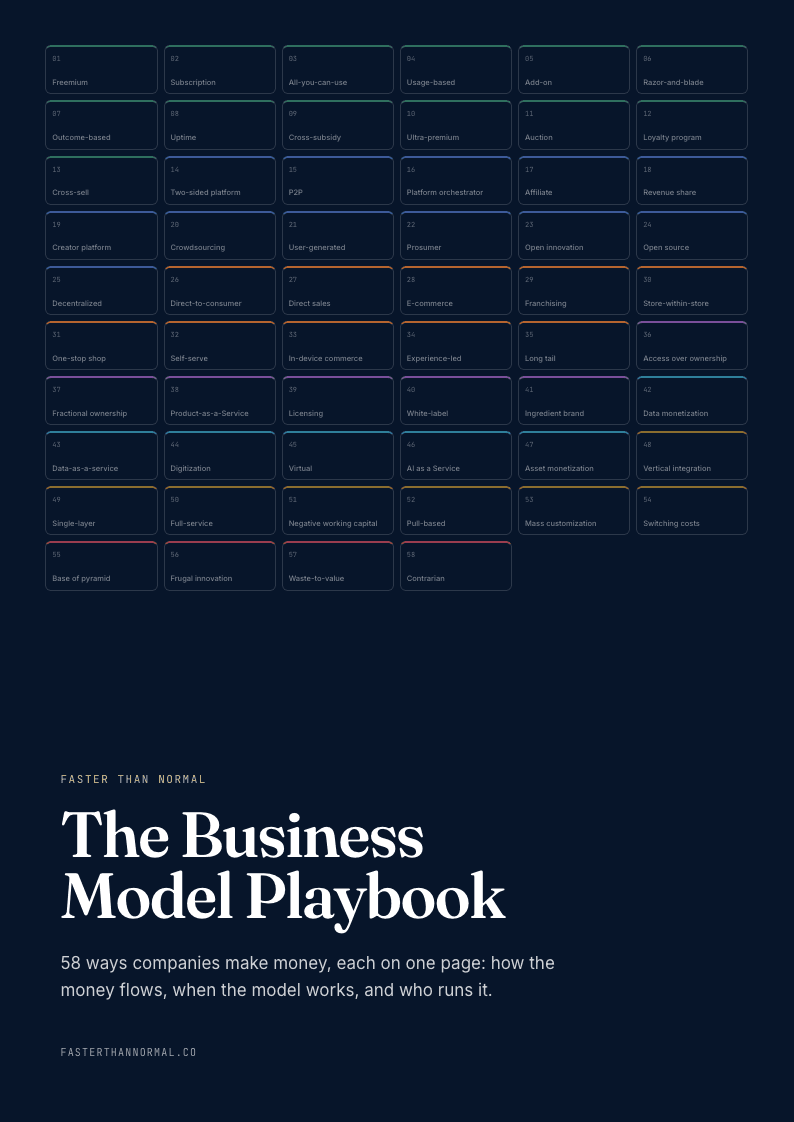
Free playbook
Get The Business Model Playbook
58 business models, one visual page each: how the money flows, the metrics that matter, and who runs it. Free when you join the Faster Than Normal email.
Free. No spam. Unsubscribe anytime.
Part IIIMaxims
-
Catastrophe is a credential. The experience of total loss recalibrates risk tolerance in ways that cannot be taught — only survived.
-
Build in the margins of someone else's time. Onassis built a tobacco empire during the daytime hours of a night-shift telephone job. The most valuable businesses are often started in the cracks of existing obligations.
-
Distressed assets are the highest-conviction bets. When the world is convinced something is worthless, the price already reflects the worst case. Your only risk is that the worst case is permanent — and it almost never is.
-
Information is the real commodity. Tobacco and oil were products. The switchboard, the yacht, the parties, the famous friendships — these were intelligence operations.
-
Ownership beats title. The man who holds the stock controls the outcome. The man who holds the title controls the paperwork.
-
Jurisdictions are products. Choose where you incorporate, bank, and live with the same rigor you apply to choosing investments. Every jurisdiction is a set of constraints — minimize the ones that cost you.
-
Scale compounds. In any asset-heavy industry, per-unit economics improve with size. The supertanker was not a better ship; it was a more profitable one.
-
Hospitality is leverage. A controlled social environment — a yacht, a dinner, a retreat — produces more negotiating advantage than a boardroom.
-
One audacious overreach defines a career. Even failed ambition, at sufficient scale, repositions how the world perceives you. The Saudi deal cost $7 million. It earned Onassis a place in the geopolitical imagination.
-
Grief is the tax on empire. The concentration of energy required to build something extraordinary starves the relationships that make life bearable. The bill arrives without negotiation.
In Their Own Words
At your job, you must be serious but in life, you must be crazy.
If there weren't any women all the money in the world wouldn't matter.
Never start a job, a battle, or a relationship, if the fear of losing overshadows the prospect of success.
Take care of your body. Be as good as you can with it. Don't mind the details. Look at me, I look nothing like a Greek God, but I never wasted my time crying over the bad aspects of myself, remember things are only as bad as you think they are.
Every win is an injustice to someone.
The secret in business is knowing something nobody else knows.
The rule is there are no rules.
After a certain point, money ceases to matter, it stops being the goal, the game is all that matters.
Crises give birth to moguls.
I don't have friends or enemies, I have competitors.
It is in our darkest moments where we have to focus to see the light.
To be successful you have to act big, think big, and talk big.
Be either rich or an enemy of the rich. I understand both, but never be envious of the rich and try to please them at the same time.
To be happy make sure you are tanned, live in expensive buildings, even if you have to stay in the cellar, go out to expensive restaurants, even if you can only afford one drink and if you have to borrow, borrow a lot.
To be successful, keep looking tanned, live in an elegant building (even if you're in the cellar), be seen in smart restaurants (even if you nurse one drink), and if you borrow, borrow big.— Aristotle Onassis
There was just a natural curiosity; after all, we were the most famous Greeks alive in the world.— Aristotle Onassis, on Maria Callas
I never gamble, it doesn't amuse me. I don't oppose it. I understand it. My whole life has been a terrific gamble.— Aristotle Onassis
Further reading
- Onassis by Willi Frischauer


