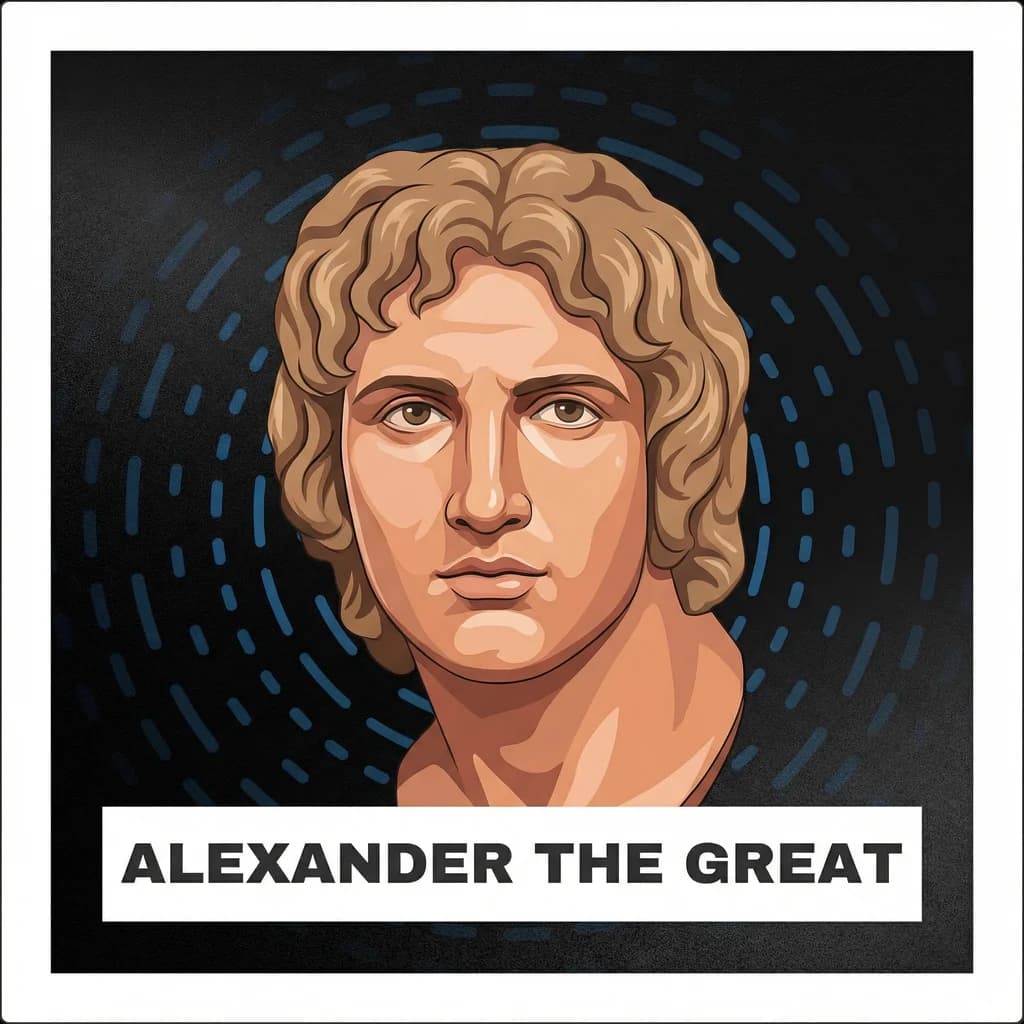
The Helmet Full of Water
Somewhere in the wastes east of Persepolis, in the killing summer of 330 BCE, a column of Macedonian soldiers was dying of thirst. They had marched four hundred miles in eleven days, pursuing a deposed king across a landscape that offered nothing but dust and the promise of more dust. Scouts had ridden ahead to a distant river and returned with a few leather bags of water — enough, perhaps, for a single man to drink his fill. They poured it into a helmet and offered it to their king.
Alexander looked at the water. He looked at his men. Then he poured it onto the ground.
The gesture was, depending on your sympathies, either the most inspired act of leadership in antiquity or the most reckless piece of theater. His soldiers, who had followed him from the green hills of Macedonia across the Hellespont and through the burning gates of Asia, who had seen him take a cleaver to the skull at the Granicus and an arrow through the lung at the Malli, watched the water sink into the dirt and understood: there would be no special dispensation for the man at the front. They spurred their horses forward and shouted for him to lead them on. With such a king, they said, they would defy any hardship.
This is the scene that keeps recurring across twenty-three centuries of retelling — in Plutarch, in Arrian, in the whispered legends that traveled the Silk Road in languages Alexander never spoke. Not the great set-piece battles. Not the burning of Persepolis. Not the god-king posturing in Egypt. A man pouring out water he desperately needed, in front of men who desperately needed to see him do it. The entire Alexandrian project — its genius and its madness, its world-historical ambition and its intimate, almost erotic relationship between a leader and the men who would die for him — distilled into a single act of refusal.
Alexander III of Macedon ruled for twelve years and eight months. He never lost a battle. He died at thirty-two in a palace in Babylon, likely of typhoid fever or perhaps Guillain-Barré syndrome, though the conspiracy theories — poison in unmixed wine, a slow-acting toxin slipped by Aristotle's nephew — have never fully gone quiet. His body, according to Plutarch, showed no signs of decomposition for six days. The ancients took this as proof he was a god. A more recent hypothesis, advanced by Dr. Katherine Hall of the Dunedin School of Medicine in 2018, suggests he may have still been alive — paralyzed, breathing so faintly that his physicians mistook coma for death. If so, he was almost certainly still conscious when the embalmers began their work. The most famous conqueror in history may have been disemboweled while he watched.
By the Numbers
The Alexandrian Empire
2M sq miTerritory at peak extent
~50MPeople under his rule — ~30% of the world's population
70+Cities founded, most named Alexandria
0Battles lost in his entire military career
12,000 miDistance marched during the Asian campaign
12 yrs, 8 mosLength of reign (336–323 BCE)
32Age at death in Babylon
The Kingdom That Shouldn't Have Mattered
Macedonia, in the middle of the fourth century BCE, was roughly what Nebraska is to Manhattan — technically part of the same civilization, but nobody from the capital took it seriously. The Athenians considered Macedonians semi-barbarians. Demosthenes, the great orator, routinely referred to Philip II as a thug from a backwater, which was not entirely unfair. The Macedonian court drank unmixed wine — a practice Greeks associated with savagery — and resolved political disputes with assassination rather than rhetoric. Between 399 and 359 BCE, five Macedonian kings died violently. It was, by any reasonable accounting, a second-rate kingdom with a first-rate talent for self-destruction.
Philip II changed this with the methodical brilliance of a man who understood that power is infrastructure before it is spectacle. Born around 382 BCE, he spent three years as a teenage hostage in Thebes, where he studied the military innovations of Epaminondas — the oblique order, the concentrated shock assault — and filed them away for later use. When he seized the Macedonian throne in 359, the kingdom was broke, besieged on all sides, and had just lost four thousand soldiers to the Illyrians. Within two decades, he had transformed the Macedonian army into the finest fighting force in the ancient world, conquered Greece, and was planning an invasion of the Persian Empire. He did this through a combination of tactical genius, diplomatic cunning, and the kind of personal toughness that defied medical explanation: by the time of his death he was one-eyed, limping from a shattered leg, and bore wounds to his collarbone, hand, and shin. He looked, as Adrian Goldsworthy notes in
Philip and Alexander, like the ruin of the man who had built the machine his son would ride to the ends of the earth.
The machine itself was the sarissa phalanx. Philip took the basic Greek hoplite formation and stretched it — literally. He issued his infantry pikes thirteen to twenty-one feet long, nearly twice the length of a standard spear, and drilled them into a bristling wall of iron points that no cavalry charge could penetrate and no opposing infantry could reach. He reorganized the cavalry into the Companion horse, an elite shock force built around personal loyalty to the king. He created specialized units — Agrianian javelin men from the Thracian highlands, Cretan archers, siege engineers who could take walled cities rather than simply starving them out. And he paid for all of it by seizing the silver mines of Mount Pangaion, which generated roughly a thousand talents per year — enough to fund a permanent professional army in an age when most Greek states still relied on seasonal citizen-soldiers.
Alexander grew up inside this machine. From the age of thirteen, his private tutor was Aristotle — Philip hired the philosopher and built him a school in the sanctuary of the Nymphs at Mieza, where for three years Alexander studied philosophy, medicine, botany, and the natural sciences. The curriculum was broad. But what Alexander took from Aristotle, more than any specific body of knowledge, was the conviction that the world was knowable, that it could be mapped and catalogued and, by extension, conquered. He kept a copy of Homer's Iliad, annotated in Aristotle's hand, under his pillow next to his dagger. The two objects tell you everything.
At sixteen, while his father was besieging Byzantium, Alexander was left as regent of Macedonia. He suppressed a revolt by the Maedi, a Thracian people, sacked their chief settlement, and renamed it Alexandropolis. He was a teenager naming cities after himself. Two years later, at Chaeronea in 338, he commanded the left wing of Philip's army and personally led the charge that destroyed the Sacred Band of Thebes — three hundred elite soldiers, a hundred and fifty pairs of lovers, who fought to the last man. The Sacred Band had been the most feared infantry unit in Greece. Alexander was eighteen years old.
The Murder and What Came After
In October 336 BCE, Philip II walked into the small theater at Aigai — the ceremonial capital of Macedonia, near modern Vergina — for the wedding celebrations of his daughter
Cleopatra. It was supposed to be a triumph. Philip was about to launch the invasion of Persia. The theater was packed with dignitaries from across Greece. Statues of the twelve Olympian gods had been paraded in — and, provocatively, a thirteenth statue, of Philip himself.
A bodyguard named Pausanias drove a knife into the king's chest. Philip fell dead. Pausanias ran for the gate, where horses were waiting. He was caught and killed before he could escape, which has always struck historians as suspiciously convenient.
The motive was officially personal: Pausanias had been sexually assaulted by one of Philip's generals, and Philip had refused to intervene. But the timing was extraordinary. Philip had recently married a full-blooded Macedonian noblewoman named Cleopatra — not his daughter but a new wife, whose uncle Attalus had publicly questioned Alexander's legitimacy at the wedding banquet, calling for a "lawful heir" to the throne. Philip, drunk, had drawn his sword on Alexander. "Look at the man preparing to cross from Europe to Asia," Alexander had sneered, "and he can't even cross from couch to couch." Alexander and his mother Olympias had fled to Epirus. They returned, but the relationship never recovered.
Olympias — daughter of King Neoptolemus of Epirus, a devotee of Dionysiac rites who reportedly slept with snakes, a woman of consuming ambition and merciless political instinct — is alleged to have helped orchestrate the murder, though the evidence is circumstantial. Alexander moved so swiftly after Philip's death that preparation seems likely. He was acclaimed king by the army, and within days he had executed the princes of Lyncestis (alleged co-conspirators), purged the opposition faction, and eliminated every plausible rival to the throne. He was twenty years old. He owed five hundred talents — roughly the kingdom's annual silver income — and he had an army that expected to be paid.
The Persian invasion, the project Philip had spent a decade preparing, was no longer optional. Alexander needed money, and the money was in Persia.
An Army Walking Off the Map
But first, a demonstration. In spring 335, Alexander marched north into Thrace, forced the Shipka Pass, crushed the Triballi, crossed the Danube on improvised rafts to scatter the Getae, wheeled west, and destroyed an Illyrian coalition that had invaded Macedonia. Then came word that Thebes had revolted. A rumor of Alexander's death had circulated — not the last time this would happen — and the Thebans, supported by Athenian gold and Demosthenes' rhetoric, had risen.
Alexander covered 240 miles from Illyria to Thebes in fourteen days. This speed — approximately seventeen miles per day over mountain terrain, with a full army — was nearly unprecedented in ancient warfare and became a hallmark of his campaigns. When the Thebans refused to surrender, he stormed the city, killed six thousand, and sold every survivor into slavery. He spared only the temples and the house of the poet Pindar. The message to the rest of Greece was precise: revolt would be met not with negotiation but with annihilation. Athens capitulated. The Greek League confirmed Alexander as supreme commander of the war against Persia.
In spring 334 BCE he crossed the Dardanelles with roughly 30,000 infantry and 5,000 cavalry — a small army by Persian standards but exquisitely balanced. The core was the Macedonian phalanx, nine thousand men armed with sarissas, supported by three thousand hypaspists (elite infantry) and the Companion cavalry. Alongside them marched Thracian javelin men, Cretan archers, Greek allied contingents, and a retinue that revealed Alexander's intentions: surveyors, engineers, architects, scientists, historians. This was not a raiding party. It was a colonizing expedition.
His first act on Asian soil was to visit Troy — Homer's Ilium — where he sacrificed at the supposed tomb of Achilles, anointed himself with oil, and ran a naked footrace around the burial mound with his closest companion, Hephaestion. Hephaestion laid a wreath on the tomb of Patroclus. The parallel was deliberate and publicly understood: Alexander was Achilles, and Hephaestion was his Patroclus, his other self. Whether the relationship was sexual — Plutarch and Curtius document Alexander's intimacy with other men, notably a Persian dancer named Bagoas — or simply the most intense friendship in the historical record, it would become the emotional axis around which Alexander's inner life turned, and its severance, nine years later, would crack something essential in him.
I observe, gentlemen, that when I would lead you on a new venture you no longer follow me with your old spirit. I have asked you to meet me that we may come to a decision together: are we, upon my advice, to go forward, or, upon yours, to turn back?
The first battle came at the Granicus River, near the Sea of Marmara, in May or June 334. The Persian satraps had positioned their cavalry on the far bank, on high ground — a killing field for anyone trying to cross. Alexander's general Parmenio, who had served Philip faithfully for decades and now served the son with the same competence and increasing unease, advised waiting until dawn. Alexander charged immediately.
Parmenio — the older man, the cautious strategist, Philip's most trusted commander, who understood that the difference between brilliance and recklessness is whether you survive — would become a recurring figure in the Alexandrian story, the voice of prudence that Alexander simultaneously relied upon and resented. He was probably in his mid-sixties at the Granicus, a stocky, battle-hardened Macedonian noble who had secured Alexander's initial foothold in Asia Minor during Philip's lifetime and whose family occupied positions throughout the command structure. He would be right about many things. Alexander would have him murdered in 330.
At the Granicus, Alexander led the Companion cavalry into the river himself, was nearly killed in the melee — a Persian nobleman's sword split his helmet — and was saved only by the intervention of Cleitus the Black, who severed the attacker's arm. The Persian line broke. Two thousand Greek mercenaries fighting for Persia were massacred; the survivors were sent to Macedonia in chains. Alexander lost roughly a hundred men. He sent three hundred sets of captured Persian armor to Athens with a pointed inscription: "Alexander son of Philip and the Greeks (except the Spartans) from the barbarians who inhabit Asia." The omission of Macedonia from the dedication was deliberate. This was, officially, a Greek war of revenge. The reality was something else entirely.
The Knot, the Siege, and the God
The campaign that followed was less a war than a methodical dismantling. Alexander swept south along the Anatolian coast, liberating Greek cities from Persian control and installing democracies — a propaganda masterstroke that simultaneously fulfilled his mandate as champion of Greek freedom and placed every liberated city under his de facto authority. At Gordium, in Phrygia, he encountered the legendary Gordian Knot — an impossibly complex binding on an ancient chariot, which prophecy declared could be undone only by the future ruler of Asia. Alexander, according to the most famous version, drew his sword and cut it in half. The story may be apocryphal. It doesn't matter. It is the Alexander legend in microcosm: the conventional puzzle rejected, the violent shortcut, the prophecy fulfilled by force rather than patience.
At Issus, in the autumn of 333, he met the Persian Great King Darius III for the first time. Darius had assembled a Grand Army — estimates range from 100,000 to 600,000, though the actual fighting force was probably far smaller — and had managed, through a failure of intelligence on both sides, to position himself behind Alexander's line of march, cutting his communications. It should have been a disaster. Alexander turned around, found Darius drawn up along the Pinarus River, and attacked. The battle was a rout. Darius fled, abandoning his mother, wife, and children.
Alexander's treatment of Darius's captured family became one of the defining anecdotes of his reign: he accorded them full royal honors, refused to mistreat them, and allegedly wept when he met Darius's mother, Sisygambis, who had initially prostrated herself before Hephaestion, mistaking the taller man for the king. "No matter," Alexander supposedly said. "He too is Alexander." It was a line that worked on multiple levels — gracious, magnanimous, and subtly asserting that his identity was transferable, that his closest companion was an extension of himself.
Darius offered peace: all lands west of the Euphrates, ten thousand talents for his family's ransom. "I would accept, were I Alexander," Parmenio said. "I too," Alexander replied, "were I Parmenio." He would settle for nothing less than everything.
The siege of Tyre, in 332, tested this absolutism. The Phoenician island-city refused him entry. Alexander spent seven months building a causeway from the mainland to the island — an engineering project of staggering ambition that permanently altered the coastline (the causeway silted up, and Tyre, once an island, is today a peninsula). When the city finally fell in July 332, eight thousand Tyrians were killed and thirty thousand sold into slavery. The pattern from Thebes repeated: resistance was met with exemplary destruction. Gaza held out for two more months; Alexander took a serious shoulder wound in a sortie. The commander of Gaza, Batis, was reportedly dragged alive behind a chariot — an echo of Achilles' treatment of Hector, and a reminder that Alexander's Homeric models were not always his most admirable ones.
In November 332 he entered Egypt, where the Persians surrendered without a fight. At Memphis he was crowned pharaoh and sacrificed to the sacred bull Apis. He founded Alexandria — the only one of his seventy-odd namesake cities that would become truly great — on a site between the sea and Lake Mareotis, laid out by the Rhodian architect Deinocrates. Then he marched across the desert to the oracle of Ammon at Siwa, where the priest greeted him as "son of the god." What the oracle actually told him, Alexander revealed to no one. But from this point forward, the question of his divinity — genuine belief, political strategy, or creeping megalomania — became inseparable from the question of who he was.
The Decisive Battle Nobody Remembers Correctly
Gaugamela, fought on October 31, 331 BCE, on a plain between Nineveh and Arbela in modern northern Iraq, was the battle that ended the Persian Empire. Darius had prepared the ground — literally smoothing it for his chariots and elephants — and assembled perhaps the largest army Alexander would ever face: estimates in the ancient sources range to a million men, though modern historians typically suggest 50,000 to 100,000. Alexander had roughly 47,000.
The tactical problem was straightforward: Alexander could not match Darius in numbers, and the flat terrain negated his usual advantage of choosing ground. His solution: Alexander advanced his right wing obliquely, drawing the Persian left forward and creating a gap in the center. When the gap opened, Alexander and the Companion cavalry drove through it like a spear point aimed directly at Darius. Again, Darius fled. Again, the Persian army disintegrated.
Alexander pursued for thirty-five miles but could not catch him. Darius escaped into Media with his Bactrian cavalry and what remained of his Greek mercenaries. It was the last time the two men would face each other in battle.
Babylon fell without resistance. Its satrap, Mazaeus, surrendered the city and was confirmed in office — the first clear sign that Alexander intended not to destroy the Persian administrative system but to absorb it. Susa yielded fifty thousand gold talents. At Persepolis, Alexander seized the treasury and then, in a gesture whose meaning scholars have debated for twenty-three centuries, burned the palace of Xerxes. The official explanation was revenge — a symbolic conclusion to the Panhellenic war that had begun with Xerxes' invasion of Greece in 480. The unofficial explanation, preserved by several ancient sources, was that Alexander was drunk and a courtesan named Thaïs suggested it. Both things can be true simultaneously. Alexander was a man who could make a decision for multiple reasons and then select the explanation that suited the audience.
In spring 330 he sent the Thessalian and Greek allied troops home. The Panhellenic war was over. What continued was "a purely personal war," as the Britannica entry notes with clinical precision. And it was here, in the transition from liberator to conqueror, from Greek avenger to would-be Great King, that the cracks began to show.
Killing the Father's Men
The trouble started with Philotas. Son of Parmenio, commander of the Companion cavalry, one of the most powerful men in the army — Philotas was accused in the autumn of 330 of knowing about a plot against Alexander's life and failing to report it. He was tried before the assembled army, condemned, and executed. A secret message was dispatched to Cleander, Parmenio's second-in-command at Ecbatana, where the old general was guarding the imperial treasury. Cleander stabbed Parmenio to death.
The double killing — the son tried and executed with a show of legality, the father assassinated without warning — sent a tremor through the officer corps. Parmenio had served two kings faithfully. He was in his seventies. He had committed no crime. But he was Philip's man, and Philip's men were becoming obstacles to the transformation Alexander was undergoing. The man who had crossed the Hellespont as a Macedonian king leading a Greek crusade was becoming something else — something his Macedonian soldiers, with their blunt drinking customs and tribal egalitarianism, could not recognize and did not want.
At Maracanda — modern Samarkand — in 328, during a banquet, the quarrel between the old world and the new finally erupted. Cleitus the Black, the man who had saved Alexander's life at the Granicus, was drunk. So was Alexander. Cleitus began loudly praising Philip and disparaging Alexander's pretensions. Alexander, who had been moving toward Persian court ceremonial and away from the rough Macedonian comradeship of shared drinking and equal speech, lost control. He grabbed a spear — or a pike; the sources vary — and ran Cleitus through.
The aftermath was theatrical even by Alexander's standards. He locked himself in his chambers for three days, refused food, wept, and had to be coaxed out by his companions. The army, prompted or pressured, passed a posthumous decree convicting Cleitus of treason. The dead man was guilty; the living man was blameless. It was a solution that satisfied no one and fooled nobody.
Then came the proskynesis crisis. At Bactra, Alexander attempted to impose the Persian court ritual of prostration — bowing or lying flat before the king — on his Macedonian and Greek courtiers. For Persians, this was simple court etiquette. For Greeks, prostration was an act of worship offered only to gods. The implication was clear, and even Callisthenes — Aristotle's nephew, the expedition's official historian, a man who had spent years flattering Alexander in his dispatches — refused. Macedonian laughter killed the experiment. Alexander abandoned the requirement. But Callisthenes was soon arrested on suspicion of involvement in a conspiracy among the royal pages. He died in prison — or was executed; the sources disagree. The Peripatetic school of philosophy, Aristotle's own tradition, never forgave Alexander.
Since Alexander wishes to be a god, let him be a god.
The River Where the Army Said No
India was the logical impossibility that Alexander nevertheless attempted. In early summer 327, he left Bactria with a reinforced army — Plutarch's figure of 120,000 almost certainly includes camp followers, muleteers, entertainers, women, and children; the fighting strength was perhaps 35,000 — and recrossed the Hindu Kush, probably through the Ghorband Valley. He stormed the fortress of Aornos (modern Pir-Sar), which legend said even Heracles had failed to take, and crossed the Indus near Attock to enter the kingdom of Taxila, whose ruler joined him against the neighboring king Porus.
Porus — ruler of the territory between the Hydaspes (modern Jhelum) and the Acesines (modern Chenab), a man of enormous physical stature who rode into battle on an elephant and refused Alexander's offer of tributary submission — represented a different kind of adversary. He was not defending a crumbling empire. He was fighting for his land, with terrain and monsoon on his side.
The Hydaspes was over a mile wide and rising fast with monsoon rain and Himalayan snowmelt. Porus camped on the eastern bank with 30,000 troops, war elephants — a weapon the Macedonians had never faced — and chariots, and waited. He knew Alexander had to cross the river to fight. He intended to destroy him in the crossing.
Alexander's solution was deception layered on deception. For weeks he made conspicuous shows of preparation — piling grain, moving troops up and down the bank — while spreading word through his camp (knowing Porus had spies) that he intended to wait until the river subsided. Nightly, he sent scouts to probe crossing points; nightly, Porus responded by marching his army to intercept; nightly, the scouts withdrew. After weeks of this, Porus stopped reacting.
Then, on a night of heavy rain — June 326 — Alexander took a select force eighteen miles upstream, crossed in darkness, discovered he'd reached an island rather than the far bank, waded the second channel, and emerged at dawn on Porus's side. Porus sent his son with a cavalry contingent to drive the Macedonians back into the river. The prince was killed. Porus then moved his main army to face Alexander, leaving the rest of Alexander's forces — under Craterus, with orders to cross when Porus moved — free to attack from behind.
The battle itself was a masterpiece of improvised adaptation. Alexander concentrated his attacks on the flanks, forcing Porus's elephants into his own infantry. The Macedonian sarissa, thirteen to twenty-one feet long, proved effective at repelling the elephants; the muddy terrain rendered the Indian chariots useless. Twelve thousand Indian soldiers and eighty elephants were lost. Macedonian casualties were roughly a thousand.
Porus, wounded and brought before Alexander, was asked how he wished to be treated. "As a king," he replied. Alexander made him a satrap and gave him additional territory. He founded two cities: Alexandria Nicaea, to celebrate his victory, and Bucephala, named for his horse Bucephalus, who died at the river — the animal he had tamed as a boy of eleven or twelve by noticing it was afraid of its own shadow and turning it to face the sun.
Alexander wanted to go farther. He had heard, or believed, that the Ganges and the eastern ocean lay beyond the Hyphasis (probably the modern Beas). He advanced to the river, and there — for the first and only time — his army refused.
Coenus, one of his four chief marshals, spoke for the men. They were exhausted. They had been away from Macedonia for eight years. They were fighting in tropical rain against enemies whose kingdoms stretched beyond the horizon. They wanted to go home.
Alexander retreated to his tent for three days, hoping the army would relent. It did not. He erected twelve altars to the twelve Olympian gods on the Hyphasis — monuments to the boundary of his ambition — and turned back. He never fully forgave the army for it.
The Desert That Ate the Army
The retreat was worse than the advance. Alexander built a fleet of 800 to 1,000 ships, sailed down the Hydaspes and into the Indus, and fought his way south through hostile tribes with what the sources describe as "heavy, pitiless slaughter." At the storming of a Malli town near the Ravi River, he was first over the wall and took an arrow through his lung. His men, who had watched him disappear over the parapet and heard the sounds of fighting on the other side, battered through the wall and found him lying in a pool of blood, the arrow shaft protruding from his chest. He survived, barely — the arrow was extracted by cutting it out through his back — but he was never the same physically.
At Patala, at the head of the Indus delta, he split his forces. Nearchus, a Cretan naval commander, was given a fleet of 100 to 150 ships and ordered to sail along the coast of the Persian Gulf — a voyage of exploration and supply. Craterus took the baggage, siege train, elephants, and wounded overland through the Mulla Pass and Kandahar. Alexander himself chose the worst route: a march along the coast through Gedrosia, the Makran Desert of modern Baluchistan.
It was a catastrophe. The desert offered no water, no food, no shelter. A sudden monsoon flood — the bitter irony of dying from water in a land with none — swept through the wadi where the army had camped, drowning women and children. The sources are vague on total losses but unanimous that they were devastating; some modern estimates suggest a quarter to a third of the army perished. Whether Alexander chose this route out of logistical necessity (he intended to establish supply depots for Nearchus's fleet), competitive emulation (the legendary queen Semiramis and Cyrus the Great had both supposedly attempted the crossing and failed), or simple miscalculation, the march through Gedrosia remains the darkest chapter of the campaign.
The Banquet at Susa and the Mutiny at Opis
He emerged from the desert into Carmania, where Nearchus and the fleet eventually found him. Then he began purging. Between 326 and 324, over a third of his provincial governors were replaced and six were executed, including three generals in Media accused of extortion. The ancient sources — even those generally favorable to Alexander — comment on the severity. The man who had poured out water to share his soldiers' thirst was now executing subordinates who had failed to meet standards he may have been inventing retrospectively.
In spring 324 he reached Susa, the administrative center of the Persian Empire, and staged the most audacious political gesture of his reign: a mass marriage. Alexander and eighty of his officers took Persian wives. He married two of Darius's daughters — Barsine (also called Stateira) and Drypetis — the latter going to Hephaestion, so that their children would be cousins. Ten thousand Macedonian soldiers with native wives were given generous dowries.
The message was revolutionary and, to his Macedonians, intolerable. Alexander was not merely ruling the Persian Empire. He was fusing it with Macedonia — creating a new ruling caste, hybrid in blood and culture. He had already begun wearing the Persian purple-and-white tunic, sitting on an elevated golden throne, surrounding himself with Persian bodyguards. Thirty thousand Persian youths, trained in Macedonian military methods, arrived at Susa. Persian nobles were admitted to the Companion cavalry.
At Opis in 324, when Alexander announced he was sending aging Macedonian veterans home under Craterus, the army saw it as a move to replace them entirely with Persians. Open mutiny followed — every unit except the royal bodyguard refused orders. Alexander escalated: he dismissed the entire Macedonian army and began enrolling Persians in their place, assigning them Macedonian unit names. The bluff worked. The Macedonians broke down and begged for reconciliation. Alexander wept with them. A banquet for nine thousand guests followed — Macedonians and Persians seated together, drinking from the same bowl, praying to the same gods. It was, depending on your reading, either the first great experiment in multicultural empire or a calculated emotional manipulation by a man who understood that an army's loyalty is not a right but a performance, constantly renegotiated.
The Death of Patroclus, Again
In the autumn of 324, Hephaestion died at Ecbatana. He had been ill with a fever, seemed to be recovering, ate a boiled fowl and drank half a gallon of wine against his doctor's orders, and collapsed. He was dead before Alexander could reach him.
Alexander's grief was annihilating. He lay on the body for a day and a night. He ordered the doctor crucified. He had the manes and tails of all the horses and mules in the army shorn, tore down the battlements of the nearby cities, banned music throughout the province, and launched a savage military expedition against the Cossaeans in the hills of Luristan — a punitive campaign that served no strategic purpose and appears to have been an offering of blood to Hephaestion's memory, an echo of Achilles slaughtering Trojans on Patroclus's funeral pyre. The funeral itself, held in Babylon, featured a pyre costing ten thousand talents — an almost unfathomable sum, equivalent to perhaps the entire annual revenue of a major province.
Alexander petitioned the oracle at Siwa to grant Hephaestion divine honors as a hero. He demanded that the Greek cities comply. And in connection with this demand, he seems to have linked a further requirement: that Alexander himself be worshiped as a god. The cities complied, most of them ironically. The Spartans, who had refused to join Alexander's Panhellenic crusade, refused to join his apotheosis with the same laconic economy: "Since Alexander wishes to be a god, let him be a god."
Ten Days in June
In the spring of 323, Alexander was in Babylon, planning. He had received embassies from Libya, from the Bruttians, Etruscans, and Lucanians of Italy — though the later claim that Romans, Carthaginians, Celts, and Iberians also sent delegations is almost certainly fiction. He was designing an expedition to Arabia. He had dispatched an officer named Heracleides to explore the Caspian Sea. He was improving the irrigation of the Euphrates and developing the ports of the Persian Gulf. He was, at thirty-two, ruling an empire that stretched from the Adriatic to the Indus and planning to extend it further.
Then, after a prolonged banquet — one account, probably apocryphal, says he attempted to drink an entire krater of wine in a single sitting; a krater held roughly six quarts — he collapsed with a searing pain in his back. Over the next ten days, the fever intensified. He continued to give orders, to plan the Arabian expedition, to sacrifice to the gods each morning. But his condition deteriorated steadily. Toward the end, his soldiers were brought in to see him. As Arrian reports, he could no longer speak, "but he struggled to raise his head and gave each man a greeting with his eyes."
On June 13, 323 BCE, Alexander was declared dead. He had named no successor — or, according to some accounts, when asked to whom he left his empire, whispered "to the strongest." His generals adopted Philip II's half-witted illegitimate son, Philip Arrhidaeus, and Alexander's posthumous son by Roxana, Alexander IV, as dual kings. Both were murdered within a decade. The generals carved the empire into rival kingdoms. The Hellenistic age — Greek language, Greek culture, Greek institutions spread across three continents — was Alexander's true bequest, and it endured for three centuries until Rome absorbed it.
His body was diverted to Egypt by Ptolemy, one of his companions, who became pharaoh and placed Alexander in a golden coffin in Alexandria.
Julius Caesar visited the tomb. Cleopatra visited the tomb. Augustus visited the tomb and accidentally broke the nose off the mummified corpse. Sometime around the fifth century, the tomb disappeared. It has never been found.
His body, although it lay without special care in places that were moist and stifling, showed no sign of such a destructive influence, but remained pure and fresh.
In 2018, Dr. Katherine Hall proposed that Alexander had died of Guillain-Barré syndrome, an autoimmune condition causing ascending paralysis. The disease would explain the gradual progression of symptoms, the preservation of mental clarity until very late, and — crucially — the failure of the body to decompose. Alexander may not have been dead when he was declared dead. The shallow breathing of a paralyzed man in a deep coma could easily have been mistaken for no breathing at all.
If this theory is correct, Alexander the Great — the man who had conquered the world, who had stood at the edge of the earth and been turned back only by the exhaustion of his own men, who had been worshiped as a god in a dozen countries — was embalmed alive. The ancient Greeks preferred a simpler explanation: the body did not decay because it was divine.
Six days of uncorrupted flesh. A golden coffin that vanished into the Egyptian sand. An empire that lasted less than a generation. And before all of it, a helmet full of water, poured out on the ground in front of men who would have followed him anywhere — and who, on one river in India, in the monsoon rain, finally said no. The water sinking into the dust. The soldiers cheering. The king who understood, better than anyone before or since, that the most powerful thing a leader can do is refuse the thing he needs most, in full view of the people who need to see him refuse it.