
Business & Strategy
Section 1
Core Idea
A distribution channel is the path through which your product or message reaches the customer — direct sales, partners, marketplaces, content, paid acquisition, or product-led flow. Channel choice shapes who you reach, at what cost, and with what control. In building and scaling, picking and optimizing the right channel(s) is often the difference between growth and stall; channel and product strategy must fit each other.
Free playbook
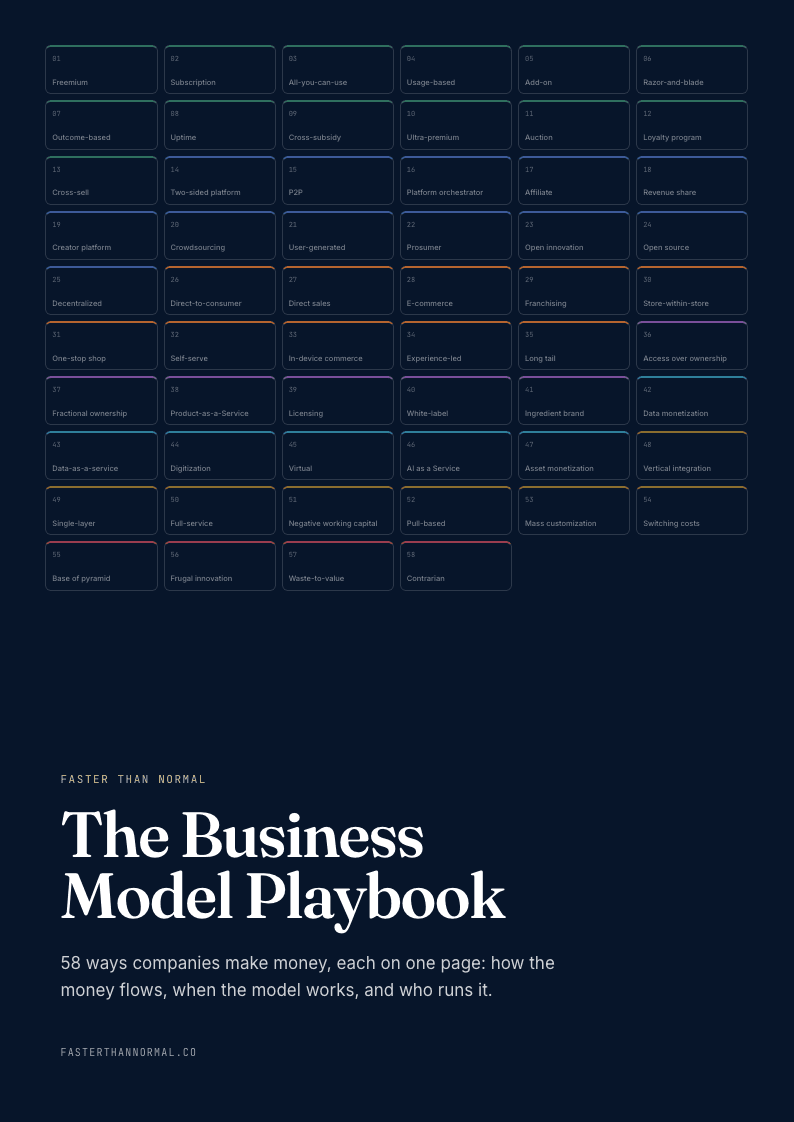
Get The Business Model Playbook
58 business models, one visual page each: how the money flows, the metrics that matter, and who runs it. Free when you join the Faster Than Normal email.
Free. No spam. Unsubscribe anytime.
Section 2
How to See It
GTM
You're seeing Distribution Channel when growth strategy explicitly names how customers are acquired (e.g. outbound, PLG, affiliates) and resource allocation follows channel performance and fit.
Unit Economics
You're seeing Distribution Channel when CAC, LTV, and payback are measured and compared by channel, and underperforming channels are cut or reworked while winners get more investment.
Product
You're seeing Distribution Channel when product and onboarding are designed for the primary channel (e.g. self-serve for PLG, demos for sales-led) so activation and retention align with how people find you.
Section 3
How to Use It
Define how you will reach the customer: direct, indirect, or product-led. Match the channel to your product, price, and buyer (e.g. high-touch for high-ACV, self-serve for low-touch). Measure CAC and LTV by channel; double down on channels that work and fix or kill the rest. Revisit when product or market changes — channel strategy isn’t set once.
Decision filter
"How does the customer get to us today, and is that the right channel for our product and unit economics? If we can’t name our primary channel, we don’t have a distribution strategy."
As a founder
Use distribution-channel thinking in planning: choose one or two primary channels and align team and budget. In hiring: hire for the channel (e.g. sales for sales-led, growth for PLG). In product: design the experience for how that channel delivers the user.
Section 5
Founders & Leaders
Jeff BezosFounder, Amazon
Bezos treated distribution as a core competency: fulfillment, marketplace, Prime, and later AWS were all channel innovations that determined who could be reached and at what cost. He obsessed over “how does the customer get it?” and built systems around the answer. Founders can apply this by explicitly choosing and investing in the channel(s) that match their product and economics, and by measuring and optimizing channel-level performance.
Section 7
Connected Models
Reinforces
Distribution
Distribution is the broader concept of how you get to the customer. Distribution channel is the specific path — the concrete channel you use and optimize.
Reinforces
Channel vs Product-led Growth
Channel vs product-led growth is the choice between indirect/direct sales and product-led acquisition. Your distribution channel is the implementation of that choice.
Tension
Channel Evaluation Framework
Channel evaluation framework is how you compare channels. The tension is positive: use a framework to pick and prioritize channels so distribution-channel decisions are deliberate, not default.
Section 8
One Key Quote
— Jeff Bezos, Amazon shareholder letters"Your margin is my opportunity. We focus on the customer and the channel that gets them the best outcome."
Section 11
Summary & Further Reading
A distribution channel is the path your product takes to the customer. Choose channels that fit your product and economics, measure by channel, and invest in the ones that work.
01
Book
Nineteen channels and how to test and focus on the right distribution for your stage.
02
Book
Technology adoption and distribution; how channel strategy changes by stage and segment.
03
Book
Networks and growth; distribution and cold start for network effects and PLG.