
Business & Strategy
Section 1
Core Idea
Channel-led growth uses sales, partnerships, or paid acquisition to get the product in front of buyers; product-led growth (PLG) uses the product itself to acquire and expand users (trials, self-serve, virality, in-product upgrades). The core idea: the two are different systems — channel-led scales by adding people and spend, PLG scales by improving the product and experience. Most companies mix both; the choice is which is primary and how they reinforce each other.
Free playbook
Get The Business Model Playbook
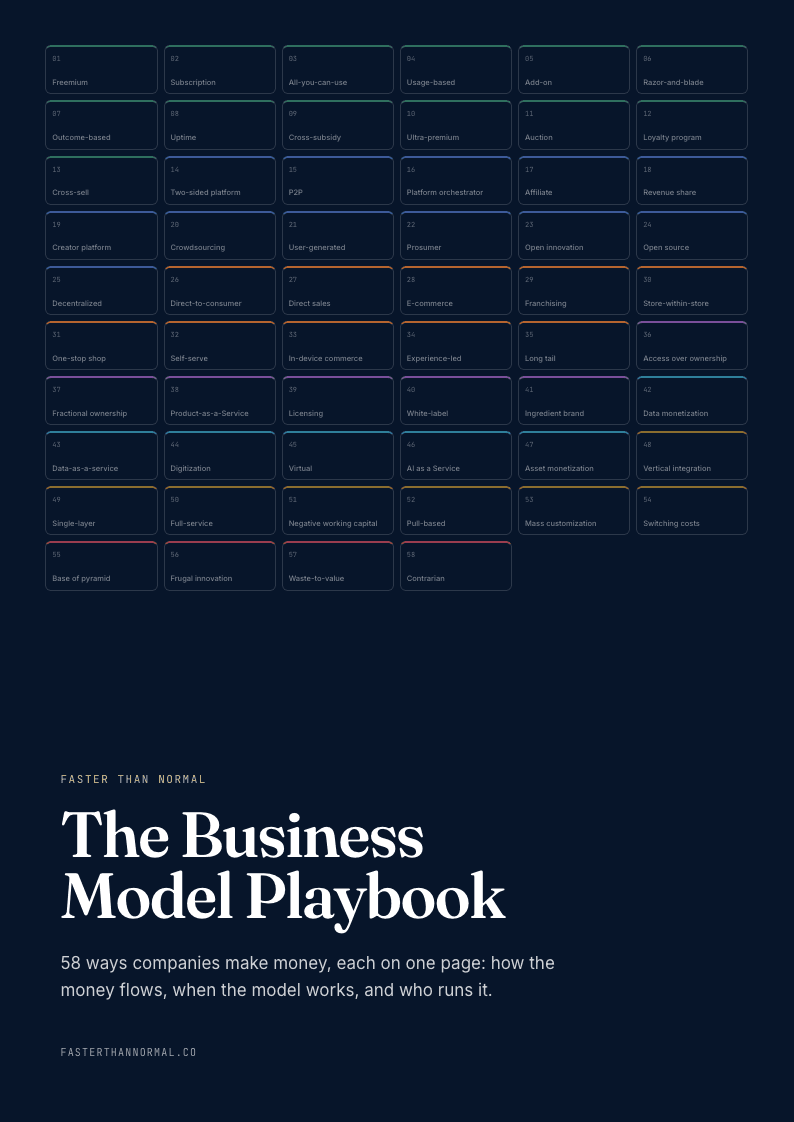
58 business models, one visual page each: how the money flows, the metrics that matter, and who runs it. Free when you join the Faster Than Normal email.
Free. No spam. Unsubscribe anytime.
Section 2
How to See It
Go-to-Market
You're seeing Channel vs Product-led Growth when strategy explicitly names the primary engine — "we're PLG with sales assist" or "we're channel-led with a free tier" — and when metrics (CAC, payback, expansion) are interpreted in that light.
Resource Allocation
You're seeing Channel vs Product-led Growth when investment goes to sales headcount and outreach vs product and onboarding — and when the roadmap reflects which engine is being fuelled (e.g. more trials and activation vs more outbound).
Section 3
How to Use It
Decide which engine is primary based on product (can users try and buy without a rep?), market (do buyers expect a sales conversation?), and economics (CAC and LTV by path). Double down on that engine; use the other to support (e.g. PLG for land, sales for expand). Avoid running both as equals without clarity — it dilutes focus.
Decision filter
"Is our growth primarily coming from people (sales, partners, paid) or from the product (trials, virality, in-product expansion)? If we don't know, we're underinvesting in one and overinvesting in the other. If we know, we can align team and budget."
As a founder
Choose the primary growth engine: channel-led if buyers need a sales motion and can support the CAC; PLG if the product can be tried and adopted without a rep. Build metrics and goals around that engine (e.g. PLG: signup → activation → expansion; channel: pipeline → close → expand). Add the other as a complement, not a second strategy.
Section 5
Founders & Leaders
Peter ThielCo-founder, PayPal and Palantir; author, Zero to One
Thiel emphasises distribution as a choice: you can win with sales-led (Palantir) or product-led (PayPal's viral growth) but you must design for one and excel at it. "Sales is hidden" — channel-led doesn't mean unglamorous; it means deliberate. Founders can apply this by making an explicit choice between channel-led and product-led as the main engine and building the org and product to serve that choice.
Section 7
Connected Models
Reinforces
Distribution
Distribution is how you get to the customer. Channel-led vs product-led is the strategic split in how distribution works: through people and spend vs through the product and experience. Choose distribution mode, then optimise within it.
Tension
Product/Market Fit
PMF determines whether the product pulls (PLG possible) or needs to be pushed (channel-led). The tension: weak PMF makes both hard; strong PMF enables PLG but channel-led can still win in enterprise. Align the growth engine with where you have fit.
Leads-to
Viral Marketing
Viral marketing is one form of product-led growth: users bring users. Channel-led rarely goes viral. If you choose PLG, viral loops are a lever; if channel-led, focus on sales efficiency and referral programs instead.
Section 8
One Key Quote
— Peter Thiel, Zero to One (2014)"Superior sales and distribution can create a monopoly, even with no product advantage. But the converse isn't true. You have to design the distribution that fits your product."
Section 11
Summary & Further Reading
Channel-led growth uses sales and paid channels; product-led growth uses the product to acquire and expand. Choose the primary engine, align metrics and investment to it, and use the other to support.
01
Book
Distribution and sales as a strategic choice; why channel matters as much as product.
02
Book
Definition and playbook for PLG: trials, onboarding, expansion, and when to add sales.
03
Book
19 channels and the Bullseye Framework; supports evaluating channel-led vs product-led options.