
Business & Strategy
Section 1
Core Idea
A channel evaluation framework is a structured way to assess and compare acquisition channels: which channels can reach your customer, at what cost, and with what control. Criteria typically include reach, cost (CAC), fit with product and buyer, and scalability. The core idea: don't spread effort across every channel; use a framework to rank, test, and double down on the few that work.
Free playbook
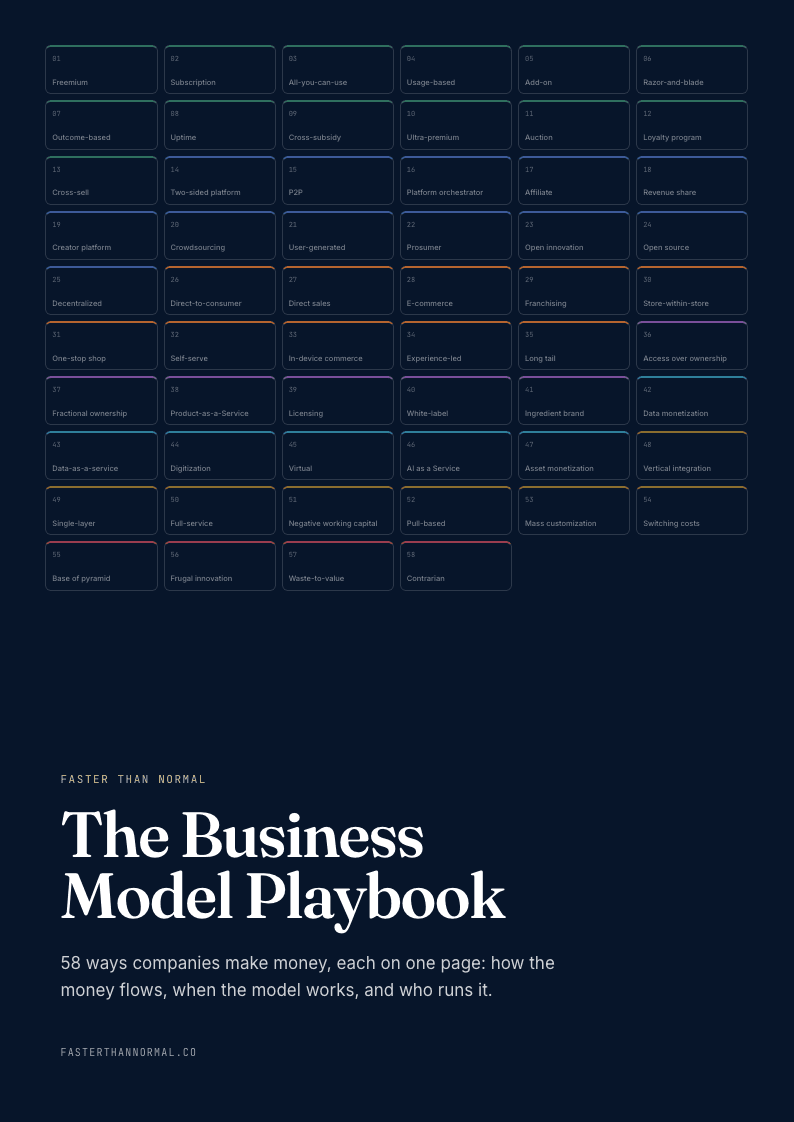
Get The Business Model Playbook
58 business models, one visual page each: how the money flows, the metrics that matter, and who runs it. Free when you join the Faster Than Normal email.
Free. No spam. Unsubscribe anytime.
Section 2
How to See It
Growth & Marketing
You're seeing Channel Evaluation Framework when channels are scored or ranked (e.g. by CAC, volume, or fit) and when resource allocation follows "we're betting on X and Y this quarter" with clear criteria for why.
Strategy
You're seeing Channel Evaluation Framework when a Bullseye-style process is used: list channels, narrow to a few to test, then focus on the winner — or when a matrix (channel × cost × fit) drives prioritisation.
Budget & Headcount
You're seeing Channel Evaluation Framework when marketing and sales spend are allocated by channel with explicit criteria (CAC, payback, volume) and when hiring follows "we're investing in X channel because the framework said so."
Section 3
How to Use It
List candidate channels (paid, organic, partnership, sales, etc.). Score each on reach, cost, fit with your product and customer, and controllability. Run small tests on the top candidates; allocate more resource to the channel that meets your CAC and volume targets. Re-evaluate when economics or market change.
Decision filter
"Which channels can reach our customer at a CAC we can afford, and do we have a way to test and measure? If we're in every channel with no framework, we're scattered. If we have criteria and tests, we can focus."
As a founder
Adopt a simple framework: e.g. list 5–10 channels, score them on fit and cost, pick 1–2 to test with a defined budget and success metric. Kill or scale based on data. Avoid "we do a bit of everything" — use the framework to choose where to concentrate.
Section 5
Founders & Leaders
Marc AndreessenCo-founder, Andreessen Horowitz; co-author, Why Software Is Eating the World
Andreessen has repeatedly stressed that distribution is underrated: great product with no channel fails. His lens is that channel strategy must be explicit — who gets the product to the customer and how. Founders can apply a channel evaluation framework by treating distribution as a first-class decision: list channels, evaluate fit and cost, test, then concentrate on the ones that work.
Section 7
Connected Models
Reinforces
Bullseye Framework
Bullseye (Traction) is one channel evaluation framework: brainstorm channels, rank by potential, test the inner ring, focus on the centre. Use it as a concrete process for applying the framework.
Tension
Distribution
Distribution is how you get to the customer; the framework is how you choose which distribution channels to use. The tension: don't confuse "we have distribution" with "we've evaluated and chosen." Apply the framework to distribution choices.
Leads-to
Channel vs Product-led Growth
Channel evaluation often surfaces the split: are we betting on channel-led (sales, paid) or product-led (trials, virality)? The framework helps you decide and then invest accordingly.
Section 8
One Key Quote
— Peter Thiel, Zero to One (2014)"Distribution is not something that happens after the product. You have to design the distribution that fits your product and your customer."
Section 11
Summary & Further Reading
A channel evaluation framework structures how you assess and choose acquisition channels. List channels, score by reach and cost and fit, test the best candidates, and concentrate resource on the winners.
01
Book
19 channels and the Bullseye Framework: brainstorm, rank, test, focus.
02
Book
Distribution as a strategic choice; why channel must be designed, not assumed.
03
Book
Channel and go-to-market by stage; reinforces evaluating channel fit for your market.