


Part IThe Story
The Fax Machines of Moscow
In the winter of 1988, a seventeen-year-old girl from Hanoi arrived in a city that was running out of bread. Moscow under Gorbachev was a study in magnificent decay — the grandest subway stations in the world servicing a population that queued for hours to buy soap. The Soviet Union had perhaps eighteen months of coherence remaining, though nobody knew it yet, and into this entropic landscape stepped Nguyen Thi Phuong Thao, a scholarship student at the Plekhanov Russian University of Economics who had been sent abroad to study the science of central planning at the precise historical moment when central planning was devouring itself. She was slight, studious, a member of the Nguyen Canh clan — a lineage whose history stretches back six centuries in Vietnam — and she possessed what would become her defining commercial instinct: she looked at the empty shelves of a collapsing superpower and saw not despair but margin.
By her second year, while classmates attended lectures on labor economics and financial credit management, Thao was awake at five in the morning making calls to suppliers in South Korea, Japan, and Hong Kong. She imported fax machines, latex rubber, plastic goods, watches, electronics, agricultural products — anything the Soviet economy could not produce and its citizens still needed. She attended classes at eight, handled more business in the afternoon, and studied until two in the morning. The rhythm was punishing and entirely self-imposed. "Don't go small," she would later distill the lesson of those years into a motto. "Go for the big deals." Before she turned twenty-one — before she had even graduated — she was a millionaire, which in 1991 dollars meant approximately $2 million in today's terms. She had earned it not by inventing anything, not by writing code or filing patents, but by the oldest commercial act imaginable: moving goods from where they existed to where they were wanted, across borders that were dissolving in real time.
That Moscow apprenticeship — chaotic, sleep-deprived, conducted in a language she'd had to learn from scratch, in a country that would cease to exist before she finished her doctorate — contains in miniature the entire logic of what would follow. The fax machines became fertilizer and steel. The steel became a seed investment in Vietnam's first private bank. The bank became real estate. The real estate became beach resorts and skyscrapers. And then, improbably, all of it became an airline.
By the Numbers
The Thao Empire
$2.7BEstimated net worth (Forbes, 2021)
25.3MPassengers carried by Vietjet (2023)
$29BValue of Airbus & Rolls-Royce deals (2025)
£155MDonation to Oxford's Linacre College (2021)
95Aircraft in Vietjet fleet
115Destinations served by Vietjet
1970Born in Hanoi, Vietnam
The Arithmetic of Scarcity
To understand Nguyen Thi Phuong Thao, you must first understand the Vietnam she left and the Russia she entered, because the collision between the two economies — one emerging from war, the other collapsing under its own weight — formed the cognitive template she would apply to every subsequent venture. Vietnam in 1987 was two years into đổi mới, the cautious economic liberalization that began to dismantle collective farming and invite private enterprise, though "invite" overstates the warmth of the gesture. The country was still desperately poor. Per capita GDP hovered around $100. The idea that a Vietnamese teenager might become a millionaire within four years of leaving home was not merely unlikely — it was conceptually foreign, a category error in a system that had not yet invented the category.
Moscow, meanwhile, offered the opposite problem: a vast consumer market with functioning infrastructure and educated citizens who simply could not buy things. The Afghan-Soviet War ground on. The ruble was volatile. And into this gap between latent demand and absent supply, a sophomore with two bachelor's degrees in progress — one in financial credit management, one in labor economics — inserted herself as intermediary. The business model was elemental: identify what people need, find where it exists, move it. She was not trading derivatives or building platforms. She was shipping watches.
But the simplicity of the model belied the operational complexity. Thao was navigating Soviet customs bureaucracies, arranging logistics across multiple countries, managing currency risk in a monetary system that was actively disintegrating, and doing it all as a foreign student with no family connections in Russia and no safety net. The merchandise grew in scale — from fax machines to fertilizer, from electronics to iron and steel — and each escalation required a different set of relationships, a different tolerance for risk. By the time she completed her doctorate in economic management at the D. Mendeleev University of Chemical Technology — a PhD earned, improbably, while running a multimillion-dollar import operation on the side — she had accumulated not just capital but a particular form of commercial intelligence: the ability to see opportunity in systemic failure, to read a broken market the way a doctor reads an X-ray, looking for the fracture that reveals the underlying structure.
It was in Moscow, too, that she met Nguyen Thanh Hung, an electromagnetic engineer pursuing his own PhD in automatic control at the Russian Academy of Sciences. He was, by all accounts, her intellectual counterpart — a systems thinker in a different register, trained in the mathematics of feedback loops and signal processing. They married. And in 1993, the two of them returned to Vietnam with capital, credentials, and a shared conviction that their country's economy, like the Soviet one they had just navigated, was full of gaps between what people needed and what they could access.
— Nguyen Thi Phuong ThaoDon't go small, go for the big deals.
Building the First Private Bank in a One-Party State
The Vietnam they returned to in 1993 was recognizable but transformed. Đổi mới had accelerated. Foreign investment was beginning to trickle in. Ho Chi Minh City — still called Saigon by most of its residents — was developing the manic commercial energy that would eventually make it one of Southeast Asia's most dynamic cities. But the financial infrastructure was primitive. The banking system was almost entirely state-owned, which meant that credit allocation was a function of political connection rather than commercial merit, and ordinary Vietnamese had essentially no access to the instruments of modern finance.
Thao and her husband founded Sovico Holdings — later renamed Sovico Group — as their vehicle for entering this nascent market. One of their first moves was a seed investment in Techcombank, which had been founded by a group of Vietnamese intellectuals who, like Thao, had studied abroad and returned with ideas about how capital markets should work. Techcombank was the first private bank in Vietnam. The significance of this is easy to underestimate from the vantage point of 2025, when Vietnam has dozens of private banks and a stock exchange with hundreds of listed companies. In 1993, the concept of a private bank in a communist country was still genuinely radical — a bet not just on a particular institution but on the direction of an entire political economy.
By 1996, Thao was a founding investor in VIB, Vietnam's second private bank. The pattern was becoming legible: she was not simply investing in companies but in the infrastructure of a market economy itself — the banking system, the property market, the legal and regulatory frameworks that would make commerce possible at scale. Dragon City, a skyscraper development in Saigon. Three beach resorts. Offshore oil and gas exploration. Each investment was a different surface of the same underlying thesis: Vietnam's economy would grow, its middle class would expand, and the enterprises that served that expansion earliest would capture disproportionate value.
What made Thao unusual was not the thesis — many investors in emerging markets have held similar views — but the breadth of her execution. She was simultaneously a banker, a real estate developer, an energy investor, and a trader. Sovico Group became a conglomerate in the truest sense, a holding company whose diverse portfolio reflected less a strategy of diversification than a single entrepreneur's inability to see a gap in the market without trying to fill it.
One Percent of the Sky
The airline idea began, like many of Thao's ventures, with an observation about access. She was talking with a family member — the specifics of the conversation have become part of her personal mythology, the kind of origin story that gets polished with retelling — and the relative mentioned how expensive plane tickets were, wondering aloud whether ordinary Vietnamese would ever be able to afford to fly. At the time, in the early 2000s, only 1% of Vietnam's population had ever traveled by air. Flying was perceived as a luxury reserved for the rich, for government officials, for foreigners. Vietnam Airlines, the state-owned carrier, operated as a monopoly with prices calibrated not to market demand but to institutional inertia.
Thao's instinct — the same instinct that had sent her scouring Hong Kong for fax machines to sell in Moscow — was immediate: this was a market failure masquerading as a cultural norm. The demand existed. Ninety million people lived in a long, narrow country where a train from Hanoi to Ho Chi Minh City took thirty-two hours. The infrastructure for road travel was poor. The only thing keeping Vietnamese from flying was the price of the ticket.
She began studying the business models of low-cost carriers around the world. Southwest Airlines in the United States. Ryanair in Europe. AirAsia in Malaysia. The playbook was well-established by the mid-2000s: single aircraft type to reduce maintenance costs, point-to-point routing to maximize aircraft utilization, unbundled pricing to keep base fares low, rapid turnaround times to squeeze more flights out of each plane. The model was proven. The question was whether it could work in a communist country where the aviation industry was entirely state-controlled and the regulatory apparatus had no framework for private participation.
In 2007, after years of preparation and lobbying, Thao received an Air Operator's Certificate — the first ever granted to a private airline in Vietnam. Then the world intervened. Oil prices spiked. The global financial crisis hit. The planned launch was delayed, then delayed again, as fuel costs made the economics of a startup airline nearly impossible. In 2010, Thao entered negotiations with AirAsia's Tony Fernandes to create a joint venture — AirAsia would take a 30% stake, providing operational expertise and brand credibility — but the Vietnamese government vetoed the deal, reportedly unwilling to cede a portion of its nascent private aviation sector to a foreign company.
So Thao did it alone. On December 25, 2011 — Christmas Day, a deliberate choice for a carrier that aspired to international legibility — the first VietJet flight departed Ho Chi Minh City for Hanoi. The airline that Vietnam's first female billionaire had spent nearly a decade trying to launch was finally in the air.
The Bikini Airline and the Problem of Attention
VietJet became famous, or perhaps infamous, for something that had nothing to do with its unit economics or route network. In 2012, the airline featured bikini-clad flight attendants in a promotional campaign, and the resulting international media coverage was both enormous and overwhelmingly reductive. The "Bikini Airline" — the label stuck like a decal on a fuselage — became the thing Western journalists wrote about, drowning out the more consequential story of what VietJet was actually doing to Vietnamese air travel.
The coverage infuriated some and delighted others, and Thao's own relationship to it has been characteristically pragmatic. She was fined by Vietnam's aviation authority for the promotional stunt — a slap on the wrist that generated still more publicity — and she never quite apologized, because the calculus was clear: VietJet had achieved in weeks the kind of brand recognition that would have taken years and millions of dollars in conventional advertising. The airline was suddenly known, and known specifically as the carrier that was different from Vietnam Airlines — younger, cheekier, cheaper. The controversy, in other words, was the marketing.
But it also created a persistent framing problem. Every profile of Thao — including, inevitably, this one — must reckon with the bikini campaigns, which threaten to flatten a genuinely complex business story into a single provocative image. The deeper truth is that VietJet's success has had almost nothing to do with promotional gimmicks and almost everything to do with operational execution at a level that few airline startups anywhere in the world have matched.
— Nguyen Thi Phuong Thao, Harvard Business School interviewBefore we joined the industry, only one percent of the Vietnamese population had access to air travel; it was perceived as expensive and only for the rich.
Teaching a Country to Fly
Consider the problem Thao actually had to solve. She was not merely launching an airline. She was creating a category of consumer behavior that did not previously exist. When VietJet began operations in December 2011, the vast majority of its potential customers had never purchased an airline ticket, never checked a bag, never been through a security screening, never fastened a seatbelt on a plane. The entire apparatus of air travel — from online booking systems to boarding procedures — was foreign to the population she needed to serve.
VietJet developed what amounted to a consumer education operation running in parallel with its airline operations. The company taught first-time flyers how to purchase tickets online, how to prepare travel documents, how to navigate airports. This was not merely customer service; it was market creation. Every passenger who learned to fly on VietJet became a repeating customer and, more importantly, an evangelist — someone who went home to their village and told their family that flying was not, in fact, something reserved for the rich.
The results were staggering. In its first full year of operation, VietJet carried hundreds of thousands of passengers. By 2023, the airline transported 25.3 million passengers — surpassing Vietnam Airlines' 24.1 million. A private startup, launched barely a decade earlier by a woman whom the state-owned carrier had every reason to dismiss, had overtaken the national flag carrier in total passengers. The growth in international routes was even more dramatic: 7.6 million international passengers in 2023, a 183% increase from 2022, driven by the post-pandemic travel boom that sent Vietnamese tourists — many of them first-generation flyers — to Thailand, South Korea, Japan, and India.
The scale of this achievement becomes clearer when you zoom out from the airline industry and consider what Thao was actually measuring. She was not competing for market share in a mature market. She was expanding the total addressable market by orders of magnitude. When she started, 1% of Vietnamese had flown. When VietJet began carrying 25 million passengers a year in a country of 100 million, the percentage was no longer 1%. The market had not been captured. It had been created.
The Architecture of a Conglomerate
Sovico Group, the holding company through which Thao and her husband control their business interests, is less a corporation than an ecosystem — a sprawling, privately held conglomerate whose tentacles reach into aviation, real estate, banking, finance, oil and gas exploration, hospitality, and logistics. The structure is characteristic of emerging market conglomerates, where the absence of deep capital markets and the importance of relationship-based commerce reward breadth over focus. Thao is not a single-product entrepreneur. She is a portfolio builder, a serial investor whose various enterprises share not an industry vertical but a common thesis about the trajectory of the Vietnamese economy.
The real estate empire alone would make her one of Vietnam's most prominent businesspeople even without VietJet. Sovico's property portfolio stretches from skyscrapers in Ho Chi Minh City to five-star beach resorts across the country. The hospitality business leverages VietJet's route network — fly passengers to a destination, then house them in your resort — creating the kind of vertical integration that makes financial analysts either deeply impressed or deeply nervous, depending on their temperament and their views on concentration risk.
The oil and gas interests add another layer of complexity, and controversy. Sovico's fossil fuel financing has drawn criticism, particularly in the context of Thao's £155 million donation to Oxford's Linacre College, which was announced on the eve of COP26 in November 2021. Environmentalists noted the dissonance between funding a college that would focus on environmental research and operating businesses that contribute to the problem that research was meant to address. Thao has not publicly engaged with this critique in detail, which is characteristic: she governs her public image with the same efficiency she brings to her route network, addressing what serves her and ignoring what does not.
The Oxford Gambit
The Linacre donation — £155 million, the largest gift to Oxford in at least 500 years — was orchestrated with the precision of a state visit. The deal was signed in Edinburgh in the run-up to COP26, in the presence of Vietnamese Prime Minister Phạm Minh Chính, lending it the character of a diplomatic event rather than a philanthropic transaction. Linacre College, one of Oxford's least well-endowed institutions, voted to rename itself Thao College.
The backlash was immediate and multidirectional. Some dons objected to the "commercialisation" of learning — the spectacle of a 16th-century academic institution trading its identity for a Vietnamese billionaire's patronage. Others raised concerns about Thao's political connections. She and her husband maintain close ties to Vietnam's ruling Communist Party, which international human rights organizations consistently criticize. Sovico also retains links to Russian business networks dating back to Thao's student days, and the company was involved in construction projects in Kazakhstan's capital, Nur-Sultan (formerly Astana).
Thao's response, delivered with characteristic directness, framed the donation in terms of civilizational uplift: "Education and research are the keys to the development and prosperity of mankind. I believe the long-term cooperation with Oxford University will bring new opportunities and good value to the community." It was the kind of statement that could mean everything or nothing, and its very blandness suggested a sophisticated understanding of how Western institutions process controversy — they absorb it, metabolize it, and eventually move on, provided the money is real.
The personal dimension was more revealing. Thao's son, Tommy Nguyen, had studied economic management at Oxford, where — in a filial echo of his mother's Moscow years — he started a logistics company called Swift247 after struggling to get his visa paperwork couriered to the UK quickly enough. In his application to Oxford, Tommy reportedly wrote: "My mother is a role model for me to strive to follow." The donation, in this light, was not merely philanthropic or strategic. It was dynastic — an attempt to embed the Nguyen Canh family name, with its 600 years of Vietnamese history, into the stonework of one of the oldest universities in the English-speaking world.
— Nguyen Thi Phuong Thao, on the Oxford donationEducation and research are the keys to the development and prosperity of mankind.
The Private Citizen of the Public World
Thao has spoken, in rare moments of personal candor, about the cost of the life she has built. There is a story she tells about her son — Tommy, again — insisting and begging her to take him to class when he was young. "Strictly, I had a meeting at 8:30," she told the Vietnamese business website Cafebiz. "Go alone, even though my heart wants to go with you." The anecdote has the quality of a confession delivered as illustration: the successful woman acknowledging what the successful woman missed, while simultaneously demonstrating that the choices she made were necessary.
She has said she would prefer not to live life in the public eye. "But business leadership has turned me into a person of the collective, of the public. I must always be aware of the exemplary spirit of leadership, sharing among staff and I am forced to sacrifice my privacy and interests." The language is revealing — "forced to sacrifice" — because it suggests a self-conception in which public life is an obligation rather than a reward, a tax levied on success rather than its natural expression. Whether this is genuine modesty, strategic self-deprecation, or the authentic weariness of someone who has been performing the role of "Vietnam's first female billionaire" for years is impossible to determine from the outside.
What is clear is that Thao occupies a peculiar position in Vietnamese public life. She is simultaneously an icon of capitalist achievement in a nominally communist country, a female power figure in a society with deeply traditional gender hierarchies, and an internationally recognized billionaire in a nation where the average annual income remains below $4,000. She is, in the language of political economy, a walking contradiction — proof that the system works and evidence of its most radical transformation.
Vietnam's Golden Moment
In October 2025, at the inaugural Vietnam Private Economy Panorama conference in Hanoi, Thao delivered a speech that revealed the full scope of her current ambitions. The private economy, she noted, now contributes over 40% of Vietnam's GDP and is on track to reach 60-70%. She spoke about artificial intelligence, semiconductor chips, data, the digital economy — the vocabulary of a country that has decided to stop being merely a manufacturing base and start competing at the frontier of global technology.
"All these signals tell us one simple truth: Vietnam's moment has arrived," she said. "If we dare to think, dare to act, and dare to move swiftly, Vietnam can fully become Asia's new innovation center." The rhetoric was expansive, even by the standards of business conference keynotes, but it was grounded in specific diagnoses. She identified four constraints: thin computing infrastructure and fragmented data; regulatory frameworks that lag behind technology; insufficient high-quality engineering talent; and a shortage of long-term, patient capital willing to accept risk.
The specificity of the critique mattered more than the optimism of the vision. Thao was essentially arguing that Vietnam's private sector — the sector she had spent three decades building, deal by deal, from fax machines to VietJet — needed to evolve from opportunistic gap-filling to systematic institution-building. The country needed not just entrepreneurs but infrastructure, not just capital but the regulatory and educational frameworks that make capital productive.
She announced, that same month, that Vietjet had signed deals with Airbus for A321neo aircraft and with Rolls-Royce for engines, valued collectively at $29 billion. The figure was staggering — roughly equivalent to 7% of Vietnam's entire GDP — and it represented a bet not on the past but on the future: that Vietnam's middle class would continue to grow, that its citizens would continue to fly in ever-greater numbers, and that the country's position in the global economy would continue to rise. The woman who had started by shipping fax machines was now signing orders for jet engines.
The Reward of Civilization
There is a line from Thao's interview with Harvard Business School that contains, in compressed form, her entire philosophy of enterprise: "The reward for us comes from the feeling that taking flight is a sign of civilization. When stepping out of their village, our passengers feel like another person and become global citizens."
It would be easy to dismiss this as corporate sentimentality — the kind of purpose-driven language that billionaires deploy when they want to sound like they are doing more than maximizing shareholder value. But Thao has earned the right to the claim in a way that most executives who make similar statements have not. She did not enter a functioning market and compete for share. She looked at a country where 99% of the population had never been on an airplane, and she built the thing that made it possible. The villager who boards a VietJet flight from Da Nang to Seoul is, in a meaningful and not merely metaphorical sense, stepping into a different world.
Whether Thao's broader project — the conglomerate, the Oxford donation, the speeches about Vietnam becoming Asia's innovation center — will succeed at the scale she envisions is an open question. The risks are real: geopolitical tension in the South China Sea, the structural challenges of Vietnam's regulatory environment, the inherent fragility of airline economics, the complications of building a family dynasty across borders and political systems. The 2024 Fortune ranking named her among the most powerful women in Asia. Forbes has tracked her net worth through the fluctuations of a pandemic, a travel boom, and a real estate cycle that has tested every developer in Southeast Asia.
But the image that persists — the one that resolves the contradictions and contains the full arc — is not of the billionaire on the stage at the Panorama conference, or the tycoon signing the Airbus deal, or the donor whose name will be carved into Oxford limestone. It is of a seventeen-year-old girl arriving at a Moscow train station in 1988, looking at the empty shelves, and doing the arithmetic.
Part IIThe Playbook
The playbook of Nguyen Thi Phuong Thao is the playbook of the emerging-market conglomerate builder — a particular species of entrepreneur who thrives not in stable, efficient markets but in the chaotic, gap-riddled economies that are in the process of becoming something else. Her principles are not abstract management theory. They were forged in the specific conditions of post-Soviet Russia and post-reform Vietnam, and they carry the residue of those origins.
The principles
- 1.Read broken systems as blueprints for opportunity.
- 2.Don't go small.
- 3.Create the market before you compete in it.
- 4.Build the infrastructure, not just the product.
- 5.Operate at the speed of your conviction, not the speed of your environment.
- 6.Use controversy as capital.
- 7.Stack enterprises vertically around a single thesis.
- 8.Make regulatory navigation a core competency.
- 9.Embed your name in institutions that outlast you.
- 10.Treat access as the product.
- 11.Sacrifice privacy as the price of leadership.
- 12.Think in civilizational time frames.
Principle 1
Read broken systems as blueprints for opportunity
Thao's entire career can be understood as a series of encounters with dysfunctional systems — the collapsing Soviet consumer economy, Vietnam's non-existent private banking sector, a state-monopolized aviation industry — in which she identified the dysfunction not as a problem to be endured but as a map of unmet demand. The empty shelves of Moscow were, to her eyes, a catalog of products people wanted. The 99% of Vietnamese who had never flown were not a statistical curiosity; they were a customer base waiting for a price point.
This is a fundamentally different orientation than the Silicon Valley model of entrepreneurship, which typically involves building something new and persuading people they need it. Thao has never built anything that didn't already exist somewhere else in the world. Fax machines existed. Private banks existed. Low-cost airlines existed. Her genius was in recognizing that the absence of these things in a particular market was itself the opportunity — and that the first mover who filled the gap would capture extraordinary value.
Tactic: When evaluating a market, look not at what exists but at what is conspicuously absent — and ask whether the absence reflects a genuine lack of demand or a failure of supply.
Principle 2
Don't go small
Thao's self-articulated motto — "don't go small, go for the big deals" — is not merely motivational rhetoric. It reflects a specific insight about the economics of emerging markets, where the fixed costs of navigating regulatory complexity, building political relationships, and establishing operational infrastructure are so high that small deals don't cover them. The marginal effort required to import steel versus watches, in a system where both require the same customs negotiations, favors the higher-value transaction.
This principle scaled directly into her later career. When she entered aviation, she didn't launch a charter service or a regional commuter line. She launched a full-service low-cost carrier with ambitions to serve 100+ destinations across Asia. When she donated to Oxford, it wasn't a modest endowment. It was £155 million — the largest gift in half a millennium. The pattern is consistent: in every domain, Thao operates at maximum viable scale.
Tactic: Before entering any new venture, determine the minimum scale at which the economics become compelling — then start at that scale, not below it.
Principle 3
Create the market before you compete in it
VietJet did not take market share from Vietnam Airlines. It created an entirely new category of passenger — the first-time flyer — and built the infrastructure (consumer education, online booking systems, simplified processes) to serve that category. The result was that VietJet grew the total market rather than dividing an existing one, which meant it could achieve massive scale without triggering the kind of zero-sum competitive response that destroys margins.
This is the most strategically valuable thing Thao has done: she understood that in a country of 90+ million people with a rapidly growing middle class, the biggest risk was not competition but the failure to convert latent demand into actual demand. The market creation approach also generated an enormous competitive moat. By the time Vietnam Airlines understood what was happening and tried to launch its own budget offering, VietJet had already trained millions of passengers on its own systems and processes.
✈
Market Creation vs. Market Capture
The fundamental strategic distinction in VietJet's approach
| Traditional approach | Thao's approach |
|---|---|
| Compete for existing passengers | Create new passengers |
| Lower price to steal share | Lower price to expand total market |
| Optimize for existing behavior | Teach new behavior (how to fly) |
| Win by differentiation | Win by being the only option for a new segment |
Tactic: Ask whether your market opportunity lies in taking share from incumbents or in converting non-consumers. If the latter, invest heavily in consumer education.
Principle 4
Build the infrastructure, not just the product
Thao's career follows a consistent pattern: before building a business, she builds or invests in the infrastructure that makes the business possible. Before launching VietJet, she invested in banks that would finance consumers and businesses. Before building resorts, she built the airline that would deliver tourists. Before advocating for Vietnam as a technology hub, she invested in the real estate and hospitality infrastructure that makes a country attractive to foreign talent and capital.
This is conglomerate thinking at its most sophisticated — not the random diversification of a company that can't decide what it wants to be, but the deliberate construction of an ecosystem in which each piece amplifies the others. The bank finances the real estate buyer who visits the resort who flies on the airline. The airline creates demand for the tourism infrastructure. The tourism infrastructure creates jobs that generate banking customers.
Tactic: Before building your core product, map the entire value chain and identify which upstream or downstream dependencies could become bottlenecks — then invest in those dependencies before you need them.
Principle 5
Operate at the speed of your conviction, not the speed of your environment
VietJet's launch was delayed by four years — from the initial license in 2007 to the first flight in 2011 — and during that period, Thao endured spiking oil prices, a global financial crisis, and a government veto of her AirAsia joint venture. A less committed founder would have walked away. Thao responded to the AirAsia veto by doing it alone, which meant assuming all the operational and financial risk that the joint venture was designed to mitigate.
The pattern repeats. Her trading operation in Moscow continued to grow even as the Soviet Union literally dissolved around her. Her investments in Vietnamese banking continued through the Asian financial crisis. Her airline continued to expand through a global pandemic. In each case, the external environment counseled caution, and Thao moved forward — not recklessly, but with a stubbornness rooted in her own analysis of long-term fundamentals.
Tactic: When external conditions force a delay, use the delay period to strengthen your position rather than re-evaluate your commitment. If the thesis hasn't changed, neither should your conviction.
Principle 6
Use controversy as capital
The bikini marketing campaigns were not an accident, and Thao's response to the resulting controversy — paying the fine, ignoring the criticism, banking the brand awareness — reveals a sophisticated understanding of media dynamics. In a market where VietJet was unknown and Vietnam Airlines was the default, the fastest way to achieve differentiation was to generate the kind of coverage that no advertising budget could buy.
The Oxford donation followed a similar logic. The controversy around the renaming of Linacre College generated global coverage of Thao, Sovico, and VietJet at a scale that the donation itself — however genuinely philanthropic — could not have achieved if the process had been uncontroversial. Thao does not seek controversy for its own sake, but she understands that in a crowded information environment, attention is the scarcest resource, and provocation is the most efficient way to acquire it.
Tactic: When entering a new market or seeking global visibility, identify the action that will generate the most attention per dollar spent — and be prepared to weather the backlash as a cost of doing business.
Principle 7
Stack enterprises vertically around a single thesis
Sovico Group's portfolio — aviation, real estate, banking, hospitality, energy — looks at first glance like unfocused diversification. But examine the connections and a coherent logic emerges: every business is a different expression of the same underlying bet on Vietnam's economic development and the expansion of its middle class.
S
The Sovico Ecosystem
How Thao's businesses reinforce each other
1993
Sovico Holdings founded; seed investment in Techcombank (Vietnam's first private bank)
1996
Founding investment in VIB (Vietnam's second private bank)
2000s
Real estate development: Dragon City skyscraper, beach resorts
2007
VietJet receives first private Air Operator's Certificate in Vietnam
2011
VietJet's first flight, December 25
2017
VietJet IPO on Ho Chi Minh Stock Exchange
2021
£155M donation to Oxford's Linacre College (renamed Thao College)
2025
$29B in Airbus and Rolls-Royce deals; ViPEL 2025 keynote on Vietnam's digital future
Tactic: If you operate in an emerging market, consider whether adjacent industries share a common growth driver — and build across them to capture the full value of that driver.
In Vietnam, every private-sector success story is, at its foundation, a story about regulatory navigation. Thao spent years lobbying for the Air Operator's Certificate that allowed VietJet to exist. She then pushed for regulatory changes that brought Vietnam's aviation standards into compliance with international norms — a process that benefited not just VietJet but the entire industry by attracting foreign investors and partners. As she told Harvard Business School, the regulatory work she did had "the broader impact of attracting more foreign investors to enter the Vietnamese aviation industry."
This is not lobbying in the Western sense — it is closer to co-development, a process in which the entrepreneur and the regulator jointly construct the legal framework within which the business will operate. Thao has been effective at this because she frames her regulatory asks not as private benefits but as public goods: opening the aviation market to private competition benefits consumers; modernizing banking regulations benefits depositors; liberalizing investment rules benefits the national economy.
Tactic: In regulated industries, treat regulatory engagement not as a compliance burden but as a strategic capability — one that, done well, creates advantages competitors cannot easily replicate.
Principle 9
Embed your name in institutions that outlast you
The Oxford donation is the most visible expression of a deeper instinct: Thao is building not just a business empire but a legacy structure. The Nguyen Canh family's 600-year history is not incidental to her ambition — it is the frame within which she understands her own achievements. The donation to Linacre College, the renaming of the institution, her son's own Oxford education and entrepreneurial ventures — these are the moves of someone thinking in generational terms.
The parallel to other dynastic builders is instructive. The Rockefellers embedded their name in universities, museums, and philanthropic institutions that persist more than a century after the family's commercial peak. The Tatas in India followed a similar pattern. Thao appears to be constructing the Vietnamese version of this model — using philanthropy and institutional investment to convert commercial wealth into durable cultural and intellectual capital.
Tactic: If you are building for generational impact, identify institutions whose time horizon exceeds your own — universities, foundations, research centers — and invest in them early enough that the association becomes permanent.
Principle 10
Treat access as the product
Across every sector Thao has entered — banking, aviation, real estate, hospitality — the underlying product is the same: access. Access to financial services for people who had none. Access to air travel for people who couldn't afford it. Access to modern housing and tourism infrastructure for a population emerging from decades of poverty.
This is not just a philosophical orientation. It has concrete strategic implications. When your product is access, your total addressable market is defined not by existing consumption but by existing deprivation. In a country of 100 million people where 99% have never flown, the TAM for a low-cost airline is essentially the entire population. This is a fundamentally more exciting market than competing for the 1% who already fly.
Tactic: Frame your market opportunity in terms of the population that currently lacks access to your product or service, not in terms of the population that currently uses a competitor's version.
Principle 11
Sacrifice privacy as the price of leadership
Thao has been candid about the personal cost of her public role: "Business leadership has turned me into a person of the collective, of the public. I must always be aware of the exemplary spirit of leadership, sharing among staff and I am forced to sacrifice my privacy and interests." This is not a complaint but a strategic acknowledgment — in Vietnam's business culture, the leader's personal conduct and public persona are inseparable from the company's brand.
The missed school drop-offs, the meetings that took priority over family moments — these are not unique to Thao, but her willingness to discuss them publicly is strategic. It humanizes a figure who could otherwise become remote, and it provides a narrative framework — sacrifice in service of a larger mission — that reinforces the VietJet brand story of democratizing access.
Tactic: As a leader, recognize that your personal narrative is a company asset — and manage it with the same intentionality you bring to product strategy, including the willingness to disclose vulnerability where it serves the brand.
Principle 12
Think in civilizational time frames
"The reward for us comes from the feeling that taking flight is a sign of civilization." This is not the language of quarterly earnings calls. Thao consistently frames her work — the airline, the banking investments, the Oxford donation, the ViPEL 2025 keynote about Vietnam's technological future — in terms that transcend commercial outcomes and point toward civilizational transformation. When she says Vietnamese villagers who board a VietJet flight "feel like another person and become global citizens," she is articulating a vision of enterprise as development — business as the mechanism by which a nation joins the world.
Whether this framing is genuine conviction or strategic positioning is, in some sense, irrelevant. It works either way. It attracts talent that wants to be part of something larger than a P&L statement. It provides a narrative that government officials can embrace when justifying regulatory concessions. And it creates a shield against criticism — because who would argue against civilization?
Tactic: Develop a narrative for your enterprise that transcends your industry and connects to a larger story about human progress. This narrative will attract partners, talent, and regulatory goodwill that a purely commercial framing cannot.
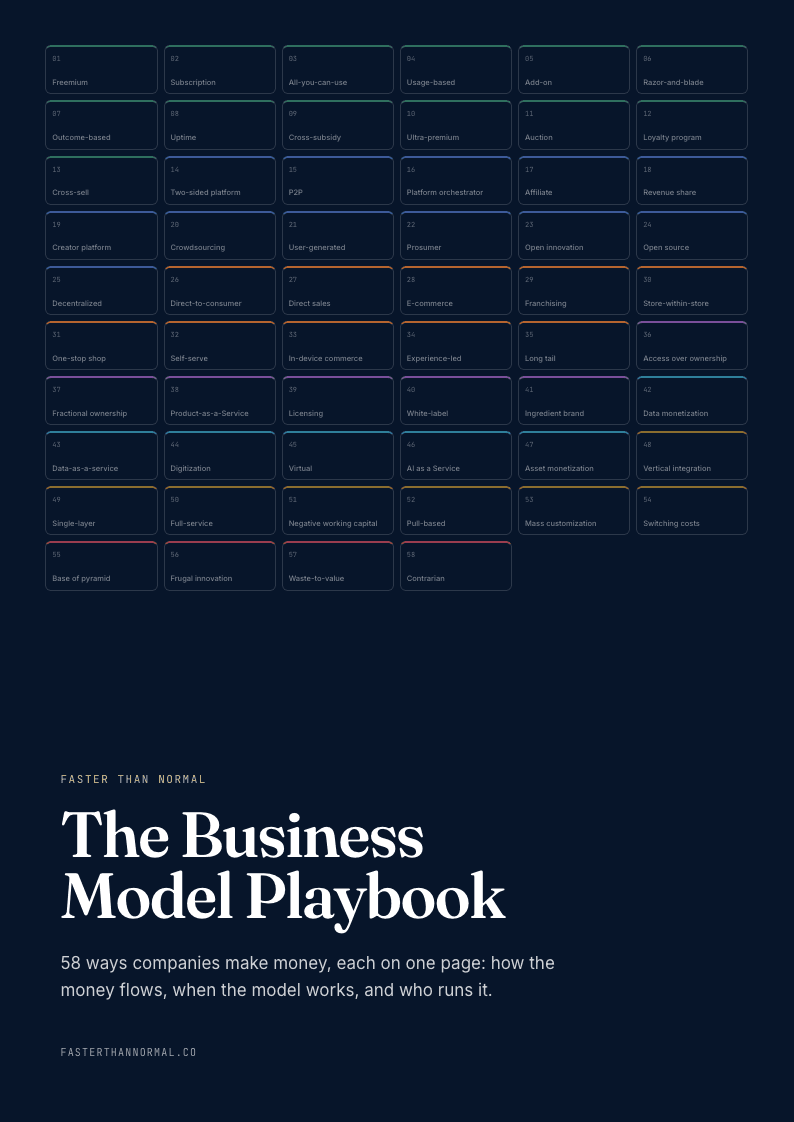
Free playbook
Get The Business Model Playbook
58 business models, one visual page each: how the money flows, the metrics that matter, and who runs it. Free when you join the Faster Than Normal email.
Free. No spam. Unsubscribe anytime.
Part IIIMaxims
-
Empty shelves are a business plan. The most valuable opportunities exist not where markets are efficient but where they are broken — where demand is real and supply is absent.
-
Scale is not the goal; scale is the minimum. In emerging markets, the fixed costs of regulatory navigation, relationship building, and infrastructure investment are so high that only large-scale ventures generate adequate returns.
-
Create customers, not campaigns. Consumer education — teaching people to use a product or service they've never encountered — is the most durable form of marketing and the deepest competitive moat.
-
The conglomerate is a thesis, not a portfolio. Diversification in emerging markets should be vertical integration around a single bet on the direction of the economy, not horizontal scattering across unrelated opportunities.
-
Patience is not passivity. When the environment forces a delay, use the time to strengthen your position. VietJet waited four years between license and launch. The waiting was not inaction — it was preparation.
-
Attention is cheaper when it's controversial. The most efficient path to brand awareness in a crowded market is to do something that generates coverage no advertising budget could buy — and to absorb the criticism as a cost of acquisition.
-
Build the infrastructure your business requires. Before launching the product, invest in the systems — financial, legal, logistical — that make the product viable. Banks before airlines. Airports before routes.
-
Regulation is a strategic weapon, not a compliance burden. The entrepreneur who co-develops the regulatory framework operates within rules tailored to their advantage.
-
Dynasties are built in stone, not in stock certificates. Commercial wealth is ephemeral. Institutional legacy — universities, foundations, named colleges — persists across generations.
-
Access is always underpriced. In any market where a large population is excluded from a product or service by cost, the entrepreneur who solves the cost problem inherits the entire excluded population as customers.
In Their Own Words
The album was the creation of a space where all of the different lives I've led. My life has been really divided and this was a place where I could finally gather them all up and they would be in one place. So that my professional life and personal life exist together.— DIVA chats to Thao Nguyen all about her new record, coming out to the world and Zoom music video magic, Diva (29 May 2020)
The lyrics are the most important part for me and I spend most of my time on the lyrics. When I'm in that process, I try to write every morning. I wake up and write and then just spend as much time as I can generating content and lyrics. Nothing happens until the music exists and then I'm writing to the music.— DIVA chats to Thao Nguyen all about her new record, coming out to the world and Zoom music video magic, Diva (29 May 2020)
I wanted to try to be a real live person, rather than just singing songs about them.— The Rumpus Interview with Thao Nguyen, The Rumpus (5 August 2013)
I had these ideas, which propelled some of the songwriting, that I was moving to a different place with. I thought it would be more change. I thought, 'Maybe I'll call him,' or whatever, which I haven't done. But it was really important to me. These were the songs that were going to exist in this time.— Visibility, Vulnerability and Strength: An Interview with Thao Nguyen, She Shreds (30 August 2016)
Not ever in depth. When I was first starting out, it was so much about me and my ethnicity. I was really turned off to that. But now I've seen that it's just really important to bolster that part of it as well, just so that there's an example of someone—a woman of color—doing something that may or may not be within the realm of what is expected.— Visibility, Vulnerability and Strength: An Interview with Thao Nguyen, She Shreds (30 August 2016)
So when I can, I try my best to meditate a little bit every day, and that helps a lot. I think that just taking a minute, or however long you can, and really acknowledging everything that you have.
The reward for us comes from the feeling that taking flight is a sign of civilization. When stepping out of their village, our passengers feel like another person and become global citizens.— Nguyen Thi Phuong Thao, Harvard Business School interview
Education and research are the keys to the development and prosperity of mankind. I believe the long-term cooperation with Oxford University will bring new opportunities and good value to the community.— Nguyen Thi Phuong Thao, on the Oxford donation
All these signals tell us one simple truth: Vietnam's moment has arrived. If we dare to think, dare to act, and dare to move swiftly, Vietnam can fully become Asia's new innovation center.— Nguyen Thi Phuong Thao, ViPEL 2025
Business leadership has turned me into a person of the collective, of the public. I must always be aware of the exemplary spirit of leadership, sharing among staff and I am forced to sacrifice my privacy and interests.— Nguyen Thi Phuong Thao, on leadership and privacy
We understand that an entrepreneur's responsibility goes beyond profit to creating social value, promoting sustainable development, protecting the environment, and fostering national confidence.— Nguyen Thi Phuong Thao, on the duty of entrepreneurs


