
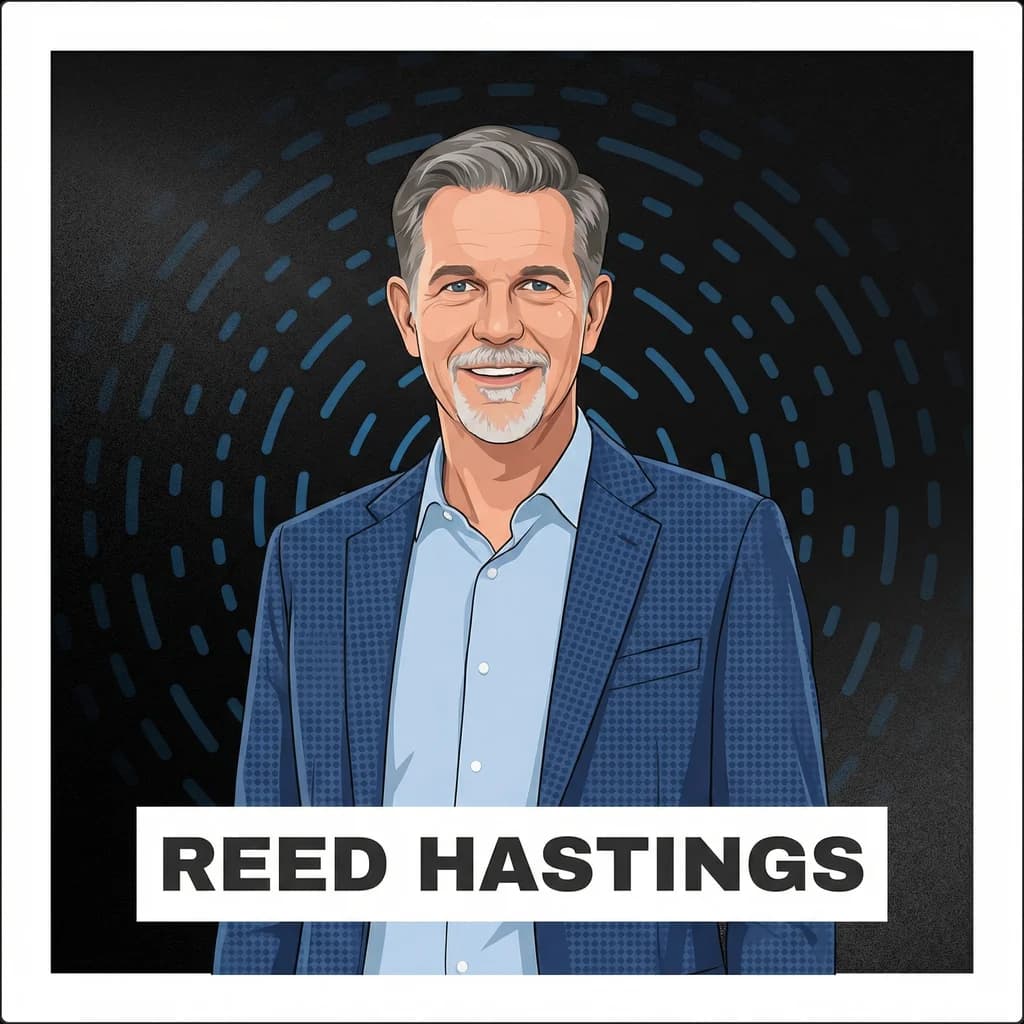

Part IThe Story
The Gate on the Tarmac
It was still dark when Barry McCarthy's BMW turned off the main road toward Santa Barbara Airport, past the overhanging oaks, down a driveway so obscure it looked residential — flower boxes, shingled roof, a cottage that might have belonged to someone's grandmother. Behind a wrought iron fence, the blinking wing lights of a chartered plane waited on the runway. Marc Randolph, sitting in the back seat, leaned forward: "What's a tail number?" Reed Hastings turned from the front passenger seat and gave him a look — the look, Randolph would later write, that a parent gives a child in a restaurant fancier than McDonald's. I can't take you anywhere.
The year was 2000. Netflix had roughly 300,000 subscribers, was bleeding cash at a rate that would have killed any company without venture funding, and its three most senior officers were racing through a gate they needed a password to open so they could fly private to Dallas and offer to sell the company to Blockbuster for $50 million. Twelve hours earlier, at a corporate retreat at Alisal Ranch in the middle of nowhere California, McCarthy — a CFO so precise he did math on picnic tables with a mechanical pencil, scribbling numbers directly into the wood grain — had calculated the logistics of getting to an 11:30 a.m. Central Time meeting and declared it impossible. "So we fly private," Hastings said, as if it were self-evident. McCarthy blanched. "Reed. That's gotta be at least 20,000 round trip." For a company that was, at that moment, spending more on postage than most studios spent on marketing, twenty thousand dollars for a single flight was either visionary confidence or clinical delusion.
They flew. They landed. They walked into Blockbuster's headquarters in Dallas and pitched John Antioco, the CEO of a company with 9,000 stores and $6 billion in annual revenue, on an acquisition: Netflix would run Blockbuster's online business; Blockbuster would promote Netflix in its stores. The price tag was $50 million — a rounding error for a chain whose late fees alone generated hundreds of millions in annual profit. Antioco's team, according to Randolph, "was struggling not to laugh." The meeting lasted less than an hour. Netflix flew home.
Twenty-five years later, Blockbuster's last remaining franchise occupies a single storefront in Bend, Oregon, operating largely as a tourist attraction. Netflix, the company that couldn't give itself away for $50 million, agreed in December 2025 to acquire Warner Bros. Discovery's studio and streaming assets in a deal valued at approximately $82.7 billion. The man who chartered that predawn flight — the one who said "so we fly private" with the unblinking certainty of someone who had already calculated the future and found it favorable — had by then stepped away from the CEO role he held for a quarter century, retreating to the executive chairmanship and a life increasingly organized around philanthropy, ski mountains, and the conviction that artificial intelligence would do to education what Netflix had done to Blockbuster.
This is not, in other words, a story about a DVD company that got lucky with streaming. It is the story of a man who saw, with unusual clarity, that the dominant mode of human entertainment was about to undergo a once-in-a-generation transformation — and who built, dismantled, and rebuilt the organization required to ride it. That the same man was also capable of catastrophic misjudgment, public humiliation, and the kind of messianic overreach that nearly destroyed his company in 2011 is not a contradiction. It is the point.
By the Numbers
The Netflix Empire
$392.7BNetflix market cap (2025)
$82.7BWarner Bros. Discovery acquisition enterprise value
~300MGlobal paid subscribers
$15B+Annual content spend (2020)
80,000%+Stock appreciation since 2002 IPO (split-adjusted)
25Years as CEO (1998–2023)
$1.1BPersonal charitable donation (2024)
The Son of a Nixon Lawyer
Wilmot Reed Hastings Jr. was born on October 8, 1960, in Boston, Massachusetts, into the kind of East Coast establishment family that produces attorneys and government officials with metronomic regularity. His father, Wilmot Reed Hastings Sr., was a lawyer who served in the Nixon administration's Department of Health, Education, and Welfare — an irony not lost on anyone who has watched his son become one of the Democratic Party's most prolific donors and a board member of organizations dedicated to charter schools and racial equity in education. His maternal great-great-grandfather was Alfred Lee Loomis, the Wall Street tycoon turned amateur physicist who, during World War II, played a pivotal role in developing LORAN navigation and helped fund the MIT Radiation Laboratory where radar was perfected. When Tim Ferriss asked Hastings about Loomis on a podcast in 2024, Hastings spoke of him with a mix of pride and analytical distance — as though the family penchant for seeing the military applications of emerging technology before anyone else was less an inheritance than a data point.
Hastings attended Buckingham Browne & Nichols, a private day school in Cambridge, Massachusetts, then Bowdoin College in Brunswick, Maine, where he studied mathematics. He was not, by his own account, a prodigy. "I was a late bloomer," he told the Times of London in 2020. "At school there was nothing that I was exceptional at." He underwent Marine Corps officer training during college summers but requested permission to leave when he concluded he was a poor fit — a rare early instance of Hastings recognizing that a system didn't suit him and exiting cleanly rather than grinding through. Between Bowdoin and Stanford, he joined the Peace Corps and spent two years teaching high school math in Swaziland (now Eswatini), an experience that would surface again and again in his rhetoric about education reform and in his comfort with operating in environments of extreme constraint.
Before all of that, though — before the Marines, before Swaziland, before Stanford's master's program in artificial intelligence — the teenage Hastings took a gap year and sold Rainbow vacuum cleaners door to door. "I started it as a summer job and found I liked it," he told the New York Times in 2006. "As a sales pitch, I cleaned the carpet with the vacuum the customer had and then cleaned it with the Rainbow." The anecdote is almost too neat: the future architect of a subscription empire discovering, at seventeen, that the way to displace an incumbent is to demonstrate its inadequacy on the customer's own turf. But it happened. And the instinct it reveals — the willingness to show up uninvited, perform a direct comparison, and let the product do the talking — would define every major strategic move of his career.
Pure Software, or, the Education of a Bad Manager
In 1988, Hastings completed his master's in computer science at Stanford, specializing in artificial intelligence. He worked briefly as a software developer at a company called Adaptive Technology before founding Pure Software in 1991. Pure built debugging tools for Unix developers — unsexy, technically demanding, and precisely the kind of infrastructure product that could scale with the exploding population of software engineers in the early 1990s. The company grew fast. Too fast. Hastings, by his own admission, was a terrible manager in these years. Pure went public in 1995, acquired several companies including Atria Software to become Pure Atria Corporation, and was itself acquired by Rational Software in 1997 for approximately $750 million.
The sale made Hastings wealthy — estimates of his personal take range around $75 million — but the years running Pure Atria had taught him something more valuable than money. He had learned, the hard way, what happens when a company's culture degrades under the weight of rapid growth and mediocre talent. "From the time we were founded in 1997 to when we went public in 2002, all we were focused on was not going bankrupt," he later said of Netflix, but the statement applies equally to Pure Software in reverse: at Pure, he'd had the resources but not the organizational wisdom to deploy them. The company had grown bloated. Decision-making had calcified. Process had replaced judgment. Years later, Hastings would describe Pure Atria as his negative example — the template for everything Netflix should never become.
One critical detail from the Pure Atria years: it was during his commute from Santa Cruz to the company's offices that Hastings carpooled with two people who would become central to the Netflix story. Marc Randolph — a serial entrepreneur with a background in direct-to-consumer marketing who had worked at companies including Borland International, Visioneer, and Integrity QA before joining Pure Software as head of marketing — rode with Hastings and began brainstorming startup ideas during their drives over the Santa Cruz mountains. Patty McCord, who would later become Netflix's chief talent officer and co-architect of its infamous culture deck, was part of the same commuting group. The three of them, trapped in a car together on California Route 17, talked their way into a company.
The Myth of Apollo 13
Every great company has an origin myth, and Netflix's is a $40 late fee.
The story, as Hastings told it for years: he rented a VHS copy of Apollo 13 from Blockbuster, misplaced it, returned it six weeks late, and was charged $40. "I had misplaced the cassette. It was all my fault. I didn't want to tell my wife." The embarrassment — not the money, but the embarrassment — sent him to the gym, where he noticed the subscription model: pay a flat fee, come as often as you want, no penalties. What if movie rentals worked the same way?
The story is, at best, a useful fiction. Randolph has called it "a convenient fiction" designed to explain why Netflix was better than Blockbuster — a marketing tool, not a history. The actual genesis, Randolph told multiple interviewers, was more prosaic: he and Hastings wanted to create "the Amazon.com of something" and settled on DVDs because the format was new, lightweight enough to mail cheaply, and because they tested the hypothesis by mailing a CD a few blocks to see if it arrived intact. It did. Netflix was incorporated in California in August 1997.
Hastings himself has offered at least three different origin stories over the years. At the Mobile World Congress in Barcelona in 2017, he said the idea stemmed from a math problem about the bandwidth of a station wagon carrying tapes — how many tapes fit inside, how much data they hold, how fast the car travels. To an Inc. reporter in 2005, he was disarmingly honest: "Netflix was originally a single rental service, but the subscription model was one of a few ideas we had — so there was no Aha! moment."
The late-fee story persists not because it is true but because it is useful — it compresses the value proposition into a single emotional beat. And Hastings's willingness to deploy it, long after Randolph publicly contradicted it, reveals something about him that is neither a virtue nor a vice but a capacity: he thinks in narratives, and he is not sentimental about which narrative serves the mission. The story of the $40 late fee is to Netflix what the garage is to Apple — less history than architecture.
The Layoff That Changed Everything
Netflix launched its website in April 1998 — the first DVD mailed to a customer was, improbably, Tim Burton's Beetlejuice — and spent its early years iterating through business models with the manic energy of a startup that knows it's doing something right but hasn't yet figured out what. Per-rental fees gave way to a subscription model in 1999. By 2000, the flat-fee unlimited rental plan was in place: no due dates, no late fees, no shipping fees. Subscribers selected movies online; DVDs arrived by mail; when you returned one, the next title on your list shipped automatically.
Then the dot-com bubble burst. The year 2000 had been, in Hastings's telling, a period when "raising money was as easy as taking a tin can and shaking it, and $50 million would show up. Never seen anything like that until last year." By 2001, the tin can was empty. Netflix was forced to lay off a third of its workforce — from 120 employees to 80.
What happened next became the foundational parable of Netflix's culture. Hastings expected productivity to crater. Instead, it accelerated. "We didn't have to dummy-proof things," he recalled in a 2015 Stanford lecture. The remaining employees were, by definition, the strongest performers — the ones who had survived the cut — and without the drag of mediocre colleagues and the process designed to manage them, they moved faster, thought more clearly, communicated more directly. The layoff was traumatic. It was also, Hastings realized, an experiment whose results were unambiguous.
"Our number one goal," he later wrote in No Rules Rules, "would be to do everything we could to retain the post-layoff talent density and all the great things that came with it." From this insight — that the concentration of exceptional talent produces nonlinear returns — Hastings derived the principle that would become Netflix's most famous and most controversial management philosophy: the Dream Team model. Not a family, where membership is unconditional. A professional sports team, where every position is staffed with the best available player and where adequate performance gets you a generous severance package and a handshake.
— Reed Hastings, No Rules RulesIf you have a team of five stunning employees and two adequate ones, the adequate ones will sap managers' energy, reduce the quality of group discussions, and show the team you accept mediocrity.
The company went public on May 23, 2002, at $15 per share. It had 150 employees. People inside and outside the company worried that the IPO would bring the usual corporate sclerosis — more process, less risk, the slow ossification that afflicts companies the moment they have public shareholders to answer to. Hastings was determined that it wouldn't. The culture deck — eventually a 125-page PowerPoint presentation that he and McCord would publish online in 2009, and that Sheryl Sandberg would later call "one of the most important documents to ever come out of Silicon Valley" — was born from this determination.
The System Builder Sees the Future
There is a passage in a 2017 Masters of Scale interview where Hastings talks about horses.
"The horse was the dominant form of human transportation for about 5,000 years, domesticated in Kazakhstan, 3000 BC. For 5,000 years, if you wanted to make a contribution to personal transportation, it was a better saddle, better breeding, better hooves. And then in one generation, from 1900 to 1930, everything changed with the internal combustion engine."
The analogy is Hastings at his most characteristic: historical sweep compressed into a strategy lesson, delivered with the certainty of a mathematician who has solved the proof and is now explaining it to the class. The point was not about horses. It was about Netflix. Hastings understood, from the moment he co-founded the company, that DVD-by-mail was the horse — a transitional technology that would be superseded by internet delivery as surely as the automobile replaced the saddle.
"There's a reason we didn't call the company 'DVD-by-Mail.com,'" he told anyone who would listen, years before broadband penetration made streaming viable. In 2005, he told Inc.: "Movies over the internet are coming, and at some point it will become big business. We started investing 1 percent to 2 percent of revenue every year in downloading, and I think it's tremendously exciting because it will fundamentally lower our mailing costs. We want to be ready when video-on-demand happens. That's why the company is called Netflix, not DVD-by-Mail."
This was not prediction. It was arithmetic. In 2000, less than 7 percent of U.S. homes had broadband. Hastings looked at the adoption curve, projected forward, and concluded that the crossing point — the moment when streaming would become more convenient than physical media — was a matter of when, not whether. His job was to build a company capable of surviving the transition: a team of flexible problem-solvers who could run a first-rate logistics operation for shipping DVDs and then, when the moment came, shed all that logistical expertise and build a streaming service from scratch.
In February 2007, Netflix shipped its billionth DVD. That same year, it launched streaming.
The timing was not coincidental. Hastings was cannibalizing his own business before anyone forced him to — a move that required either extraordinary strategic vision or extraordinary nerve, and probably both. "Does the firm survive?" he asked a Fortune reporter in 2010, dressed in jeans and monk-strap shoes in the courtyard of Netflix's vaguely Italianate headquarters in Los Gatos. "The turnover in the S&P 500 is terrifying. Most of the time change in the world overtakes you." He was speaking philosophically, but the subtext was personal: he had watched Pure Atria become a company he didn't recognize, and he was not going to let it happen again.
The Qwikster Catastrophe
On September 18, 2011, Hastings posted a blog entry announcing that Netflix would split into two companies. The DVD-by-mail service would be rebranded as Qwikster. The streaming service would remain Netflix. Customers who wanted both would need two subscriptions, two billing accounts, two queues. The announcement came on the heels of a July price increase — from $9.99 for a combined DVD-and-streaming plan to $15.98 for both — that had already ignited a consumer revolt.
The backlash was volcanic. Netflix lost 800,000 subscribers in a single quarter. Its stock, which had peaked above $300 earlier that year, plummeted to below $80. Hastings appeared in a widely mocked apology video that managed to be both contrite and tone-deaf. Within three weeks, he reversed the Qwikster decision entirely.
Jeffrey Bewkes, then CEO of Time Warner — the parent company of HBO, CNN, and Warner Bros. — had compared the Netflix threat to the Albanian army. The Qwikster debacle seemed to prove him right. A Vanity Fair profile from early 2012 found Hastings "bloody but only slightly bowed," working through what he described as "a reservoir of self-doubt, because it's how you create an internal dialogue and how you check your assumptions."
What the public humiliation taught Hastings was not that he had been wrong about the strategic direction — the DVD business was dying, and separating the two services did make long-term sense — but that he had been catastrophically wrong about the process of deciding. He had been, in his own word, "messianic." He had not sought dissent. He had not tested the idea against the judgment of the people who worked for him. "Lots of people had severe doubts," he told Tim Ferriss in 2024, "but they didn't know the other executives had doubts."
From this failure — which he calls his "favorite failure" — Hastings developed the practice he calls "farming for dissent." Before any major decision, Netflix now requires executives to submit a rating, from +10 to -10, on whether they believe the proposed action is wise. "If we had done that at the time," Hastings said, "we would've seen tons of -7, -6, -8, and that would've been shocking."
The Qwikster episode occupies an unusual place in the Hastings mythology. It is the wound he displays most willingly — the scar he points to when explaining why the culture works. Other CEOs bury their catastrophes. Hastings performs autopsies on his, publicly, and then institutionalizes the findings. The farming-for-dissent process is not, in his telling, an abstract management principle. It is the specific lesson of a specific failure, encoded into organizational DNA.
— Reed Hastings, on the Qwikster debacleWe didn't do much farming for dissent in those days. I was messianic, convinced this is the right move — and it turned out that lots of people had severe doubts, but they didn't know the other executives had doubts.
The Hundred-Million-Dollar Bet Without a Pilot
In 2011, Ted Sarandos — a man who had spent his first three years at Netflix working out of his bedroom in Los Angeles because the company was headquartered in Los Gatos and couldn't afford a proper LA office, a man who had gotten DVDs from Warner Bros. and Sony on the strength of personal relationships built during his years working at video chains like West Coast Video, and who had told Hastings upon being hired in 2000 that "it helped that I wasn't some Silicon Valley guy flying in with my lawyer or my agent" — walked into a meeting and proposed that Netflix spend $100 million on two seasons of a political drama called House of Cards. No pilot. No audience testing. Two full seasons, committed upfront, sight unseen.
The decision has been retrospectively mythologized as a data play — Netflix's recommendation algorithms knew that its subscribers liked Kevin Spacey, liked David Fincher, liked political dramas, and the Venn diagram justified the investment. Hastings is more honest than the myth. "There's some data," he told the Knowledge Project podcast, "but I would say it's instinct." The data told them the audience existed. The instinct told them to bet $100 million that the audience would find the show.
House of Cards debuted on February 1, 2013 — all thirteen episodes of the first season released simultaneously, a distribution model that was itself a radical bet against the television industry's entire economic structure. The show was nominated for nine Primetime Emmy Awards in its first season, winning three. It proved two things at once: that Netflix could produce premium content, and that the "binge release" model could generate the kind of cultural conversation that had previously required the weekly drip of appointment television.
What followed was an arms race. Netflix invested in Orange Is the New Black, Stranger Things, The Crown, Narcos, Money Heist, Bridgerton, Squid Game. By 2020, the company was spending $15 billion annually on content. By 2023, it boasted more than 3,600 original titles. "We don't want to give away our secrets in entertainment, how we make shows and how we do casting," Hastings told TIME in 2020. "But corporate-culture stuff is useful to a broad range of nonentertainment firms." The implication was clear: the real competitive advantage was not any individual show but the system that produced shows — the talent density, the freedom, the willingness to bet big without the safety net of a pilot.
Sarandos's role in this cannot be overstated. If Hastings was the system builder, Sarandos was the taste engine — the former video-store clerk who could walk into a room of Hollywood executives and speak their language while simultaneously representing a company whose engineers thought in algorithms and A/B tests. When Hastings promoted Sarandos to co-CEO in July 2020, it was an acknowledgment that Netflix had become a two-headed organism: Silicon Valley in one skull, Hollywood in the other.
The Culture Deck and Its Discontents
In August 2009, Hastings published a 125-page PowerPoint presentation titled "Netflix Culture: Freedom & Responsibility." Sheryl Sandberg called it one of the most important documents to ever come out of Silicon Valley. Within a few years it had been viewed more than 15 million times. It became the template — and the target — for every technology company's attempt to articulate what it valued.
The deck's principles were deliberately provocative. Netflix was not a family; it was a professional sports team. Brilliant jerks were to be eliminated, regardless of individual output. There was no vacation policy — employees took as much time as they wanted, provided they delivered results. There was no expense policy — employees were expected to "act in Netflix's best interest" and the company would trust them to do so. Adequate performance earned "a generous severance package," not a performance improvement plan. Managers were instructed to apply the "Keeper Test": if a member of your team told you they were leaving, would you fight hard to keep them? If the answer was not an emphatic yes, it was time to part ways.
The philosophical architecture was Hastings's, but the human engineering belonged substantially to Patty McCord — Netflix's chief talent officer from 1998 until her departure in 2012. McCord, who had carpooled with Hastings from Santa Cruz in the Pure Atria days, was the one who translated his systems-thinking into the language of organizational behavior. Together, they created a framework that was simultaneously admired and feared, emulated and misunderstood.
The culture has been called "cutthroat" — a word Hastings rejects. "If I came across that way, then it's just personal failings, it's not intention," he told TIME. The more accurate characterization is that Netflix's culture is optimized for a specific type of person: high-performing, self-directed, comfortable with ambiguity, and capable of receiving blunt feedback without interpreting it as hostility. People who thrive in that environment describe it as the best professional experience of their lives. People who don't describe it as something closer to The Hunger Games.
In 2020, Hastings co-authored No Rules Rules: Netflix and the Culture of Reinvention with INSEAD professor Erin Meyer, codifying the principles of the culture deck into book form. The timing was notable: the book appeared the same year Hastings elevated Sarandos to co-CEO, signaling that the culture had matured enough to survive its creator's gradual disengagement.
The culture memo has been updated four times since 2009. The most recent revision, published in June 2024, took twelve months to produce and incorporated more than 1,500 comments from employees through a process the company calls — of course — "farming for dissent." The core principles were reorganized around four pillars: The Dream Team, People Over Process, Uncomfortably Exciting, Great and Always Better. The emphasis on responsibility was reintroduced after having been "watered down" in previous revisions. The fundamental premise remained unchanged: in a creative enterprise, the biggest risk is not chaos but stagnation, and the way to prevent stagnation is to hire extraordinary people, give them extraordinary freedom, and remove the rules that would prevent them from doing extraordinary work.
The Quiet Exit
On January 19, 2023, Reed Hastings announced that he was stepping down as co-CEO of Netflix. He was sixty-two years old. The company he had co-founded twenty-five years earlier had 231 million paid subscribers, annual revenue approaching $40 billion, and a market capitalization that had, at one point, exceeded that of the Walt Disney Company. He would become executive chairman. Day-to-day management would pass to Sarandos and Greg Peters, the former chief product officer whom Hastings had elevated to co-CEO.
The transition had been visible for years. Hastings had promoted Sarandos to co-CEO in 2020, told investors he was "in for a decade," and then proceeded to delegate management with the systematic efficiency of a man running a succession playbook. "In the last two and a half years, I've increasingly delegated the management of Netflix to them," he wrote in his announcement. "It was a baptism by fire, given COVID and recent challenges within our business. But they've both managed incredibly well."
The "recent challenges" were substantial. In the first half of 2022, Netflix had shocked Wall Street by losing subscribers for the first time since 2011 — a reversal that sent the stock plunging and prompted existential questions about whether the streaming revolution had peaked. Sarandos and Peters responded with two moves Hastings had previously resisted: an ad-supported subscription tier and a crackdown on password sharing. Both worked. Netflix added 8.8 million subscribers in the third quarter of 2023. The company's stock recovered. The crisis, like the Qwikster crisis before it, became a parable about adaptation.
Hastings likened his departure to those of Jeff Bezos and Bill Gates — founders who stepped away from operational roles while retaining enormous influence through board chairmanships and stock ownership. He owns approximately 3 million shares of Netflix, valued at roughly $1.9 billion. He is a pure index-fund investor outside of that. "The few times I've done investing, I've lost my shirt," he told Tim Ferriss with characteristic self-deprecation. "I realize I'm just so optimistic. Anybody who seems to have a good idea, I'm like, 'Sure!'"
Mountains, Schools, and the Moral Universe
The post-CEO chapter of Reed Hastings's life is organized around three obsessions: snow, children, and artificial intelligence.
He purchased Powder Mountain, a ski resort in Utah, after the first group of investors failed to realize their vision of turning it into — improbably — "the Burning Man of the slopes." Hastings saw something simpler: a mountain with excellent terrain that could become a community, and he applied the same systems thinking that had built Netflix to the problem of resort operations.
His educational philanthropy is more consequential and more controversial. Hastings has served on the California State Board of Education (2000–2004), sat on the boards of KIPP, Pahara, DreamBox Learning, the Hispanic Foundation of Silicon Valley, and City Fund, and donated hundreds of millions of dollars to charter school organizations. In 2020, he and his wife, Patty Quillin, pledged $120 million to historically Black colleges and universities, including Morehouse College, Spelman College, and the United Negro College Fund. In 2024, his charitable giving reportedly exceeded $1.1 billion — approximately 20 percent of his net worth.
The most recent gift was $50 million to Bowdoin College, his undergraduate alma mater, to fund what the college calls the Hastings Initiative for AI and Humanity — a program to hire ten new faculty members, support research into the ethical implications of artificial intelligence, and prepare liberal arts students for a world in which content creation, the core activity of their education, is being automated at exponential speed. "We are thrilled and so grateful," Bowdoin's president said. The gift was the largest in the college's 231-year history.
There is a through-line here that Hastings himself rarely articulates explicitly but that his actions make legible. He spent two years teaching math in Swaziland. He spent four years on the California State Board of Education. He has poured hundreds of millions into charter schools, HBCUs, and AI-in-education initiatives. The man who built a company premised on the idea that talent density is the highest competitive advantage has spent the second half of his career trying to increase the density of talent in the places where it has been most systematically underinvested.
At Stanford's 131st Commencement in June 2022 — speaking remotely, on video, because he had tested positive for COVID the day before — Hastings told the Class of 2022 to harness the powers of invention and story. "As the world speeds up," he asked, "will our wax wings melt? Or will we bend the arc of the moral universe toward justice?"
He had started the speech, characteristically, with a joke about a failed invention: the foot mouse. A device that would save users the trouble of moving their hands from keyboard to mouse by letting them control the cursor with their feet. It did not work. The audience laughed. And then Hastings pivoted, without transition, from comedy to moral ambition — from the absurd to the aspirational — with the same ease he had always shown in moving between registers: the math teacher and the mogul, the systems builder and the idealist, the man who told his co-founder I can't take you anywhere and the man who flew private to Dallas because he knew, with a certainty that bordered on recklessness, that the future was worth the fare.
Part IIThe Playbook
Reed Hastings ran Netflix for twenty-five years across four distinct business models — per-rental DVDs, subscription DVDs, streaming licensed content, and streaming original content — without losing the thread of what the company was for. The principles below are distilled from his decisions, his failures, and the organizational architecture he built to survive transformations that would have killed most companies. They are not motivational slogans. They are operating instructions.
The principles
- 1.Name the company for the destination, not the vehicle.
- 2.Use layoffs as a laboratory.
- 3.Cannibalize yourself before someone else does.
- 4.Pay for density, not for loyalty.
- 5.Farm for dissent.
- 6.Replace rules with context.
- 7.Make the bet before the data is complete.
- 8.Use generous severance as management lubricant.
- 9.Build succession into the operating system.
- 10.Treat the culture memo as a living product.
Principle 1
Name the company for the destination, not the vehicle
When Hastings co-founded a DVD-by-mail company in 1997, he called it Netflix — a portmanteau of "internet" and "films" at a time when less than seven percent of American homes had broadband. The name was a strategic commitment disguised as branding. It foreclosed the possibility of becoming complacent with the current business model by embedding the future model into the company's identity. "There's a reason we didn't call the company 'DVD-by-Mail.com,'" he said repeatedly throughout the 2000s, sometimes to audiences who had no idea what he meant.
This is not merely about naming. It is about the cognitive frame that a name establishes for every employee, investor, and partner. A company called DVD-by-Mail would have optimized for logistics. A company called Netflix optimized for the internet delivery of entertainment — even when it was, in practice, a logistics company. The name became a constant, low-grade pressure to evolve.
Tactic: When naming a product, company, or initiative, choose a name that describes where you're going, not what you're doing today — it forces every subsequent decision to orient toward the future.
Principle 2
Use layoffs as a laboratory
The 2001 layoff — one-third of Netflix's workforce, from 120 people to 80 — was born of necessity. Its lesson was born of observation. Hastings expected the company to slow down. Instead, it sped up. The remaining employees, freed from the gravitational drag of adequate colleagues and the processes designed to manage them, produced more and better work than the full team had.
Most CEOs treat layoffs as damage. Hastings treated his as an experiment. He studied the results — higher velocity, better communication, sharper decisions — and then asked: what if we could maintain this talent density without the trauma of a layoff? The answer was the Keeper Test, the Dream Team model, and the entire cultural apparatus that followed. "So at first we said, let's do a one-third layoff every year," he joked at Stanford. "Instead, we decided to continually focus on talent density."
Tactic: After any organizational disruption — a layoff, a reorg, a major departure — study what improved, not just what broke, and institutionalize the improvements before the organization drifts back to its previous equilibrium.
Principle 3
Cannibalize yourself before someone else does
In 2007, the same year Netflix shipped its billionth DVD, Hastings launched a streaming service that would eventually render the DVD business obsolete. He did not wait for broadband penetration to peak. He did not wait for a competitor to move first. He invested one to two percent of revenue annually in streaming R&D for years before the technology was ready, so that when the inflection point arrived, Netflix was already there.
The difficulty of this move is routinely underestimated. The DVD business was profitable, growing, and beloved by customers. Streaming, in 2007, was a buffering mess with a limited catalog. Hastings was asking investors, employees, and customers to accept the degradation of a service they loved in exchange for the promise of a service that didn't fully exist yet. The stock, the subscriber base, and the public narrative all punished him for it at various points. But the alternative — optimizing the horse while the automobile was being invented — was extinction.
📊
Netflix's Self-Cannibalization Timeline
Key moments in Netflix's transition from physical media to streaming.
1998
First DVD shipped by mail — Beetlejuice
2005
Hastings publicly predicts internet delivery will replace DVDs
2007
Netflix ships billionth DVD; launches streaming service
2010
Streaming-only plan introduced
2011
Qwikster debacle — failed attempt to formally separate DVD and streaming
2013
House of Cards debuts; Netflix becomes a content creator
2023
DVD-by-mail service officially shut down
Tactic: Identify the one product or service that generates the majority of your revenue today and ask: what technology or behavior change would make it obsolete within ten years? Begin investing in that successor now, even if it cannibalizes current revenue.
Principle 4
Pay for density, not for loyalty
Netflix pays at the top of the market — not the 75th percentile, not "competitively," but the top. Hastings's reasoning is arithmetical: "With a fixed amount of money for salaries and a project I needed to complete, I had a choice: Hire 10 to 25 average engineers, or hire one 'rock-star' and pay significantly more than what I'd pay the others, if necessary. Over the years, I've come to see that the best programmer doesn't add 10 times the value. He or she adds more like a 100 times."
This is not generosity. It is optimization. Paying below market invites a perpetual talent drain that creates a self-reinforcing cycle of mediocrity: the best people leave, the remaining people become the benchmark, and the company's expectations adjust downward. Paying at the top of market inverts the cycle — it attracts people who know they're exceptional and selects against people who are primarily motivated by stability.
Sarandos reportedly encouraged his employees to take calls from recruiters — not as a threat but as a market signal. If an employee discovered they could make more elsewhere, Netflix wanted to know, so it could match. The company was not buying loyalty. It was renting excellence, at market rates, for as long as the excellence lasted.
Tactic: Benchmark your top performers against the market annually and pay them what they would earn elsewhere — not what your internal compensation band says they should earn.
Principle 5
Farm for dissent
The Qwikster disaster was, in Hastings's taxonomy, a decision-process failure rather than a strategic failure. The strategy was directionally correct: separating DVDs and streaming would eventually be necessary. The failure was that Hastings had not created the conditions for people to tell him he was wrong about the timing and execution.
"Farming for dissent" is the institutional remedy. Before any major decision, Netflix executives submit a numerical rating — +10 to -10 — on whether the proposed action is wise. The ratings are visible to all participants, which means a junior executive who rates a CEO initiative at -7 can see that three VPs also rated it negatively, creating the psychological safety of shared dissent. "Because it's difficult, emotionally, in most companies to disagree with your manager," Hastings explained, "we call it farming for dissent."
The metaphor is agricultural, not military, and that matters. Farming implies cultivation — deliberate effort to create the conditions in which a useful crop (critical feedback) can grow. You don't wait for dissent to sprout spontaneously. You till the soil, plant the seeds, and water them, because in most organizations the default state is deference.
Tactic: Before any decision that cannot easily be reversed, require every stakeholder to submit a written, numerical rating of its quality — and make all ratings visible to all participants simultaneously.
Principle 6
Replace rules with context
Netflix has no expense policy. No vacation policy. No approval workflows for most expenditures. The company's operating principle is "act in Netflix's best interest" — five words that replace the thousands of pages of policy that govern comparable organizations. "You might think that this kind of freedom leads to chaos," Netflix's chief talent officer Sergio Ezama wrote in 2024. "While we've had our fair share of failures — and a few people have taken advantage of our culture — our emphasis on individual autonomy has created a very successful business."
The precondition for this freedom is the talent density that Principles 2 and 4 establish. You can only eliminate rules when you trust that the people making decisions are both competent and aligned. The sequence matters: first, increase talent density; then, increase candor and feedback; then remove controls. Attempting the third step without the first two produces not freedom but anarchy.
Hastings calls this framework "context, not control." Managers provide strategic context — the problem, the constraints, the definition of success — and then step back. Employees own the decision. "I take pride in making as few decisions as possible," Hastings has said. "When you get to real scale, most of my job is just vision."
Tactic: Identify one policy in your organization that exists to prevent bad behavior by a small minority and ask: would we need this policy if we only employed people we fully trusted? If the answer is no, replace the policy with context and monitor the results.
Principle 7
Make the bet before the data is complete
Netflix committed $100 million to House of Cards — two full seasons, no pilot — based on what Hastings describes as "some data" and a lot of instinct. The recommendation algorithm suggested that subscribers who liked political dramas also liked Kevin Spacey and David Fincher. The instinct said that the intersection of those audiences was large enough to justify the largest single content bet in the company's history.
HBO, which had the option to acquire the project first, declined. HBO required a pilot. Netflix didn't. This structural difference — the willingness to commit before the data was complete — became Netflix's competitive advantage in the content market. Creators preferred working with a company that would order two seasons upfront to one that would order a pilot and then decide.
The lesson extends beyond content. In every domain where speed-to-commitment creates competitive advantage — recruiting, partnerships, M&A — the company or individual willing to act on incomplete information captures opportunities that the cautious miss. The risk is real. Hastings admits that even after twenty years in the business, Squid Game's global explosion surprised him. But the system is designed to produce enough hits that individual misses are survivable.
Tactic: When competing for a scarce asset — talent, content, a deal — ask whether the incremental data you'd gain from waiting is worth the risk of losing the asset to a faster competitor.
Principle 8
Use generous severance as management lubricant
Netflix's severance packages are unusually large — by design. "Managers are generally selected because they have good human skills and they like people, so it's very hard for them to let people go," Hastings explained. The money reduces friction. It provides a legal release. It eliminates the performance improvement plan — a process that, in Hastings's view, "rarely works" and merely delays an inevitable separation while demoralizing both the employee and the team.
The economic logic is straightforward: the cost of a generous severance package is a fraction of the cost of retaining an adequate performer who depresses the productivity of their colleagues. The emotional logic is more subtle. By making exits humane and even generous, Netflix reduces the stigma of departure, which in turn makes managers more willing to act and employees more willing to accept that the organization's needs have changed.
"By saying adequate performance gets a generous severance package," Hastings told TIME, "only very confident, very successful people join us." The severance policy is not just an exit mechanism. It is a filtering mechanism — a signal that selects for people who believe they will never need it.
Tactic: If your organization uses performance improvement plans, calculate their success rate over the past three years; if it's below 25 percent, replace them with a generous severance process and reinvest the management hours saved into recruiting.
Principle 9
Build succession into the operating system
Hastings's exit from the CEO role was not an event. It was a process that took at least three years and arguably began the moment he hired Ted Sarandos in 2000. The promotion of Sarandos to co-CEO in 2020, the elevation of Greg Peters to COO and then co-CEO, the public articulation that the co-CEO model was "a high-performance technique" rather than a compromise — these were not spontaneous decisions but staged transitions designed to transfer institutional knowledge and external relationships without disrupting the company's trajectory.
The co-CEO model is unusual and often fails. Hastings was explicit about the preconditions: "If you've got two people that work really well together and complement and extend and trust each other, then it's worth doing." Sarandos brought Hollywood credibility and content instinct. Peters brought product and technology expertise. Neither alone could have replaced Hastings; together, they covered more surface area than he had.
Tactic: Identify the two or three people who, together, could replace you, and begin delegating the most visible and consequential elements of your role to them now — not when you're ready to leave, but years before.
Principle 10
Treat the culture memo as a living product
Netflix's culture deck has been revised five times since its initial publication in 2009. The most recent revision took twelve months, involved every employee in the company through the "farming for dissent" process, and incorporated more than 1,500 comments. Concepts from the original deck that had been "watered down" in intervening versions — the emphasis on responsibility, the distinction between good process and no process — were deliberately reintroduced.
This is not bureaucratic iteration. It is product management applied to organizational design. The culture memo is treated with the same rigor Netflix applies to its recommendation algorithm: it is tested, measured, debated, and updated based on evidence. "Culture isn't something you can build up and then ignore," Hastings has written. "We are constantly debating our culture and expecting it will continually evolve."
The instinct of most founders is to write the values document once and frame it. Hastings's instinct is to version it — to treat cultural principles as hypotheses that require ongoing validation against the reality of how the company actually operates.
Tactic: Schedule an annual review of your organization's stated values and invite every employee to submit anonymous feedback on which values are lived and which are aspirational; publish the results and update the document accordingly.

Free playbook
Get The Business Model Playbook
58 business models, one visual page each: how the money flows, the metrics that matter, and who runs it. Free when you join the Faster Than Normal email.
Free. No spam. Unsubscribe anytime.
Part IIIMaxims
-
Name things for where they're going. The word "Netflix" committed the company to internet delivery years before broadband made it possible — the brand became a forcing function for strategic evolution.
-
Talent density is not a slogan; it's a physics problem. Concentrating exceptional people produces nonlinear returns because the best performers elevate each other, while adequate performers create drag that compounds geometrically.
-
Cannibalize your own business on your own schedule. If you wait for the market to force the transition, you will be too late — the company that disrupts itself controls the timing, the narrative, and the talent allocation.
-
Process is a proxy for distrust. Every rule, approval workflow, and policy manual is an implicit admission that you've hired people you don't trust to exercise judgment; eliminate the rules or upgrade the people.
-
Generous severance is not charity; it's velocity. Making exits painless makes managers willing to act and employees willing to accept that the organization's needs have changed — the alternative is a slow accumulation of people who would be better served elsewhere.
-
Farm for dissent before every irreversible decision. The default state of any hierarchy is deference; you must actively cultivate disagreement, make it visible, and protect it from retaliation, or you will make decisions in an information vacuum.
-
Bet before the data is complete. In markets where speed-to-commitment creates competitive advantage, the cost of waiting for certainty exceeds the cost of being occasionally wrong.
-
A culture memo is a product, not a monument. Version it, test it, debate it, update it — the moment your values document stops changing, it has stopped describing reality.
-
Build succession as infrastructure, not as an event. The best transitions are invisible from the outside because they began years before anyone noticed — delegate the most visible elements of your role to your successors while you still have the authority to protect them.
-
Self-doubt is an operating system, not a weakness. The leaders who survive multiple reinventions are the ones who maintain an internal dialogue that questions their own assumptions — the "reservoir of self-doubt" that Hastings describes is not paralysis but quality control.
In Their Own Words
Do not tolerate brilliant jerks. The cost to teamwork is too high.
Don't be afraid to change the model.
Be brutally honest about the short term and optimistic and confident about the long term.
The best managers figure out how to get great outcomes by setting the appropriate context, rather than by trying to control their people.
Be big, fast and flexible.
Fibre optic is becoming like electricity. If you look at how electricity spread around the globe 100 years ago, that's what's happening now.
Taking smart risks can be very gratifying.
Companies rarely die from moving too fast, and they frequently die from moving too slowly.
On the Internet you get continuous innovation, so every year the streams are a little better.
I've worked very hard, but my life's always been fun.
If the Starbucks secret is a smile when you get your latte... ours is that the Web site adapts to the individual's taste.
In 20 years from now we will all be able to click and watch TV.
Does the firm survive? The turnover in the S&P 500 is terrifying. Most of the time change in the world overtakes you.— Reed Hastings, Fortune, 2010
The horse was the dominant form of human transportation for about 5,000 years. And then in one generation, from 1900 to 1930, everything changed with the internal combustion engine. The trick is to realize, those are pretty rare.— Reed Hastings, Masters of Scale, 2017
This book is really designed to be an antidote to 300 years of industrialization. For 300 years we've been factory, factory, factory. That's influenced our management paradigms to where the boss is top down, there's no errors, there's lots of process. For innovative or creative organizations, it's really much better to go with flavors of creativity and freedom and responsibility.— Reed Hastings, TIME, 2020
The few times I've done investing, I've lost my shirt. I realize I'm just so optimistic. Anybody who seems to have a good idea, I'm like, 'Sure!'— Reed Hastings, Tim Ferriss Show, 2024
It's healthy for leaders to have a reservoir of self-doubt, because it's how you create an internal dialogue and how you check your assumptions.— Reed Hastings, Vanity Fair, 2012


