


Part IThe Story
Six Drops
The rope bit into his wrists. His arms, wrenched behind his back and lashed together, bore the full weight of his body as the pulley hoisted him toward the ceiling of a Florentine jail cell in February 1513—then released. The fall was sudden, the stop brutal, the shoulders dislocating with a sound that the men who administered the strappado had learned not to hear. They dropped him six times. Six jolts designed to shatter not merely the joints but the will, to extract a confession from a man whose name had appeared on a list of conspirators plotting to murder the city's newly restored Medici rulers. Niccolò Machiavelli had nothing to confess. He had played no part in the conspiracy—this much is established by the historical record, though the distinction between innocence and mere lack of evidence would not have troubled his torturers. What is remarkable, what exceeds the merely biographical and enters the realm of the mythic, is what happened next: with shoulders likely dislocated and muscles torn, he asked for pen and paper.
He wrote sonnets. Two of them, addressed to "the Magnificent Giuliano" de' Medici, mixing pathos with an audacity that borders on the unhinged. "I have on my legs, Giuliano, a pair of shackles," he began, then reported that the lice on his cell walls were as big as butterflies, that the boom of keys and padlocks around him sounded like Jove's thunderbolts. Worried the poems wouldn't impress, he complained that the muse he had summoned had slapped him in the face rather than serve a man chained up like a lunatic. To the heir of a dynasty that prided itself on artistic patronage, the forty-three-year-old former diplomat, former Secretary, former architect of a citizen militia that had actually conquered Pisa—this man now languishing in filth and agony—submitted the outraged complaint: "This is the way poets are treated!"
It was an absurd gambit. It was also, in miniature, everything Machiavelli would become: the marriage of ruthless calculation and incandescent wit, the willingness to use whatever instrument was at hand—even a sonnet, even a joke—in the service of survival. The question that has haunted five centuries of readers is whether this man, who understood power with a precision that terrified his contemporaries and continues to unsettle ours, was its apostle or its victim. The answer, characteristically, is both.
By the Numbers
The Florentine Secretary
1469–1527Lifespan (58 years)
14 yearsIn active diplomatic service for the Florentine Republic
40+Diplomatic missions across Italy, France, and the Holy Roman Empire
6Drops of the strappado endured in prison
~50,000Population of Florence during Machiavelli's tenure
3,000+Members of Florence's Great Council, its chief democratic body
350 yearsBetween The Prince and Italian unification—the end Machiavelli envisioned
The Republic of a Poor Man's Son
Bernardo Machiavelli was a doctor of laws who could not practice law—or rather, could not practice it openly. Barred from public office in Florence as an insolvent debtor, he lived frugally on a small landed property near the city, supplementing his meager income from the "restricted and almost clandestine exercise of his profession," as Britannica delicately puts it. He was poor. He was also a man who spent a considerable portion of what little he had on books. His library, modest but curated, was the first political education of his son Niccolò, born on May 3, 1469, in the Santo Spirito district of Florence.
The Machiavelli family had been wealthy once—prominent since the thirteenth century, holders of Florence's most important offices. Two of Bernardo's cousins had been beheaded for opposing Cosimo de' Medici, who had effectively ended the historic republic in 1434 to protect the family bank's enormous fortune. This is the inheritance Niccolò received: not money, not power, but a name associated with republican defiance and a father who taught him that ideas, at least, were cheap. Florence in the 1470s and 1480s was a thriving center of philosophy and a brilliant showcase of the arts, governed by the widely beloved Lorenzo de' Medici—Lorenzo the Magnificent—who managed to rule for decades "without the Florentines' feeling the brunt or shame of being ruled." It was the great trick of the Medici: tyranny that didn't feel like tyranny, patronage so lavish it anesthetized dissent.
Bernardo seems to have gained his son entrée to the scholarly circles orbiting Lorenzo. Niccolò learned Latin well, probably some Greek, attended lectures by Marcello Virgilio Adriani at the Studio Fiorentino, and acquired the humanist education expected of officials in the Florentine Chancery. But Lorenzo died in 1492. Two years later, the Medici were expelled from the city. Into the vacuum rushed Girolamo Savonarola, a Dominican friar who had been attracting popular supporters with his thinly veiled accusations against the government, the clergy, and the pope. Savonarola effectively ruled Florence for four years, imposing a theocratic regime of moral purification. Machiavelli disdained the preacher's pious "lies" even while admiring his republican reforms—an early display of his capacity to hold contradictory judgments in productive suspension. In The Prince, composed years later, he would immortalize Savonarola as an "unarmed prophet" who must fail.
On May 24, 1498, the prophecy fulfilled itself. Savonarola was hanged as a heretic—having himself endured fourteen drops of the strappado—and his body burned in the public square. Several days later, emerging from obscurity at the age of twenty-nine, Machiavelli became head of the Second Chancery.
How so young a man, with no prior apprenticeship in the chancery, could be entrusted with so high an office remains, as Britannica notes, "a mystery." But the mystery dissolves if you consider what Florence needed in that moment: not a nobleman, not a Medici loyalist, not a Savonarola partisan, but someone unaffiliated with any faction, smart enough to be useful, poor enough to be hungry. Machiavelli was all of these things.
The Saddlebags Full of Books
For fourteen years—from 1498 to 1512—Machiavelli served the Florentine Republic with an energy that reads, even across five centuries, as almost manic. As Second Chancellor, he handled the city's correspondence and domestic reports. Within a month, he was additionally appointed Secretary of the Ten of War, the committee responsible for the republic's diplomatic and foreign relations. These were not ceremonial posts. War was never far off. France, Spain, and the Holy Roman Empire were sending formidable armies marching across the weak and perpetually sparring Italian states—Milan, Genoa, Florence, Venice, Naples, and any number of smaller duchies, marquisates, and republics found it nearly impossible to defend themselves for lack of a united front.
Machiavelli thrived on the urgency. He filled his saddlebags with books and galloped off to argue the Florentine case, then report back on what he had found. He was technically too poor for the rank of ambassador—officially a mere envoy—but he styled himself, "rather grandly," the Florentine Secretary. In one report, he described his duties as weighing what the ruler's "intentions are, what he really wants, which way his mind is turning, and what might make him move ahead or draw back." He wrote of the need "to conjecture the future through negotiations and incidents." All in all, as the New Yorker's profile of him observed, "it seems that he was expected to bring the gifts of a psychologist to the task of a prophet."
He embarked on more than forty diplomatic missions. He was sent to the court of Louis XII of France, to Pope Julius II, to the Holy Roman Emperor Maximilian I, and—most consequentially—to Cesare Borgia.
— Niccolò Machiavelli, letter to the Florentine SignoriaI step inside the venerable courts of the ancients, where, received by them with affection, I feed on that food which only is mine and which I was born for.
Borgia was the son of the Spanish Pope Alexander VI, at the height of his power when he received Machiavelli in the ducal palace of Urbino in 1502—by candlelight, as legend has it, dressed all in black, already a figure of self-consciously theatrical menace. He had recently conquered Urbino, along with a large swath of central Italy, by means of daring, speed, and treachery. Machiavelli especially admired a maneuver in which Borgia had asked the Duke of Urbino to lend him his artillery to help take a nearby town, then turned on the undefended duchy and took it instead. The envoy could not help but contrast Borgia's stunning effectiveness with the "frustratingly slow and prudent" Florentine republic, which displayed the deficiencies as well as the virtues of popular consensus. He wrote excitedly to his bosses in the Palazzo della Signoria of the lessons offered by this majestic enemy. In the ruthless young warrior he saw not a monster but a potential hero: a leader strong enough to expel the foreign armies and transform Italy from a poetic entity into a real one.
He also witnessed, at close range, the bloody vengeance Borgia took on his mutinous captains at Sinigaglia on December 31, 1502—a famous episode of calculated brutality that Machiavelli wrote up with the detachment of a surgeon describing an operation. In much of his early writing, a single lesson recurs: "One should not offend a prince and later put faith in him."
The Farmers in Red-and-White Trousers
The most practical lesson Machiavelli took from Borgia was the deployment of a citizen army. At one point in his campaigns, after his hired mercenaries had conspired against him, Borgia had been forced to draft peasants from his conquered territories. Machiavelli recognized the advantages immediately. Florence's own mercenary troops—the standard military instrument of the Italian states—were unreliable to the point of comedy. During the war against Pisa, the city's hired soldiers had ignominiously turned and fled once the fighting got too rough. Who, after all, was willing to die for a handful of florins? On the other hand, who was not willing to die for one's country?
In 1505, Machiavelli argued the case for a Florentine citizen militia before a skeptical government. His patron, Piero Soderini—the gonfaloniere, or chief magistrate, elected for life in 1502—backed him. On a brisk February day in 1506, several hundred Tuscan farmers paraded through the Piazza della Signoria, snappily dressed in red-and-white trousers and white caps. The scene had a commedia dell'arte air about it. The professional soldiers of Europe would have laughed.
Three years later, Machiavelli led a thousand citizen troops in the latest of fifteen years of attacks on Pisa. To general astonishment, the Florentines won.
It was the high-water mark. On September 16, 1512, the militia collapsed. Defending the neighboring town of Prato from Spanish troops allied with Pope Julius II—part of a wider conflict between France and the Holy League—Machiavelli's citizen soldiers broke ranks and ran as shamelessly as the most craven mercenaries. The defeat left Florence on the losing side. A long-resentful pro-Medici faction seized its chance. The republican government was overthrown. The Great Council—that body of more than three thousand citizens that had given Florence the most broadly representative government of its time—was dismissed.
The Medici rode back into the city after eighteen years of exile. Within days, Machiavelli's militia was disbanded. Within weeks, he lost his position. Within months, his name appeared on an incriminating list.
Then the rope.
The Evening Costume Change
He was released after a month behind bars, thanks to an amnesty granted upon Cardinal Giovanni de' Medici's election to the papacy as Leo X. ("God has granted us the papacy," the new Pope reportedly told his brother Giuliano. "Let us enjoy it.") For four days, Florence was alight with fireworks, bonfires, pealing bells, and cannonades—all greeting the weary former Secretary as he made his way home with ruined shoulders and no job.
Even now, Machiavelli hoped that "these new masters of ours" would find his services of use. He was experienced, vigorous at forty-three, and during his years of civil service had shown himself trustworthy. "My poverty is evidence of my fidelity and virtue," he confided to a friend. But no offer came.
That spring, still unemployed, he retreated to the family farm near San Casciano, in taunting view of the tower of the Palazzo della Signoria. It was a sprawling and ramshackle place, and he was sadly out of his element. He caught birds. He played cards. His worldly friends sent mocking regards to the chickens.
But in the evening—and here the most famous letter of the Renaissance takes over—approaching his study, he stripped off his muddy clothes and put on his ambassadorial attire. "Fitted out appropriately, I step inside the venerable courts of the ancients," he wrote to his friend Francesco Vettori on December 10, 1513, "where I am unashamed to converse with them and to question them about the motives for their actions, and they, out of their human kindness, answer me." Livy, Cicero, Virgil, Tacitus: for four hours he communed with the dead, forgetting every trouble, not dreading poverty, not frightened by death. "I feed on that food which only is mine and which I was born for."
And because Dante says it does not produce knowledge when we hear but do not remember, he wrote down everything their conversation had profited him. He composed "a little work on princes—a whimsy," he told Vettori, introducing, with devastating understatement, arguably the most famous book on politics ever written.
The Scandal That Would Not Die
The Prince, completed toward the end of 1513, was a book of strictly practical matters—armies and fortresses, ways of holding on to power—that Machiavelli resolved would demonstrate his usefulness once and for all. It discussed people and their actions "as they are in real truth, rather than as they are imagined." Never before or since, as the New Yorker observed, has a writer so clearly proved that the truth is a dangerous thing.
The book circulated in manuscript for years but was not published until 1532, five years after Machiavelli's death. Within the decade, an English cardinal pronounced its author "an enemy of the human race." Machiavelli stood accused of having inspired Henry VIII to defy papal authority. Some thirty years later, in France, The Prince was blamed for inciting Queen Catherine de' Medici to order the massacre of two thousand Protestant rebels. His notoriety grew less through actual knowledge of the book than through the many lurid attacks it prompted, with titles on the order of Stratagems of Satan. The Catholic Church banned his works in 1559, placing him in the company of Plato, Aristotle, and Homer—a sentence that would have pleased him enormously.
What caused the furor? Here, stripped of context and placed end to end—a method not unfamiliar to his attackers—are some of the most salient points: "A prince, particularly a new prince, cannot afford to cultivate attributes for which men are considered good." "A wise ruler cannot and should not keep his word when it would be to his disadvantage." "Men must be either flattered or eliminated." "A man is quicker to forget the death of his father than the loss of his patrimony." And the distilled spirit of the dark brew: "How one lives and how one ought to live are so far apart that he who spurns what is actually done for what ought to be done will achieve ruin rather than his own preservation."
— Niccolò Machiavelli, The PrinceThe best fortress for the prince is to be loved by his people.
To underscore how shocking such notions were, they should be compared with others from the genre in which Machiavelli was consciously working: the "Mirrors of Princes," professional primers offered to young monarchs. Erasmus, whose Education of a Christian Prince was written just two years later, spun his pious counsel around the thesis "What must be implanted deeply and before all else in the mind of the prince is the best possible understanding of Christ." Machiavelli proposed the best possible understanding of the methods of Cesare Borgia.
But here is the complication that has kept five centuries of scholars arguing: the book is not what its most inflammatory quotations suggest. It is both worse and better. Machiavelli writes that Borgia's ruthlessness had brought peace and order to territories where weak petty rulers had allowed robbery and murder to go unchecked—that "with a few exemplary executions" Borgia had proved "more genuinely merciful" than the Florentines, who, guarding their reputation, had allowed the town of Pistoia to be destroyed by factional fighting rather than intervene. Cruel measures were to be used only out of necessity, ended quickly, and converted into benefits for the prince's subjects. Rulers who perpetrated needless cruelties are rebuked, regardless of their achievements. "These means can lead to power," Machiavelli confirms, then adds: "but not glory."
And threaded through the book, easily missed amid the glittering malice of the famous aphorisms, is a drumbeat of a different kind: "A prince must have the people on his side, otherwise he will not have support in adverse times." "A prince need not worry unduly about conspiracies when the people are well disposed toward him. But if they are his enemies and hate him, he must fear everything and everybody." And the forthright climax: "The best fortress for the prince is to be loved by his people." Whether the prince turns out to be a lion or a fox, The Prince sets a trap to render him, in relation to his people, a lamb.
The Two Machiavellis
The puzzle that has driven scholars to distraction for half a millennium is the relationship between The Prince and Machiavelli's other major political work, the Discourses on Livy—a sprawling commentary on the Roman historian that he began writing around 1514 or 1515 and completed sometime in 1518 or 1519. Where The Prince is short, ruthless, and addressed to monarchs, the Discourses is long, passionate, and explicitly republican. "It is not the particular good but the common good that makes cities great," he writes there. "And without doubt this common good is observed nowhere but in a republic."
The conventional explanation is that one book is insincere—that Machiavelli, the true republican, wrote The Prince merely to win Medici favor, or, conversely, that the Discourses represents a scholarly exercise while the grimly pragmatic Prince reveals the real man. But Machiavelli never repudiated either work. He refers to The Prince in the Discourses in a way that suggests he viewed them as companions, not contradictions. The more honest answer, proposed by the scholar Mark Hulliung, is that "both" Machiavellis need to be given equal weight—that the man who wrote a handbook for princes and the man who wrote an ode to republican liberty were the same person, thinking about the same problem from different angles: how do you create and maintain a political order in a world where fortune is malevolent, men are unreliable, and the stakes are annihilation?
The Discourses makes an argument that is, in its way, even more radical than The Prince. It claims that ordinary people are more prudent, more stable, and of better judgment than princes. "A people is more prudent, more stable, and of better judgment than a prince," Machiavelli writes flatly. Where princes confuse their liberty with their ability to dominate, the masses are more concerned with protecting themselves against oppression. A republic can adapt to changing circumstances in ways that a principality cannot, because its diversity of citizens means it can always find the right leader for the moment. Rome could call on the cautious Fabius Maximus when patience was needed and on the aggressive Scipio when the time came to strike. "If Fabius had been king of Rome," Machiavelli observes, "he might easily have lost this war, since he was incapable of altering his methods according as circumstance changed."
The argument is grounded in a devastating insight about human psychology. People are constitutionally incapable of changing their fundamental nature. A cautious man cannot become bold; an impetuous one cannot learn patience. The prince who succeeds is the one whose character happens to match his times—and since times change, every prince will eventually be undone by the very qualities that made him great. Only a republic, with its "diversity found among its citizens," can escape this trap. It is the earliest and most rigorous case for institutional adaptability over individual genius.
John Adams loved this book. John Pocock traced its diffusion throughout the Atlantic world and into the ideas that guided the framers of the American Constitution. The "neo-Roman" political theorists of our own time—Philip Pettit, Quentin Skinner, Maurizio Viroli—find in Machiavelli the source of their principle of "freedom as non-domination." The man whom an English cardinal called "an enemy of the human race" is, on this reading, one of the founding theorists of modern democracy.
The Playwright and the Pope
"After everything was lost" is the way Machiavelli referred to the years following his release from prison. But even while he lamented his fate and continued to angle for Medici favor, he wrote with a ferocity that suggests not despair but its opposite—a man who has discovered that having nothing left to lose is its own form of freedom.
He completed the Discourses. He devoted himself to poetry, working on classical themes in Dantesque terza rima. He wrote The Art of War, published in 1521. He composed his Florentine Histories, commissioned by Cardinal Giulio de' Medici and presented to the Cardinal—by then Pope Clement VII—in Rome in June 1525, receiving in return a gift of 120 ducats. He read aloud to friends in the increasingly anti-Medici circle that gathered in the gardens of the Rucellai palace. He discovered a gift for the theatre.
Most strikingly, in the midst of these dark years, he turned to comedy. The Mandrake (La Mandragola) is a satiric, bawdy, often scatological farce involving the timeless trio of aspiring lover, stupid husband, and venal priest, all conspiring to get a Renaissance Sophia Loren into bed. It was the greatest hit of Machiavelli's career. First performed in 1520, the production was so successful that Pope Leo X ordered a command performance at the papal court later that year. And so, seven years after everything was lost—thanks to the Pope's delight in a show that happily trafficked in adultery and the shifty morals of the clergy, this in the same year that Leo X excommunicated Martin Luther—Machiavelli at last came into Medici favor, and everything was more or less regained.
Virtù Against the Flood
Two concepts sit at the center of Machiavelli's intellectual universe, and neither translates cleanly into English. Virtù looks like "virtue" but means something closer to the full range of personal qualities—skill, courage, adaptability, ruthlessness when necessary, mercy when possible—that a leader must deploy to master circumstances. It is not moral goodness. It is not moral indifference. It is the capacity to do whatever the moment demands, to vary one's conduct "from good to evil and back again as fortune and circumstances dictate."
Fortuna looks like "fortune" but carries a violence absent from the English word. Where conventional representations treated Fortuna as a mostly benign, if fickle, goddess, Machiavelli's fortune is—in the Stanford Encyclopedia's precise formulation—"a malevolent and uncompromising fount of human misery, affliction, and disaster." In Chapter 25 of The Prince, his most famous discussion of the concept, he proposes an analogy:
"She resembles one of our destructive rivers which, when it is angry, turns the plains into lakes, throws down the trees and buildings, takes earth from one spot, puts it in another; everyone flees before the flood; everyone yields to its fury and nowhere can repel it."
Yet the furor of a raging river does not mean its depredations are beyond human control. Before the rains come, it is possible to take precautions—to build dykes and embankments. "She shows her power where virtù and wisdom do not prepare to resist her and directs her fury where she knows that no dykes or embankments are ready to hold her."
The relationship between these two concepts is the engine of Machiavelli's political thought. Virtù is what you build before the flood comes. Fortuna is the flood that comes regardless. The question is never whether disaster will arrive but whether you have built the infrastructure—psychological, institutional, military—to survive it. Machiavelli was deeply skeptical that any single individual could possess enough virtù to master fortune indefinitely. Pope Julius II succeeded because his impetuous nature matched his circumstances, but his consistency of conduct "would have brought about his downfall" had circumstances changed. Even the Emperor Severus, whose techniques Machiavelli lauds, succeeded only because he employed "the courses of action that are necessary for establishing himself in power"—he is not to be imitated universally.
This is why Machiavelli ultimately preferred republics: they contain multitudes. No single person can change their nature, but a republic, with its diversity of citizens, can rotate leaders whose qualities match the times. The adaptability that no individual can achieve, institutions can.
Liberty Was Unknown in Florence
The commission to write an official History of Florence placed Machiavelli in a delicate position. It was a plum assignment, carrying a salary of 57 gold florins a year (later increased to 100), offered by Cardinal Giulio de' Medici, the de facto ruler of Florence. Any sensible courtier would have produced a flattering narrative. Machiavelli agonized over how to present the Medici—and the result is anything but the work of a flatterer. Recounting how the family's desire to "wield exclusive power" had led it to crush all political opposition, leaving other parties with no alternative except plots and murderous conspiracies, he concluded bluntly that under the Medici regime "liberty was unknown in Florence."
The man who is still accused of teaching tyrants how to rule wrote, in a book commissioned by a tyrant's family, the most devastating indictment of their tyranny. It was not courage in the sense Thomas More would have recognized—More, who was beheaded for his refusal to condone royal power. It was something slipperier, more characteristically Machiavellian: the truth embedded in a structure of obedience, smuggled past the censor in the guise of scholarly dispassion. Machiavelli faced a dilemma, Britannica notes, "about how to tell the truth about the rise of the Medici in Florence without offending his Medici patron." His solution was to tell the truth anyway, trusting that the historical framing would provide deniability.
In 1522, a plot to murder Cardinal Giulio was found to have originated among the learned circle of the Rucellai gardens—Machiavelli's own circle. His closest friends were exiled or beheaded. He, however, was neither arrested nor implicated. Scholars have agreed that he knew nothing of the plot: he was too historically suspect a figure for his friends to risk including. But Ross King, in his biography Machiavelli: Philosopher of Power, points out how curiously often Machiavelli writes about political conspiracy, and the overt sympathy with which he handles conspirators. In the portion of the History he was composing that very year, he treats the fifteenth-century ringleader of a plot against the Sforza tyrant of Milan with the respect due to a Roman republican hero.
It may have been the incriminating scrap of 1513—the list that landed him in the strappado—that taught him the rules by which conspirators must proceed: confide in absolutely no one except when absolutely necessary, try to leave no one alive who might take revenge, and, above all, never put anything in writing.
The Walls That Held and the Man Who Didn't
Even military opportunities returned. In 1523, Giulio de' Medici succeeded to the papacy as Clement VII. Machiavelli was entrusted with maintaining Florence's fortifications. He did his job ecstatically and well. In April 1526, he was made chancellor of the Procuratori delle Mura to superintend the city's defenses. When, in the spring of 1527, the Emperor's armies thundered south through Italy, they bypassed Florence, judging the walls and forts too difficult to breach.
Instead, the army—angry, starving, part-Spanish, part-Lutheran, barely controllable—marched directly on to Rome, where soldiers poured through the walls and viciously sacked the city for days on end, robbing, raping, murdering, destroying. It was one of the great catastrophes of the Renaissance. Machiavelli himself helped Clement escape.
But he had done even more for Florence than he knew, and less for himself. In the ensuing chaos, the Medici regime in Florence was overthrown. The republic was restored. The Great Council was reinstated. This was everything Machiavelli had hoped for, even when he appeared to be working for the other side. He was not seen as brilliantly adaptable, however, but simply as being on the other side. As a Medici supporter, he found himself once again unemployed, subject to the same political suspicions as when the Medici had first returned fifteen years earlier.
At fifty-eight, he no longer had the resources to start over. He developed mysterious stomach ailments and took to his bed. Within weeks of the republic's restoration, attended by his loving children, his loyal friends, and a priest, Niccolò Machiavelli died.
— Niccolò Machiavelli, letter to Francesco VettoriI love my country more than my own soul.
Odd, that an expert at winning should have lost so much, and then lost it all again. A republican when the republic ruled, a servant of princes when princes returned, cast out by both when each suspected him of loyalty to the other. "To succeed in life a man must be adaptable"—this was his prime lesson, and he was determined to live by it. But a corollary, if contradictory, lesson was that "man cannot deviate from that to which nature inclines him." He could not stop telling the truth. He could not stop being funny about it. And he could not stop loving a city that never quite loved him back.
In however perverse a way, he was no less a martyr to his convictions than Thomas More, who was canonized for refusing to bend. More had the courage to stand in opposition to the moral direction of his times. Machiavelli was his times: he gave permanent form and force to its political habits and unspoken principles. Then, as now, it is a terrible choice.
The tower of the Palazzo della Signoria is still visible from San Casciano. Every evening, for fourteen years, a man in muddy clothes changed into ambassadorial dress and sat down to argue with the dead about how the living might be saved. The dead, out of their human kindness, answered him. Whether the living ever did remains the open question of his life.
Part IIThe Playbook
Niccolò Machiavelli did not write self-help books or leadership manuals—he would have found the genre contemptible. But embedded in his writings, his diplomatic dispatches, his letters, his comedies, and the arc of his career is a body of operational wisdom about power, institutions, and human nature that remains, five centuries later, more honest than almost anything produced since. What follows are twelve principles distilled from the source material—not rules for tyrants, but lessons for anyone who must act in a world that does not conform to their wishes.
The principles
- 1.See the world as it is, not as you wish it were.
- 2.Build your own army.
- 3.Study the psychology of your counterpart, not just their position.
- 4.Adaptability is the supreme virtue—and the rarest.
- 5.The people are your fortress.
- 6.Cruelty must be swift, mercy sustained.
- 7.Build the dykes before the flood.
- 8.Institutions outlast individuals.
- 9.Use every instrument available—including humor.
- 10.Write in plain language about hard truths.
- 11.The exile is the laboratory.
- 12.Never mistake reputation for reality.
Principle 1
See the world as it is, not as you wish it were
"How one lives and how one ought to live are so far apart that he who spurns what is actually done for what ought to be done will achieve ruin rather than his own preservation." This is the foundational claim of Machiavelli's thought—not a celebration of evil but an insistence that effective action begins with accurate perception. Every "Mirror of Princes" before him had advised rulers to be virtuous and trust that virtue would be rewarded. Machiavelli had watched virtuous republics get conquered and pious leaders get hanged. Savonarola's Florence was righteous and disarmed; it lasted four years. Borgia's territories were ruthlessly governed; they enjoyed unprecedented peace.
The insight extends far beyond politics. Machiavelli was, in a sense, the first thinker to insist that the gap between theory and practice is not a failure of practice but a failure of theory. If your model of reality consistently produces bad predictions, the problem is not that reality is misbehaving. This is why scholars have called him the founder of modern political science, even though he sought to establish no exact or universal laws. He was not building a system; he was clearing away the systems that prevented people from seeing.
Tactic: Before making any strategic decision, ask not "What should happen?" but "What actually happens in situations like this?"—and build your plan from empirical patterns, not aspirational models.
Principle 2
Build your own army
The citizen militia was Machiavelli's proudest creation and, in its failure at Prato, his most devastating humiliation. But the principle underlying it is sound and he never abandoned it: dependence on mercenaries—people who fight for money rather than conviction—is fatal. Florence's hired soldiers fled when the fighting got difficult because they had no stake in the outcome. Who is willing to die for a handful of florins? Machiavelli's farmers in red-and-white trousers may have looked absurd, but they conquered Pisa after fifteen years of mercenary failure.
The principle generalizes. In The Discourses, Machiavelli argues that the liberty of a state is contingent upon the military preparedness of its subjects—that a weapons-bearing citizen militia is "the ultimate assurance that neither the government nor some usurper will tyrannize the populace." Rome was armed and free for four hundred years; Sparta, armed and free for eight hundred. "Many other cities have been unarmed and free less than forty years." The French monarchy had disarmed its people for the sake of security, and the result was a nation that could not defend itself without hiring foreigners.
In organizational terms: any capability that is core to your survival must be built internally. Outsourced capabilities create dependencies, and dependencies create vulnerabilities.
Tactic: Identify the one or two capabilities most critical to your survival and ensure they are owned—not rented—by your organization.
Principle 3
Study the psychology of your counterpart, not just their position
Machiavelli's diplomatic dispatches are masterclasses in psychological observation. He described his duties as weighing what the ruler's "intentions are, what he really wants, which way his mind is turning, and what might make him move ahead or draw back." When he visited Cesare Borgia in Urbino, he did not merely catalog troops and territories—he studied the man's character, his theatrical self-presentation, the candlelight and black clothing that were instruments of intimidation as deliberate as any military formation.
This is what made him invaluable to Piero Soderini: not his access to information, which any competent bureaucrat could gather, but his ability to read the human being behind the position. It is also what makes The Prince enduringly useful. The book is less a manual of political technique than a catalog of human types—the cautious ruler, the impetuous one, the ruler who inherits power versus the one who seizes it—and an analysis of how each type's fixed psychological nature determines the range of actions available to them.
Tactic: In any negotiation or strategic encounter, spend as much time analyzing your counterpart's character, temperament, and psychological needs as you do their stated position.
Principle 4
Adaptability is the supreme virtue—and the rarest
The Italian word virtù—which Machiavelli deploys throughout his work—does not mean moral virtue. It means something closer to adaptive excellence: the capacity to vary one's conduct as circumstances demand. The prince of virtù can be merciful when mercy serves and cruel when cruelty is necessary; generous in prosperity and austere in scarcity; bold in one season and cautious in the next. He "must not deviate from right conduct if possible, but be capable of entering upon the path of wrongdoing when this becomes necessary."
But here is Machiavelli's devastating qualification: he himself doubted whether any human being could actually achieve this. "If it were possible to change one's nature to suit the times and circumstances, one would always be successful"—note the conditional, the subjunctive mood. Pope Julius II succeeded through impetuosity, but "would have brought about his downfall" if circumstances had changed. No individual in all of Machiavelli's historical examples displays the complete flexibility he describes. Human character is constitutionally fixed.
⚖
The Adaptability Paradox
Machiavelli's central insight about leadership and the limits of individual character.
| The Ideal | The Reality |
|---|---|
| Leaders should vary their conduct as circumstances change | People cannot deviate from what nature inclines them toward |
| The cautious leader should become bold when boldness is needed | Fabius Maximus could not have fought like Scipio |
| The impetuous leader should become patient when patience is needed | Julius II's consistency would eventually have destroyed him |
| One person should embody all necessary qualities | Only a republic, with its diversity of citizens, can approximate total adaptability |
Tactic: Know your own character honestly—its strengths and its limits—and build a team whose members compensate for the situations your temperament cannot handle.
Principle 5
The people are your fortress
Strip away the notorious quotations and The Prince reveals a steady, almost subliminal argument: the prince must treat his subjects well, because without popular support no amount of military strength or political cunning can sustain a regime. "A prince must have the people on his side, otherwise he will not have support in adverse times." "A prince need not worry unduly about conspiracies when the people are well disposed toward him." And the sentence that could never pass as "Machiavellian": "The best fortress for the prince is to be loved by his people."
In the Discourses, the argument becomes even more emphatic. The people are not merely a base of support; they are wiser than princes. They are better at selecting qualified leaders. They are more resistant to flattery. An "uncontrolled and tumultuous people can be spoken to by a good man and easily led back into a good way. But no one can speak to a wicked prince, and the only remedy is steel."
This is the thread that connects The Prince and the Discourses—the conviction that legitimacy ultimately rests on the consent and well-being of the governed, whether the governor is a prince or a republic. The difference is that a republic institutionalizes this dependency, while a principality leaves it to the personal wisdom of the ruler.
Tactic: In any organization, the single most important metric of a leader's effectiveness is whether the people they lead feel protected, heard, and invested in the outcome.
Principle 6
Cruelty must be swift, mercy sustained
Machiavelli did not oppose the use of force—he would have found such a position naïve to the point of irresponsibility. But he was precise, almost surgical, in his prescriptions for when and how force should be deployed. Cruel measures were to be used "only out of necessity," ended quickly, and converted into benefits for the affected population. "Well-used" cruelty is cruelty committed once, for the purpose of security, and not persisted in afterward. "Badly used" cruelty is cruelty that increases over time—the kind that makes a regime progressively more hated and therefore progressively weaker.
The insight is fundamentally about tempo. Swift, concentrated action creates a new reality that people adjust to; prolonged, escalating severity creates an environment of permanent fear that breeds permanent resistance. Borgia's "few exemplary executions" established peace in territories where chaos had reigned. Ferdinand of Spain's systematic robbery and expulsion of his country's Jews and Moors—needless, excessive, ideologically motivated—earns Machiavelli's rebuke despite Ferdinand's considerable achievements. "These means can lead to power, but not glory."
Tactic: When difficult organizational decisions are necessary—layoffs, restructurings, the removal of underperforming leaders—make them decisively and once, then immediately pivot to rebuilding trust and delivering visible benefits to those who remain.
Principle 7
Build the dykes before the flood
Machiavelli's metaphor of Fortuna as a destructive river is one of the great images in political philosophy—not because it is beautiful (it is not meant to be) but because it captures a specific operational truth: the time to prepare for crisis is before the crisis arrives. "She shows her power where virtù and wisdom do not prepare to resist her." The dykes and embankments must be constructed during the calm. Once the water is rising, it is too late.
This applies to every domain of action: financial reserves built in prosperity, relationships cultivated before you need favors, institutional knowledge documented before key people leave, contingency plans drafted when the scenario seems improbable. Machiavelli's fortifications of Florence in 1526–27 are the literal embodiment of the principle: walls built years before they were tested, strong enough to divert an imperial army.
Tactic: Dedicate a fixed percentage of every calm period—time, budget, attention—to preparing for scenarios you hope will never materialize.
Principle 8
Institutions outlast individuals
The most profound argument in the Discourses is that republics are superior to principalities not because they are more moral but because they are more durable. A single ruler, no matter how brilliant, possesses a fixed character that will eventually be mismatched with his circumstances. A republic, by contrast, contains citizens of diverse dispositions and can rotate leaders as conditions change. "Since, however, he was born in a republic where there were diverse citizens with diverse dispositions, it came about that, just as it had a Fabius, who was the best man to keep the war going when circumstances required it, so later it had a Scipio at a time suited to its victorious consummation."
But Machiavelli also recognized the limitation of institutions: they change slowly, "because it is more painful to change them since it is necessary to wait until the whole republic is in a state of upheaval." If the failing of principalities is the fixed nature of human character, the failing of republics is devotion to institutional arrangements whose time has passed. The solution is not fewer institutions but better ones—more responsive, more adaptive, more capable of absorbing the shock of changing circumstances without requiring revolution.
Tactic: Design organizational structures that allow for leadership rotation and institutional adaptation without requiring crisis as the trigger for change.
Principle 9
Use every instrument available—including humor
Machiavelli's sonnets from prison are an extreme case of a pattern that runs throughout his career: the willingness to deploy whatever instrument is at hand—a diplomatic dispatch, a scholarly commentary, a bawdy comedy—in the service of his objectives. The Mandrake got him back into Medici favor. The Florentine Histories allowed him to tell the truth about Medici tyranny under the cover of a scholarly commission. His letters to Vettori mixed philosophical reflection with obscene jokes and barnyard anecdotes.
This is not cynicism. It is virtù applied to communication. The effective operator matches the medium and the register to the audience and the moment. Sometimes the situation demands a formal treatise; sometimes it demands a sonnet about lice-as-butterflies. The man who can do both has a range that the specialist in either mode cannot match. Machiavelli wrote with equal skill in the "scholarly Latin commonly used for significant works" and in his "native Tuscan-inflected Italian," choosing whichever served his purpose.
Tactic: Cultivate versatility in how you communicate—formal and informal, written and spoken, analytical and narrative—and match the mode to the audience rather than defaulting to a single register.
Principle 10
Write in plain language about hard truths
Machiavelli was a very precise writer who continually reworked his manuscripts to achieve a style "as clear as daylight." He was proud of his freedom from "unnecessary artifice with which so many writers gild their work." He relied on simple words and expressions. The verbal clarity is itself a philosophical statement: if you are going to say dangerous things, say them plainly. The ornamented style creates ambiguity that lets the reader off the hook. Clarity forces confrontation.
Peter Constantine, translating The Prince into English, aimed to win Machiavelli the status of "a major stylist, a writer of beautiful prose." But the beauty of Machiavelli's prose is not decorative. It is the beauty of a well-made argument, of the right word in the right place. George Bull's translation, nearly fifty years old, remains the most stylistically elegant—"taut and almost Hemingwayesque"—because it mimics the punch of the original Italian. Machiavelli's sentences hit like his conclusions: without warning and without apology.
Tactic: When delivering difficult analysis, strip away qualifications, hedging language, and decorative complexity. Clarity is a form of respect for both the subject and the audience.
Principle 11
The exile is the laboratory
Every significant work Machiavelli produced was written after he lost his job. The Prince, the Discourses, The Art of War, the Florentine Histories, The Mandrake—all of them emerged from the period of enforced idleness that began in late 1512 and, in various forms, lasted until his death. The man who had spent fourteen years in the thick of action, galloping between courts and battlefields, was suddenly confined to a farm where his most exciting activity was catching birds.
The exile did not break him. It turned the practitioner into a theorist. The diplomat who had spent years making "Greek, Latin, Hebraic, and Chaldean" references casually now had time to read systematically, to synthesize experience with scholarship, to transform the raw material of observation into enduring principle. The evening costume change—muddy clothes for ambassadorial dress—was the ritual that marked the transition from one mode of existence to another.
📜
Works Produced in Exile
Major works Machiavelli composed after losing his government position in 1512.
1513
The Prince completed (published posthumously 1532)
1514–1519
Discourses on Livy composed (published posthumously 1531)
1519–1520
The Mandrake, his greatest theatrical hit
1521
The Art of War published
1520–1525
Florentine Histories composed and presented to Pope Clement VII
Tactic: Treat periods of forced inactivity—between roles, between ventures, between eras—as opportunities to synthesize experience into transferable knowledge. The practitioner who can theorize about their practice produces insights the pure theorist never reaches.
Principle 12
Never mistake reputation for reality
Machiavelli's own reputation is the greatest proof of this principle. The man whom five centuries have called the apostle of tyranny was a republican who served an elected government for fourteen years, organized a citizen militia, and wrote the most passionate defense of popular liberty in the Western canon. The man whom an English cardinal called "an enemy of the human race" was—in Sebastian de Grazia's Pulitzer Prize-winning account—a profoundly thoughtful moralist. The name that became a synonym for cunning belonged to a person who was, by all accounts, not particularly good at advancing his own career.
"Men in general live as much by appearances as by realities," Machiavelli wrote in the Discourses. "Indeed, they are often moved more by things as they appear than by things as they really are." The gap between reputation and reality is one of the most exploitable features of human psychology. A prince can exploit it by cultivating the appearance of virtues he does not possess. But the gap also works against those who cannot control their own narrative—as it worked against Machiavelli himself, whose "most titillatingly debased form" has made him, in American business circles, a cultural hero for the principle that winning—no matter how—is all.
The real lesson is subtler: reputation is a strategic asset that can be deliberately shaped, but it is also a prison. The Florentines, "guarding their reputation" for mercy, allowed Pistoia to be destroyed rather than intervene. Machiavelli, his reputation already tainted by association with the republic, could not be trusted by the Medici; his reputation tainted by association with the Medici, he could not be trusted by the restored republic. He died in the gap.
Tactic: Manage your reputation actively, but never let the reputation you've built prevent you from taking necessary action that contradicts it.
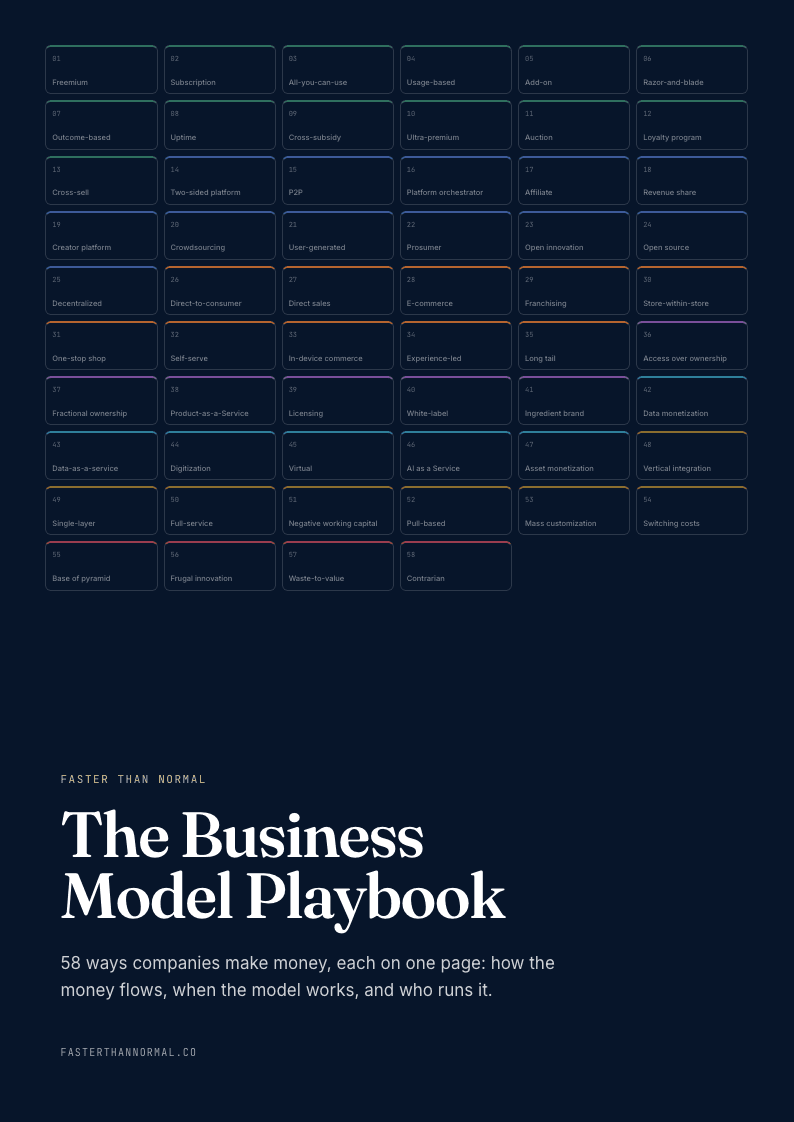
Free playbook
Get The Business Model Playbook
58 business models, one visual page each: how the money flows, the metrics that matter, and who runs it. Free when you join the Faster Than Normal email.
Free. No spam. Unsubscribe anytime.
Part IIIMaxims
-
Truth is a dangerous thing. Describing people and their actions "as they are in real truth, rather than as they are imagined" will always be more useful—and more threatening—than telling them what they want to hear.
-
Poverty can be proof of integrity. When a man who has held power for fourteen years leaves office with nothing, his empty pockets are a more eloquent testimony of character than any letter of recommendation.
-
The unarmed prophet will always fail. Conviction without capability is self-destruction. Savonarola had the vision; he lacked the means to defend it.
-
Character is destiny—and destiny is limitation. You cannot change your fundamental nature, so know it, account for it, and surround yourself with people whose natures compensate for your own.
-
The best fortress is the love of the people. No wall, no army, no treasury can substitute for the willing support of those you lead. Everything else is a temporary hedge.
-
Cruelty has a shelf life. Used once and converted into benefits, it can establish order. Prolonged, it breeds the hatred that guarantees your destruction.
-
Republics adapt; princes don't. The diversity of a collective body is not a weakness to be overcome but the mechanism by which institutions survive changing circumstances.
-
Write it down. Machiavelli told Vettori that Dante taught him it does not produce knowledge when we hear but do not remember. The act of writing is the act of converting experience into transferable intelligence.
-
The ends do not justify the means—they judge the means. Machiavelli distinguished between cruelty that leads to power and cruelty that leads to glory. Power without glory is a kingdom built on sand.
-
Love your city more than your soul. The highest form of commitment is the willingness to sacrifice not just your life but your moral comfort for the thing you serve—knowing that such a sacrifice may never be recognized or rewarded.
In Their Own Words
Everyone sees what you appear to be, few experience what you really are.— The Prince
If an injury has to be done to a man it should be so severe that his vengeance need not be feared.— The Prince
The first method for estimating the intelligence of a ruler is to look at the men he has around him.— The Prince
The lion cannot protect himself from traps, and the fox cannot defend himself from wolves. One must therefore be a fox to recognize traps, and a lion to frighten wolves.— The Prince
It is better to be feared than loved, if you cannot be both.
It is double pleasure to deceive the deceiver.
The wise man does at once what the fool does finally.
It is not titles that honor men, but men that honor titles.
One who deceives will always find those who allow themselves to be deceived.
Men ought either to be indulged or utterly destroyed, for if you merely offend them they take vengeance, but if you injure them greatly they are unable to retaliate, so that the injury done to a man ought to be such that vengeance cannot be feared.
Never was anything great achieved without danger.
Where the willingness is great, the difficulties cannot be great.
How one lives and how one ought to live are so far apart that he who spurns what is actually done for what ought to be done will achieve ruin rather than his own preservation.— Niccolò Machiavelli, The Prince, Chapter XV
She shows her power where virtù and wisdom do not prepare to resist her and directs her fury where she knows that no dykes or embankments are ready to hold her.— Niccolò Machiavelli, The Prince, Chapter XXV
It is not the particular good but the common good that makes cities great. And without doubt this common good is observed nowhere but in a republic.— Niccolò Machiavelli, Discourses on Livy, Book I
I feed on that food which only is mine and which I was born for, where I am not ashamed to speak with them and to ask them the reason for their actions; and they in their kindness answer me.— Niccolò Machiavelli, letter to Francesco Vettori, December 10, 1513
A people is more prudent, more stable, and of better judgment than a prince.— Niccolò Machiavelli, Discourses on Livy, Book I


