


Part IThe Story
The Mottled Finish
The breakthrough was an accident. Sometime in late 1994, in the basement of a rented townhouse near Annapolis, Maryland, Mei Xu was melting paraffin wax in recycled Campbell's Soup cans — the cream of mushroom variety, wide-mouthed, sturdy enough to serve as improvised pillar molds — when she forgot to add an ingredient. The specific additive has varied in retellings: a chemical agent meant to produce the smooth, satin finish that was standard across the American candle industry, the uniform glossy surface you'd find on any department store shelf from Yankee Candle to the no-name votives stacked in supermarket checkout aisles. She left it out. The wax cooled wrong, or rather, cooled in a way nobody intended. Instead of the expected polished surface, the candle emerged with a mottled, crystalline texture — something between marble and frost on glass, a pattern that looked deliberately artisanal, as if it had been designed by someone who understood that imperfection, presented with sufficient confidence, reads as sophistication.
Xu did not throw the candle away. She looked at it.
This is the foundational story of Chesapeake Bay Candle, and it carries the structural logic of the entire enterprise within it: a woman trained by the Chinese state to become a diplomat, rerouted by history into a dusty warehouse in Dalian, rerouted again by Tiananmen Square into an American graduate program, rerouted once more by a hiring freeze at the World Bank into a basement operation pouring wax into soup cans — and then, at the precise moment when she might have produced something ordinary, she made an error that became a signature. The mottled candle was not a product of vision. It was a product of omission. But the decision to recognize it as beautiful, to build a company around an accident rather than correcting it, was an act of entrepreneurial perception so acute it would, over the next twenty-three years, generate a brand sold in Target, Kohl's, Bloomingdale's, Bed Bath & Beyond, and Amazon, employing more than 1,400 people across three countries before Newell Brands acquired the whole thing in September 2017.
The candle — its texture, its accidental origin, its transformation from mistake into meaning — is also, if you're willing to read it that way, a precise metaphor for the life of the woman who made it.
By the Numbers
Chesapeake Bay Candle & Mei Xu
1994Year Chesapeake Bay Candle was founded
$90KOrders from first trade show at Charlotte Gift Fair
1,400+Employees worldwide at peak
$75MReported acquisition price by Newell Brands (2017)
100+U.S. manufacturing jobs reshored to Glen Burnie, MD (2011)
7Languages in which Daughter of China was published
50 Over 50Forbes recognition (2021)
Eighty Children, One Corridor
To understand how a woman ends up pouring candle wax into soup cans in a Maryland basement, you have to go back to 1979, to a selection process so improbable it reads like state-administered fiction.
China in 1979 was three years past the death of Mao Zedong, one year into the normalization of diplomatic relations with the United States, and roughly a decade into recovering from the psychic devastation of the Cultural Revolution — a period that had shuttered schools, sent intellectuals to labor camps, and produced an entire generation of young people whose educations had been replaced by ideological fervor and agricultural work. Deng Xiaoping's reform era was just beginning. The country needed diplomats who could speak English, understand the West, and represent a nation that was attempting, with considerable awkwardness, to re-enter the world. So the government went looking for children.
Out of more than 10,000 candidates across China, eighty were selected. Mei Xu, twelve years old, born in 1967 in Hangzhou — the capital of Zhejiang province, a city famous for its West Lake, its silk, its green tea, and, less romantically, for being one of the centers of radical Maoist politics during the Cultural Revolution — was one of them. She was sent to the Hangzhou Foreign Language School, an elite boarding institution where the curriculum was conducted almost entirely in English, using American textbooks. The history they learned was organized not by Chinese dynastic periods but by European, Asian, African, and Islamic civilizations. The reading list included Great Expectations, Shakespeare, Hemingway. Nothing, Xu later recalled, was censored.
This is a detail worth pausing on. A twelve-year-old girl in post-Mao China, selected by the state to serve the state, was handed Dickens and Hemingway — writers whose entire bodies of work are animated by individual will exerted against institutional constraint — and told to absorb them in preparation for representing the very institutions those writers spent their careers questioning. The Chinese government was building a diplomatic corps. It was also, inadvertently, building something else: a generation of young people who had been given the vocabulary of Western ambition and the analytical tools to apply it to their own circumstances. The education was instrumental. Its effects were not.
Xu continued from the Hangzhou school to Beijing Foreign Studies University, the pipeline school for China's foreign service. She was fluent in English, poised, deeply conversant with American culture and history. She was, by every metric the state applied, precisely the kind of diplomat it had spent a decade training.
Then came June 4, 1989.
The Warehouse and the Clipboard
The Tiananmen Square massacre did not happen to Mei Xu in the way it happened to the students who were there — the ones who built the Goddess of Democracy out of Styrofoam and plaster, who faced down tank columns on Chang'an Avenue, who died or didn't die depending on which account you believe and which government's numbers you accept. What happened to Xu was subtler, slower, and in its own way more complete: the massacre didn't kill her career. It erased it.
All graduating students in Beijing that summer — the class of 1989, an entire cohort — were dispatched to far-flung assignments for "re-education." This was not punishment in the dramatic sense; it was something more suffocating. It was the state reasserting control over the trajectory of lives it had invested in, reminding a generation that their talents belonged not to them but to the apparatus that had cultivated those talents. Xu was sent to Dalian, a coastal city in northeast China, to a warehouse operated by a minerals exporter. Her job was to stand with a clipboard and place a check mark every time a truck arrived to pick up a load.
"It was very boring," she would later say, a sentence whose flatness contains more than it appears to. This was a woman who had been reading Hemingway in English at twelve, who had spent nearly a decade preparing to represent China on the world stage, now standing in a dusty warehouse tallying trucks. The boredom was not incidental. It was the point. The re-education was not ideological indoctrination — it was the systematic destruction of purpose.
Xu lasted a year. Then she quit.
The decision to leave was not merely bold; it was structurally irreversible. In China's state-controlled employment system of the early 1990s, quitting an assigned post meant exiting the system entirely. There was no lateral move, no appeal, no reassignment. You were out. And because the state had funded her decade of elite education, Xu was now both unemployed and encumbered with the implicit debt of that investment — a debt that could never be formally repaid because it had never been formally calculated, which made it worse, not better. She was a trained diplomat with no country willing to deploy her, an English-language prodigy in a nation that had just decided English-language prodigies were a liability.
She took the Graduate Record Examination. She sent her scores and applications to journalism schools in the United States. She was accepted at the University of Maryland. She left.
Bloomingdale's and the Gap in the Market
The next few years moved quickly, as they tend to for immigrants whose velocity is a function of having nothing to go back to.
Xu arrived in the United States around 1991 with her husband, David Wang — an engineer and, like Xu, a product of China's elite educational system who had made his own calculation about the diminishing returns of remaining. She enrolled at the University of Maryland, College Park, and earned a master's degree in 1993. She interned at the World Bank. She applied for a permanent position there. A hiring freeze shut that door. She moved to New York and took a job at a company that exported medical equipment to China — the export industry, which had defined her miserable year in Dalian, had circled back, this time from the other side of the Pacific.
Then one afternoon, she walked into Bloomingdale's.
The store is worth contextualizing. For an immigrant from a country that had only recently begun to participate in consumer culture — a country where, within living memory, private enterprise had been ideologically criminal — an American department store in the early 1990s was not merely a retail environment. It was an argument about abundance, about the possibility that an entire economy could be organized around the premise that people deserved beautiful things and would pay for them. Xu was not shopping so much as conducting fieldwork.
What she noticed was a gap. The ready-to-wear apparel sections were lush with sophisticated, contemporary design. The home décor sections were not. There was a scarcity of modern, well-designed housewares — the kind of objects that treated the domestic environment with the same aesthetic seriousness that fashion designers applied to clothing. The candle aisle, in particular, was a wasteland of generic pillars and uninspired scented votives. No one was treating candles as design objects.
Xu returned to Maryland, where she and David had settled near Annapolis — near the Chesapeake Bay, a detail that would eventually supply a name. She began researching the candle industry. What she found was a market dominated by a few large incumbents — Yankee Candle chief among them, founded in 1969 by Michael Kittredge, who had poured his first candle as a birthday gift for his mother using a melted crayon and a milk carton — producing traditional, nostalgia-driven products in a narrow aesthetic register. The industry was large, profitable, and aesthetically stagnant.
In early 1994, Mei Xu and David Wang both quit their jobs.
Soup Cans and the Charlotte Gift Fair
The founding mythology of Chesapeake Bay Candle is almost absurdly humble, which is part of its power.
They started in their basement. The molds were Campbell's Soup cans. The wax was paraffin, purchased wholesale. The fragrances were nature-inspired — bayberry, seaside, pine — drawing on the Chesapeake Bay landscape outside their windows. The aesthetic sensibility Xu brought was neither American nor traditionally Chinese; it was something more diffuse, the product of a woman who had been trained to see across cultures, who had absorbed Western design language through Hemingway and Dickens and Bloomingdale's, and who applied it with the rigor of someone who had been trained to analyze civilizations for a living.
The mottled-finish accident happened sometime in this early period. It became the brand's calling card — a visual texture that signaled handcrafted quality without requiring the labor costs of actual hand-pouring at scale. It was reproducible. It was distinctive. It was, crucially, protectable: nobody else was making candles that looked like that, because nobody else had made the same mistake and recognized it as an asset.
Before they had a factory, before they had employees, before they had a single retail account, Xu and Wang took their candles to the Charlotte Gift Fair in North Carolina. Gift fairs are the unglamorous engine rooms of the American consumer-products industry — cavernous convention halls where thousands of small manufacturers display their wares for buyers from department stores, gift shops, and retail chains. You rent a booth. You stack your product. You pitch.
They came home with more than $90,000 in orders and a customer list that would put their candles in approximately one hundred retail doors by the end of 1994.
Ninety thousand dollars. In the mythology of American entrepreneurship, this is the moment the garage becomes a company. But it is also, if you're paying attention, the moment where the story shifts from biography to business strategy. Having orders is not the same as having the infrastructure to fulfill them. Xu and Wang had to figure out manufacturing — how to produce thousands of candles consistently, at a quality that matched their samples, at a cost that allowed them to sell at wholesale prices and still survive. This was not a problem that could be solved in a basement with soup cans.
The Architecture of a Supply Chain
What Mei Xu built over the next two decades was not, in the end, a candle company. It was a supply-chain architecture that happened to produce candles.
The company — formally Pacific Trade International, Inc., doing business as Chesapeake Bay Candle — grew along two axes simultaneously. The first was product: Xu expanded from the original mottled pillars into an ever-wider range of candles, home fragrances, and décor products, each designed with the same clean, modern, nature-inspired aesthetic that had distinguished the brand from its competitors. The second axis was manufacturing: Xu established production facilities in China and Vietnam, leveraging her fluency in Mandarin, her understanding of Asian business culture, and her family and professional networks to build relationships with suppliers and factories that American competitors couldn't easily replicate.
This is the structural advantage that rarely appears in the inspirational version of the story. Xu was not merely an immigrant who made candles. She was a bilingual, bicultural operator who could sit in a meeting with a factory manager in Guangdong province and negotiate in his language, understand his constraints, and structure deals that aligned his incentives with hers — and then fly back to the United States and walk into a buyer's office at Target with a product that looked like it belonged at Bloomingdale's but was priced for mass retail. She was the bridge. The company existed in the gap between Chinese manufacturing capability and American consumer aspiration, and Xu was the only person who could see both sides clearly because she had lived on both.
— Mei Xu, Asia Times interview, 2017I was sent to a warehouse of a minerals exporter in Dalian and my job was to put a check mark on a clipboard when a truck came to pick up a load. It was very boring.
The retail expansion was methodical. Target became the anchor account — a relationship that provided volume, credibility, and the kind of shelf placement that turns a niche brand into a household name. Kohl's followed. TJX Companies. Bed Bath & Beyond. Amazon. Bloomingdale's, the store that had catalyzed the original insight, eventually stocked Chesapeake Bay Candle in its home section, completing a loop that Xu must have found satisfying in its symmetry: the woman who had gazed at the housewares section as an immigrant outsider now had her products displayed there.
By the mid-2010s, Chesapeake Bay Candle was one of the leading candle brands in the United States, with more than 1,400 employees worldwide and a product line sold in thousands of retail locations. The brand's "Mind & Body" collection — candles and home fragrances positioned explicitly around wellness, calm, and sensory well-being — helped pioneer a category that would explode during the pandemic years, when millions of Americans confined to their homes discovered that a candle was not merely decorative but therapeutic, a small technology for the management of interior atmosphere.
Glen Burnie
In 2011, Xu did something that ran against the prevailing logic of American consumer-products manufacturing. She opened a factory in Glen Burnie, Maryland.
This was not a symbolic gesture. By 2011, the economics of candle manufacturing overwhelmingly favored offshore production — the labor costs, the raw material proximity, the regulatory flexibility of Chinese and Vietnamese facilities made domestic production look, on a spreadsheet, like an act of charity. Every incentive in the global supply chain pointed away from Maryland and toward Shenzhen. Xu had those offshore facilities. They worked. They were profitable.
She built the factory anyway. It created more than one hundred American manufacturing jobs — jobs with benefits, jobs in a community that had been losing manufacturing employment for decades. In 2012, she was invited to the White House to participate in President Obama's "Insourcing American Jobs" forum, a panel discussion about reshoring that was, frankly, more useful as politics than as policy but that nevertheless placed Xu in a specific narrative: the immigrant entrepreneur who creates American jobs, who gives back to the country that gave her a second chance.
The narrative was real. It was also incomplete. Xu understood something more sophisticated about the economics of domestic manufacturing than the reshoring rhetoric suggested: having a U.S. factory was not merely philanthropic. It was strategic. It reduced shipping times for domestic orders. It provided a hedge against supply-chain disruptions (a hedge whose value would become spectacularly apparent during the COVID-19 pandemic, though that was years away). It gave the brand a "Made in America" story that retailers could use in their own marketing. And it gave Xu herself a visible, tangible answer to the question that every immigrant entrepreneur in a politically complicated industry eventually faces: Where do your loyalties lie?
The factory in Glen Burnie was, among other things, an argument.
The Second Book
There is another Mei Xu, or rather, the same Mei Xu refracted through a different medium.
In 1998, Xu published Daughter of China: A True Story of Love and Betrayal, a memoir that told a story dramatically different from the one that would later define her public persona as a candle entrepreneur. The book described a young woman — Meihong Xu, the author's full name — who had grown up during the Cultural Revolution, been inducted into the People's Liberation Army at seventeen, and became a member of the elite intelligence corps, where she was assigned to spy on a visiting American professor who had drawn the suspicion of Chinese authorities. As she got to know the professor, her loyalties divided. When her friendship was discovered, she was arrested, interrogated, and imprisoned. The book was published in seven languages and became an international bestseller. CNN, NBC, BBC, VOA, NPR — the media apparatus of the Western world lined up to tell the story of a former Chinese intelligence operative who had chosen conscience over country and escaped to America.
The timeline here is striking. Daughter of China was published in 1998, four years after Chesapeake Bay Candle was founded. Xu was simultaneously building a candle company and publishing an internationally bestselling memoir about espionage, loyalty, and political imprisonment. These two activities existed in entirely separate registers — one domestic, aesthetic, commercial; the other geopolitical, literary, traumatic — and yet they were being conducted by the same person, at the same time, from the same house near the Chesapeake Bay.
The second memoir, Burn: How Grit, Innovation, and a Dash of Luck Ignited a Multi-Million Dollar Success Story, arrived in 2021 and told the entrepreneurial version — the soup cans, the trade fairs, the Target account, the sale to Newell. The title itself, Burn, is doing double work: the candle that burns, obviously, but also the verb that describes what it costs to build something from nothing, the way ambition consumes its fuel.
Between the two books, you can see the full architecture of a life that refuses to be reduced to a single narrative. Xu is not just the inspiring immigrant entrepreneur. She is not just the former intelligence operative. She is not just the woman who built a factory in Glen Burnie. She is all of these, simultaneously, and the tension between them — between the geopolitical and the domestic, the traumatic and the commercial, the past she escaped and the future she built — is the thing that makes the story worth telling.
The Sale
In September 2017, Newell Brands acquired Chesapeake Bay Candle.
Newell was, at that moment, a $14 billion consumer-products conglomerate whose portfolio included Rubbermaid, Sharpie, Elmer's Glue, Crock-Pot, and a constellation of other brands that had achieved the peculiar American status of being so ubiquitous they had become invisible — products that existed in every household without anyone remembering how they got there. The reported acquisition price was approximately $75 million, a figure that, depending on how you think about these things, either validates the extraordinary journey from soup cans to global brand or undervalues a company with 1,400 employees and shelf space in every major American retailer.
Xu stayed on as CEO through 2018, managing the integration, then stepped away. The sale was clean, profitable, and, by the standards of founder exits, unremarkable — which is itself remarkable, given that the founder had arrived in the United States with functionally nothing, no capital, no network, no industry experience, no safety net.
What Xu did next was characteristically multidirectional. She launched Blissliving Home, a premium lifestyle brand for globally inspired home textiles sold through Nordstrom, Bloomingdale's, and Neiman Marcus — a brand that operated in a completely different product category but applied the same underlying insight: that there was an underserved market for home products that combined multicultural design sensibility with modern aesthetic standards. Blissliving Home was founded in 2007, a decade before the Newell sale, and transitioned into a licensing business in 2014, suggesting that Xu had been building parallel enterprises for years, hedging against the possibility that any single venture might not survive.
— Mei Xu, on her Bloomingdale's epiphanyI noticed the abundance of sophisticated, contemporary ready-to-wear apparel compared to the scarcity of modern, home décor offerings.
She founded Yes She May, an e-commerce platform dedicated to women-owned businesses, during the pandemic in 2020 — a venture that combined her entrepreneurial instincts with a genuine commitment to supporting other women founders. The platform curated products from women-owned brands across five continents and twelve countries, limiting onboarding to four brands per month to ensure each received meaningful marketing support. She launched meixu.com, an online community and marketplace for women entrepreneurs. She started Concord Fragrances, creator of a wellness fragrance brand called Blueme, redefining scent — the raw material of her entire career — as a tool for mental and physical well-being.
The pattern is visible: Xu does not retire. She does not rest. She pivots, launches, builds, iterates. Each new venture carries the DNA of the last but applies it in a different direction. The restlessness is not random; it is structural. It is the restlessness of someone who learned, at age twenty-two, standing in a warehouse in Dalian with a clipboard, that any single path can be closed at any time by forces entirely outside your control. The only hedge against that kind of risk is to have multiple paths open simultaneously.
The White House Candle
In 2009, First Lady Michelle Obama invited Mei Xu to collaborate on a candle design for the White House. The details of the collaboration are sparse in the public record — what fragrance, what occasion, what room — but the symbolism is not. A woman who had been imprisoned by one government for befriending an American was now being invited by the American government to design an object for its most iconic residence.
This is the kind of detail that, in a lesser profile, would be deployed for inspirational effect — the arc from oppression to honor, the American Dream validated, the immigrant story crowned with presidential imprimatur. And it is all of those things. But it is also something more specific and more interesting: it is an act of aesthetic diplomacy. The candle is a designed object. Its fragrance is a form of atmosphere. In placing it in the White House, Xu was not merely being honored; she was doing what she had originally been trained to do — representing a cultural sensibility across a diplomatic divide — just not for the government that had trained her.
Xu has been recognized by Politico as a Woman of Impact in 2019. Forbes named her to its 50 Over 50 list in 2021. She serves on the boards of the University of Maryland, Children's National Hospital Foundation, and Sandy Spring Bancorp. She has spoken at Wharton, Georgetown, Tsinghua University in Beijing. She has been a delegate at the Fortune Most Powerful Women Summit and a mentor in the U.S. State Department's Global Women's Mentoring Partnership.
The accumulation of these recognitions is significant not for what each individually means but for what they collectively reveal: Xu has built a public identity that bridges the very divide she was originally trained to bridge, just from the other side. She is a Chinese American entrepreneur who speaks at both American and Chinese universities, who serves on both financial and philanthropic boards, who designs products that draw on both Eastern and Western aesthetic traditions. She has become, in effect, the diplomat her government intended — just not the government, and not the diplomacy, anyone anticipated.
The Texture of Accident
There is a photograph — widely circulated in profiles and interviews — of a Chesapeake Bay Candle pillar with the original mottled finish. It looks, in the way that all good design looks, simultaneously natural and intentional. The crystalline patterns in the wax seem to suggest something organic, something that emerged from the material's own properties rather than from human intervention. You would never guess, looking at it, that it was the product of a mistake. That's the point.
Mei Xu's life has the same quality. The transitions — from Hangzhou diplomat-in-training to Beijing intelligence operative to Dalian warehouse worker to Maryland graduate student to New York medical-equipment exporter to basement candle maker to CEO of a brand sold in every major American retailer to White House collaborator to venture founder — look, in retrospect, like a designed trajectory. Each phase seems to lead logically to the next. But anyone who has actually lived through history, who has stood at a checkpoint or a hiring freeze or a trade fair or a moment of forgetfulness with a wax mold, knows that the logic is applied afterward. In the moment, it is just the next thing you do because the last thing closed behind you.
What distinguishes Xu is not the trajectory itself — immigrant success stories, while each unique in their details, are structurally common in America — but her capacity to recognize value in the unexpected. The mottled finish. The Bloomingdale's gap. The Glen Burnie factory. The pandemic e-commerce platform. In each case, she saw something that others either overlooked or discarded and built around it. This is not optimism, exactly, though she has that. It is a form of perception trained by disruption: when your life has been rerouted enough times, you develop a sensitivity to the detours themselves, a habit of looking at wrong turns for the right direction hidden inside them.
The candle burns. The wax pools. The texture holds.
Part IIThe Playbook
Mei Xu's career, from twelve-year-old diplomatic trainee to multi-brand consumer-products entrepreneur, encodes a set of operational and strategic principles that are more useful — and less obvious — than the standard immigrant-founder narrative suggests. What follows is an attempt to extract those principles, grounded in the specific decisions that defined her trajectory.
The principles
- 1.Let the accident become the signature.
- 2.Bridge two worlds — and own the gap.
- 3.Find the category that design forgot.
- 4.Build the supply chain before you build the brand.
- 5.Use trade shows as market research, not just sales channels.
- 6.Reshore strategically, not sentimentally.
- 7.Build parallel ventures as a hedge against fragility.
- 8.Treat exits as beginnings.
- 9.Convert personal narrative into brand architecture.
- 10.Let irreversible decisions accelerate you.
- 11.Design for the gap between aspiration and price.
- 12.Stay a student of displacement.
Principle 1
Let the accident become the signature
The mottled candle finish was not the result of R&D or consumer testing. It was the result of a mistake — a forgotten ingredient, a batch that should have been discarded. Xu's insight was not in making the error but in recognizing that the error produced something more interesting than the intended outcome. The smooth satin finish was what everyone else was making. The mottled texture was what no one else could replicate.
This principle operates at a deeper level than "embrace failure." It is about developing the perceptual acuity to distinguish between errors that destroy value and errors that create it — and having the nerve to build a brand around the latter. Most companies, confronted with an off-spec product, would reformulate and try again. Xu saw that the "defect" was actually a differentiator — one that communicated handcrafted quality, visual distinctiveness, and artisanal credibility. She made the mistake reproducible and turned it into intellectual property.
Tactic: When a process produces an unexpected outcome, interrogate whether the outcome is actually more valuable than what you intended — before you correct it.
Principle 2
Bridge two worlds — and own the gap
Xu's most durable competitive advantage was not her product design or her retail relationships. It was her position as someone who could operate fluently in both Chinese manufacturing culture and American consumer culture — negotiating factory contracts in Mandarin and pitching retail buyers in English, understanding both the cost structures of Guangdong and the aesthetic expectations of Target's merchandising team.
This bicultural fluency was not incidental to her success. It was the business model. Pacific Trade International existed in the arbitrage space between Chinese manufacturing capability and American consumer aspiration. Xu was the only person who could see both sides of that gap clearly — because she had lived on both sides, because she spoke both languages, because she understood both sets of incentives. Competitors who tried to replicate her supply chain from the American side couldn't navigate the cultural complexity. Competitors on the Chinese side couldn't read the American market.
🌏
The Bicultural Advantage
How Xu's position between two economies created structural competitive advantage.
| Capability | American-only competitor | Xu's position |
|---|---|---|
| Factory negotiation in China | Relies on intermediaries | Direct relationship, native fluency |
| American retail buyer meetings | Home-court advantage | Fluent, culturally calibrated |
| Design sensibility | Single-culture reference frame | Cross-cultural synthesis |
| Supply chain disruption response | Remote, slow | On-the-ground knowledge, dual facilities |
Tactic: Identify the gap between two worlds you inhabit — cultural, technical, geographic — and position your company in that gap rather than choosing one side.
Principle 3
Find the category that design forgot
Xu's Bloomingdale's epiphany was not about candles specifically. It was about noticing that an entire product category — home décor — had been left behind by the design revolution that had already transformed fashion, electronics, and food. The ready-to-wear sections were sophisticated and contemporary. The home sections were stale. Nobody was treating candles as design objects.
This insight — that there are always product categories operating below their aesthetic potential, waiting for someone to apply design thinking — is the foundation of every successful consumer-products disruption from Method soap to Dyson vacuums to Casper mattresses. The specific genius was in identifying which category to enter. Candles had several structural advantages: low manufacturing complexity, high margins, emotional resonance, repeat purchase behavior, and a fragmented competitive landscape dominated by incumbents (Yankee Candle, primarily) who had defined the category around nostalgia rather than modernity.
Tactic: Walk through any department store with fresh eyes and ask: Which section looks like it hasn't been redesigned in twenty years? That's your opportunity.
Principle 4
Build the supply chain before you build the brand
Pacific Trade International was incorporated before Chesapeake Bay Candle was a brand. The company's original business, before the Charlotte Gift Fair, involved importing a variety of home products from China, using Xu's and Wang's networks there. The candle brand emerged from this broader import operation — one product among many that happened to outperform at its first trade show.
This sequence matters. Xu did not start with a brand concept and then scramble to find manufacturing. She started with manufacturing capability — relationships with Chinese suppliers, an understanding of import logistics, the ability to move product across the Pacific — and then let the market tell her which product to build the brand around. The supply chain came first. The brand was an expression of what the supply chain could deliver.
Tactic: Before investing in brand building, secure your manufacturing and supply-chain infrastructure. Let operational capability, not marketing aspiration, determine what you bring to market.
Principle 5
Use trade shows as market research, not just sales channels
The Charlotte Gift Fair was where Chesapeake Bay Candle found its market — $90,000 in orders from a single exhibition. But trade shows served a deeper function throughout the company's growth: they were real-time experiments. Xu could observe which products buyers gravitated toward, which fragrances generated conversation, which designs prompted reorders. The trade show floor was a laboratory with immediate feedback loops, and every fair produced data that informed the next product cycle.
This is a principle that scales beyond trade shows. Any context where you can put an unfinished product in front of a potential buyer and observe their reaction — a pop-up shop, a prototype demo, a beta test — serves the same function. The key is treating these interactions as research, not merely as revenue opportunities.
Tactic: Put your product in front of buyers earlier than you're comfortable with, and watch their hands, not just their words.
Principle 6
Reshore strategically, not sentimentally
The Glen Burnie factory, opened in 2011, looks like a patriotic gesture — and Xu was happy to let it be read that way, accepting the White House invitation and the media attention that followed. But the decision had hard strategic logic behind it. Domestic manufacturing reduced shipping lead times for American retail orders. It provided a buffer against supply-chain disruptions originating in Asia. It gave the brand a "Made in America" narrative that retailers could use in their own marketing to consumers who were increasingly sensitive to origin stories. And it created political goodwill that insulated the company — a Chinese-founded import operation — from the rising protectionist sentiment that would intensify throughout the 2010s.
The lesson is not "reshore your manufacturing." The lesson is that reshoring, done for the right structural reasons, can simultaneously serve operational, marketing, political, and risk-management objectives. The factory was not charity. It was a multi-dimensional strategic asset wrapped in a patriotic narrative.
Tactic: When making a major operational decision, evaluate it against at least four dimensions — operational efficiency, marketing story, political positioning, and risk mitigation — not just one.
Principle 7
Build parallel ventures as a hedge against fragility
Xu launched Blissliving Home in 2007, a full decade before the Newell sale. This means she was building a second brand — in a different product category, through different retail channels — while still running Chesapeake Bay Candle at scale. After the sale, she launched Yes She May, Concord Fragrances, and meixu.com. The pattern is consistent: multiple ventures, operating simultaneously, each in a different market segment.
This is not the Silicon Valley model of total focus on a single venture. It is the immigrant operator's model of diversification against catastrophic loss — a model informed by the lived experience of having your career erased overnight by political forces you cannot control. When you have been sent to a warehouse in Dalian because of decisions made by strangers in Beijing, you develop an instinct for never putting all of your identity, income, or purpose in a single container.
Tactic: Once a venture reaches operational stability, begin building the next one — not as a distraction but as a structural hedge against the fragility of any single enterprise.
Principle 8
Treat exits as beginnings
Xu sold Chesapeake Bay Candle to Newell Brands in September 2017 and stayed through 2018 to manage the integration. Many founders who sell their companies experience a period of identity crisis — the loss of the thing they built, the adjustment to someone else's organizational culture, the existential question of what to do next. Xu appears to have experienced no such crisis. She had already launched multiple ventures before the sale and launched several more afterward.
The exit was not an endpoint. It was a liquidity event that freed capital and attention for the next set of projects. This framing — the sale as beginning rather than conclusion — is only possible if you have been building your next venture while still running your current one, and if your identity is rooted in the act of building rather than in any single thing you've built.
Tactic: Begin planning your post-exit ventures before the exit happens. Your identity should be in the practice of entrepreneurship, not in any single company.
Principle 9
Convert personal narrative into brand architecture
Xu's personal story — the diplomatic training, the Tiananmen disruption, the immigration, the basement candle-making, the mottled-finish accident — was not merely backstory. It was deployed, strategically and repeatedly, as the brand's origin narrative. The NPR How I Built This episode. The Forbes profiles. The White House panel. The speaking engagements at Wharton, Georgetown, and Tsinghua. Each telling of the story reinforced the brand's positioning: authentic, globally inspired, design-driven, resilient.
This is not the same as "building a personal brand." Xu was not promoting herself as a personality; she was using her biography to answer the question every consumer implicitly asks when they encounter a product: Why should I care? The answer — because this candle was created by a woman who crossed continents and survived political imprisonment to bring design-driven beauty to your home — is more compelling than any tagline a marketing agency could invent.
Tactic: Identify the elements of your personal biography that authentically support your brand's positioning, and systematically deploy them in every media opportunity.
Principle 10
Let irreversible decisions accelerate you
When Xu quit her assigned post in Dalian, she made an irreversible decision: she could never re-enter the state-controlled employment system. When she left China for the United States, the decision was similarly one-directional, at least in its practical consequences. When she and David Wang both quit their jobs in 1994 to start Pacific Trade International, they burned yet another set of bridges.
Each of these decisions eliminated fallback options. Each also eliminated the friction of ambivalence — the energy wasted on keeping alternatives open, the psychological drag of always having a safe option to retreat to. Xu's career has been characterized by a willingness to make decisions that are structurally irreversible, and then channel the urgency that irreversibility creates into forward motion.
Tactic: When facing a major decision, ask whether keeping your options open is actually costing you more in distraction and ambivalence than committing fully would cost in flexibility.
Principle 11
Design for the gap between aspiration and price
Chesapeake Bay Candle's genius was not in being the most expensive candle or the cheapest. It was in occupying the space between Bloomingdale's and Walmart — products that looked like they belonged in an upscale department store but were priced for the Target shopper. This positioning required design discipline (the products had to genuinely look premium) and manufacturing discipline (the cost structure had to support mass-market pricing).
The gap between aspiration and price is one of the most consistently underserved spaces in consumer products. Consumers want to feel like they're buying something special without paying a luxury premium. Brands that can deliver that feeling — through design, texture, packaging, and narrative — at a mass-market price point capture enormous market share.
Tactic: Study the premium end of your product category, identify its aesthetic signals, then figure out how to replicate those signals at a price point one or two tiers below.
Principle 12
Stay a student of displacement
Xu's most recent ventures — Yes She May, Concord Fragrances, Blueme — are not retreads of Chesapeake Bay Candle. They apply the same underlying sensibility (design-driven, globally inspired, wellness-oriented) but in new directions: e-commerce platforms for women founders, wellness fragrances positioned as mental-health tools. Each venture reflects a new displacement — from physical retail to digital, from candles to broader wellness, from individual entrepreneurship to platform-building for other entrepreneurs.
The willingness to keep being displaced — to keep entering unfamiliar territory, keep being the beginner, keep building from scratch — is itself a skill, and it is one that Xu has been practicing since she was twelve years old, standing in a classroom in Hangzhou reading Hemingway in a language that was not her own.
Tactic: Seek out the next displacement before it finds you. The skills that come from starting over — adaptability, perception, urgency — are more valuable than the comfort of expertise in a single domain.
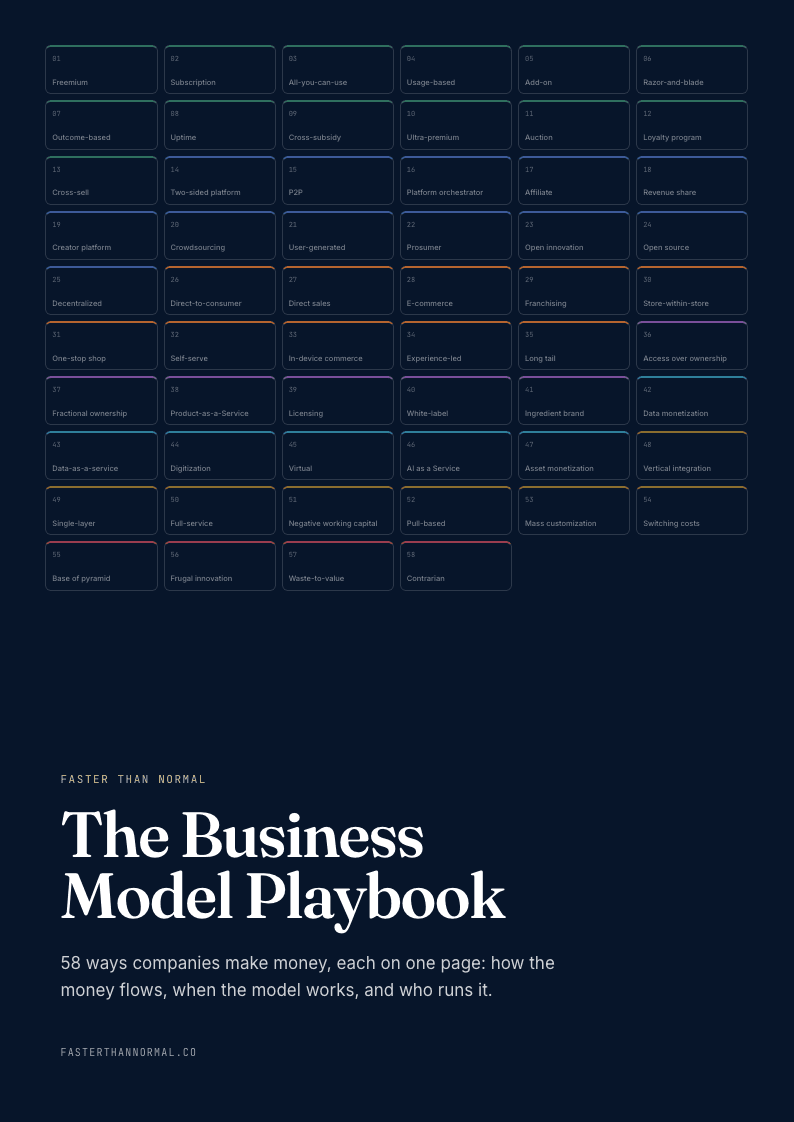
Free playbook
Get The Business Model Playbook
58 business models, one visual page each: how the money flows, the metrics that matter, and who runs it. Free when you join the Faster Than Normal email.
Free. No spam. Unsubscribe anytime.
Part IIIMaxims
-
The mistake is the message. The mottled candle finish was an accident. Xu's insight was recognizing that the accident was more valuable than the intention — a principle applicable to any creative or entrepreneurial process where unexpected outcomes are routinely discarded.
-
Displacement is a skill, not a setback. Being rerouted — by governments, by markets, by hiring freezes — taught Xu to treat disruption as information about where the next opportunity lives, not as evidence that the current plan has failed.
-
Supply chains are strategies, not logistics. The operational architecture of Pacific Trade International — Chinese manufacturing, American design, dual-country production — was not a support function for the brand. It was the brand's structural competitive advantage.
-
Every bridge you've crossed is a bridge you can build on. Xu's bicultural fluency was the product of a childhood spent between Chinese and Western education. That fluency became the foundation of every business she built.
-
The gap in the department store is the gap in the market. Xu's Bloomingdale's epiphany — that home décor lagged behind fashion in design sophistication — was not a unique observation. It was uniquely acted upon. Observation without action is tourism.
-
Reshore for strategy, not for sentiment. The Glen Burnie factory served operational, political, narrative, and risk-management objectives simultaneously. Never make a major operational decision that serves only one purpose.
-
Parallel ventures are not distractions — they are hedges. Building multiple businesses simultaneously is not a sign of unfocused ambition. It is a rational response to the demonstrated fragility of any single enterprise.
-
Irreversibility creates momentum. Burning your bridges eliminates the energy drain of maintaining fallback options. Xu's most consequential decisions — quitting Dalian, leaving China, starting the company — were all one-way doors.
-
Your biography is your brand's best asset. Xu's personal story — the political disruption, the immigration, the basement startup — was not backstory. It was the most effective marketing tool Chesapeake Bay Candle ever had, deployed across NPR, Forbes, the White House, and every speaking engagement for two decades.
-
Design for the space between aspiration and price. The mass market wants to feel like it's buying something premium. Brands that can deliver that feeling — through texture, packaging, fragrance, and narrative — at an accessible price point win disproportionately.
In Their Own Words
You can learn a lot while you are building your business, don't wait until after you get a Ph.D.— Interview series, 2023
The path to lasting success often starts with a leap of faith.— Interview, 2023
I wanted to create the beauty that I didn't see.— Interview, 2023
Candles have the power to evoke emotions, transform spaces, and provide a sense of home.— Interview, 2023
I recognized an opportunity to create something that merged my personal passions with my newfound independence.— Interview, 2023
I did something bold: I resigned.— Interview, 2023
With my success, I'm committed to helping other women find their own paths to success.— Interview, 2023
I believe in the power of community and collaboration among women entrepreneurs.— Interview, 2023
I spotted a trend, believing that this product category contained the highest innovation potential.— Interview, 2023
I wanted to bring fragrance-infused candles into the health and wellness space.— Interview, 2023
My journey is about creating something beautiful that reflects my culture and vision.— Interview, 2023
With my success, I'm committed to helping other women, particularly immigrants like myself, find their own paths to success.— Interview, 2023
We thought about it, and we didn't have children or a mortgage. So, we just said, 'OK, let's do it!— Interview, 2023
I believe that innovation is about infusing a founder's spirit into conglomerates, universities, and hospitals.
I want to inspire others to embrace their unique journeys and create their own definitions of success.
It was a very difficult period of time. I knew I would never be admitted back into the system again.— Mei Xu, on being sent to Dalian after Tiananmen
We used American textbooks, so the history we learnt was divided into European, Asian, African and Islamic.— Mei Xu, on her diplomatic education in Hangzhou
We're on a mission to elevate women's business by showcasing innovative, well-designed products made by women-owned brands from around the world.— Mei Xu, on the founding of Yes She May


