
Natural Sciences
Section 1
The Core Idea
Some changes cannot be undone. Irreversibility is the property that certain processes run one way: time, entropy, and many decisions move forward only. You can't unburn fuel, unbreak trust, or unlaunch a product that has gone public. Physics gives the clearest case: the second law of thermodynamics says entropy in a closed system does not decrease. You can localise order by expending energy elsewhere, but the global arrow of time points one way. In human affairs, irreversibility is everywhere: reputation damage, regulatory sanctions, key-person dependency, and commitments that are costly to exit.
The strategic implication is that reversible and irreversible decisions should be treated differently. Reversible decisions (try a feature, test a price) can be made fast and corrected by feedback. Irreversible decisions (major partnership, acquisition, firing a key person, going public) deserve more time, more options left open, and explicit consideration of what cannot be undone. Jeff Bezos's "one-way door / two-way door" frame is exactly this: one-way doors need senior judgment and care; two-way doors should be delegated and reversed quickly if wrong.
The mistake is treating big, irreversible moves like small, reversible ones — or the reverse, treating every choice as irreversible and stalling. The discipline is to classify before deciding. What can we undo? What can we not? For the irreversible, invest in information, scenario planning, and margin of safety. For the reversible, bias toward action and learning.
Free playbook
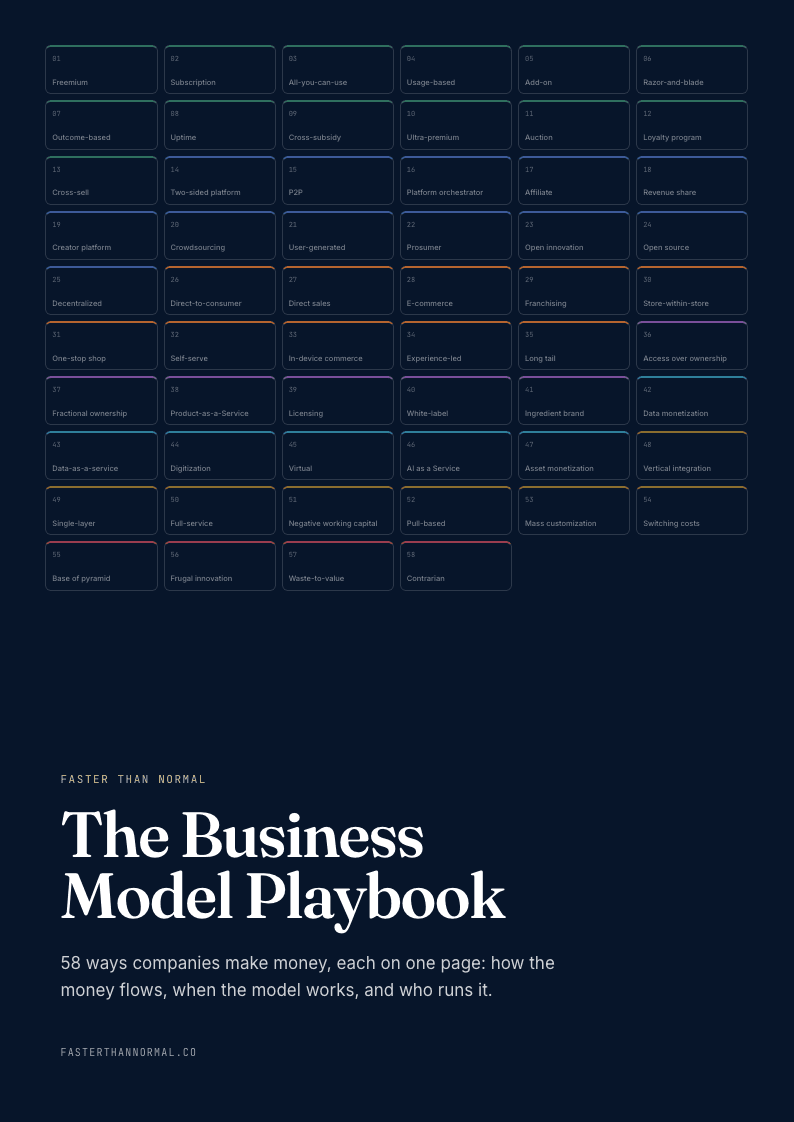
Get The Business Model Playbook
58 business models, one visual page each: how the money flows, the metrics that matter, and who runs it. Free when you join the Faster Than Normal email.
Free. No spam. Unsubscribe anytime.
Section 2
How to See It
Irreversibility shows up when you hear "we can't take that back," "there's no undo," or "that will always be on the record." Sunk costs, reputational damage, legal commitments, and technical debt that is too expensive to reverse are all examples. Look for asymmetry: easy to do, hard or impossible to undo.
Business
You're seeing Irreversibility when a company signs a long-term lease or a multi-year contract. The commitment is hard to exit without penalty. Hiring a senior executive, acquiring a company, or going public are similarly irreversible in practice — you can reverse them only at high cost and with lasting effects. The decision process should reflect that.
Technology
You're seeing Irreversibility when a team ships a public API or a data format that others depend on. Changing or removing it breaks clients; the decision is effectively one-way. Same with architecture choices that would require a full rewrite to change. Technical debt becomes irreversible when the cost of paying it down exceeds the benefit.
Investing
You're seeing Irreversibility when an investor takes a board seat or signs a side letter that commits to future behaviour. Selling a position is reversible; the relationship and reputational effects of how you behaved are not. Concentrated bets can be irreversible if the position is too large to exit without moving the market.
Markets
You're seeing Irreversibility when a regulator issues a fine, a product recall is announced, or a brand crisis goes viral. The event is on the record. Markets and customers may forgive, but the past doesn't disappear. Reputation and trust are hard to restore once broken — classic irreversibility.
Section 3
How to Use It
Decision filter
"Before a major decision, ask: is this reversible? If not, slow down. Get more information. Consider downside scenarios. Preserve option value where you can. If it is reversible, speed up and learn by doing."
As a founder
Separate one-way and two-way doors. Delegate and accelerate two-way doors (experiments, iterations, reversible hires). Reserve one-way doors (equity structure, key partnerships, regulatory commitments, public statements that define the brand) for careful process and senior judgment. The mistake is treating a one-way door like a two-way door and rushing. The second mistake is treating every decision as one-way and creating bottleneck and delay.
As an investor
Assess which decisions in the company are irreversible and whether the team treats them with appropriate weight. Founders who rush into irreversible commitments (bad terms, wrong partner, premature scaling) are a red flag. Those who preserve optionality on the big calls and move fast on the reversible ones are using the model well.
As a decision-maker
Use irreversibility to allocate time and process. Reversible: bias to action, short feedback loops. Irreversible: pre-mortems, scenario analysis, margin of safety, and explicit "what can we not undo?" checklist. When in doubt, ask what the cost of reversal would be. If it's prohibitive, treat the decision as irreversible.
Common misapplication: Treating sunk costs as a reason to continue. Sunk costs are irreversible — that's exactly why they should not dictate future decisions. The irreversibility is in the past; the only question is what to do next. Letting past irreversibility force future bad choices is the sunk-cost fallacy.
Second misapplication: Assuming everything is irreversible. Many decisions feel big but are reversible (pivots, pricing, org changes). Over-classifying as irreversible creates paralysis. Default to reversible unless you can clearly name what cannot be undone.
Section 4
The Mechanism
Section 5
Founders & Leaders in Action
Jeff BezosFounder & CEO, Amazon, 1994–2021
Bezos framed Amazon’s decision culture around one-way vs two-way doors. Two-way doors are reversible; he wanted them made quickly by the people closest to the work. One-way doors — big, hard-to-undo choices — get senior attention and more process. The regret-minimisation framework is another irreversibility lens: he asked what he would regret not trying, treating life and career as a one-way timeline.
Warren BuffettChairman & CEO, Berkshire Hathaway, 1965–present
Buffett treats permanent capital and reputation as irreversible assets. He avoids leverage that could force irreversible liquidation. He is famously careful about what he says and commits to publicly, because words are one-way. His "never risk what you have for what you don't need" is a rule for irreversible downside.
Section 6
Visual Explanation
Irreversibility — One-way doors need care and information; two-way doors can be delegated and reversed.
Section 7
Connected Models
Irreversibility ties to how we treat sunk costs, optionality, and the design of decisions. These models either formalise it or apply it.
Reinforces
Reversible vs Irreversible Decisions
The canonical decision framing. Reversible decisions: bias to action and learning. Irreversible: slow down, gather information, preserve options. Irreversibility is the property that defines which bucket a decision belongs in.
Reinforces
Sunk Cost Fallacy
Sunk costs are irreversible. The fallacy is using that past irreversibility to justify continuing. The correct use of irreversibility is to treat sunk costs as irrelevant to the forward-looking choice — only future costs and benefits matter.
Reinforces
Path Dependence
Path dependence means history constrains the future; past choices are hard to reverse. Irreversibility is the mechanism: once you're on a path (technology, standard, relationship), switching cost can be prohibitive.
Leads-to
Pre-Mortem Analysis
For irreversible decisions, a pre-mortem asks "what could make this fail?" before you commit. It's a way to surface downside while you still have the option not to proceed.
Leads-to
Option Value
Option value is the value of waiting before making an irreversible commitment. The more irreversible the decision and the more uncertainty, the higher the value of keeping the option open.
Tension
Margin of Safety
Margin of safety is the buffer against being wrong. For irreversible decisions, you want a larger margin — because you can't easily undo. The two together say: on one-way doors, demand more margin before you step through.
Section 8
One Key Quote
— Jeff Bezos, 2015 Amazon Letter"Some decisions are consequential and irreversible or nearly irreversible — one-way doors — and these decisions must be made methodically, carefully, slowly. … Most decisions should probably be made with somewhere around 70% of the information you wish you had."
Bezos ties irreversibility to process: one-way doors get more time and care; you don't wait for perfect information, but you don't rush either. The 70% rule applies to both types, but the consequence of being wrong is much higher for one-way doors.
Section 9
Analyst's Take
Faster Than Normal — Editorial View
Classify before you decide. The first question is: can we undo this? If yes, delegate and move. If no, who needs to be in the room and what information do we need? Don't use the same process for both.
Preserve option value on big, irreversible bets. Delaying a commitment until you have more information is often valuable. That doesn't mean endless delay — it means not committing earlier than you need to when the commitment is hard to reverse.
Sunk costs are irrelevant. The money or time already spent is irreversible. It should not dictate the next step. The only question is: from here, what is the best use of resources? Irreversibility in the past is not a reason to continue a bad course.
Reputation and trust are one-way in practice. You can rebuild them, but slowly and at high cost. Treat public commitments, key relationships, and brand as irreversible assets. Damage them only when the upside clearly justifies it.
Reversible decisions should be fast. If you're treating experiments, tests, and iterations as one-way doors, you're slowing learning. Default to reversible; upgrade to irreversible only when the cost of reversal is real and high.
Section 10
Test Yourself
Is this mental model at work here?
Scenario 1
A founder signs a 10-year office lease at the top of the market. Two years later, the team is remote-first and the space is half-empty, but the lease is costly to break.
Scenario 2
A team ships an A/B test to 5% of users. The variant underperforms; they turn it off the same day.
Scenario 3
A company has already spent $2M on a failing product. The CEO says we must keep going to justify the investment.
Scenario 4
Before a major acquisition, the board runs a pre-mortem: what could make this fail? They identify three risks and add contractual protections.
Section 11
Top Resources
Summary: Irreversibility means some changes can't be undone. Treat one-way doors with care, information, and margin of safety; treat two-way doors with speed and delegation. Don't let past irreversibility (sunk costs) dictate future choices.
01
Article
Bezos's one-way / two-way door framing and the 70% information rule. Applied irreversibility to decision-making at scale.
02
Book
Kahneman on how we misjudge risk and commitment. Relevant to over- or under-weighting irreversibility and to sunk cost behaviour.
03
Concept
Physical basis for irreversibility: entropy and the arrow of time. The canonical "can't be undone" in nature.
04
Concept
The value of keeping options open when decisions are irreversible. Formal treatment of delay and flexibility.
05
Concept
Bezos's lens on life and career as a one-way timeline: minimise regret by taking the irreversible nature of time seriously.