


Part IThe Story
The List That Became an Empire
Sometime in the summer of 1963, a forty-five-year-old woman sat at her kitchen table in Dallas and began making two lists. She had recently quit her job — her second career in direct sales, her second time watching a man she'd personally trained get promoted over her at twice her salary — and the stated plan was to write a book. A guide for working women, the kind of practical manual that might spare the next generation the particular humiliation of being told, as male board members at World Gift Company had told her when she raised an idea, "Oh, Mary Kay, you're thinking just like a woman." The first list catalogued everything that had gone wrong in twenty-five years of selling for other people's companies: the territories stripped without compensation, the promotions denied, the assumption — bone-deep in mid-century corporate America — that a woman's ambition was a category error. The second list described a dream company, a business that would do the opposite of all those wrongs: treat everyone equally, base advancement on merit alone, and choose products for their marketability rather than their margin.
She looked at the two lists side by side. The book could wait. What she had written, she realized, was not a manuscript. It was a business plan.
One month before the doors of Beauty by Mary Kay were to open — September 13, 1963, the date already circled, a 500-square-foot storefront already leased in downtown Dallas, nine saleswomen already recruited — her second husband, George Hallenbeck, died of a heart attack at the breakfast table. She had married him only weeks earlier, in July, partly so he could handle the company's administration while she ran sales. Now the administrator was dead, the launch date was a month away, and her accountant and her attorney both advised her to liquidate the inventory and walk away. The venture, they said, would be "a terrible waste of time and money."
Her children intervened. Richard Rogers, her youngest, twenty years old and selling life insurance in Houston, told his mother he would quit his job, move to Dallas, and handle the books. Ben Rogers, the eldest, contributed his own savings. Marylyn, her daughter, signed on as the company's first sales director. What opened on September 13 was not a corporation in any conventional sense but a family wager — $5,000 of Mary Kay's life savings, a shelf of skin-care formulas purchased from the family of a hide tanner in Arkansas, and the unshakable conviction that if you built a company around the Golden Rule, the math would follow.
The math followed.
By the Numbers
The Pink Empire
$5,000Initial investment, September 1963
$1MApproximate sales by end of second year
$3.5B+Peak annual revenue (retail)
2.5M+Independent beauty consultants worldwide
35+Countries with Mary Kay operations
$280KAverage annual earnings, national sales director
Nov. 22, 2001Date of Mary Kay Ash's death, age 83
You Can Do It, Mary Kay
To understand what happened at that kitchen table, you have to go back further — not to the founding myth, but to the telephone.
Mary Kathlyn Wagner was born on May 12, 1918, in Hot Wells, Texas, a town so small it barely registers on a map, twenty-five miles from Houston. She was the youngest of four children. When she was two, her father, Edward Wagner, contracted tuberculosis and spent three years in a sanitarium; he returned home an invalid. The family sold their hotel — Lula Wagner's cooking had been its main draw — and moved to Houston, where Lula leased and managed a café on Washington Avenue, working fourteen-hour days as cook and sole operator. Mary Kay was seven.
The arrangement was this: every day after school, the girl came home to cook dinner for her father, clean the house, do the laundry, manage the household. When she needed instructions — how long to boil the rice, whether the roast was done — she called her mother at the restaurant. And her mother, stretched between the lunch rush and the evening prep, gave the instructions and then added, every time, the same four words: "You can do it."
It is easy, at this distance, to sentimentalize. But the phrase was not sentimental. It was operational. A seven-year-old was running a household for a dying man because there was no other option, and the mother's encouragement was less affirmation than assignment. You can do it because you must do it. You can do it because I am not there. The confidence was real but so was the absence, and the two were inseparable.
Mary Kay later traced almost everything — her salesmanship, her motivational philosophy, the entire scaffolding of praise and recognition that would become the Mary Kay system — back to that telephone. "Throughout my childhood," she wrote, "I knew that in order to get something, I had to give up something else." The calculus of scarcity became a calculus of performance. She sold the most tickets for her school's May Fete. She won typing trophies. She became the second-best public speaker in Texas. She outsold everyone in Girl Scout cookies, locked in perpetual competition with her friend Dorothy Zapp — rich, smart, and capable, the kind of girl whose family could afford vacations and Christmas parties that Mary Kay attended as a grateful guest. Dorothy went to college. Mary Kay could not.
At seventeen, she married Ben Rogers, a Houston radio personality. They had three children — Ben Jr., Marylyn, and Richard — before Rogers left for World War II. When he returned, the marriage dissolved. She was in her late twenties, a single mother of three in 1940s Texas, with no college degree and no alimony.
— Mary Kay AshThose men didn't believe a woman had brain matter at all. I learned back then that as long as men didn't believe women could do anything, women were never going to have a chance.
Queen of Sales, Invisible Woman
She found direct sales the way many women of that era did: by accident, necessity, and a knock on the door. In 1939, a Stanley Home Products saleswoman gave Mary Kay the pitch — host parties in your living room, demonstrate cleaning fluids and housewares, earn a commission. The flexibility was the point. She could work while her children were at school, be home by dinner, and never have to explain to a boss why she needed Tuesday off for a sick child.
Her first year was slow. Then she attended Stanley's annual convention in Dallas and watched the reigning "Queen of Sales" walk across a stage to claim an alligator handbag. That was the entire prize: a handbag. But the ceremony — the applause, the spotlight, the public coronation — rewired something in her. She found the Queen after the ceremony and asked to see a demonstration. She transcribed the woman's entire presentation, word for word. The next year, Mary Kay Wagner was Queen of Sales.
The victory earned her only a trophy — the alligator bag, apparently, was a one-time affair — but the lesson was worth more than any commission check. People will run through walls for recognition. Not money. Recognition. She would carry an alligator briefcase with her initials in gold for the rest of her career, a private memorial to the insight.
At Stanley she learned the mechanics of direct selling: recruiting salespeople, earning commissions on their sales, building a downline. She enlisted her children to pack products — Richard Rogers's lifetime career as his mother's business partner began, in a sense, when he was a boy stuffing cleaning supplies into boxes. She recruited 150 women and earned a percentage of each one's sales. She was, by any measure, one of Stanley's most productive people. When the company asked her to relocate to Dallas to develop that market, she went. But they refused to pay her commissions on the Houston women she'd built. She went anyway. Then, in 1952, she left Stanley entirely.
She joined World Gift Company, a Dallas-based home accessories firm, and over the next eleven years extended its distribution into forty-three states. She was made a member of the board of directors. But membership on the board did not mean her voice carried weight. Her ideas were dismissed with that particular gendered condescension that doubles as a compliment — you're thinking just like a woman — and the final insult came when a man she had trained was named her supervisor at double her salary. She quit.
She was forty-five. She had spent a quarter-century building other people's companies and training other people's future executives. She had nothing to show for it except a deep understanding of direct sales, an encyclopedic knowledge of what motivated women to sell, and a rage she would later transform into a business model.
The Formula in the Tanner's House
The skin-care products came from an unlikely source. Years earlier, while still at Stanley, Mary Kay had attended a home party hosted by a woman named Ova Heath Spoonemore. After the regular demonstration, Spoonemore began passing around homemade skin-care concoctions — creams and lotions developed by her father, J. W. Heath, a hide tanner in Arkansas who had noticed that the chemicals he used to soften animal hides also made his hands remarkably smooth. He had spent years refining the formulas into a rudimentary skin-care line.
Mary Kay tried the products. Her skin felt different. She kept buying them, kept using them, and — with the instinct of a woman who had been selling door-to-door for two decades — kept noticing that other women noticed. When she sat down at her kitchen table to design a dream company, the product line was already in her medicine cabinet.
She purchased the formulas from the Heath family for $500. She had them professionally bottled and packaged. The original line was called the Basic Treatment Set: cleansing cream, freshener, mask, night cream, and makeup base. Priced at $27.50. The extra emollient night cream from that original formulation is still in production more than sixty years later.
What she was selling, though, was never really the cream. It was the system. Each independent beauty consultant — never "saleswoman," always "consultant" — would purchase products from Mary Kay at wholesale and sell them at retail, keeping the 40 to 50 percent markup. No territories. No ceilings. No man between her and her commission. The consultant could also recruit other women into the sales force and earn a percentage of their sales — the multilevel structure that Mary Kay had learned at Stanley, refined at World Gift, and now ported into her own operation with one critical philosophical overlay: the Golden Rule.
God First, Family Second, Career Third
The phrase was everywhere. Stitched into the culture like pink thread. "God first, family second, career third" — the ordering of priorities that Mary Kay Ash repeated at every convention, printed in every training manual, and cited in every interview as the foundation of her business philosophy. It was, depending on who you asked, either the most radical thing about the company or the most conservative.
Radical because it acknowledged what mid-century American business refused to: that the women doing the selling had lives outside the office, children who got sick, husbands who expected dinner, churches that expected attendance. By building the company's sales model around in-home demonstrations — Beauty Shows, held in living rooms and dens, scheduled at the consultant's discretion — Mary Kay created a structure that bent around domestic life rather than demanding its subordination. A woman could book shows around her children's school schedule. She could cancel without a supervisor's wrath. She could scale up or down depending on the season of her life. The flexibility was not a perk. It was the architecture.
Conservative because the theology was literal. Mary Kay Ash was a devout Christian, and "God first" was not a metaphor. The annual convention in Dallas — Seminar, as the company called it — had the ecstatic energy of a revival meeting. Thousands of women in sequined gowns and sashes wept openly as Mary Kay, in pink from crown to heel, dispensed motivational wisdom that blurred the line between corporate rally and Sunday service. The bumblebee was the company's symbol — an insect that, aerodynamically, should not be able to fly but does so anyway — and its message was as much spiritual as commercial: your limitations are illusions. God made you a somebody.
The tension between empowerment and tradition ran deep. Mary Kay urged women to earn their own money, build their own businesses, aim for six-figure incomes — and also told them to be good wives, never threaten the breadwinner, and keep their families intact. "We must figure out how to remain good wives and good mothers while triumphing in the workplace," she wrote. "This is no easy task for the woman who works full-time." The feminists found her maddening. The housewives found her liberating. Both were right.
Beth Kreydatus, a historian who studied the company's ideological development, described it as "a surprisingly coherent ideology of feminism and conservatism" — a blend that made Mary Kay accessible to its consultants and customers for over four decades precisely because it refused to choose sides in the culture war. You could be a feminist at your Beauty Show and a church lady on Sunday morning, and the company would celebrate both versions of you.
— Mary Kay AshIf an employer would treat employees and customers as he or she wished to be treated, all would profit.
The Invisible Sign
The management philosophy was deceptively simple. "Pretend that every single person you meet has a sign around his or her neck that says, 'Make Me Feel Important,'" Mary Kay wrote. "Not only will you succeed in business, you will succeed in life."
It sounds like a needlepoint pillow. It was a system.
Mary Kay Ash understood, with a precision that eluded most of her male contemporaries in corporate America, that recognition — not compensation — was the primary driver of human performance. She had lived this truth. The alligator handbag at the Stanley convention had been worth more than a year of commission checks, not because of its retail value but because of the stage, the applause, the public acknowledgment that you had outperformed everyone else. She built her entire incentive structure around this insight.
The famous pink Cadillacs, introduced in 1969, were not bonuses. They were billboards. A woman driving a pink Cadillac through her neighborhood was a walking advertisement for what was possible — a testament to the company's generosity and, more importantly, to her own achievement. The cars were supplemented by diamond rings, mink coats, exotic vacations, and — at the annual Seminar — tiaras. Actual tiaras. The top performers were crowned onstage before audiences of thousands, weeping and cheering in an atmosphere that one Texas Monthly reporter described as more religious than commercial.
The praise was layered. "Sandwich every bit of criticism between two heavy layers of praise," Mary Kay instructed her managers. "Sometimes it's necessary to let somebody know you're unhappy with their performance. But direct your criticism at the act, not the person." New consultants received praise for everything they did right, no matter how small. The theory was that confidence preceded competence — that a woman who had spent her life being told she couldn't would only discover she could if someone praised her relentlessly until she believed it herself.
The system was formalized at every level. Verbal praise at meetings. Written praise in newsletters. Visual recognition on stage. Symbols — pins, ribbons, blazers, car emblems — that signaled status without requiring explanation. "Praise people to success," Mary Kay said. "Each of us craves recognition. Let people know you appreciate their performance, and they'll respond by doing even better."
Robert Simons, a professor at Harvard Business School who studied Mary Kay Ash's leadership for his MBA course on transformative leaders, concluded that "Mary Kay was a master of harnessing the power of recognition. We talk about compensation, but at every level, she gave prizes and they had to be given onstage. She believed you could praise people to success." Simons placed her in the company of Steve Jobs, Jackie Robinson, and Margaret Thatcher — leaders whose personal histories had forged unconventional management insights.
The Party Plan
The selling happened in living rooms. That was the point.
A Mary Kay Beauty Show — the company's core revenue event — was a small gathering of women, usually five to seven, hosted in someone's home. The consultant set up a hot-pink card table, a Styrofoam palette, a mirror, and a flip chart. She drew from her Beauty Showcase the creams and oils and liquefying powders for mixing up another pretty face. The pace and inflection, as one Texas Monthly reporter observed in the late 1970s, were those of a first-grade teacher — patient, encouraging, conspiratorial, as if the five women around the table were sharing a secret that the outside world hadn't yet discovered.
The demonstration began with the story of the hide tanner — the mythology of origin, retold at every show — and moved through the Basic Set ($27.50 in the 1970s), the Glamour Set ($22), and the boutique items: lip gloss, colognes, specialty products. The consultant guided each woman through the application, helped her choose colors — "we eventually went with plum" — and, by the end of the evening, had typically sold $100 to $200 in product and perhaps recruited one of the guests to become a consultant herself.
The genius of the model was its self-replication. Every customer was a potential recruit. Every recruit was a potential host. Every host gathered five more women who were potential customers who were potential recruits. The network grew exponentially, fueled not by advertising — Mary Kay spent almost nothing on traditional media — but by the personal relationships of the women who sold the product. A consultant in Chicago could be vacationing in Pittsburgh and sign up a new team member there; a Pittsburgh sales director would "adopt" the new recruit and train her locally, even though the Chicago director earned the commissions. They called it the adoptee program, and it worked because the culture had made generosity a competitive advantage.
By the end of the company's second year, sales had reached approximately $1 million. By 1979, when Texas Monthly sent a reporter to sit in Ouida Caldwell's all-blue North Dallas den for a Beauty Show, the company's annual wholesale volume was $53 million, and approximately 46,000 consultants were selling in the United States, Canada, and Australia. Ouida's den — blue paint, blue paneling, blue curtains, blue braided rugs, a cross-stitched wall hanging declaring it "My Blue Heaven" — contained only one exception to the color scheme: her Mary Kay office, which was, naturally, a glowing pink.
Public, Private, Family
The company went public on the New York Stock Exchange in 1968, five years after opening. The IPO was modest — Mary Kay Cosmetics was still a small Dallas firm, unknown outside direct-sales circles — but it gave the company access to capital and its founder access to a new kind of scrutiny. For nearly two decades, the stock performed well, rising with the sales force. Then, in the mid-1980s, the stock price declined. Analysts who didn't understand the direct-sales model shorted it. Wall Street valued predictability, and a company whose revenue depended on the enthusiasm of hundreds of thousands of independent contractors was, by definition, unpredictable.
In 1985, Mary Kay Ash and her family took the company private in a leveraged buyout. It was a decisive act — a refusal to let outsiders dictate the company's culture or pace. Richard Rogers, who had been running daily operations for years, led the transaction. The company would never answer to quarterly earnings calls again.
The family governance was itself a kind of architecture. Richard Rogers — the twenty-year-old who had quit selling insurance to handle his mother's books in 1963 — became chairman of the board when Mary Kay stepped down from that role in 1987. He stepped down as CEO in 1992, replaced by an executive team, then returned to the CEO role in 2001. The company was, from birth to maturity, a family operation wearing the costume of a corporation, and the costume fooled almost no one. Mary Kay's face was the brand. Richard's hand was on the tiller. The rest was employees and consultants, 500,000 strong by 2001, operating in thirty-seven countries, generating $1.3 billion in wholesale revenue.
Mary Kay herself, though she relinquished titles, never relinquished presence. She remained chairman emeritus, attended every Seminar, reviewed every major decision. Her son Richard once described the arrangement with the diplomatic understatement of a man who had spent his entire adult life in his mother's company: she was "involved in the day-to-day operations." She was also, by any reckoning, the most recognized female entrepreneur in America. A market study found that her name was almost as well known as Coca-Cola. She had eleven secretaries to handle the daily flood of gifts and fan mail. She wrote three bestselling books — Mary Kay: The Success Story of America's Most Dynamic Businesswoman in 1981, Mary Kay on People Management in 1984, and Mary Kay: You Can Have It All in 1995 — the last of which debuted on the Wall Street Journal bestseller list and briefly reached number one.
The Pink Cloud and Its Shadow
No account of Mary Kay, Inc. is honest without confronting the question that has trailed the company like a persistent rumor at a Beauty Show: Is it a pyramid scheme?
The structural resemblance is undeniable. Consultants earn money two ways: by selling products to retail customers and by recruiting new consultants and earning commissions on their wholesale orders. The more women you recruit, the more commissions you earn. The more women they recruit, the higher your commissions climb. The incentive to recruit is, in many cases, stronger than the incentive to sell, because the commissions on a growing downline can dwarf the markup on any individual jar of night cream.
Virginia Sole-Smith, a reporter who spent months inside the company for Harper's magazine — buying $1,800 in inventory to become a decorated beauty consultant — concluded that Mary Kay was "a pink pyramid scheme" for most participants. Her reporting found that the initial $100 fee to become a consultant was only the beginning; new recruits were pushed to purchase $600 to $4,800 in inventory immediately, the logic being that "you can't sell from an empty wagon." One woman Sole-Smith profiled, a sales director who couldn't maintain the $4,000 in monthly sales required to keep her title, ended up with "over $15,000 in credit card debt and a basement full of unsold products inching closer to their expiration dates." Her husband filed for divorce, citing "different attitudes towards money."
The Federal Trade Commission has never taken action against Mary Kay. The legal distinction between a legitimate multilevel-marketing company and a pyramid scheme rests on whether the majority of revenue comes from retail sales to actual consumers or from fees and inventory purchases by participants. Mary Kay has consistently maintained that its consultants sell real products to real customers, and the company's longevity — sixty-plus years without a federal enforcement action — is its strongest defense. But the critics' math is stubborn: only approximately 300 of the company's hundreds of thousands of consultants earn six-figure incomes. The vast majority earn far less than minimum wage when you factor in the cost of inventory, samples, and the time spent hosting shows.
Mary Kay Ash herself was not naive about this tension. The company's internal language — "You are in business for yourself, but not by yourself" — acknowledged that most consultants were small operators whose earnings were modest. The system was designed so that the exceptional performers rose to spectacular heights — national sales directors earning $280,000 or more annually, more than 150 women earning at least $1 million over their careers — while the broad base earned supplemental income, if that. Whether this constituted exploitation or opportunity depended entirely on which consultant you asked and how long she had been carrying that Beauty Showcase.
Jinger and the Pink Cloud
The competitive landscape revealed something about Mary Kay's dominance that pure financial analysis could not. In Dallas, five miles from Mary Kay Ash's home in the 1990s, a woman named Jinger Heath was building BeautiControl, a cosmetics firm modeled almost exactly on Mary Kay's direct-sales structure. Jinger Heath — forty-two, designer skirts, cocktail-party legs, a $12 million mansion built to resemble a seventeenth-century French château — was everything Mary Kay was not: younger, flashier, and unapologetically competitive about it. "When you're the smaller company and you have the huge pink cloud hanging over you, you have to move fast," she told Texas Monthly in 1995, her glamour-puss face topped by swirls of blond hair.
BeautiControl had grown from $1.87 million in sales in 1983 to an estimated $80 million by 1995. It was, as Mary Kay herself observed, "a gnat" — less than a tenth of her company's $866 million in wholesale volume. But the gnat's strategy was revealing. BeautiControl was positioning itself to capture the next generation of consultants, banking on the inevitable day when Mary Kay Ash would step down and the gravitational pull of her personality would no longer hold the empire in orbit.
This was the bet that every competitor and every skeptic made about Mary Kay, Inc.: that it was a personality cult disguised as a corporation, and that when the personality departed, the cult would collapse. The company's entire culture — the Seminars, the pink Cadillacs, the tearful coronations, the golden-rule philosophy — was so deeply stamped with one woman's character that it seemed impossible to imagine the machine running without her. Mary Kay Ash was not merely the founder. She was the product.
The Stroke, the Silence, the Videotape
In 1996, Mary Kay Ash suffered a stroke. She was seventy-eight. The stroke was severe enough to end her career as a motivational speaker — the role that had, more than any title or stock certificate, defined her public life. She could no longer travel to Seminar. She could no longer stand before the thousands of women who paid their own airfare to Dallas each summer to hear, cheer, and revere their founder.
The company adapted. It sent videotapes. The annual Seminar continued, and Mary Kay's presence was mediated through screens — a recorded message, a written greeting, the assurance that she was watching. She sent written messages to all five divisional sales meetings in 1997. The consultants understood. The image was enough. The system she had built was robust enough to operate without her physical presence, which was itself the ultimate vindication of her management philosophy: if you build the culture right, the culture sustains itself.
She rarely left her famous "round house" in North Dallas during those final years. Eleven secretaries continued to manage the flood of correspondence. The company reported that both sales and new-recruit numbers remained high. Richard Rogers held the titles. The executive team managed the operations. The pink Cadillacs continued to roll off the lot.
Mary Kay Ash died on November 22, 2001 — Thanksgiving Day — at her home in Dallas. She was eighty-three. The causes were listed as natural. "The world has lost one of its greatest champions of women and one of the most loving and inspirational business leaders," Richard Rogers said in the company's press release, standing in the dual role of son and CEO, a position he had occupied, in one form or another, since he was twenty years old.
— Mary Kay AshTo me, life is no brief candle. It's a splendid torch that I want to burn brightly before I pass it on to future generations.
A Pink Torch in the Dark
The company she left behind was, by 2001, the second-largest direct-selling cosmetics firm in the world, behind only Avon. It employed approximately 5,000 people at its headquarters and manufacturing facilities and supported a global sales force of more than 850,000 independent consultants. It had been listed among Fortune's "100 Best Companies to Work for in America." It had expanded into China in 1995, where it would eventually build a consultant base of more than 850,000 on the mainland alone. In 2012, the company recorded $3 billion in sales. Its 453,000-square-foot manufacturing facility in Lewisville, Texas, which opened in 2018, replaced the Dallas complex that had served as headquarters since 1968.
In 2000, the year before her death, Lifetime Television named Mary Kay Ash the most outstanding woman in business in the twentieth century. She had been inducted into the National Business Hall of Fame in 1996 by Fortune magazine. The Horatio Alger Association had honored her in 1978. "It will always and forever be one of the achievements I am proudest of," she said of the Alger Award.
She had established the Mary Kay Ash Charitable Foundation in 1996, after watching her third husband, Mel Ash, die of cancer in 1980. (They had married in 1966; he was the love of her life, the husband who supported the business without trying to run it.) The foundation funded research into cancers affecting women and supported shelters for survivors of domestic violence. The cancer research wing at St. Paul Medical Center in Dallas was dedicated in her name and expanded in 1995.
What she had not done — what she could not do, no matter how many lists she made — was resolve the contradiction at the center of her legacy. She had built a company to empower women, and it had empowered some women spectacularly. More than 150 earned at least $1 million. Thousands drove pink Cadillacs. Tens of thousands earned meaningful supplemental income. But hundreds of thousands more had cycled through the system with basements full of expired product and credit-card debt and the vague, lingering sense that the dream had been oversold. The company that honored the Golden Rule also operated by the iron law of multilevel marketing: the pyramid narrows as it rises.
She knew this. Or she knew something adjacent to it. In her 1974 oral history interview with the University of North Texas, she spoke at length about recruiting, training, and the "attitude building" that was central to the Mary Kay method. She spoke about the party plan, the pricing, the incentive structures. She did not speak about failure rates, because the architecture of the company — like the architecture of her own personality — was engineered to make failure invisible. You didn't fail at Mary Kay. You simply hadn't tried hard enough yet. You hadn't believed hard enough yet. The invisible sign around your neck still read MAKE ME FEEL IMPORTANT, and the company would keep reading it until you left.
The round house in North Dallas is quiet now. The pink Cadillacs still roll. The formulas that a hide tanner mixed in Arkansas to soften animal skins still soften the faces of millions of women in thirty-five countries. And somewhere, at a kitchen table, a woman is making two lists.
Part IIThe Playbook
Mary Kay Ash built a $3.5-billion-revenue empire from a $5,000 investment, a hide tanner's formula, and a set of convictions about human motivation that most executives would have dismissed as sentimentality. What follows are the principles distilled from her methods — not as motivational homilies, but as operational insights with application far beyond cosmetics.
The principles
- 1.Turn grievance into architecture.
- 2.Recognition scales; compensation doesn't.
- 3.Sell the system, not the product.
- 4.Eliminate territories to eliminate ceilings.
- 5.Build flexibility into the load-bearing walls.
- 6.Make your customer your sales force.
- 7.Sandwich criticism so it sticks without scarring.
- 8.Go private when the market misunderstands you.
- 9.Encode culture so deeply it survives the founder.
- 10.Prioritize publicly — and mean it.
- 11.The speed of the leader is the speed of the gang.
- 12.Confront the shadow honestly.
Principle 1
Turn grievance into architecture.
Mary Kay Ash's two lists — everything that went wrong, everything a dream company would do differently — were not an exercise in catharsis. They were reverse engineering. Every structural decision in the company she built was an explicit correction of a specific injustice she had experienced. Men got promoted over women who trained them? Her company would have no management hierarchy that could block a consultant's advancement. Territories were stripped without compensation? Her company would have no territories at all. Ideas were dismissed because they came from a woman? Her company would be run almost entirely by women.
The power of this approach is that it produces specificity. She was not designing a company based on abstract principles of fairness. She was designing a company that solved particular problems she had personally encountered. Every feature of the business model was an answer to a question that had once been asked at her expense.
Tactic: Before designing any organization, product, or policy, write two lists — everything wrong with the current system and the specific structural correction for each wrong. Let the grievances generate the blueprint.
Principle 2
Recognition scales; compensation doesn't.
The insight that recognition — not compensation — is the primary driver of performance was not original to Mary Kay. But no one in American business applied it more systematically. The pink Cadillacs, the diamond rings, the mink coats, the tiaras, the onstage coronations — these were not expenses. They were investments in a self-reinforcing loop: the more visible the reward, the more other consultants aspired to earn it, the harder they worked, the more revenue the company generated.
The genius was that recognition costs less than compensation and scales better. A $40,000 car awarded to one top performer generates aspirational energy across hundreds of thousands of consultants. A $40,000 raise, by contrast, is invisible to everyone except the recipient. Mary Kay understood that humans are social animals who calibrate their ambitions to what they see others achieve, and she made achievement maximally visible.
🎀
Recognition vs. Compensation
Why Mary Kay chose visibility over pay raises.
| Traditional compensation | Mary Kay's recognition model |
|---|---|
| Private salary increase | Public onstage award ceremony |
| Motivates only the recipient | Motivates every observer |
| Consumed and forgotten | Visible daily (pink Cadillac in driveway) |
| Scales linearly with headcount | Scales exponentially with aspiration |
Tactic: Design at least one reward in your organization that is publicly visible, physically tangible, and aspirational to those who haven't yet earned it. The billboard matters more than the bonus.
Principle 3
Sell the system, not the product.
Mary Kay Cosmetics sold skin cream. Mary Kay, Inc. sold a way of life. The distinction is critical. The products were good — the original hide-tanner formulas were genuinely effective, and the company invested heavily in research and development over the decades — but they were not meaningfully differentiated from competitors. What was differentiated was the experience of buying and selling them: the Beauty Show in a friend's living room, the personal attention of a consultant who knew your skin type and your daughter's name, the sense of belonging to a community of women who believed in each other.
This is why the company spent almost nothing on traditional advertising. The product was the vehicle; the system was the business. A woman didn't buy Mary Kay because of a magazine ad. She bought it because her neighbor invited her to a party, and the party was fun, and the consultant was enthusiastic, and the whole thing felt more like friendship than commerce.
Tactic: If your product isn't ten times better than the competition's, make the experience of buying it ten times better. The system around the product is often more defensible than the product itself.
Principle 4
Eliminate territories to eliminate ceilings.
Most direct-sales companies in the 1960s operated with geographic territories — assigned regions that limited where a consultant could sell and recruit. Mary Kay eliminated territories entirely. Any consultant could sell to any customer anywhere. A sales director in Chicago could recruit a woman in Pittsburgh, and a Pittsburgh director would train the new recruit locally through the adoptee program, with commissions flowing back to Chicago.
The structural effect was profound. Territories create scarcity — a fixed number of customers in a fixed area, generating inevitable conflict between salespeople. No territories meant no scarcity, no conflict, and — crucially — no artificial ceiling on a consultant's potential. The message was philosophical as much as operational: your success is limited only by your effort, not by your geography.
Tactic: Audit your organization for artificial scarcity — territorial restrictions, headcount caps, zero-sum incentive pools — and ask whether removing them would generate more total output than the conflict they prevent.
Principle 5
Build flexibility into the load-bearing walls.
The company's entire sales structure was designed to accommodate the rhythms of women's domestic lives — not as an afterthought, but as the primary design constraint. Consultants scheduled their own shows. They set their own hours. They could scale up during school semesters and scale down during summers. They could take maternity leave without asking anyone's permission and return without losing their position.
This was not work-life balance as a corporate benefit. It was work-life balance as a competitive moat. By making flexibility structural rather than optional, Mary Kay attracted women who would never have entered the traditional workforce — and those women, grateful for the accommodation, worked with an intensity that salaried employees rarely matched.
Tactic: Design your organization's workflow around the actual lives of the people who do the work, not around an idealized nine-to-five template. Flexibility, when structural, attracts talent that rigidity repels.
Principle 6
Make your customer your sales force.
Every woman who attended a Beauty Show was a potential consultant. Every consultant was a potential director. The boundary between customer and seller was deliberately blurred, creating a self-replicating sales engine that required no central marketing spend. The cost of customer acquisition was borne by the network itself, one living-room party at a time.
The economics were elegant. A traditional cosmetics company spent millions on advertising to reach millions of women, most of whom would ignore the ad. Mary Kay spent nothing on advertising and instead relied on personal relationships — the most effective sales channel in existence — to reach women one at a time. The conversion rate from personal recommendation vastly exceeded anything a billboard or magazine spread could achieve.
Tactic: Design your growth loop so that the act of using your product naturally creates the opportunity to sell it. The best distribution channel is the customer herself.
Principle 7
Sandwich criticism so it sticks without scarring.
"I don't think it's ever appropriate for a manager to criticize an individual," Mary Kay said. "There are times when a manager must communicate dissatisfaction, but it should be directed at what's wrong, not at who's wrong." Her rule was specific: every piece of critical feedback must be sandwiched between two layers of genuine praise. Praise first, critique the specific behavior, praise again.
The technique sounds soft. It is not. It is a disciplined method for preserving the emotional conditions under which people can actually hear feedback and change their behavior. Criticism delivered without the sandwich triggers defensiveness, which blocks learning. Criticism delivered within the sandwich reaches the brain in a state of receptivity. Mary Kay had learned this, like most of her management insights, from her mother — from thousands of phone calls in which instructions were delivered alongside the words "You can do it."
Tactic: Before delivering any critical feedback, identify two specific, genuine things the person has done well. Lead with one, deliver the critique, close with the other. The order is not optional.
Principle 8
Go private when the market misunderstands you.
The 1985 leveraged buyout — taking Mary Kay Cosmetics private after seventeen years as a public company — was one of the most consequential decisions in the company's history. Wall Street did not understand the direct-sales model. Analysts penalized the stock for the unpredictability of a revenue stream that depended on the enthusiasm of independent contractors. The quarterly earnings cycle forced short-term thinking that was incompatible with the long-term culture-building that Mary Kay required.
By going private, the Ash-Rogers family liberated the company from external accountability that was generating perverse incentives. They could invest in Seminar without justifying it on a conference call. They could award pink Cadillacs without an analyst asking about the depreciation expense. They could think in decades instead of quarters.
Tactic: If your stakeholders' time horizons are structurally shorter than the time required to execute your strategy, change your stakeholders. Going private — or staying private — is a strategic choice, not a financial retreat.
Principle 9
Encode culture so deeply it survives the founder.
Mary Kay Ash's stroke in 1996 was, in a sense, the company's greatest test. The founder could no longer appear in person. The motivational engine that had driven every Seminar for thirty-three years was silenced. And yet the company continued to grow. Sales remained strong. Recruitment held.
The reason was that Mary Kay had spent decades encoding her personality into the system itself — the rituals, the language, the hierarchy of recognition, the Golden Rule philosophy, the bumblebee symbol, the three-part priority ordering. These were not decorations. They were load-bearing cultural elements that operated independently of any individual. When Mary Kay could no longer stand on stage, the stage still existed, the tiaras were still awarded, and the women in the audience still wept — not for the absent founder, but for the culture she had built.
Tactic: Identify the three to five cultural elements that most powerfully drive behavior in your organization, and invest in making them self-sustaining — codified in ritual, reinforced in language, embedded in incentive design — so they persist regardless of any individual's presence.
Principle 10
Prioritize publicly — and mean it.
"God first, family second, career third" was not a suggestion. It was a structural commitment. By naming family as a higher priority than career — and reinforcing this ordering at every convention, in every book, through every training manual — Mary Kay gave her consultants permission to put their families first without guilt. This was, in the 1960s and 1970s, genuinely radical. Most companies treated family obligations as impediments to productivity. Mary Kay treated them as preconditions for it.
The business logic was counterintuitive but sound: a woman who felt guilty about neglecting her children would sell less, not more. A woman who felt supported in balancing her roles would bring more energy and commitment to her work. By publicly prioritizing family, Mary Kay generated more productivity than a "career first" culture ever could have.
Tactic: Name your organization's priorities explicitly and publicly, in rank order. Then design your policies and incentives to be consistent with that ordering. A stated priority that contradicts the incentive structure is worse than no stated priority at all.
Principle 11
The speed of the leader is the speed of the gang.
Mary Kay wrote her weekly sales goals in soap on her bathroom mirror. She carried an alligator briefcase with her initials in gold. She wore pink from head to toe. She met personally with all new employees within their first month. She was the first to arrive and the last to leave. "Real leaders aren't afraid to get their hands dirty," she wrote. "They set examples by demonstrating good work habits, displaying positive attitudes, and possessing team spirit."
This was not performative. It was functional. In a company where every consultant was an independent contractor — not an employee, with no salary, no benefits, no obligation to show up — the founder's behavior was the only reliable signal of what the culture expected. If Mary Kay worked hard, the consultants worked hard. If she displayed relentless optimism, they absorbed relentless optimism. The leader's pace was the organization's pace, and in a distributed network of hundreds of thousands of independent operators, the leader's pace was the only pace signal that reached everyone.
Tactic: In any organization where participants are loosely affiliated — freelancers, contractors, franchise operators, volunteers — the founder's personal behavior is the primary culture transmission mechanism. Act accordingly.
Principle 12
Confront the shadow honestly.
Mary Kay, Inc.'s greatest vulnerability — the uncomfortable structural similarity between its multilevel compensation model and a pyramid scheme — is also the most instructive element of its playbook. The company has survived for more than sixty years without federal enforcement action, but the criticism has never gone away, and the failure rates among consultants remain stubbornly high. The vast majority of women who purchase a Beauty Showcase will not earn meaningful income.
Mary Kay Ash's response to this vulnerability was, characteristically, a mixture of genuine conviction and strategic avoidance. She believed sincerely that her company offered opportunities that didn't exist elsewhere, and she was right — for the small percentage who thrived. She also avoided discussing failure rates, framing every departure as a personal choice rather than a systemic outcome.
The lesson is not that the criticism was wrong. It is that every powerful business model contains a shadow — an externality, a structural flaw, a population it serves poorly — and the founder's willingness to confront that shadow determines whether the company ages into wisdom or hardens into denial.
Tactic: Identify the strongest criticism of your business model and articulate it more clearly than your critics do. Then decide what you are willing to change and what you are willing to defend, and be transparent about both.
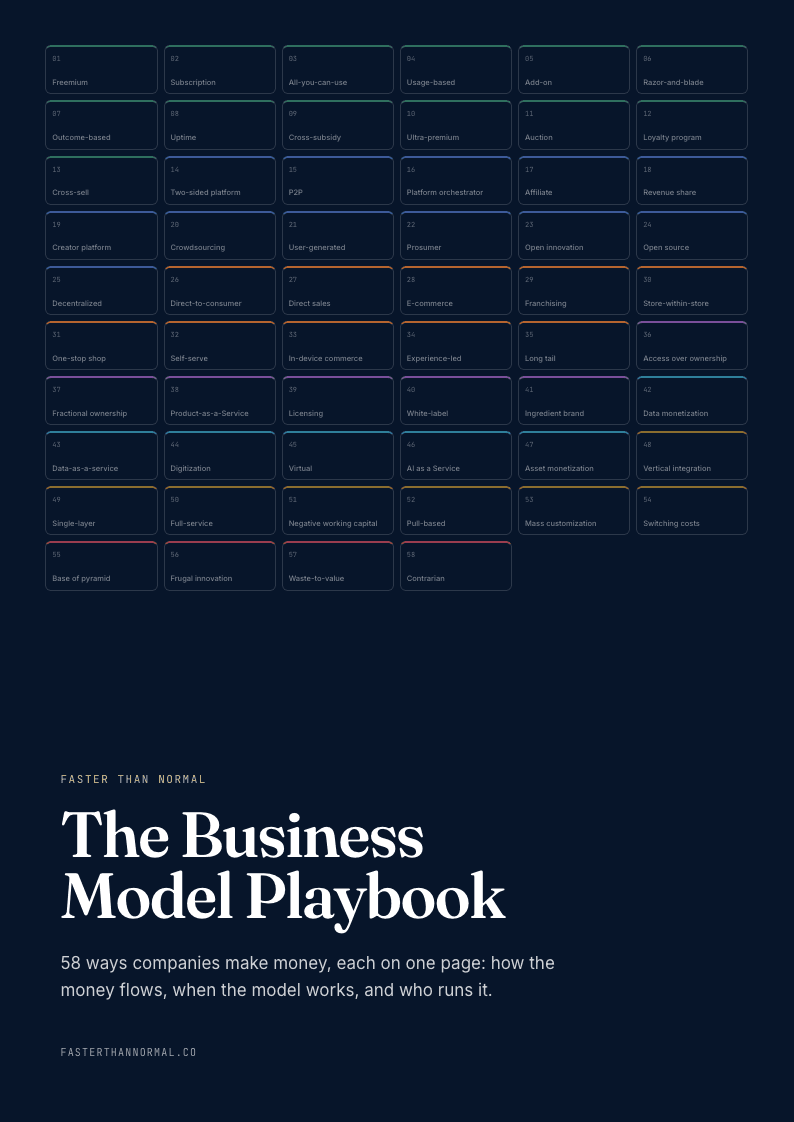
Free playbook
Get The Business Model Playbook
58 business models, one visual page each: how the money flows, the metrics that matter, and who runs it. Free when you join the Faster Than Normal email.
Free. No spam. Unsubscribe anytime.
Part IIIQuotes and Maxims
In Her Words
— Mary Kay AshPretend that every single person you meet has a sign around his or her neck that says, "Make Me Feel Important." Not only will you succeed in business, you will succeed in life.
— Mary Kay AshI wasn't that interested in the dollars-and-cents part of business. My interest in starting Mary Kay Inc. was to offer women opportunities that didn't exist anywhere else.
— Mary Kay AshWe must figure out how to remain good wives and good mothers while triumphing in the workplace. This is no easy task for the woman who works full-time. With your priorities in order, press on, and never look back. You can, indeed, have it all.
— Mary Kay AshI believe that most successful people are ordinary people with extraordinary determination.
— Mary Kay AshPeople are a company's greatest asset. Good people are more important than the plan.
Maxims
-
Write the list before you write the plan. Every grievance is a design specification in disguise. The injustice you experienced is the architecture of the company you should build.
-
Praise is not optional — it is infrastructure. The woman who built a multibillion-dollar company on a hide tanner's formula understood that confidence precedes competence, and that confidence must be supplied from outside before it can be generated from within.
-
The billboard beats the bonus. A pink Cadillac in the driveway motivates the entire neighborhood. A direct deposit motivates only the recipient.
-
Flexibility is a moat, not a perk. If your organization is designed around the actual lives of the people who power it, you will attract talent that rigid competitors cannot reach.
-
The customer and the sales force are the same person. Blur the boundary between buying and selling, and you create a growth engine that requires no advertising budget.
-
Go private to go long. If quarterly accountability distorts your strategy, remove the quarter. Own the timeline.
-
Culture is the machine that runs after the founder leaves. Encode your values in ritual, language, and incentive design — not in your personal presence, which is temporary.
-
The speed of the leader is the speed of the gang. In a distributed organization, the founder's behavior is the only signal that reaches everyone. Write your goals on the mirror.
-
Name your priorities in rank order, then prove you mean it. A stated priority that contradicts the incentive structure is worse than silence.
-
Every empire casts a shadow. The pyramid narrows as it rises. Confront the structural flaw in your model before your critics do, and decide transparently what you will change and what you will defend.
In Their Own Words
Don't limit yourself. Many people limit themselves to what they think they can do. You can go as far as your mind lets you. What you believe, remember, you can achieve.
We must have a theme, a goal, a purpose in our lives. If you don't know where you're aiming, you don't have a goal. My goal is to live my life in such a way that when I die, someone can say, she cared.
Pretend that every single person you meet has a sign around his or her neck that says, 'Make me feel important.' Not only will you succeed in sales, you will succeed in life.
When you reach an obstacle, turn it into an opportunity. You have the choice. You can overcome and be a winner, or you can allow it to overcome you and be a loser. The choice is yours and yours alone.
People fail forward to success.
Everyone wants to be appreciated, so if you appreciate someone, don't keep it a secret.
A mediocre idea that generates enthusiasm will go further than a great idea that inspires no one.
My goal in life is to live my life in such a way that when I die, someone can say, she cared.
Aerodynamically, the bumble bee shouldn't be able to fly, but the bumble bee doesn't know it so it goes on flying anyway.
The greatest pollution problem we face today is negativity.
Most people live and die with their music still unplayed. They never dare to try.
If you think you can, you can. If you think you can't, you're right.


