


Part IThe Story
Two Trunks at Kennedy Airport
In August 1983, a Swissair jet was taxiing for takeoff at John F. Kennedy Airport, bound for Zurich, when U.S. Customs officers stopped it on the runway. They were looking for two steamer trunks. When they found them, the trunks were full of documents belonging to Marc Rich & Co., the Swiss commodity trading house whose American subsidiary a federal grand jury had been trying to examine for more than a year. Time reported that the officers appear to have acted on a tip from someone inside the company.
The episode was the low point of a long fight between one of the most profitable trading firms in the world and the U.S. Attorney's office in Manhattan. A federal judge, Leonard Sand, had already been fining the company $50,000 a day for refusing to hand over records. The company had responded by secretly selling its American arm to a group of its own officers and renaming it Clarendon Ltd. Now it had been caught trying to fly the evidence out of the country.
The man at the center of it had already gone. Marc Rich and his partner Pincus Green had left New York that summer for Zug, a small Swiss canton with low taxes and discreet laws, where their company had its headquarters. In September a grand jury indicted them on 51 counts, including racketeering, tax evasion, wire fraud and trading with the enemy. Time calculated that the charges carried combined sentences of up to 325 years each. Rich never came back to face them. He spent the next seventeen years as a fugitive and kept trading the whole time, until a president pardoned him on his last morning in office.
That arc, from the boy who fled the Nazis to the fugitive on the FBI's most-wanted list, is the part of Rich's life most people know. The more lasting part is what he built in between. Rich did more than anyone to turn crude oil into a traded commodity, bought and sold by independent middlemen rather than moved inside the pipes of a few giant companies. The firm he founded in 1974 became Glencore. Its alumni founded Trafigura. Almost every large independent commodity house of the past fifty years carries some of his methods. So does the commodity trading industry's long record of scandal.
By the Numbers
Marc Rich, 1974–2001
$5MApproximate seed capital when Rich and Green set up their own firm in 1974, per Time
~$1BProfit in 1979, the year of the Iranian Revolution, according to former senior executives interviewed by Blas and Farchy
51Criminal counts in the September 1983 indictment of Rich and Green
$150MPaid by two Rich companies when they pleaded guilty to tax charges in October 1984
$172MLost on the firm's failed attempt to corner the zinc market in the early 1990s
17Years Rich lived as a fugitive before Bill Clinton pardoned him in January 2001
The Quietest Kid at Camp
He was born Marcell David Reich in Antwerp on December 18, 1934, into a Jewish family. In 1941, with Belgium under German occupation, his parents took him out of Europe by way of Vichy France, Spain and Portugal, and crossed the Atlantic on the Portuguese liner Serpa Pinto. The family settled first in Kansas City, Missouri, where his father, David, opened a jewelry store. The name was anglicized along the way.
In 1950 the family moved to Queens. David Reich went into business importing jute from Bengal to make burlap bags, and later into trading agricultural products, work that would eventually tie the family to Bolivia. He paid for his son to attend the private Rhodes School in Manhattan, where, according to Time, the boy earned a B-minus average and ran the French club. The writer Calvin Trillin, who shared a tent with him at a summer camp in the Ozarks, later described him to the Observer as the quietest kid at Camp Osceola. French, German and Yiddish came to him more easily than English, and he learned early to draw as little attention as he could. People who worked with him decades later described the same trait, grown into an obsession with privacy.
He enrolled at New York University and lasted a semester. In 1954 he left to take a job at Philipp Brothers, then the largest raw materials trading firm in the world. He never went back to school.
An Apprenticeship at Phibro
Philipp Brothers, known in the trade as Phibro, was a metals house. It recruited young men, many of them Jewish émigrés like Rich, and trained them to buy ore from mines in poor countries and sell refined metal to factories in rich ones. The work rewarded languages, stamina, and a willingness to spend long stretches in places most American businessmen avoided. Rich started at the bottom and moved quickly. The Observer's 2001 profile describes an early coup in mercury, bought cheap and sold to plants that needed it for batteries. He was soon working the firm's business in Cuba, Bolivia and Spain, and by 1967 he was running its Madrid office.
At Phibro he also met Pincus Green, a trader whose command of ships, routes and freight rates earned him the nickname "the Admiral." Green would be his partner for the rest of his career. Together they pushed Phibro into oil, a market the firm barely touched.
In the 1960s that market hardly existed in the form a trader could use. A handful of vertically integrated Western companies, the so-called Seven Sisters, pumped the crude, shipped it in their own tankers, refined it in their own plants, and sold it at their own stations. Oil moved inside these companies under long-term contracts at posted prices. There was little room for a middleman.
Rich found one of the few openings in a pipeline. After the 1956 Suez crisis, Israel and Iran had built a secret joint venture to carry oil from Eilat on the Red Sea to Ashkelon on the Mediterranean, bypassing the canal. When Egypt closed Suez again in 1967, and kept it closed until 1975, the pipeline became a valuable shortcut to European refineries. As Laleh Khalili recounted in the London Review of Books, it was Rich, still at Phibro, who arranged tankers to lift Iranian oil and deliver it to the line. The deals gave him something rarer than profit: trusted contacts inside the Shah's oil establishment.
Leaving the Family Firm
By the early 1970s the old order in oil was breaking up. Producing countries were nationalizing their fields, and the new national oil companies had crude to sell and no loyalty to the Seven Sisters. Rich saw that they needed buyers who would take cargoes on short notice, pay promptly, and not ask where the oil was going next.
In 1973 his conviction ran ahead of his employer's nerve. According to the Observer's account, Rich and Green bought a large volume of Iranian crude in the spring, betting that an Arab embargo was coming, and Phibro's board in New York forced them to unwind the position. The embargo came that October and prices soared. The firm's chief, Ludwig Jesselson, also reprimanded the pair for committing Phibro to a long-term oil contract. Time later reported that during the embargo Rich used his Middle Eastern contacts to buy Iranian and Iraqi crude at roughly $12 a barrel and resell it to American refiners desperate for supply at about twice that.
The final break came over money. In 1974 Phibro refused to pay the bonuses Rich and Green believed they had earned. They left and set up Marc Rich + Co. AG in Zug, with about $5 million in starting capital, according to Time. Several other Phibro traders followed. Time noted that commodity insiders regarded this as a breach of an industry taboo. Poaching colleagues from your old firm was simply not done.
Rich's choice of Switzerland was deliberate. Zug offered low taxes and a tradition of corporate discretion, and Swiss law gave a trading company there far more room than it would have had in New York. For the next decade, though, much of the actual trading ran through a U.S. subsidiary in Manhattan, a structure that would matter a great deal later.
Oil Without Oil Fields
What Rich built in Zug was a new kind of oil company, one that owned almost no oil. The Financial Times columnist Andrew Hill later summed up his insight: oil could be traded with far less capital and far fewer assets than the majors assumed, as long as a bank would finance the cargo. Rich is also credited with popularizing bank letters of credit in the oil trade. A national oil company that wanted payment security got a bank's guarantee. A refinery that wanted a cargo got it without a long-term contract. The trader in the middle put up little money of his own and kept the spread.
— Andrew Hill, Financial Times, 2013Rich's key insight was that oil – and other raw materials – could be traded with less capital, and fewer assets, than the big oil producers thought, if backed by bank finance.
That leveraged model spread. It became, in Hill's words, the template for the modern trading houses, including Vitol, Trafigura and Glencore. It also made the business extremely sensitive to trust. Every deal rested on the bank believing the trader would deliver, and the seller believing the trader would pay. Rich's firm became known for doing both, fast, in places others would not go.
The firm grew quickly. By 1982, Time reported, the group traded about $10 billion a year of oil, gold, aluminum, sulfur, sugar and other goods, with roughly 1,000 employees in 40 offices. In their history of the industry, The World for Sale, the journalists Javier Blas and Jack Farchy report that former senior executives told them the company made about a billion dollars in profit in 1979, the year of the Iranian Revolution. Farchy told the Freakonomics podcast that this would then have ranked it among the ten most profitable companies in America, though almost no one outside the trade had heard of it.
The year 1979 was pivotal because Rich kept buying from Iran after the Shah fell. His relationships survived the revolution, and according to his biographer Daniel Ammann, Iran became his most important source of crude for more than fifteen years. He continued to supply Israel, with oil that came from the Islamic Republic, through the same pipeline network. It was the kind of trade only a middleman with no flag and no public profile could arrange.
A Supplier to Everyone
Rich's client list read like an index of the Cold War's pariahs. According to Ammann's biography and later reporting, he did business with Fidel Castro's Cuba, Marxist Angola, the Sandinistas in Nicaragua, Muammar Gaddafi's Libya, Nicolae Ceaușescu's Romania and Augusto Pinochet's Chile. The largest of these trades went to apartheid South Africa. The country was under an international oil embargo, and Rich supplied it for years with crude from Iran and elsewhere. Ammann estimated that the South African business earned him about $2 billion, and Rich told him those embargo-breaking deals were among his most important and most profitable.
Rich did not dress this up as anything other than business. Ammann, who persuaded him to sit for more than thirty hours of interviews late in his life, summarized his view as a belief that business is neutral. Rich said he delivered a service. People wanted to sell oil to him, other people wanted to buy it, and in his account he was a businessman rather than a politician.
— Marc Rich, to Daniel Ammann, quoted in The Daily Beast, 2009If you are too proud, you don't do business.
The same neutrality made him useful to governments in trouble. Blas and Farchy tell a story from the early 1980s, recounted by Farchy on Freakonomics, about Jamaica's energy minister, Hugh Hart. Facing a fuel shortage on a Friday afternoon and fearing unrest, Hart called Rich in Switzerland at two in the morning. Within an hour, by Hart's account, Rich had diverted a tanker bound from Venezuela to the United States so it went to Jamaica instead, before any contract was signed or any money had changed hands. The relationship that followed was lucrative. Rich's firm struck long-term deals to buy Jamaican alumina, the raw material for aluminum, at prices later Jamaican governments complained were far too low. He even helped pay for the country's bobsleigh team at the 1988 Winter Olympics.
Both halves of that story matter. Rich was genuinely valuable to people in a hurry, and he was also shrewd about turning that value into terms that favored him for years afterward.
He spread into other markets as well. Time reported that in 1981 Rich helped the Malaysian state tin company buy up much of the world's supply in an attempt to push up the price. The scheme made money at first and then lost it when the U.S. government released tin from its stockpile. In the same year he and the Denver oilman Marvin Davis bought 20th Century Fox, a stake Rich kept so quiet that the Observer reported it stayed secret for months.
The Case in New York
The trouble started with price controls. In 1980 and 1981, American crude from older wells was still sold at government-capped prices, sometimes as low as $5 a barrel, while newer and imported oil sold at world prices several times higher. The federal indictment, as Time summarized it, alleged that Rich's U.S. subsidiary worked with two Texas firms, West Texas Marketing of Abilene and Listo Petroleum of Houston, to disguise controlled oil as uncontrolled oil. The crude passed through a chain of paper sales until its origin was hard to trace, and was then resold at the higher price. The Texas companies allegedly returned more than $70 million of the proceeds to Rich's headquarters in Switzerland. Prosecutors also charged that the Swiss parent had sold oil to its American subsidiary at inflated prices, so that the U.S. arm showed little profit and paid little tax. They alleged at least $48 million in evaded taxes and called it the largest tax-evasion scheme ever prosecuted.
The FBI began looking at the dealings in late 1981. The investigation fell under the U.S. Attorney's office for the Southern District of New York, run from 1983 by Rudolph Giuliani, with Assistant U.S. Attorney Morris Weinberg Jr. leading the prosecution team. Separately, investigators found that during the Iran hostage crisis Rich's companies had bought about 6.2 million barrels of Iranian crude, worth some $200 million, in violation of the U.S. embargo.
Rich fought the subpoenas the way he fought everything, by exploiting every gap between jurisdictions. His lawyers argued that a Swiss company did not have to obey an American grand jury. Swiss authorities, citing their business-secrecy laws, seized documents at the Zug headquarters to keep them out of American hands. Judge Sand held the company in contempt and imposed the daily fines. The secret sale of the U.S. subsidiary and the trunks on the Swissair flight followed. Time reported that Rich had tried, without success, to negotiate a plea that would have meant a few years in prison. When that failed, he and Green stayed in Switzerland.
The companies settled in October 1984. Marc Rich & Co. AG and its American subsidiary pleaded guilty to tax charges and paid the government $150 million, the New York Times reported, on top of about $21 million already paid in contempt fines. The plea freed the companies to keep doing business in the United States. It did nothing for the two men. Switzerland declined to extradite them, on the grounds that tax and energy offenses fell outside the 1900 extradition treaty between the two countries.
Seventeen Years in Zug
For the next seventeen years Rich ran a global business from a small area of central Switzerland. He took Spanish citizenship and also held Belgian, Bolivian and Israeli passports, though a U.S. appeals court ruled in 1991 that he remained an American citizen for tax purposes. He appeared on the FBI's list of most-wanted fugitives. His company's glass headquarters in Zug, nicknamed the Dallas building after the television show, became a local landmark, and a target for Swiss activists who objected to his dealings with dictators.
There were repeated accounts of near misses: attempts to arrest him in Britain, Germany, Finland and Jamaica that came to nothing. One story, told to the Observer, held that his jet reversed course in the air in 1991 to avoid FBI agents waiting at Helsinki. The accounts are hard to verify, but they reflect how narrow his world had become. He could trade anywhere and travel almost nowhere.
The cost fell hardest on his family. Rich had married Denise Eisenberg, a songwriter and shoe-fortune heiress, in 1966, and they had three daughters. The marriage broke down in the early 1990s, and the divorce was bitter and protracted. Ammann reported that it ultimately cost Rich about $365 million. In 1996 their daughter Gabrielle died of leukemia at 27. Rich did not travel to the United States to see her during her illness or for her funeral, because he would have been arrested.
He also gave large sums away. Over the decades Rich donated an estimated $150 million or more to Israeli institutions, including museums, hospitals, universities and immigrant absorption programs, as well as to medical research elsewhere. He later acknowledged to Ammann that he had assisted the Mossad, and the former Mossad chief Shabtai Shavit said Rich had let Israeli agents use his offices around the world.
Losing the Firm
Rich's business survived the indictment, but his hold on it did not survive the early 1990s. According to the Swiss newspaper NZZ, by then it was clear to his senior people that the founder's legal status had become a liability. Some banks were wary of lending to a firm run by a fugitive, and Rich could not travel to meet clients. His top executive, the German trader Willy Strothotte, and other senior traders pushed him to give up his majority stake. Rich refused and forced Strothotte out in 1992, which triggered an exodus of talent.
Then came zinc. Starting in 1991, the firm tried to corner the zinc market on the London Metal Exchange, buying up most of the available stocks. Ammann said the company committed more than $1 billion to the position without hedging it. The exchange intervened, prices fell, and the firm lost $172 million. Ammann described the zinc disaster, the divorce and the prosecution together as the reasons Rich was finally forced to sell.
Rich brought Strothotte back and agreed to hand over control in stages. With the pharmaceutical group Hoffmann-La Roche as a silent backer, the managers completed the buyout in 1994, and on September 1 of that year Marc Rich + Co. became Glencore. The New York Times later put the price Rich received at about $600 million. Meanwhile other former Rich traders, led by Claude Dauphin and Eric de Turckheim, had founded Trafigura in 1993. By the end of that decade, two of the world's biggest commodity traders were run by people Rich had trained, and neither carried his name.
One of those trainees, Ivan Glasenberg, became Glencore's chief executive in 2002. In May 2011 Glencore listed in London in a $10 billion initial public offering, then the largest in the exchange's history, which valued the company at about $59 billion. Rich was not among the beneficiaries.
The Pardon
The campaign that ended Rich's exile was run like one of his trades, through many intermediaries at once. Jack Quinn, a former White House counsel to Bill Clinton, took over as Rich's lawyer in 2000 after prosecutors in New York refused to negotiate with a fugitive. Avner Azulay, a former Mossad officer who ran Rich's foundations in Israel, organized appeals from prominent Israelis. Prime Minister Ehud Barak raised the case with Clinton several times, and letters arrived from Jewish leaders in the United States and Europe. Denise Rich, who had given more than $1 million to Democratic causes and $450,000 to the fund for Clinton's presidential library, wrote to the president in December 2000 asking him to grant the pardon.
The application went directly to the White House rather than through the Justice Department's normal pardon review. Clinton later wrote that he understood Deputy Attorney General Eric Holder's position to be "neutral, leaning for." Clinton's own senior advisers testified to Congress that almost all of them had urged him not to do it. On January 20, 2001, hours before leaving office, he pardoned Rich and Green.
The reaction was immediate and bipartisan. Former President Jimmy Carter called the pardon "disgraceful." A House committee said it raised substantial questions of direct corruption. Federal prosecutor Mary Jo White opened an investigation into whether the pardon had been bought, and her successor, James Comey, continued it. It ended without charges. On February 18, 2001, Clinton defended himself in a New York Times op-ed that listed eight reasons. Among them were that other oil companies accused of similar conduct had been sued civilly rather than prosecuted, that two prominent tax professors had concluded the companies' tax treatment was correct, that the companies had paid about $200 million in fines, penalties and taxes, and that Israeli officials had urged clemency. Three Republican lawyers Clinton named as having reviewed and advocated the case promptly denied they had supported a pardon.
— Bill Clinton, quoted in The Independent, 2013It was terrible politics. It wasn't worth the damage to my reputation.
For Rich, the result was a strange kind of freedom. The pardon ended the criminal case, but the uproar made him more famous than he had ever been and brought back every old story. Friends told the Observer later that year that he was disappointed with how it had turned out.
The Last Interviews
Rich spent his final years in Meggen, on Lake Lucerne. In 2001 his remaining trading arm was merged into Crown Resources, another Zug-based oil trader, and he put much of his energy into his foundations and his art collection. In his seventies he did something he had avoided for most of his life: he agreed to talk. Ammann, a Swiss business journalist, spent more than thirty hours interviewing him, went skiing with him, and in 2009 published The King of Oil: The Secret Lives of Marc Rich.
In those conversations Rich spoke calmly about the embargo-breaking deals and the South African trade, and described himself in words that stuck. According to Ammann, he said he had been painted as the biggest devil. He did not sound remorseful about the business. He sounded like a man who had priced every trade and still believed most of them were sound.
Marc Rich died of a stroke in a Lucerne hospital on June 26, 2013, at 78, and was buried in Israel. Glencore had merged with the mining group Xstrata the month before. The firm he founded had become one of the largest natural resource companies in the world, its roots in his office in Zug.
His legacy is split, and both halves are real. He saw before almost anyone that oil would become a traded commodity and that a middleman with credit, speed and contacts could stand between the producing states and the consuming world. He also treated embargoes, tax law and national allegiances as costs to be managed rather than lines to be respected, and that choice cost him his country, his company and much of his family. The industry he shaped has spent the years since paying fines for versions of the same habits.
Part IIThe Playbook
Rich's methods are worth studying for two reasons. The positive lessons, about serving neglected sellers, financing trades without owning assets, and moving faster than incumbents, built an entire industry. The cautionary lessons, about legal risk, concentration and reputation, are just as instructive, because Rich learned them at the highest possible price. The principles below cover both.
The principles
- 1.Serve the sellers the incumbents ignore.
- 2.Borrow the balance sheet, own the relationship.
- 3.Be the one who answers at two in the morning.
- 4.Trade where information is scarcest.
- 5.Hire from the bench of the firm you are leaving.
- 6.Put headquarters where the rules fit the business.
- 7.Treat legal exposure as a risk you cannot hedge.
- 8.Never let one position threaten the whole firm.
- 9.Plan your succession before your partners do it for you.
- 10.Neutrality is a choice other people will judge.
- 11.Secrecy protects the trade and isolates the trader.
- 12.Know the difference between a favor and a debt.
Principle 1
Serve the sellers the incumbents ignore.
Rich's first great opening came when producing countries nationalized their oil and suddenly had crude to sell outside the Seven Sisters' system. The majors saw the national oil companies as a threat to their contracts. Rich saw them as customers with no distribution. He offered them what they lacked: a buyer who would take a cargo quickly, pay through a bank, and find a destination.
The same logic works well beyond oil. When an industry restructures, the new players on the supply side often have product but no channels, and the incumbents are the last people who will help them. A newcomer who treats those sellers as partners can grow on volume the established firms are refusing to handle.
Tactic: List the suppliers in your market who recently gained independence or lost their traditional buyer, and design an offer around the single thing each of them most needs.
Principle 2
Borrow the balance sheet, own the relationship.
Rich built a vast oil business without owning oil fields, refineries or, for the most part, tankers. Bank letters of credit carried the cargoes, which let a firm that began with about $5 million handle billions of dollars of trade. The scarce asset was the relationship with the seller and the buyer, and that belonged to Rich.
The model is powerful because the capital needed to grow is someone else's, while the margin stays with you. It is also fragile, because it depends entirely on lenders continuing to trust you. When Rich's legal problems made some banks nervous in the early 1990s, the weakness showed. See counterparty risk for why that trust is the real balance sheet.
Tactic: Identify which of your fixed assets a partner could finance or own, and put the freed capital and attention into the relationships that generate your margin.
Principle 3
Be the one who answers at two in the morning.
When Jamaica's energy minister needed fuel on a Friday night, the only name he could think of was Rich's. By Hugh Hart's account, Rich diverted a tanker within an hour, before any contract existed. That single act bought a relationship that paid off for years, in alumina deals worth far more than the cargo.
Most businesses compete on price during normal times. The lasting relationships are usually formed during emergencies, when a customer learns who actually delivers. Being reachable and able to act when others are asleep or cautious is a form of capacity that rarely shows up on a balance sheet.
Tactic: Decide in advance what you are able to do for a key customer in an emergency, who has the authority to commit to it, and how the customer reaches that person directly.
Principle 4
Trade where information is scarcest.
Rich made his largest profits in places where prices were opaque and few competitors had contacts: revolutionary Iran, embargoed South Africa, Jamaica in crisis, the Soviet bloc. In a liquid market with public prices, a trader's margin is thin. In a market where only a handful of people know who is selling, who is buying and at what price, the spread is wide.
That is information asymmetry used as a business model. It rewards patient relationship building in unfashionable places. It also tends to attract trouble, because the markets with the least transparency are often the ones with the weakest rule of law. Rich's record shows both the returns and the cost.
Tactic: Map the markets you serve by how visible their prices are, and put your best relationship builders where prices are least visible and the rules are still clear.
Principle 5
Hire from the bench of the firm you are leaving.
When Rich and Green left Phibro in 1974, several colleagues went with them. Time reported that the trade regarded this as a breach of etiquette. It also gave the new firm a team that already knew the suppliers, the routes and each other, and let it start trading at scale almost immediately.
Talent that has learned together inside an incumbent carries the incumbent's knowledge without its bureaucracy. For a founder, that is often the fastest way to be credible with counterparties from the first day. The move has costs, including lasting resentment and, in many industries today, legal limits, and it needs to be done within the law and any contracts.
Tactic: Before you leave to start a firm, identify the two or three colleagues whose skills complete yours, and understand exactly what your employment agreements allow before you speak to them.
Principle 6
Put headquarters where the rules fit the business.
Rich chose Zug for its low taxes, corporate discretion and permissive legal framework, and the choice shaped everything that followed. Swiss law let the firm deal with clients an American company could not, and Swiss authorities later refused to extradite him over tax offenses.
Jurisdiction is a strategic decision, not just an administrative one. The right location lowers costs, reduces friction and widens the set of legal deals. Rich's case also shows the limit: he still ran much of his trading through New York, which put the business within reach of U.S. prosecutors. A structure is only as protective as the most exposed entity inside it.
Tactic: For each entity in your structure, write down which country's courts and regulators can reach it, and make sure your riskiest activities are not sitting in the most exposed one.
Principle 7
Treat legal exposure as a risk you cannot hedge.
Rich priced political risk better than almost anyone, but he appears to have treated U.S. law as another cost of doing business. The oil-pricing scheme, the Iranian purchases during the hostage crisis, and the fight over the subpoenas led to a 51-count indictment and seventeen years in exile. His companies paid $150 million to settle, and the case helped cost him control of the firm.
Market risk can be sized, hedged and diversified. The risk of criminal prosecution is personal and binary, and no derivative offsets it. It also compounds: the attempt to move documents out of the country turned a tax dispute into a far worse contest with a federal judge.
Tactic: When a proposed deal depends on an aggressive reading of the law, get an independent legal opinion and ask what the downside looks like for you personally, not just for the company.
Principle 8
Never let one position threaten the whole firm.
The zinc corner of the early 1990s was a bet on market control rather than on price. By Ammann's account the firm committed more than $1 billion, unhedged, and when the London Metal Exchange intervened, it lost $172 million. The loss weakened the company at the moment Rich could least afford it and helped force the sale.
Great traders survive because they size their positions so that being wrong is survivable. A strategy that only works if the exchange, the regulators and the market all behave as you expect is fragile, however clever it looks. Rich's earlier tin episode had already shown how a government can change the rules in the middle of a trade.
Tactic: For every large position, write down what happens to the firm's capital and credit lines if it goes to its worst plausible outcome, and cut the size until the answer is survivable.
Principle 9
Plan your succession before your partners do it for you.
Rich refused his senior traders' requests to reduce his stake, forced out his top lieutenant in 1992, and then had to bring him back and sell the firm on terms set by others. Within a few years, the company he founded had a new name, and his former protégés were running both Glencore and Trafigura.
Founders who hold on after they have become a liability rarely keep control. The people who can run the business eventually leave or take it over. A planned handover lets the founder choose the timing and the price. An unplanned one is decided by a crisis.
Tactic: Name the person who could run your business if you had to step back next year, and give them real authority now so the transfer is a decision rather than an emergency.
Principle 10
Neutrality is a choice other people will judge.
Rich insisted business was neutral and that he was a businessman, not a politician. The governments, courts and public who watched him trade with apartheid South Africa and revolutionary Iran did not accept that framing. His neutrality was itself a position, and it shaped how he was treated for the rest of his life.
Any business that operates across borders will be judged by the most demanding audience it touches, not by its own definition of itself. Rich's reputation outlived his profits and followed his successors into their own compliance crises decades later.
Tactic: Before entering a controversial market, write the headline a critic would publish about the deal, and decide whether you are willing to live with it for twenty years.
Principle 11
Secrecy protects the trade and isolates the trader.
Rich's discretion gave him an edge. Competitors rarely knew what he was buying, governments trusted him with sensitive cargoes, and his stake in 20th Century Fox stayed private for months. The same habit left him with few defenders when he needed them. To most Americans he was unknown until he was a fugitive.
Confidentiality is valuable in negotiations and in trading. As a permanent posture, it means others will tell your story for you, usually at the worst moment. Rich waited until his seventies to give a long interview, and by then the public image was fixed.
Tactic: Keep your positions private, but put your principles and your side of major disputes on the record early, while people are still willing to listen.
Principle 12
Know the difference between a favor and a debt.
The campaign for Rich's pardon drew on decades of accumulated goodwill: Israeli officials, foundation grantees, former employees and lawyers who had known him for years. It worked, in the narrow sense that Clinton signed the pardon. It also left everyone involved exposed to accusations that the pardon had been bought, and Clinton later called it terrible politics.
Goodwill freely given is an asset. Goodwill that looks like it was accumulated to be cashed in turns into a liability for both sides once it is used. The appearance matters as much as the intent, especially when the favor is public.
Tactic: When you are about to ask a powerful ally for help, consider how the request will look if it becomes public, and whether the ally will still be glad they helped.
Free playbook
Get The Business Model Playbook
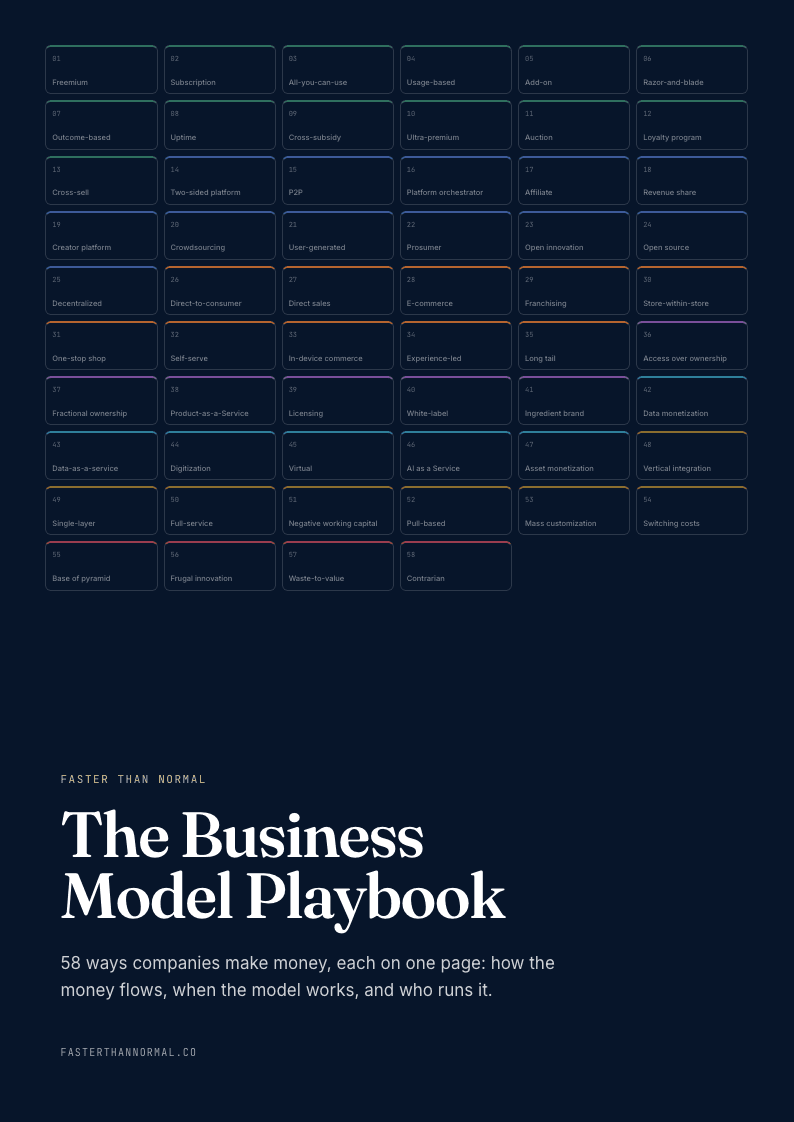
58 business models, one visual page each: how the money flows, the metrics that matter, and who runs it. Free when you join the Faster Than Normal email.
Free. No spam. Unsubscribe anytime.
Part IIIMaxims
- Middlemen are paid for certainty. A trader earns the spread by giving a nervous seller a guaranteed buyer and an anxious buyer a guaranteed cargo.
- Restructurings create customers. Whenever an industry is broken up, someone is left holding product with nowhere to sell it.
- Speed is a form of credit. Delivering before the paperwork is signed tells a counterparty more than any contract.
- The spread lives in the dark. Wide margins usually mean opaque prices, and opaque prices usually mean higher legal and political risk.
- Jurisdictions eventually cooperate. Every gap between two legal systems looks like an opportunity until both systems close it at once.
- A fugitive cannot be a salesman. Rich could trade from Zug, but he could not shake a client's hand in most of the world, and the business eventually noticed.
- Corners are a bet on the referee. Trying to control a market means betting the exchange will let you, and exchanges rarely do.
- Protégés are the real legacy. The people Rich trained built two of the largest trading houses in the world, under other names.
- Old stories come back with new publicity. Rich's pardon brought every old story about him back into the headlines, which was the opposite of what he wanted.
In Their Own Words
I never did anything illegal. I may have bent the rules, but I never broke them. There's a difference between what's legal and what's right, and I always stayed on the legal side.— Marc Rich
Marc Rich epitomized the worst aspects of American capitalism. He was willing to trade with America's enemies and evade American taxes while still claiming the benefits of American citizenship.— Rudy Giuliani
In this business, you're only as good as your last trade. You have to manage risk constantly, because the market can turn against you in minutes.— Marc Rich
I have always been fascinated by the oil business. It's the most political of all commodities, and politics create opportunities for those who understand them.— Marc Rich
In commodity trading, you must be prepared to lose money every day. The key is to make sure your winners are bigger than your losers.— Marc Rich
Information is the only real edge in this business. Everything else—capital, relationships, infrastructure—can be replicated. But superior information cannot.— Marc Rich
The market is always right, even when it's wrong. Your job as a trader is not to fight the market but to understand what it's telling you.— Marc Rich
I never did anything that wasn't legal in the jurisdiction where I did it. The problem is that what's legal in one place may not be legal in another.— Marc Rich
Risk and opportunity are two sides of the same coin. The markets that others avoid due to risk are often the most profitable.— Marc Rich
You cannot eliminate risk in this business—you can only manage it. The traders who try to eliminate risk eliminate their profits as well.— Marc Rich
Political instability creates the best trading opportunities. When governments fall and borders change, commodity flows are disrupted, and that creates arbitrage opportunities.— Marc Rich
The biggest risks are the ones you don't see coming. That's why you must always maintain financial flexibility and never bet everything on a single position.— Marc Rich
In this business, your word is your bond. Once you lose your reputation for reliability, you're finished as a trader.— Marc Rich
I have always believed in building long-term relationships rather than maximizing short-term profits. A relationship that lasts twenty years is worth more than any single transaction.— Marc Rich
Trust is earned in drops and lost in buckets. You must be constantly vigilant to maintain the trust of your counterparties.— Marc Rich
The best business relationships are built on mutual benefit. If only one party is benefiting, the relationship won't last.— Marc Rich
The commodity business is constantly evolving. The strategies that worked yesterday may not work tomorrow. You must be willing to adapt or you will be left behind.— Marc Rich
I have always been willing to try new approaches when the old ones stopped working. Innovation is essential for survival in this business.— Marc Rich
The spot oil market didn't exist when I started trading. We created it because the existing contract system wasn't meeting the needs of buyers and sellers.— Marc Rich
Technology changes everything in commodity trading. The firms that embrace new technology will dominate those that don't.— Marc Rich
Success in trading is not about being right all the time—it's about being right more often than you're wrong, and making sure your right trades are bigger than your wrong ones.— Marc Rich
I measure success not just by profits but by the relationships I've built and the innovations I've contributed to the industry.— Marc Rich
My greatest achievement was creating the modern spot oil market. That innovation has benefited the entire industry, not just my own company.— Marc Rich
I have no regrets about my career. I operated within the law as I understood it, and I created value for my shareholders, my employees, and my counterparties.— Marc Rich
I have been criticized for trading with countries that others wouldn't deal with. But commerce is often the best way to build bridges between nations.— Marc Rich
The line between what's legal and what's ethical is not always clear in international business. I have always tried to stay on the right side of both.— Marc Rich
My critics don't understand the complexity of international commodity trading. What looks simple from the outside is actually extraordinarily complex.— Marc Rich
I became a fugitive not because I was guilty, but because I believed I could not receive a fair trial in the United States. History has proven me right.— Marc Rich
Further reading
- The King of Oil: The Secret Lives of Marc Rich by Daniel Ammann


