


Part IThe Story
Fifty No's and a Closet Full of Data
In the spring of 2012, Stitch Fix had six weeks of cash left. Not six months — six weeks. Katrina Lake, twenty-nine years old, was shipping boxes of clothing out of a Cambridge apartment, collecting styling fees via physical checks, tracking customer preferences on SurveyMonkey, and watching venture capitalist after venture capitalist shake their heads. Over fifty of them said no. Some didn't believe in the business model — a clothing subscription service that married human stylists with data science sounded, to the overwhelmingly male partnership ranks of Sand Hill Road, like a glorified personal shopper with a spreadsheet. Others simply didn't want to be part of it, which Lake found more alarming than the intellectual objections. The intellectual objections you could argue with. The not-wanting-to-be-part-of-it was something else entirely — a kind of ambient dismissal that had less to do with unit economics than with who was standing in the room pitching.
And yet the customers kept saying yes. That was the paradox Lake lived inside for the better part of two years: a company that venture capital couldn't see but consumers couldn't stop using. Even when there was no website — for the first eight months of the business, there was literally no website — people were waiting, excited, coming back. Lake had started the whole thing as an experiment, recruiting twenty friends to see if she could choose clothes for them that accurately matched their style and personality. The experiment worked. The friends told other friends. The demand was real. The question was whether the capital markets would ever catch up to what was happening in those living rooms and front porches where women opened boxes and found, to their genuine surprise, jeans that actually fit.
Lake would eventually raise $42 million in total venture funding — a figure that, in a Silicon Valley ecosystem where competitors burned through hundreds of millions, amounted to a rounding error. She would take Stitch Fix public on November 17, 2017, at a $15 share price, raising $120 million and establishing an initial market capitalization of roughly $1.4 billion. She was thirty-four years old, the youngest female founder ever to lead a tech company through an IPO. In 2017, she was the only woman to take a tech startup public. The company had been profitable for three consecutive years. It had done this on discipline, on data, and on a thesis that almost nobody in the investment world wanted to hear: that the future of retail was not the everything store, but something closer to its opposite.
By the Numbers
The Stitch Fix Story
$42MTotal venture capital raised pre-IPO
$1.6BValuation at November 2017 IPO
3.4MPeak active clients (Q1 FY2020)
~$1.6BAnnual revenue at peak (FY2019)
50+Venture capitalists who said no
$20Styling fee per 'Fix'
85+Data scientists employed at scale
The Rave Scene and the Econometrician
The story of how Katrina Lake ended up founding anything at all requires a detour through San Francisco's underground music scene in the mid-1990s, which is not where most founder narratives begin. She grew up in the Bay Area — her mother a public school teacher, her father a physician in the public university system — in a household that prized creativity alongside pragmatism. "Creativity was definitely a big part of our household," Lake has said. "I remember always writing stories and being encouraged to be creative." She was, by most accounts, a bright and restless kid who gravitated toward the unconventional.
How restless became clear when, as a teenager, Lake got deeply into the Bay Area's rave scene. Her parents, alarmed enough to act, made the dramatic decision to move the entire family to Minnesota. The geographic displacement — from the chaotic permissiveness of 1990s San Francisco to the structured calm of Minneapolis at fifteen — is one of those biographical details that sounds like a novelist's invention. It is also, in retrospect, a small parable about what Lake would spend her career doing: taking something messy, intuitive, and deeply human — taste, style, self-expression — and imposing enough structure on it to make it scale.
She settled down. Got into Stanford. Intended to become a doctor, following her father's path, but became fascinated by economics and the quantitative architecture underneath markets. She graduated with a B.S. in economics in 2005, equipped with a solid understanding of econometrics — the application of statistical methods to economic data — which would prove to be not a detour from fashion but the foundation for everything she later built. The pre-med student who became an econometrician who became a retail entrepreneur: the path makes no sense chronologically and perfect sense thematically. Lake's gift was always for seeing the hidden data layer underneath human behavior.
The Education of an Outsider
After Stanford, Lake joined the Parthenon Group (now EY-Parthenon), a management consultancy where she spent two years advising e-commerce and traditional retailers. The work was illuminating in the way that consulting often is — you learn the vocabulary of an industry's problems without developing the muscle memory of solving them. She consulted with companies wrestling with the migration from stores to online, watched her sister's work as a buyer, and began to form an intuition about what was broken in retail: the experience was fundamentally impersonal, the paradox of choice was paralyzing, and the industry's response to the internet was to take the exact same overwhelming catalog and put it on a screen.
In 2007, she moved to Leader Ventures, a private investment firm, hoping to find among the startups flowing through its doors the company she wanted to join — the one that was reimagining how people bought clothes. "Ultimately, I didn't quite find the company I wanted to join," Lake later recalled, "but I met more than 100 entrepreneurs and realized that all these entrepreneurs were just as unqualified as I was." The realization had the quality of a revelation. "I had this realization that was like, 'I could do this too.' And so I got here almost by process of elimination."
It was an unusual path to entrepreneurship — not the burning-bush conviction of the born founder, but a slow, empirical conclusion drawn from watching other people try. Lake has never romanticized her origin story. She was not the person who could quit her job, have no income, and live in a garage. She was the person who needed a salary, had student loans, and wanted a safety net. So in 2009, she enrolled at Harvard Business School with the explicit intention of using her MBA to start a company. "Worst case scenario I would have an MBA from a great school and have a lot of opportunities," she said, "so that was the way I was able to stomach the idea of entrepreneurship."
At Harvard, she interned at Polyvore — a fashion collage and online moodboard company — in marketing and blogger outreach, adding another layer of understanding about how women actually discovered and talked about clothes. The initial company name was Rack Habit. The initial concept was a data-driven personal shopping service at an accessible price point, built for people who couldn't access personal shoppers. The initial infrastructure was her apartment.
Twenty Friends and a SurveyMonkey
The founding of Stitch Fix in February 2011 — technically co-founded with Erin Morrison Flynn, though Lake was the driving force and would be the one to lead the company for the next decade — was almost comically lo-fi. Lake recruited twenty friends for a pilot experiment. She would buy clothes at boutiques around Boston, bring them to people's houses, watch them try on the clothes, ask them questions, and have them fill out a survey, gathering as much data as she could. There was no algorithm. There was no website. There was Katrina Lake, a stack of clothing, and a legal pad.
The genius of the approach was that it was deliberately unscalable. Lake was doing things by hand precisely because she needed to understand, at a granular level, what was happening in the interaction between a person and a curated box of clothing before she could encode that interaction into software. She acquired inventory knowing she could return products people didn't buy, but every try-on generated data — preference data, fit data, style data, price sensitivity data — that would eventually become the foundation of the company's competitive advantage. The styling fee was $20, collected in those early days by physical check. Customers filled out their preferences on SurveyMonkey or a Google Doc. Lake personally tracked orders and curated selections.
Even in this primitive state, the signal was unmistakable. "Even when we didn't have a website it was crazy how difficult we were making it, and yet people were waiting and excited and kept coming back," Lake said. She invested $10,000 of her own savings and took a $20,000 loan from her parents. Steve Anderson of Baseline Ventures led a seed round of $750,000 in 2011, joining the board as the first major institutional investor. Bill Gurley of Benchmark — who would become a crucial advisor and board member — participated as an early angel.
It was Gurley who would later articulate what made Stitch Fix unusual in the Silicon Valley landscape: "One of the unique things about Stitch Fix relative to all the unicorns in Silicon Valley is they've run a very disciplined and profitable approach. They've been profitable for several years. The reason that you never heard of them as a unicorn is that they never raised money over a billion because they didn't need to."
— Katrina Lake, Female Founders Fund CEO Summit, 2019Even when the venture community wasn't saying yes, our clients were saying yes, and that was a really important signal.
The Inventory Nightmare and the Data Scientist from Netflix
One moment from the early years crystallized the tension between Lake's outsider perspective and the entrenched wisdom of the retail industry. A veteran retail expert sat her down and explained, in terms that brooked no disagreement, that her idea for Stitch Fix would be an inventory nightmare. He was not wrong about the complexity. The model required buying inventory across hundreds of brands in thousands of SKUs, sending five items to each customer, absorbing the cost of returns on the pieces they didn't want, and somehow making the economics work on a $20 styling fee. Every experienced person in retail could see why this was impossible. Lake, who had worked at a Banana Republic store and a smoothie shop and had no other retail experience, could not.
"Ironically, I think it helped me see the problem in a different light," she said. "With his decades of experience, it made it hard for him to see possibility outside of what he already knew. I didn't understand why you couldn't do things, and in so many ways, that was such a benefit to me."
The pivot point came in early 2012, when Lake recruited Eric Colson — formerly of Netflix, where he had worked on the recommendation algorithms that powered the streaming service's suggestion engine — as Chief Algorithms Officer. Colson's arrival transformed Stitch Fix from a personal shopping service with ambitions toward data into a data science company that happened to sell clothes. Under his leadership, the company would eventually employ more than 85 data scientists and over 3,700 stylists, creating a hybrid human-machine system that got measurably better with every Fix sent. Each returned item was not a failure but a data point. Each customer's style profile grew richer with every interaction. The algorithms learned not just what you liked but why you liked it, building what the company called a "latent style map" — a multidimensional visualization of each customer's aesthetic DNA, comprising hundreds of suggested pieces that constructed an extremely nuanced picture of individual taste rather than pigeonholing customers into overly general categories.
By 2014 — just three years after launch — Stitch Fix was profitable. Not "approaching profitability" in the creative accounting sense that Silicon Valley startups favored, but actually, genuinely profitable: more money coming in than going out. In an era when the dominant playbook was to burn capital at furious rates in pursuit of growth, Lake's company was making money.
The Loneliest IPO
The road to the Nasdaq bell on November 17, 2017, was lined with skeptics. Stitch Fix had raised just $42 million in total outside funding — pocket change in a world where competitor Trunk Club had been acquired by Nordstrom for $357 million (only to suffer a $197 million writedown a year later). The IPO raised $120 million at $15 per share. Lake was thirty-four. She held a 16.6% ownership stake. Her son was still young enough to be held at her side during the bell-ringing ceremony.
The offering was criticized in some quarters for not producing the first-day stock price "pop" that investment banks favored because it enhanced their reputation for future IPO order books. The criticism was rubbish, as Gurley-school investors understood — a pop meant the company had sold shares below market value, transferring wealth from founders and early investors to institutional flippers. Lake had priced the offering correctly, which was the whole point.
But the milestone's significance extended beyond finance. In the entire year of 2017, across the hundreds of tech companies that went public, Katrina Lake was the only woman leading one. The only one. When she took the stage at the Vanity Fair Founders Fair in April 2018, she put it plainly: "It really is pathetic how little money is going to female entrepreneurs. I can be a visual representation of why you should back women."
The isolation of being a rarity carried its own weight. "People talk about the CEO job as being a lonely job," Lake told Fortune. "And you look around, and you see how few women are in those public seats, and it's an even lonelier job." When Whitney Wolfe Herd — the founder of Bumble, who had been a Tinder co-founder before leaving amid a harassment and discrimination lawsuit, who built her dating app on the radical premise that women should message first — took Bumble public in early 2021, making her the youngest woman to lead an IPO at thirty-one, she cited Lake as her primary mentor. Lake was relieved to pass the title. "I was very eager to pass that title along," she said. "Given the state of the world, I was happy to have that association, but at the same time it was so sad that it took so long."
— Katrina Lake, Vanity Fair Founders Fair, 2018It really is pathetic how little money is going to female entrepreneurs. I can be a visual representation of why you should back women.
The Anti-Amazon
The strategic logic of Stitch Fix was best understood as the precise inversion of Amazon. If Jeff Bezos built the everything store — a platform of infinite selection, infinite scroll, and the relentless burden of choice — Lake built the nothing-you-didn't-ask-for store. A maximum of five items per Fix. Thirty to forty suggestions in the Shop Your Looks feature, not the thousands of results Amazon's search engine returned. "If Amazon is the everything store, we are in some ways almost the antithesis of that," Lake told ABC News. "Our focus on personalization, our focus on apparel, our focus on recommendations at the core of what we do is what's going to differentiate us."
The distinction was philosophical as much as tactical. Amazon's model assumed that more selection was always better and that the customer's job was to search. Stitch Fix's model assumed that more selection was often paralyzing and that the company's job was to know. Every data point the company collected — and by 2019, it had sold roughly $5 billion of clothes, "all sight unseen," as Lake put it, with 100% of purchases based on stylist recommendations rather than customer browsing — reinforced the thesis that personalization was not a feature but a business model.
The HBR case study that W. Chan Kim, Renée Mauborgne, and their co-authors would write about Stitch Fix was titled "Katrina Lake vs Jeff Bezos: Surviving Amazon," and it framed the company as a blue ocean retailer — one that had created a new market space rather than competing head-to-head with the incumbent. The case described how Lake launched "a personal styling service based on a mix of human creativity and artificial intelligence, and grew it into a $3.6B company." The blue ocean framing was apt. Lake had not built a better mousetrap for the same mice. She had identified a different animal entirely: the person who didn't want to shop at all but still wanted to look good.
By the time Amazon launched Prime Wardrobe — its own try-before-you-buy clothing service — in 2017, Stitch Fix had years of data advantage and a hybrid human-machine system that Amazon, for all its technological prowess, could not easily replicate. The stylists were not a cost center but a competitive moat. Every human judgment they made — this blouse pairs with that customer's lifestyle, this neckline flatters that body type — generated training data for the algorithms, which in turn made the stylists more efficient, which generated more data. It was a flywheel, and it spun on a currency Amazon didn't have: intimate knowledge of individual bodies and lives.
The Billion-Dollar Closet and the Pandemic Pivot
By 2019, Stitch Fix had more than 3.2 million active customers and revenue of $1.58 billion, up 29% year over year. The company carried 450 brands. It had expanded from women's clothing to men's, kids', and plus sizes. Lake's personal fortune, driven by her roughly 13 million shares, reached $375 million by mid-2019, landing her on Forbes' list of America's Richest Self-Made Women at number fifty-five. On a single day in June 2019, after the company delivered another quarter of double-digit growth, she became $45 million richer overnight.
Then came 2020. The pandemic hit Stitch Fix the way it hit most retailers — hard, fast, and with contradictions. People stopped buying work clothes "just like that," Lake said. Men's dress shirts disappeared from orders overnight. But the company's data infrastructure, the same system that had been learning customer preferences for nearly a decade, allowed it to pivot at a speed that traditional retailers couldn't match. The "casualization" of clothing — athleisure, comfortable pants, weekend-to-workday versatility — was a trend Stitch Fix had already been tracking. COVID simply accelerated it. "We're at this intersection," Lake told Fortune, of being both a technology company with data-informed agility and a retailer that understood the physical, tactile nature of clothing.
The stock surged 282% over the course of 2020, from around $12 in March to $48 by March 2021. Lake became, for a time, a self-made female billionaire. She pushed the company to offer employees four weeks of paid time off, an employee relief fund, and a specific fund for parents navigating the childcare crisis. "It really was the most challenging year of my leadership period," she said. "There are so many dimensions across which we were seeing a huge amount of change."
The kids' business held steady throughout — "Kids still grow, and they still need clothes," Lake noted with the matter-of-factness of a mother of two young children. The women's business began recovering first. Lake, characteristically, refused to force trends on customers. "We really are in the business of listening to the consumer and delivering what he or she wants; we're not in the business of forcing it."
The Handoff and the Return
On April 13, 2021, Lake announced she was stepping down as CEO. She was not yet forty. Elizabeth Spaulding — formerly the global head and founder of Bain & Company's digital practice, who had joined Stitch Fix as president in January 2020 — would take over effective August 1. Lake would become executive chairperson, remaining an employee and focusing on social impact, sustainability, the company's entrepreneurial mentorship program called Elevate, and the intersection of technology and environmental responsibility.
The announcement carried the cadence of a planned transition, which Lake insisted it was. "I have always embraced the idea that every year my role has changed," she wrote in a note to employees. "This succession has been in the works for some time, and while change can be hard, I also believe in its transformational power." At the time, Stitch Fix was trading at $54, up 259% from its IPO price. Lake left the CEO post having built a management team that was half female and a board where women held three of the seven seats. She was one of the vanishingly rare female CEOs of a public company to hand the reins to another woman.
Then the company fell apart.
In the eighteen months following Lake's departure from the CEO role, Stitch Fix's stock plummeted 93% — from $54 to $3.47. The company conducted multiple rounds of layoffs. It lost 200,000 customers. Spaulding attempted a pivot from the subscription box model to a comprehensive, on-demand shopping destination, and the pivot stalled. Market forces were brutal — the entire retail sector struggled as pandemic tailwinds reversed — but the operational challenges were Stitch Fix's own.
On January 5, 2023, Lake returned. The announcement was twinned with devastating news: a 20% reduction in salaried positions and the closure of the Salt Lake City distribution center. Spaulding stepped down. Lake took the interim CEO role, initially for an expected six months to lead a CEO search. But the search would end with Lake herself staying on, joining the small, storied cohort of boomerang founders — Steve Jobs at Apple, Howard Schultz at Starbucks, Bob Iger at Disney — who returned to companies they had built because no one else could see the thing clearly enough to save it.
"I still deeply believe in the Stitch Fix business, mission and vision," Lake wrote to employees on the day of her return. "We know because of the hard work and foundation laid by this team that there is a great future available for this company and we are committed to getting the company on a path to achieve it."
The message to departing employees was characteristically direct and humane: "You took a chance on Stitch Fix, trusted us with your time and investment of yourself, and I am sincerely sorry that we are parting ways with you in this way today."
The Offer She Didn't Take
There is a moment in nearly every founder's story that functions as the hinge — the decision that, in retrospect, made everything else possible or impossible. For Lake, it came in 2012, when Stitch Fix was barely a year old. The company had raised less than a million dollars. An acquirer materialized with a tens-of-millions-of-dollars offer. Lake was in her late twenties, living paycheck to paycheck. The offer would have made her a millionaire.
Her lawyer urged her to take it. "He's like, 'This is so lucky. This is so lucky,'" Lake recalled. "And I'm like, 'Well, do I think that I'm lucky or do I think that I'm actually good at this? And if I'm actually good at this, then I should actually double down on myself and invest in myself.'"
She turned it down.
The decision was not bravado. It was a calculation — cold, precise, and informed by the same econometric instinct that had drawn her away from pre-med. She had data. Not the algorithmic data that would later power the company's recommendation engine, but something more fundamental: the data of customer behavior. People wanted this. The signal was strong. The question was whether she trusted the signal more than the safety of a check.
She did.
A Pantsuit She Never Wore
Lake's advice to the next young female CEO who came along was simple: "Authentic leadership is especially accessible to women because there's no point in putting on a pantsuit and pretending to be a guy. We can all chart our own paths of what leadership looks like."
The comment was casual, almost offhand, but it contained the compressed logic of a decade of navigating rooms where she was the only woman, often the youngest person, and always the one whose company was dismissed as "just fashion." The seven percent figure — the oft-cited statistic that only seven percent of partners at venture capital firms were women — was one Lake cited frequently, noting that the public markets were slightly better at roughly fifteen percent. "Still low, but better."
She took a full sixteen weeks of maternity leave after the birth of her second child in late 2018, when Stitch Fix was a public company valued at more than $3 billion. She planted a flag. She sat on the board of Glossier — Emily Weiss's beauty brand, which generated more revenue per square foot from a windowless sixth-floor Manhattan showroom than the average Apple Store — and on the board of Grubhub. She appeared as a guest shark on Shark Tank. She joined Recruit Holdings, the Japanese conglomerate behind Indeed and Glassdoor, as an independent director in 2023, drawn by the opportunity to learn corporate governance in a country where half the companies are more than a hundred years old.
Through it all, she maintained what she described as a tension between pragmatism and ambition. "I've always been very pragmatic," she told Fortune. "I have to learn, I do have big goals, I do have big aspirations, and unless I'm saying those things out loud I can't bring people along on that." The pragmatism was the Minnesota in her — the steadiness imposed by a move at fifteen, the discipline of a household where both parents worked in public service. The ambition was the San Francisco — the rave kid, the risk-taker, the person who looked at a retail industry mired in tradition and saw not constraints but absences.
— Katrina Lake, Fortune, 2021People talk about the CEO job as being a lonely job. And you look around, and you see how few women are in those public seats, and it's an even lonelier job.
The Latent Style Map
In the end, the thing Stitch Fix built was not a clothing company. It was a map — a latent style map, in the company's technical language, but also a broader cartographic project: mapping the space between what people say they want and what actually makes them feel good. The company's 85-plus data scientists and 3,700-plus stylists worked together in a system that was neither purely algorithmic nor purely human but irreducibly both, each making the other better in a feedback loop that had no clean analogue in the technology industry.
Seventy percent of customers returned for a second Fix within ninety days. Eighty-five percent chose to share feedback on what they kept and returned. Five billion dollars of clothing sold, all sight unseen, all recommended rather than browsed. The numbers described something more interesting than a business — they described a relationship between a company and its customers built on an unfashionable premise: that being known is more valuable than having options.
Lake returned to lead that company not because she had to, but because no one else could hold the contradictions together — the data and the humanity, the discipline and the ambition, the pragmatism of Minnesota and the wildness of a San Francisco rave. By 2025, the company had gone through another transformation, with fiscal year 2025 net revenue of $1.27 billion and a net revenue per active client that had grown 3.0% to $549, even as the active client base contracted. The strategy shifted from volume to value: fewer customers, but each one known more deeply.
On the windowsill of an apartment in Cambridge where this all began, where a twenty-eight-year-old woman once sorted blouses into FedEx boxes using SurveyMonkey and physical checks, the data was always the same. People don't want more choices. They want to be understood.
Part IIThe Playbook
What follows are twelve principles distilled from Katrina Lake's journey building Stitch Fix from an apartment experiment to a public company, losing it, and winning it back. They are not motivational slogans. They are structural insights about how to build something enduring in an industry that rewards the disposable.
The principles
- 1.Prove the value hypothesis before the growth hypothesis.
- 2.Use inexperience as a lens, not a liability.
- 3.Build the safety net that lets you take the leap.
- 4.Let customers overrule investors.
- 5.Treat capital scarcity as a competitive advantage.
- 6.Design hybrid systems that make humans and machines mutually better.
- 7.Invert the incumbent's core assumption.
- 8.Know whether you're lucky or good — and bet accordingly.
- 9.Rehire yourself every year.
- 10.Make authenticity structural, not performative.
- 11.Build the succession — or be prepared to undo it.
- 12.Optimize for depth, not breadth.
Principle 1
Prove the value hypothesis before the growth hypothesis
Lake's first eight months had no website, no algorithm, and no scale. She was buying clothes at boutiques, bringing them to people's houses, and watching them try things on. This was not a failure of ambition — it was a deliberate decision to prove that people would pay for a curated, personalized clothing experience before investing in the infrastructure to deliver it at scale. Too many startups invert this sequence, spending heavily on growth before confirming that customers actually want what they're building.
The MVP approach — deliberately doing things that don't scale in order to learn — is a well-known concept in startup methodology. But Lake executed it with unusual discipline. She acquired inventory she could return, used free tools like SurveyMonkey and Google Docs, and collected data at every interaction. The signal she was looking for was not growth but retention: were people coming back? They were. Seventy percent of customers returned for a second Fix within ninety days, a metric that held even when the "website" was an email chain and the "payment processor" was a personal check.
Tactic: Before investing in growth infrastructure, design the cheapest possible experiment to answer one question: will customers come back unprompted?
Principle 2
Use inexperience as a lens, not a liability
A retail veteran told Lake her idea was an inventory nightmare. He was right about the complexity. He was wrong about the impossibility. "With his decades of experience, it made it hard for him to see possibility outside of what he already knew," Lake reflected. "I didn't understand why you couldn't do things, and in so many ways, that was such a benefit to me."
This is not an argument for ignorance. Lake had spent two years consulting retailers at Parthenon, two years evaluating startups at Leader Ventures, and a summer at Polyvore. She understood the industry's problems deeply. What she lacked was the industry's ingrained sense of what couldn't be done — and that absence of inherited limitations allowed her to ask different questions. The retail expert's decades of pattern-matching led him to pattern-match Stitch Fix against existing models. Lake, unburdened by those patterns, could see the model as new.
Tactic: When entering an established industry, audit the things insiders tell you are impossible — the impossibilities are often just unchallenged assumptions disguised as physics.
Principle 3
Build the safety net that lets you take the leap
Lake enrolled at Harvard Business School not because she needed an MBA to start a company, but because she needed the psychological safety net to try. "I was not cut from the cloth of somebody who was going to be able to quit my job, have no income, and live in a garage," she said. Her worst-case scenario was an MBA from a top school and a wide field of opportunities. Her best-case scenario was building the company while enrolled.
This is a profoundly pragmatic approach to risk — and a more honest one than the mythology of the fearless founder who bets everything on a vision. Lake's parents were public servants. She had student loans. The decision to de-risk entrepreneurship by embedding it within a credentialed institution was not a hedge against ambition but a structure that enabled it. She started the company during business school, paid herself a salary, and graduated with a functioning business.
Tactic: Design your risk architecture before the risk event — create fallback positions that make the ambitious choice survivable, not just possible.
Principle 4
Let customers overrule investors
Fifty-plus venture capitalists said no to Stitch Fix. The customers kept saying yes. Lake held to the customer signal even when the investment signal was uniformly negative, and this was the single most consequential judgment call of the company's early years.
The venture rejections were not irrational. The model was capital-intensive (inventory), low-margin (apparel retail), and operated in a category most VCs didn't understand or value. But the customer data — retention rates, repeat purchase behavior, willingness to endure an awkward pre-website experience — pointed unambiguously to product-market fit. Lake chose to optimize for the signal that mattered (customer behavior) rather than the signal that was loudest (investor sentiment).
This required a particular kind of stubbornness. Not the stubborn refusal to adapt — Lake iterated constantly on the product — but the stubborn insistence that market demand, not capital market enthusiasm, was the relevant measure of viability. Stitch Fix eventually raised only $42 million in total venture capital and reached profitability by 2014. The discipline was downstream of the conviction.
Tactic: When investor feedback and customer feedback diverge, build a system to rigorously measure which one is telling you something real about your business — and trust that system over the room.
Principle 5
Treat capital scarcity as a competitive advantage
"It was hard to raise money," Lake said. "We always treated every dollar very preciously and focused early on profitability. There are companies out there that may have failed because they had too much money and never had to think about the economics of their business."
This is not contrarianism for its own sake. Lake lived through a period when Stitch Fix had eight weeks of cash left. The experience — terrifying in real time — instilled a unit economics discipline that competitors who raised hundreds of millions never developed. While Trunk Club burned through Nordstrom's capital and collapsed, Stitch Fix was profitable and growing. The constraint forced focus. Every dollar had to justify itself against the only metric that mattered: were the economics of each customer relationship positive?
$
Capital Efficiency Comparison
Stitch Fix vs. comparable subscription retail ventures
| Company | Total funding | Outcome |
|---|---|---|
| Stitch Fix | $42M pre-IPO | Profitable by 2014, IPO at $1.4B in 2017 |
| Trunk Club | $357M (Nordstrom acquisition) | $197M writedown, underperformed expectations |
Tactic: When capital is scarce, use the constraint to force unit economics discipline from day one — the companies that survive funding droughts are the ones that learn profitability early.
Principle 6
Design hybrid systems that make humans and machines mutually better
The Stitch Fix model was neither fully algorithmic nor fully human. It was a system in which data scientists built recommendation engines that made stylists more efficient, and stylists made judgments that generated training data for the algorithms. Each side of the system improved the other. The algorithms could identify statistical patterns across millions of customers — correlations between body type, color preference, and price sensitivity that no human could compute. The stylists could make contextual, empathetic leaps — this customer is nursing, this one just started a new job, this one mentioned she's going to a wedding — that no algorithm could infer.
The result was a flywheel. Every Fix sent generated data. Every piece of feedback refined the model. Every stylist decision trained the next generation of recommendations. Eric Colson's arrival from Netflix in 2012 was the catalyst, but the design insight was Lake's: the system should make the humans better at being human, not replace them. By the time competitors tried to copy the approach, Stitch Fix had years of proprietary data and a deeply integrated human-machine workflow that couldn't be replicated by bolting an algorithm onto a retail operation.
Tactic: When designing systems that combine human judgment and machine intelligence, optimize for mutual reinforcement — each should generate the input the other needs to improve.
Principle 7
Invert the incumbent's core assumption
Amazon's core assumption is that more choice is better. Lake inverted it: less choice, better chosen, is what people actually want. A Fix contains five items. The Shop Your Looks feature shows thirty to forty suggestions — not the infinite scroll. "We've sold about $5 billion of clothes, all sight unseen," Lake said. "100 percent of that is recommended to our clients."
The inversion was not merely a product decision but a philosophical stance about the nature of retail. Amazon solves for selection. Stitch Fix solves for understanding. The two approaches serve different psychological needs — the need to explore versus the need to be known — and target different customer mindsets. Lake recognized that the "paradox of choice" was not an academic abstraction but a lived experience for millions of people who dreaded shopping but still wanted to look good.
Tactic: Identify the dominant player's foundational assumption about the customer and ask: what if the opposite were true? Build your entire model around that inversion.
Principle 8
Know whether you're lucky or good — and bet accordingly
When the acquisition offer came in 2012 — tens of millions of dollars for a company that had raised less than a million — Lake's lawyer told her she was lucky. Lake asked herself a different question: "Do I think that I'm lucky or do I think that I'm actually good at this? And if I'm actually good at this, then I should actually double down on myself and invest in myself."
The distinction is not semantic. A lucky person should take the windfall. A good person should compound. Lake had data — customer retention, growth metrics, product-market fit signals — that suggested she was good, not lucky. The decision to turn down a life-changing payday in her late twenties, while living paycheck to paycheck, was a calibration of self-knowledge against external validation. She trusted her reading of the evidence over the consensus opinion.
Tactic: When offered an exit, separate the question of your financial situation from the question of your capability — underprice yourself only if you genuinely believe the outcome is luck rather than skill.
Principle 9
Rehire yourself every year
At a live HIBT Summit event, Lake described the practice of mentally "rehiring" herself each year — asking whether she was still the right person for the role the company needed. "I have always embraced the idea that every year my role has changed," she wrote in her 2021 succession announcement. "From helping get Fixes out the door to leading us through an IPO, I've had to modulate my roles and responsibilities every year to make sure I'm serving the company most impactfully."
This is an unusually honest framework for a founder-CEO. Most founders resist the question entirely, conflating their identity with the company's. Lake's willingness to ask it — and, eventually, to answer it by stepping aside — reflected the same empirical temperament that had led her to entrepreneurship in the first place. The irony, of course, is that the answer in 2023, when she returned as CEO after the stock had cratered 93%, was the same as it had always been: she was still the right person. But the question was worth asking both times.
Tactic: At the end of each year, honestly assess whether you are the best person for your current role — the exercise builds the muscle for both staying and leaving.
Principle 10
Make authenticity structural, not performative
"Authentic leadership is especially accessible to women because there's no point in putting on a pantsuit and pretending to be a guy," Lake said. "We can all chart our own paths of what leadership looks like."
Lake operationalized this insight in ways that went beyond personal style. She took sixteen weeks of maternity leave as the CEO of a public company, establishing a precedent rather than making an exception. She pushed for pay equity and parental leave as structural policies, not aspirational goals. She built a management team that was half female and a board with women in three of seven seats. She created the Elevate program to mentor entrepreneurs from underrepresented backgrounds. These were not branding exercises — they were architectural decisions about the kind of company Stitch Fix would be.
Tactic: Translate personal values into company structures — policies, programs, hiring practices — that persist independent of any individual leader's presence.
Principle 11
Build the succession — or be prepared to undo it
The CEO transition to Elizabeth Spaulding was planned, deliberate, and by Lake's account the right move at the right time. It was also, by any financial measure, a catastrophe. The stock dropped 93%. The company lost 200,000 customers. Lake returned to clean up what her departure had made possible.
The lesson is not that Lake chose the wrong successor — Spaulding was handed a difficult task made harder by macroeconomic forces outside her control. The lesson is that founder-led companies have a structural dependency on the founder's judgment, relationships, and institutional knowledge that is extremely difficult to transfer. Bob Iger at Disney, Steve Jobs at Apple — the pattern repeats. The founder who steps away must either ensure the successor has internalized not just the strategy but the culture, or accept that the return ticket may need to be used.
Tactic: If you plan to hand off leadership, invest as much in transferring institutional knowledge and decision-making intuition as you do in transferring operational authority — and maintain the ability to return.
Principle 12
Optimize for depth, not breadth
By fiscal year 2025, Stitch Fix had shifted strategy from client acquisition to client value. Active clients had contracted to 2.3 million, but net revenue per active client grew 3.0% to $549. The company generated $49.1 million in adjusted EBITDA and $9.3 million in free cash flow despite a net revenue decline. Fewer customers, known more deeply, each worth more.
This was a strategic choice, not a retreat. Lake's original insight — that people don't want more choices, they want to be understood — scaled down as elegantly as it scaled up. The latent style map got richer with every interaction. The algorithms got more precise. The flywheel still spun, just for a more concentrated set of customers who were staying longer and spending more. In a retail landscape obsessed with traffic, Lake bet on intimacy.
Tactic: When growth stalls, ask whether the path forward is more customers or deeper relationships with existing ones — the economics of depth often outperform the economics of breadth.
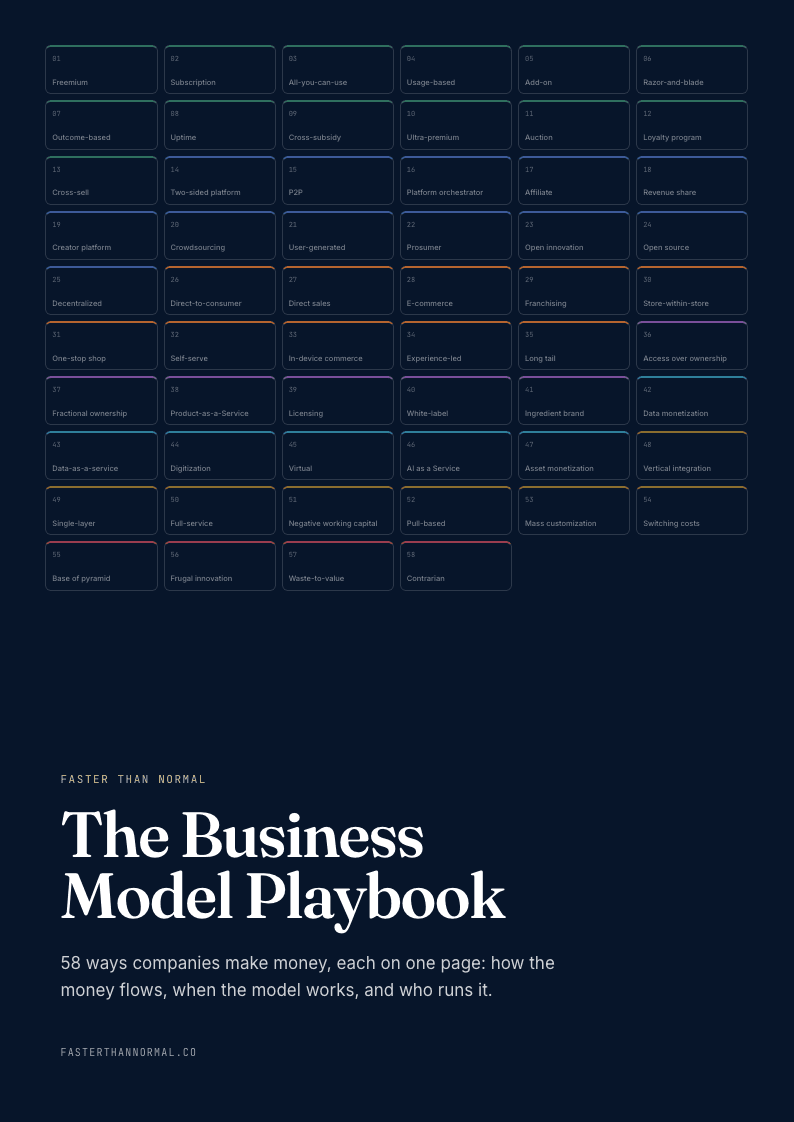
Free playbook
Get The Business Model Playbook
58 business models, one visual page each: how the money flows, the metrics that matter, and who runs it. Free when you join the Faster Than Normal email.
Free. No spam. Unsubscribe anytime.
Part IIIMaxims
-
The customer signal is louder than the investor signal. When fifty VCs say no and your customers keep coming back, the customers are right.
-
Capital scarcity is a feature, not a bug. The companies that learn unit economics under constraint outperform the ones that never had to.
-
Inexperience is a lens. Not knowing why something is "impossible" is the precondition for discovering that it isn't.
-
Prove value before growth. Spending money to scale a product nobody wants is the most expensive way to learn you have no business.
-
Invert the giant's assumption. The dominant player's core belief about the customer is the exact place where a new market can be found.
-
Build human-machine systems, not human-replacement systems. The most defensible technology makes people better at being people.
-
Authentic leadership compounds. Taking maternity leave, hiring for diversity, and building equitable structures are not distractions from the business — they are the business.
-
Rehire yourself annually. The founder who can honestly ask whether she's still the right person for the job is the one most likely to remain so.
-
The boomerang is not failure. Returning to a company you built is not an admission that leaving was wrong — it's evidence that the knowledge you carry is irreplaceable.
-
Depth beats breadth. A smaller number of customers who feel deeply understood will always be worth more than a larger number who feel generically served.
In Their Own Words
I see the business now more through the lens that a public market investor looks through. And that's a different mindset.— Interview on Stitch Fix's approach to goals and efforts
I've learned to prioritize the ideas that bring the most value.— Interview discussing decision-making in business
When hiring people, consider whether or not you could enjoy spending 12 hours traveling with them.— Advice on hiring practices
Having a shared sense of self for the company helps provide more alignment around hiring practices.— Reflection on company values and vision
Make sure to test your hypothesis/product/idea in a low-budget way before you invest more.— Financial advice for entrepreneurs
I felt like no one was really thinking about which jeans are going to fit your body best.— Keynote at Female Founders Fund’s 2019 CEO Summit
It took me awhile to figure out that I could start the company.— Reflection on her journey to founding Stitch Fix
I was not cut from the cloth of somebody who was going to be able to quit my job, have no income, and live in a garage.— On her approach to entrepreneurship
It's really important for me to feel present when I'm at work.— On balancing work and motherhood
It's such an amazing reminder for me of who our clients are and why we're doing this.— On personal styling for clients
I want to feel totally present in everything I do.— On being present in work and home life
I wouldn't say it was a muscle I even had.— Interview on adapting as a founder, 2019
It's both a gift and a challenge to have lots of ideas.— Interview on managing advice, 2019
Make sure to test your hypothesis/product/idea in a low-budget way before you invest more of your or another investor's time and money.— Advice for entrepreneurs, 2019
I had this realization that was like, 'I could do this too.— On starting her company, 2019
I try to bring that same level of being present at home.— Interview on motherhood and work, 2019
I learned to prioritize the ideas that bring the most value.— Interview on decision-making, 2019
I felt like there were a lot of people looking at things like the future of transportation. But I felt like no one was really thinking about which jeans are going to fit your body best.— Katrina Lake, Female Founders Fund CEO Summit, 2019
Do I think that I'm lucky or do I think that I'm actually good at this? And if I'm actually good at this, then I should actually double down on myself and invest in myself.— Katrina Lake, ABC News, 2020
There's never going to be a sense of 'Oh, we solved it!' There's a constant evolution in people's personal style — you might love something today but not next year. That's the challenge.— Katrina Lake, Entrepreneur, 2020
Authentic leadership is especially accessible to women because there's no point in putting on a pantsuit and pretending to be a guy. We can all chart our own paths of what leadership looks like.— Katrina Lake, Fortune, 2021
I still deeply believe in the Stitch Fix business, mission and vision. We know because of the hard work and foundation laid by this team that there is a great future available for this company and we are committed to getting the company on a path to achieve it.— Katrina Lake, Stitch Fix employee memo, January 2023


