


Part IThe Story
The Rug Shop on Little Santa Monica
The address was Beverly Hills, but the office was a fiction. Or nearly so — a sliver of space carved from the front of a rug shop, barely large enough for a desk, a telephone, and the fax machine that its new occupant regarded with something like wonder. It was 1978. Janice Bryant Howroyd was twenty-six years old. She had $1,500 — $500 she'd saved, plus a $900 loan from her mother and another small sum from a brother — and she had a phonebook. No Rolodex of Fortune 500 contacts, no MBA from Wharton, no venture capital term sheet folded into the pocket of a power suit. She had a phonebook. And she had the memory of what it felt like to look for work in Los Angeles and discover that no employment agency was particularly interested in seeing her as a person rather than a problem to be sorted.
What she built from that rug shop over the next four and a half decades — a workforce solutions enterprise now called The ActOne Group, operating in more than thirty-two countries, serving over 17,000 clients, generating north of $3 billion in revenue — is not merely a business success story, though it is that. It is something rarer: a parable about the compound interest earned on personal integrity in an industry that trades, literally, in human capital. Howroyd became the first African American woman to found and own a billion-dollar company. She did it without ever taking outside investment. Without going public. Without a single acquisition funded by debt. She did it the way her mother had taught her to do everything — by figuring out what was missing and taping the answer into the book for the next person.
By the Numbers
The ActOne Group
$3.4BRevenue (USD), global operations
32+Countries of operation
17,000+Clients worldwide
2,600+Employees
1978Year founded
$1,500Startup capital
#39Forbes America's Richest Self-Made Women
Eleven Children and a System of Guardians
Tarboro, North Carolina. Population roughly 10,000 in the 1950s, a tobacco-country town in Edgecombe County where the Tar River bends and the social architecture of Jim Crow was as fixed and unremarkable as the humidity. Janice Bryant was born there on September 1, 1952, the fourth of eleven children raised by John and Elretha K. Bryant. John was a teacher. Elretha was a force — a woman who ran a household of thirteen with the organizational precision of a logistics operation and the moral clarity of a sermon.
The Bryant family's internal governance structure was, in retrospect, Howroyd's first lesson in workforce management. Each child was assigned the sibling immediately older as a mentor — a "guardian angel," in the family's language. Howroyd's appointed angel was her sister Sandy, who was responsible for ensuring that Janice's homework was complete, her hair was done, her thinking was in line with the family's expectations. "We were very organized," Howroyd later told the Los Angeles Times, with the understatement characteristic of someone who learned to run systems before she could articulate what a system was.
The Bryants were not wealthy. The children attended segregated schools where the textbooks arrived pre-damaged — pages torn out, information deliberately missing. When young Janice complained about the books, her father refused to indulge the grievance. "You're smart enough to figure out what's missing," he told her. Her mother went further: find the missing information, write it down, tape it into the book, and leave it for the next student. This was not merely parental encouragement. It was a philosophy of radical responsibility — the idea that your job is not simply to overcome a broken system for yourself but to repair it for whoever comes behind you. Howroyd would carry this instruction, essentially unmodified, into the operating principles of a multibillion-dollar enterprise.
A Teacher's Lesson in the Integrated Classroom
In the eleventh grade, Janice Bryant became one of the first Black students to attend her town's previously segregated high school. The experience was not the triumphant narrative of progress that the national mythology sometimes makes of desegregation. On her first day, a teacher explained to the class — in Howroyd's presence — why Africans were "so well suited to slavery" and how the country would be "much poorer as a society if we went any further with this affirmative action."
She bit the inside of her jaw so hard she could taste blood. She would not cry. Crying, she later explained, would have been conceding. That evening she went home and pleaded with her father to let her leave the school. He gave her three choices: he could confront the teacher himself, she could transfer back to the all-Black high school, or she could hold her head up and return. She chose to return.
This is a small scene, a teenager walking back into a hostile classroom, but it contains the essential architecture of everything that followed. The refusal to be driven out. The insistence on choosing your own response rather than accepting the terms someone else has set. The discovery that biting your jaw — metabolizing the outrage rather than being consumed by it — is itself a kind of power, if you learn to direct it.
— Janice Bryant Howroyd, Black EnterpriseOn the first day of class, I listened to my teacher explain why Africans were so well suited to slavery and how we'd be much poorer as a society if we went any further with this affirmative action.
Howroyd performed well enough at the integrated school to earn a full scholarship to North Carolina Agricultural and Technical State University — the nation's largest Historically Black College and University — where she studied English. She later earned a master's degree from the University of Maryland and a doctorate from North Carolina State University. But the academic credentials, while important, were secondary to something else she'd internalized: the conviction that excellence is not just a personal aspiration but a form of defiance, and that defiance, properly channeled, can become strategy.
Billboard, the Brother-in-Law, and the Office That Didn't Know It Was Waiting
In 1976, Howroyd left Tarboro for Los Angeles. She was twenty-four years old, carried approximately $900, and had come to visit her sister Sandy — the same sister who had once been her "guardian angel." Sandy had married Tom Noonan, who worked at Billboard magazine in the entertainment industry. The plan was a vacation. The vacation became a life.
Tom Noonan is a consequential figure in this story, though he tends to appear only briefly in the retellings. He was the brother-in-law who saw something in Howroyd that she had not yet fully seen in herself — not talent, exactly, but an instinct for making systems work. He gave her a temporary job as his secretary at Billboard's Los Angeles offices, and what happened next has acquired the patina of founding mythology: when Noonan left for a conference in Europe, he put his young sister-in-law in charge.
She reorganized the office. She improved the workflows. She managed the personnel. When Noonan returned, he didn't recognize the physical space — but he recognized that it was functioning better than it ever had. It was Noonan who told Howroyd she should consider "hanging her own shingle." It was Noonan who became her first client.
The Billboard experience taught Howroyd two things that would prove foundational. First, she noticed that many of the magazine's employees were aspiring entertainers — people marking time, waiting for their big break, treating their desk jobs as holding patterns rather than commitments. This was not a moral judgment but an operational insight: misalignment between a worker's aspirations and an employer's needs creates friction, turnover, and waste. Second, she noticed that the temp agencies she'd encountered while looking for her own work in Los Angeles were impersonal to the point of dehumanization. They processed bodies, not people. They filled slots. They did not care whether the fit was right — for the candidate or the company.
Here was the gap. And she had been raised by a woman who taught her to tape the missing pages back into the book.
WOMB: The Anti-Strategy Strategy
The company that Howroyd founded in September 1978 was called ACT-1 Personnel Services — a name that carried a theatrical double meaning she relished. The first act. The beginning. But also: to act. To do something rather than wait.
She opened in that rug shop on what she later described as a Beverly Hills address without "really classy funds." She wanted the cachet of the zip code because in staffing — an industry built on trust — appearances matter. But she had no advertising budget, no marketing department, no salesforce. What she had was a method she would later name with characteristic directness: the WOMB method. "Word-of-Mouth, Baby!"
The strategy, if it can be called that, was devastatingly simple: send companies the right employees, guarantee satisfaction, and let the results speak. If the placement didn't work out, she'd refund the payment. This was not a gimmick. It was an expression of genuine conviction — that if you get the human match right, everything else follows. "It still matters in business more what someone else says about you than what you say about yourself," she told the Los Angeles Times. "You can have the best advertising, but unless someone else certifies what they are saying, you won't last long."
Within a few years, ACT-1 had earned $10 million in revenue. Howroyd had built the business by cold-calling, by making promises and keeping them, and by doing something that her larger competitors — the Manpower Incs. and Kelly Services of the world — had no particular interest in doing: she prepared her candidates. Before sending a worker to a client, she trained them in the company's philosophy, its expectations, its culture. "It always works best when you can tailor a hire to fit into a company's philosophy," she explained. "They walk in better prepared and it's more likely to be a very good fit for your client." This was not rocket science. It was, however, a form of competitive advantage that scaled beautifully — because it was rooted in caring, and caring is the one thing large organizations find almost impossible to systematize.
— Janice Bryant HowroydNever compromise who you are personally to become who you wish to be professionally. It is very difficult to pay yourself back for any moment you've cheated yourself from living life truthfully to who you are.
The Candidate Is the Center of the Universe
Walk into any ActOne Group office and you will encounter a mantra mounted on the wall: The applicant is the center of our universe. This is not decorative. It is operational doctrine — a first principle from which decisions cascade.
The insight behind the mantra is deceptively simple but has profound implications for how the company operates. In the staffing industry, the conventional power hierarchy places the paying client — the corporation seeking workers — at the top. The candidate, the person looking for work, is a commodity to be processed. Howroyd inverted this. Her argument, developed over decades and refined into a governing philosophy, is that if you invest in truly understanding the candidate — their skills, their aspirations, their character, the conditions under which they thrive — then the placements you make will be superior, the retention rates will be higher, and the client will be better served precisely because you prioritized the worker.
"The most important person in the room is the person you're speaking with," Howroyd teaches her employees. Not the most powerful person, not the biggest client, not the CEO. The person in front of you. This is not sentimentality dressed up as business philosophy. It is a structural decision that generates measurable outcomes: deeper candidate loyalty, lower turnover, higher client satisfaction, and — crucially — word-of-mouth referrals that cost nothing and are worth everything.
The approach also reflects something less quantifiable. Howroyd knew what it was like to be the person on the other side of the desk — the one being assessed, categorized, reduced. She had been a temp worker herself, a young Black woman from North Carolina navigating the indifference of Los Angeles employment agencies. She knew what it felt like when nobody asked what you actually wanted, what you were capable of, what kind of work would make you come alive. She built the company she wished had existed for her.
The Geometry of Growth: From Torrance to Thirty-Two Countries
By 1990, Howroyd had relocated ACT-1's headquarters from Beverly Hills to Torrance, California. The company was growing, branching from full-time placements into temporary staffing, then into workforce consulting, background screening, procurement solutions. By 2000, the firm had offices in seventy-five U.S. cities. Clients now included Ford, Toyota, and a roster of Fortune 500 companies across telecommunications, energy, retail, and government.
The expansion was not the result of a single strategic pivot. It was organic — almost biological — driven by the recognition that a company built on understanding human capital could extend its expertise in multiple directions. ActOne Group became an umbrella for a portfolio of specialized divisions: AppleOne for staffing, Agile-1 for managed services and procurement, A-Check Global for background screening, ACT-1 Government for public-sector contracts, AllSTEM Connections for technical talent. Each brand served a different market segment, but all operated under the same foundational principle: the humanity in human resources.
The company crossed the billion-dollar revenue threshold in 2011, landing at number three on Black Enterprise's industrial/service companies list with $1.4 billion in revenues. The milestone made Howroyd the first African American woman to own and operate a billion-dollar company — a distinction she acknowledged with characteristic matter-of-factness. She had not been chasing a number. She had been chasing a standard.
📈
ActOne Group: From Rug Shop to Global Enterprise
Key milestones in four decades of growth
1976
Howroyd arrives in Los Angeles with $900, begins temping at Billboard magazine.
1978
Founds ACT-1 Personnel Services in a Beverly Hills rug shop with $1,500.
1990
Relocates headquarters to Torrance, California; expands beyond full-time placements.
2000
Offices in 75+ U.S. cities; clients include Ford and Toyota.
2011
Crosses $1.4 billion in revenue; recognized as first Black woman to own a billion-dollar company.
2019
Revenues approach $3 billion; launches AllSTEM Connections for technical talent.
2024
Operations span 32+ countries; $3.4 billion in workforce solutions revenue.
The international expansion — what Howroyd calls not "globalization" but "glocalization" — reflects her understanding that labor markets are irreducibly local. You cannot simply transplant an American staffing model into Denmark or Brazil. You must understand the local culture, the local regulations, the local definition of what constitutes a good hire. ActOne's technology platform now services over fifty languages, but the underlying philosophy remains stubbornly humanistic: every placement is a relationship between a person and an opportunity, and relationships do not scale unless you preserve the intimacy at each node.
The Painting in the Hallway
In the hallway of ActOne Group's headquarters hangs a painting inspired by the U.S. Supreme Court decision Brown v. Board of Education, the 1954 ruling that declared school segregation unconstitutional. Howroyd put it there. When asked why, she has said simply: "I'm a product of that energy."
This is worth sitting with. A multibillion-dollar company's headquarters, adorned not with the typical corporate art — the abstract expressionist pieces chosen by interior decorators to signal taste without risking opinion — but with a painting that references the legal destruction of American apartheid. The painting is a declaration of origin. It says: This company exists because the barriers came down. And this company exists because the barriers didn't all come down.
Howroyd has never been shy about the role of race in her story, but she has been precise about how she frames it. She does not perform victimhood. She does not minimize the obstacles. She occupies a more demanding position: acknowledging the structural reality of racial discrimination while refusing to let it define the limits of her ambition. "Janice Bryant Howroyd is an African American female of a certain age," she told Entrepreneur magazine. "You add that formula up and it's a formula designed for failure, right? I'm not supposed to be sitting here having this conversation with you. Then again, yes I am."
The tension in that "then again" — the simultaneous recognition that the odds were stacked and that the odds were beaten — is the tension that animates her entire career. She has never pretended that meritocracy is sufficient. But she has insisted, through her own example, that it is necessary.
What She Would Have Done Sooner
In an interview with Her Agenda, the journalist asked Howroyd what she would have done sooner if she could do it all again. The expected answer — started the company earlier, expanded faster, invested in technology sooner — never came. Instead, Howroyd said something that stopped the interviewer cold: she would have forgiven herself sooner for being a smart Black woman.
The statement requires unpacking. In a cultural moment of "Black Girl Magic" and unapologetic self-celebration, it sounds almost counterintuitive. But Howroyd was pointing to something deeper — the psychic cost of navigating spaces where your intelligence is treated as a provocation, where your competence triggers discomfort, where you must modulate your brilliance to avoid threatening people who hold power over your livelihood. She was talking about the years she spent dimming herself, code-switching, performing a version of deference that her actual capabilities did not require. The energy wasted on that performance — the energy that could have gone into building, creating, leading — is what she mourned.
"You know," she told the interviewer, turning the question back on her, "what did it mean to you to hear me say that? Because it sounds as though it resonated with you in a personal way." This is characteristic Howroyd: redirecting the spotlight, insisting on connection over monologue. The most important person in the room is the person you're speaking with.
The Marriage, the Alzheimer's, and the 100% That Isn't 50/50
Bernard Howroyd — Bernie — was the CEO of AppleOne Employment Services, one of the divisions within the ActOne Group umbrella. The marriage was both personal and professional, a partnership that required what Howroyd describes as "balance" — though her definition of that word is idiosyncratic. "Balance is not 50/50," she says. "Balance is reaching your 100."
The distinction matters. The conventional wisdom of work-life balance assumes a zero-sum equation: more time at work means less time at home, and the goal is to equalize the two. Howroyd rejects this framing entirely. Her version of balance is not about dividing your attention equally but about bringing your full self to whatever you're doing in the moment. "You got to be thoughtful that somebody else is winning along with you," she told an audience at Cal State San Bernardino in January 2020.
That afternoon, she spoke about Bernie — who by then was in the sixth of seven phases of Alzheimer's disease — with a rawness that corporate speeches rarely permit. "My husband, Bernie Howroyd, has loved me well for over 41 years," she said. "He has supported everything I've ever wanted to do." The past tense was not grammatical but existential. He was present "in her heart and her spirit," she said, even as the disease had taken much of the man she married.
The detail matters because Howroyd's story is often told as a narrative of pure professional triumph — the $900, the rug shop, the billion-dollar milestone. But the fuller story includes the costs of the climb, the private dimensions of a public life, the fact that building a global enterprise while raising a family while maintaining a marriage while navigating the racial and gender dynamics of American business is not a linear progression but a daily negotiation with competing demands, each of which is total.
Taping Pages Into the Book
Howroyd has given a great deal of money away. She is the first African American to gift $10 million to the University of Southern California. She has donated millions to North Carolina A&T, her alma mater. She sits on the Women's Leadership Board at Harvard University, where she was recently elected chair. She served on President Obama's Board of Advisors on Historically Black Colleges and Universities. She has been a U.S. Department of Energy Ambassador for Minorities in Energy and a member of the Federal Communications Commission's Advisory Committee on Diversity and Digital Empowerment.
The philanthropy is not separate from the business. It is an extension of the same principle her mother articulated in Tarboro: find what's missing, write it down, tape it in, leave it for the next person. When Howroyd funds scholarships for students at HBCUs, she is taping pages. When she endows career development programs at Nash Community College in her native North Carolina, she is taping pages. When she establishes partnerships between ActOne Group and universities to provide career services for students and alumni, she is taping pages.
During a company President's Council meeting, a vice president once asked Howroyd what her next measure of success would look like. She didn't cite a revenue target or a market share goal. "What would really please me," she answered, "is if everybody who works in our company who wants to own a home can afford to own one." Near the end of that year, the VP brought her a large gift wrapped in gold ribbons. Inside was documentation that the goal had been achieved — or at least meaningfully advanced.
The anecdote reveals something essential about the kind of leader Howroyd is. She does not separate her company's financial performance from the material well-being of its employees. She does not treat human capital as a metaphor. She means it literally: the people are the capital, and if the people aren't thriving, the capital is depreciating.
— Janice Bryant HowroydI've never once doubted that I could achieve what I set out to do, because I framed my goals around principles and values that I could be comfortably aggressive about and sustainably enduring about.
A Six-Thousand-Book Library and the Poem on the Wall
Howroyd's personal library contains over 6,000 volumes. She is the author of two Amazon bestsellers: The Art of Work: How to Make Work, Work for You!, published in 2009, and Acting Up: Winning in Business and Life Using Down-Home Wisdom, published in 2019. Both books synthesize the principles she learned in Tarboro and applied in Beverly Hills and Torrance and thirty-two countries beyond — the centrality of integrity, the compound returns of treating people as ends rather than means, the insistence that personal values and professional ambitions are not adversaries but allies.
She has spoken at commencements, at the United Nations, at conferences for the Women's Business Enterprise National Council. She maintains what her website describes as "one of the most motivational social media presences across all social platforms" — a characterization that is both accurate and telling, because Howroyd treats social media the way she treats staffing: as a tool for connection, not broadcast.
Among her favorite works of literature is Rudyard Kipling's poem "If" — the one that begins "If you can keep your head when all about you / Are losing theirs and blaming it on you." It is a poem about composure under duress, about maintaining your identity when the world conspires to strip it from you. It is, in other words, a poem about biting the inside of your jaw and walking back into the classroom.
Her company's motto — "Never compromise who you are personally to become who you wish to be professionally" — hangs on ActOne Group walls the way the Brown v. Board painting hangs in the hallway. Not as decoration but as instruction. As load-bearing philosophy.
The Missing Pages
In Tarboro today, the Bryant family is remembered. Janice was inducted into the Twin County Hall of Fame in 2018. She returns to the region, funds local institutions, speaks at Nash Community College. The town that shaped her — with its segregated schools and its missing textbooks and its teachers who justified slavery to a child's face — is not something she has escaped. It is something she has answered.
The answer is not revenge. It is not bitterness. It is the daily, operational, relentless practice of building something that generates opportunity for millions of people, in fifty languages, across thirty-two countries, and of doing it without ever abandoning the values of a woman in North Carolina who told her daughter to tape the missing pages into the book.
Somewhere in the ActOne Group headquarters, the painting of Brown v. Board faces a hallway that employees walk through every morning. Somewhere in Tarboro, a textbook may still be missing pages. And somewhere between those two facts — the constitutional ideal and the material reality, the aspiration and the gap — lives the entire career of Janice Bryant Howroyd: a woman who started with a phonebook and refused to accept that the world had to stay the way she found it.
Part IIThe Playbook
Janice Bryant Howroyd built a multibillion-dollar global enterprise from $1,500 and a rug shop without outside capital, without acquisitions fueled by debt, and without ever compromising the personal values she learned as the fourth of eleven children in segregated North Carolina. The following principles distill the operating logic behind that achievement — not as inspirational platitudes but as strategic decisions that compounded over four decades.
The principles
- 1.Invert the power hierarchy.
- 2.Build on WOMB: let your clients sell for you.
- 3.Turn biography into competitive advantage.
- 4.Prepare the candidate, not just the placement.
- 5.Use constraints as innovation fuel.
- 6.Refuse to separate personal values from professional strategy.
- 7.Glocalize, don't globalize.
- 8.Define balance as 100%, not 50/50.
- 9.Make the next person's path easier.
- 10.Keep the company private to keep the values intact.
- 11.Forgive yourself for your strengths.
- 12.Measure success in human terms.
Principle 1
Invert the power hierarchy
The staffing industry's default logic treats the paying client — the corporation — as the customer to optimize for, and the job candidate as interchangeable inventory. Howroyd reversed this. By making "the applicant the center of the universe," she created a structural incentive to deeply understand candidates' capabilities, aspirations, and fit. Superior candidate understanding produced superior placements, which produced higher retention rates, which produced happier clients, which produced referrals.
The inversion was not altruism. It was strategy. When you invest in understanding the supply side of a marketplace more deeply than your competitors do, you develop informational advantages that compound over time. Candidates who feel seen become loyal to the platform that saw them. Clients who receive consistently excellent hires stop shopping around. The entire flywheel spins faster precisely because the starting point is empathy rather than extraction.
Tactic: Identify the least-powerful stakeholder in your value chain and rebuild your operations around serving them first — the improvement in quality will flow upward to every other stakeholder.
Principle 2
Build on WOMB: let your clients sell for you
Howroyd's "WOMB" strategy — Word-of-Mouth, Baby! — was born of necessity (she had no marketing budget) but evolved into a deliberate competitive moat. In an industry where trust is paramount, a referral from a satisfied client carries more weight than any advertisement. Howroyd guaranteed her placements, backing them with a refund promise. This eliminated risk for new clients and created a virtuous cycle: every successful placement generated the next conversation.
The deeper insight is about capital allocation. Every dollar not spent on advertising was a dollar available for investing in the quality of the service itself — better candidate preparation, better client matching, better follow-through. Howroyd effectively redirected her marketing budget into her product, and the product marketed itself.
Tactic: Before investing in paid acquisition, ask whether the same capital spent improving your product's quality would generate more referrals than the ads would generate clicks.
Principle 3
Turn biography into competitive advantage
Howroyd's experience as a young Black woman navigating hostile schools and indifferent employment agencies was not merely a backstory. It was a source of genuine insight that her competitors — predominantly older white males running large staffing firms — simply did not possess. She knew what it felt like to be reduced to a demographic category. She knew what it felt like when no one asked what you were actually good at. This knowledge informed every operational decision, from how ActOne trained its recruiters to how it designed its candidate intake process.
🔄
Conventional Staffing vs. ActOne's Approach
How lived experience translated into operational differentiation
| Conventional staffing firms | ActOne under Howroyd |
|---|---|
| Optimize for the paying client | Optimize for the candidate |
| Process candidates as inventory | Prepare candidates as future employees |
| Mass-market advertising | Word-of-mouth referral engine |
| Standardized, impersonal intake | Personalized matching based on aspirations and fit |
| Scale through acquisition | Scale through organic growth and reputation |
The lesson is not that suffering is useful. It is that outsider status, when metabolized rather than merely endured, produces market intelligence that insiders cannot access.
Tactic: Audit the moments in your life where you were underserved by an existing market — those moments contain product insights that incumbents are structurally blind to.
Principle 4
Prepare the candidate, not just the placement
One of Howroyd's earliest differentiators was training candidates before sending them to clients. She prepared prospective hires on the employer's philosophy, expectations, and culture — ensuring they arrived not just qualified but oriented. This reduced the friction of onboarding, improved first-day performance, and dramatically increased the likelihood of a successful long-term match.
The practice sounds obvious. But in a staffing industry optimized for speed and volume, it represented a genuine cost — in time, in effort, in the delay between filling an order and filling it well. Howroyd absorbed that cost because she understood that a placement is not a transaction but a relationship, and relationships thrive on preparation.
Tactic: Add a preparation step before delivering your product or service — invest in ensuring the customer is ready to succeed with what you provide, not just ready to receive it.
Principle 5
Use constraints as innovation fuel
Howroyd started with no fax machine, no advertising budget, and no industry connections. "I thought I was Judy Jetson when I got my fax machine," she later joked. Her parents raised eleven children in a segregated community on teachers' salaries. Her childhood textbooks were missing pages. Every foundational fact of her life was a constraint.
But the Bryants did not teach their children to complain about constraints. They taught them to innovate within them. When the textbook is missing pages, you find the information and tape it in. When you can't afford a premium office, you rent the front of a rug shop and choose a Beverly Hills zip code. When you have no marketing budget, you guarantee your product and let satisfied clients do the selling.
This is not merely motivational. It is a strategic orientation. Constraints force specificity, creativity, and focus in ways that abundance never does. Howroyd's entire business model — the WOMB method, the candidate preparation, the personalized service — was designed under constraint and would not have been designed the same way with unlimited resources.
Tactic: Before seeking more capital, ask what your current constraints are forcing you to do differently from incumbents — the difference may be your edge.
Principle 6
Refuse to separate personal values from professional strategy
"Never compromise who you are personally to become who you wish to be professionally." This is not a platitude for Howroyd. It is an operating principle with specific strategic implications: she only does business with companies she would "send a relative to." She builds relationships with clients based on shared values, not just shared economics. She has walked away from opportunities that required her to compromise her standards.
The argument for this approach is both moral and financial. In a people business, authenticity is the scarcest resource. Clients and candidates can sense when a company's stated values are performative. When they sense genuineness — when the company's culture is actually what it claims to be — the trust compounds. And trust, in staffing, is literally the product.
Tactic: Articulate a personal value you refuse to violate in business, then test every major decision against it — the consistency will become a competitive asset.
Principle 7
Glocalize, don't globalize
Howroyd's term for ActOne's international expansion — "glocalization" — captures a strategic nuance that many scaling companies miss. She recognized that labor markets are irreducibly local: the cultural norms, regulatory frameworks, candidate expectations, and employer needs in Brazil differ fundamentally from those in Denmark or the United Kingdom. ActOne's technology platform services over fifty languages, but the company's approach in each market is adapted to local conditions.
This is expensive. It is slower than simply replicating a single model across geographies. But it produces something that one-size-fits-all globalization cannot: genuine local credibility. In a business built on trust, credibility is everything.
Tactic: When expanding into new markets, invest in understanding local context before scaling your existing model — adaptation is slower but produces more durable market position.
Principle 8
Define balance as 100%, not 50/50
Howroyd's definition of balance — "Balance is reaching your 100" — rejects the zero-sum framing of work-life balance. Her argument is that the goal is not to divide your attention equally between competing priorities but to be fully present in whatever you are doing at any given moment. When you're working, be completely at work. When you're with family, be completely with family. The 100% is not about hours; it's about presence.
This is a subtle but transformative reframe. The conventional balance discourse produces guilt — you're never enough in either domain. Howroyd's version produces focus — you're always enough in the domain you're currently in. "Balance isn't levered by you alone," she adds. "You got to be thoughtful that somebody else is winning along with you." The full-presence model requires delegation, trust, and the willingness to let other people carry weight — which is itself a leadership skill.
Tactic: Stop measuring balance by time allocation and start measuring it by quality of presence — then build systems (delegation, boundaries, rituals) that protect that presence.
Principle 9
Make the next person's path easier
The Bryant family's textbook principle — find what's missing, tape it in, leave it for the next student — is a philosophy of compounding generational impact. Howroyd has applied it to philanthropy ($10 million to USC, millions to NC A&T, scholarships and career development programs across multiple institutions), to corporate policy (ActOne's career services partnerships with universities), and to mentorship (her books, her social media presence, her speaking engagements).
The strategic dimension of this principle is often overlooked. By investing in the pipeline — in the education and development of future workers and future entrepreneurs — Howroyd is simultaneously serving her industry and building her brand. The students she funds today may become the candidates ActOne places tomorrow, or the clients who hire through ActOne, or the entrepreneurs who partner with ActOne. The generosity creates a network effect that is both genuine and strategic.
Tactic: Identify a systemic barrier faced by the people you serve and invest in removing it — the long-term returns will exceed any short-term marketing spend.
Principle 10
Keep the company private to keep the values intact
ActOne Group has never gone public. It has never taken outside investment. It remains the largest privately held, woman-minority-owned workforce solutions company in the United States. This is not an accident or an oversight. It is a deliberate strategic choice.
Public markets impose quarterly reporting cadences, activist shareholder pressure, and governance requirements that can erode the kind of values-driven, long-term decision-making that defines ActOne's culture. By staying private, Howroyd retains complete control over the company's direction, its culture, and its commitment to the principles that have driven its growth since 1978. She can choose clients based on values, not just revenue. She can invest in employee well-being without defending the expenditure to analysts. She can prioritize reputation over growth rate.
Tactic: Before seeking external capital, calculate the cost of the control you'll surrender — some companies are more valuable precisely because they remain privately held.
Principle 11
Forgive yourself for your strengths
Howroyd's most counterintuitive insight — that she should have forgiven herself sooner for being a smart Black woman — points to a hidden tax on talent that operates outside any financial model. The energy spent dimming yourself, performing deference, managing others' discomfort with your competence is energy diverted from creation, leadership, and growth.
This principle applies far beyond racial and gender dynamics. Any founder who has ever softened a pitch, undersold a capability, or deferred to someone less qualified out of social anxiety knows the cost. The forgiveness Howroyd describes is not about arrogance. It is about permission — the permission to operate at your full capacity without apology.
Tactic: Identify the specific ways you modulate your competence to make others comfortable, then systematically stop — the energy you reclaim is your highest-leverage resource.
Principle 12
Measure success in human terms
When a vice president asked Howroyd what her next measure of success looked like, she didn't name a revenue target. She said she wanted every employee who wanted to own a home to be able to afford one. This is not a soft metric. It is a radical reframe of what a company exists to do.
Howroyd's argument is that you cannot call yourself a leader if you're living well while the people you lead are not. This is not socialism; it is long-term capitalism. Employees who can afford homes are more stable, more productive, more loyal. They have a stake in the community and, by extension, in the company that helped them get there. The human metric and the financial metric converge.
Tactic: Identify one material quality-of-life metric for your team and elevate it to a strategic goal — the alignment between human flourishing and organizational performance is tighter than most leaders acknowledge.
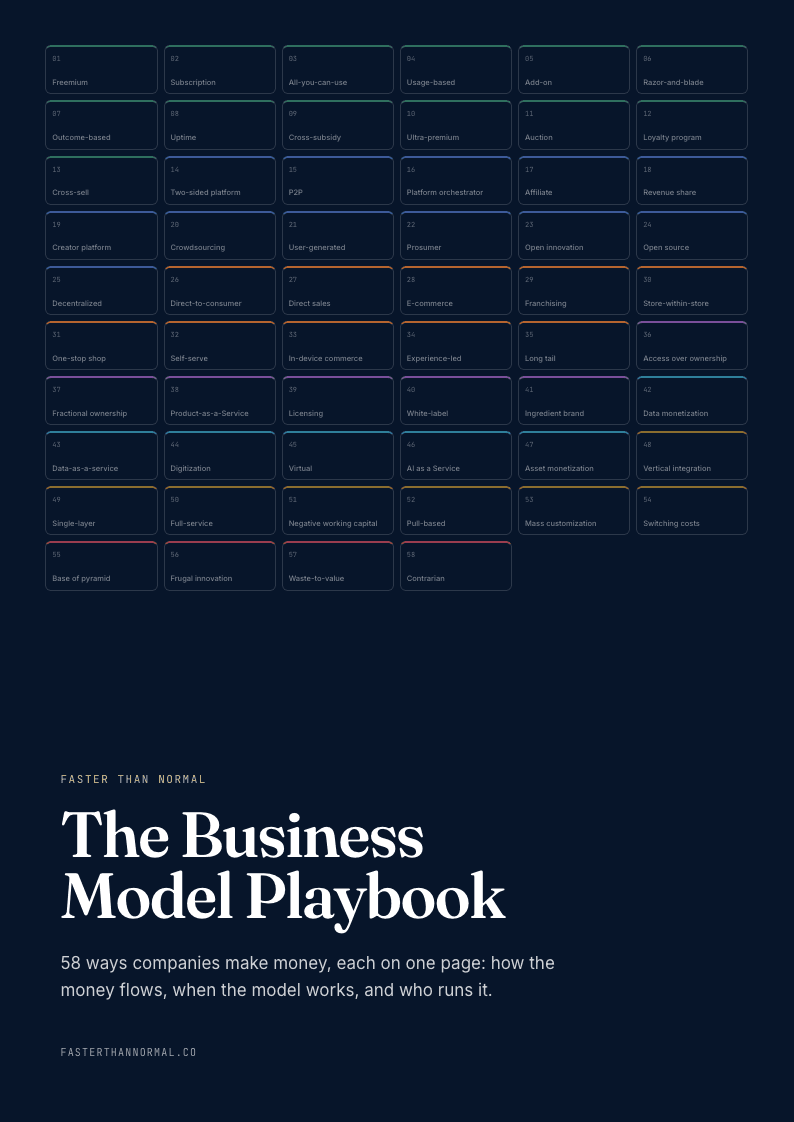
Free playbook
Get The Business Model Playbook
58 business models, one visual page each: how the money flows, the metrics that matter, and who runs it. Free when you join the Faster Than Normal email.
Free. No spam. Unsubscribe anytime.
Part IIIMaxims
-
The applicant is the center of the universe. Build your business around the least powerful stakeholder in your value chain, and the most powerful stakeholders will benefit.
-
Word-of-Mouth, Baby. The most cost-effective marketing is a product so good that your customers become your salesforce.
-
Tape the missing pages into the book. When you encounter a broken system, don't just navigate it — repair it for whoever comes after you.
-
Jobs don't have futures; people do. Invest in the human, not the position, and you'll create value that outlasts any single role.
-
You're smart enough to figure out what's missing. Constraints are not excuses; they are invitations to innovate.
-
Attitude beats aptitude. Character, work ethic, and alignment with values are more predictive of success than raw credentials.
-
You can't call yourself a leader if the people you lead aren't thriving. Leadership is measured by the material well-being of those who follow, not by the leader's own prosperity.
-
What my mind conceives and believes, I achieve. Conviction is not delusion — it is the precondition for execution.
-
In order to be outstanding, sometimes you're just gonna have to stand out. Visibility is the cost of excellence; pay it without apology.
-
One cannot effectively lead without passionately serving. Service and authority are not opposites; they are the same thing practiced at different scales.
In Their Own Words
When I founded my business, I did not have the technology that I employ today to help immediate success as well as strategic success. All I had was a brain, a phone and a phonebook.— CNBC iCONIC conference, November 2020
The advantage of technology has given so much to the business world. I think it does require a very careful, and in some terms, actually artful attention to utilizing technology in a smart way.— CNBC iCONIC conference, November 2020
Forgive yourself for being a smart Black woman.
You can't be afraid to fail. It's the only way you learn.
Success is not just about what you accomplish in your life, it's about what you inspire others to do.
I believe that if you can see it, you can be it.
Your identity is your greatest asset.
Diversity is not just a metric; it's a mindset.
The road to success is always under construction.
Every day is a new opportunity to make a difference.
Empowerment is about giving people the tools to succeed.
You have to be willing to take risks to achieve greatness.
I wish someone had told me that I could forgive myself for being a smart Black woman.— Interview with Her Agenda, 2023
You can't be afraid to fail. It's the only way to learn.
To be a successful entrepreneur, you must be willing to take risks and embrace change.
I believe that every challenge is an opportunity in disguise.
Your identity is your greatest asset. Own it.
The journey of a thousand miles begins with one step.
Empowerment is about creating opportunities for others.
In business, you must be both a dreamer and a doer.
Never let anyone tell you that you can't do something.
Never compromise who you are personally to become who you wish to be professionally.— Janice Bryant Howroyd
Janice Bryant Howroyd is an African American female of a certain age. You add that formula up and it's a formula designed for failure, right? I'm not supposed to be sitting here having this conversation with you. Then again, yes I am.— Janice Bryant Howroyd, Entrepreneur magazine
The most important person in the room is the person you're speaking with. Not the most powerful person, the biggest client, or the CEO. The correct answer is the person you're speaking with.— Janice Bryant Howroyd, Authority Magazine
Balance isn't levered by you alone. You got to be thoughtful that somebody else is winning along with you.— Janice Bryant Howroyd, Cal State San Bernardino


