

Part IThe Story
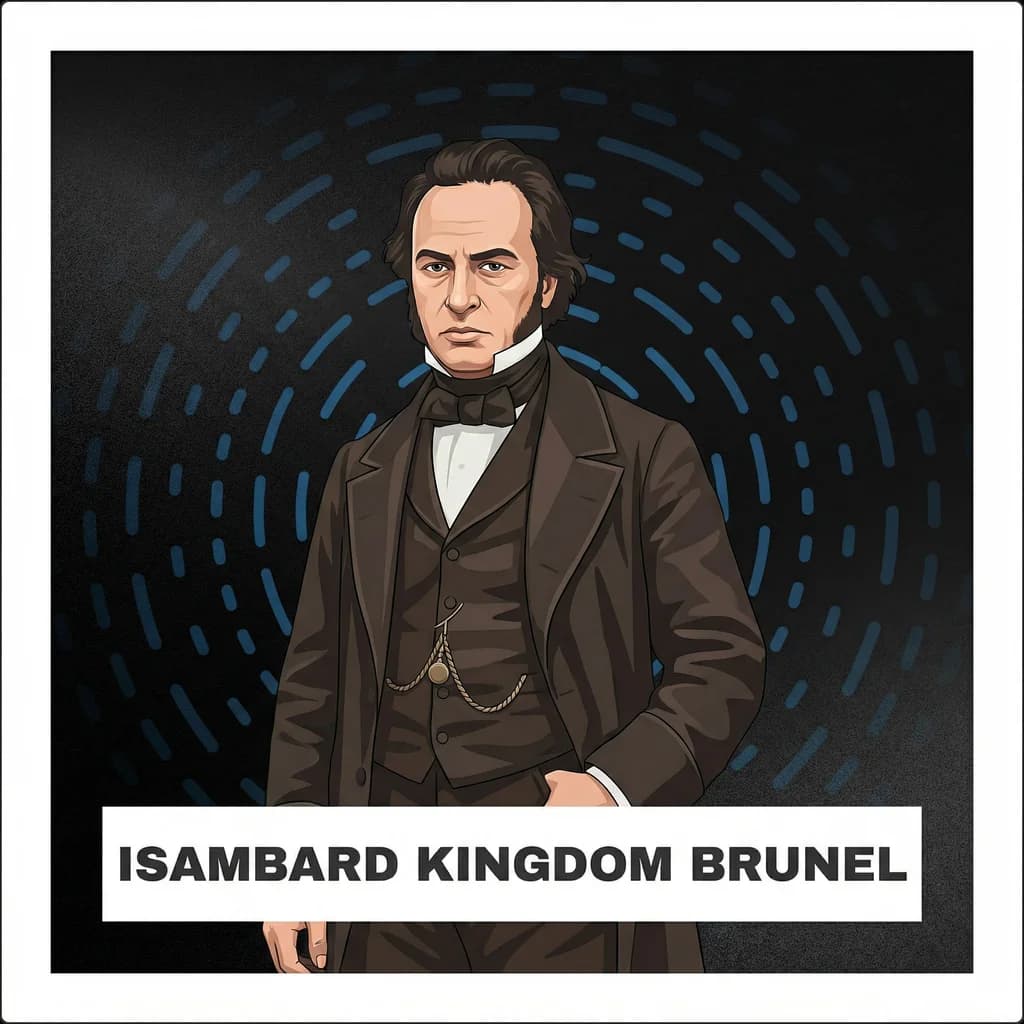
Isambard Kingdom Brunel was the defining engineer of the Victorian age—a man who built railways, ships, tunnels, and bridges that seemed to defy the limits of what was possible. In an era when Britain was industrializing at breakneck speed, Brunel did not follow precedent; he set it. The Great Western Railway, the SS Great Britain, the Thames Tunnel, and the Clifton Suspension Bridge are not merely projects. They are arguments, in iron and steam, for a different scale of ambition.
Brunel was born in Portsmouth in 1806, the son of Marc Isambard Brunel, a French émigré engineer who had fled the Revolution. The father had already made his name with block-making machinery for the Royal Navy and with the first tunnel under a navigable river—the Thames Tunnel at Rotherhithe. The son grew up inside that project: he was educated in England and France, then thrust into the tunnel works as a teenager. When the Thames flooded the tunnel in 1828, Brunel was nearly killed; he was carried out unconscious and spent months convalescing. The disaster did not temper his ambition. It sharpened it.
By the Numbers
Brunel's Legacy
1833Appointed engineer of the Great Western Railway (age 27)
7 ft 0¼ inBroad gauge (GWR) vs 4 ft 8½ in standard
1843SS Great Britain launched—first iron, propeller-driven ocean steamer
1859Death, age 53; Great Eastern launched same year
322 ftLength of SS Great Britain (98 m)
~1,300 ftThames Tunnel (Rotherhithe–Wapping)
The Great Western Railway
In 1833, at 27, Brunel was appointed chief engineer of the Great Western Railway (GWR), the line that would link London with Bristol and the West of England. He did not simply lay track. He reimagined the system. He chose broad gauge—7 feet 0¼ inches between the rails instead of the emerging "standard" of 4 ft 8½ in—arguing that wider gauge allowed higher speeds, greater stability, and larger rolling stock. The GWR became a technological showpiece: sweeping curves, minimal gradients, and the famous Box Tunnel, then the longest railway tunnel in the world. Broad gauge was eventually abandoned in favor of the national standard, but for decades the GWR was the fastest and most comfortable way to travel by rail in Britain.
Brunel's vision extended beyond the rails. He conceived of the GWR as one leg of a continuous journey: train from London to Bristol, then steamship across the Atlantic. The Great Western Steamship Company was formed to realize that idea. In 1838 the SS Great Western, a wooden paddle steamer, crossed the Atlantic in 15 days. It was the first purpose-built transatlantic steamship and proved that steam could compete with sail on the ocean.
SS Great Britain and the Shift to Iron and Propeller
The next step was bolder. In 1843, the SS Great Britain was launched—the first ocean-going ship built of iron and driven by a screw propeller rather than paddle wheels. She was the largest vessel afloat. Brunel had pushed the limits of materials and propulsion; the ship would later run aground in Ireland and be repurposed for decades as an emigrant ship to Australia, but her design principles—iron hull, propeller, longitudinal framing—became the template for modern shipping.
Brunel did not stop. His final and most grandiose project was the SS Great Eastern, designed to carry 4,000 passengers to Australia without refueling. She was six times the tonnage of any ship then built. Construction was plagued by cost overruns, technical failures, and Brunel's deteriorating health. He died in 1859, days before the Great Eastern's maiden voyage. The ship never achieved commercial success as intended, but she later laid the first lasting transatlantic telegraph cable—a fitting coda for an engineer who had always thought in systems.
Bridges, Tunnels, and the Cost of Ambition
Beyond rail and ships, Brunel left a trail of structures: the Clifton Suspension Bridge (designed in his twenties, completed after his death), the Royal Albert Bridge at Saltash, and the Thames Tunnel, which he and his father drove through fluid, treacherous ground. He took risks that would be unthinkable today—personally descending into flooded tunnels, pushing contractors and financiers to the edge of bankruptcy, and staking his reputation on unproven technology.
That appetite for risk defined him. He was often wrong: broad gauge lost the "gauge war"; the Great Eastern was a commercial failure. But when he was right, he was decades ahead. The lesson of Brunel is not that every bet pays off. It is that the scale of what gets built is set by the scale of what is attempted—and that the most lasting impact often comes from the projects that fail in their original form but change the frontier of what is possible.
Part IIThe Playbook
Brunel's career yields a small set of principles that apply far beyond Victorian engineering: how to think in systems, how to own the full stack, and how to treat failure as the price of ambition.
Think in systems, not projects
Brunel did not build a railway and stop. He built a railway that connected to a steamship line that connected London to New York. He designed the Great Eastern not as a ship but as a node in a global transport and communications network. The same instinct drove the Thames Tunnel: it was not just a crossing but part of a vision for moving people and goods under and over geography.
Tactic: When you are building something large, ask what the next link in the chain is. Design so that your output becomes someone else's input—or so that your project can be the first leg of a longer journey.
Own the full stack
Brunel was not only the engineer; he was the designer of the track, the stations, the locomotives, the ships, and the company structures that funded them. He insisted on controlling the entire system so that no component would constrain the others. Broad gauge was a choice that only made sense if the whole GWR was built to that standard—and he made sure it was.
Tactic: Where you have the leverage, own the critical path end to end. Accept interfaces and standards only when you must; when you can define them, do.
Bet on new materials and new methods
Iron ships, screw propellers, and broad gauge were all controversial. Brunel adopted them because he believed they were superior, not because they were proven. He was willing to be wrong in public—and he often was. The payoff was that when he was right, the industry moved with him.
Tactic: Allocate a share of your portfolio to the unproven. Treat failure as tuition. The goal is not to be right every time but to be right when it matters and to move the frontier when you are.
Free playbook
Get The Business Model Playbook
58 business models, one visual page each: how the money flows, the metrics that matter, and who runs it. Free when you join the Faster Than Normal email.
Free. No spam. Unsubscribe anytime.
Part IIIMaxims
- Build the next link. Design every project so it connects to the next—rail to ship, ship to cable, tunnel to network.
- Own the stack. Control the full system where you can; don't let someone else's standard cap your ambition.
- Bet on iron. New materials and new methods are the only way to shift the frontier; accept failure as the cost of being first.
- Scale is a choice. The Great Western Railway and the Great Eastern were as large as they were because Brunel refused to think small. The constraint was rarely technology; it was imagination and capital.
- Death before complacency. Brunel died at 53, exhausted by the Great Eastern. He never stopped pushing. The lesson is not to work yourself to death but to treat the long game as the only game—and to build so that others can continue when you cannot.
In Their Own Words
The railway now is in progress. I am thus engineer to the finest work in England. A handsome salary, on excellent terms with my directors & all going smoothly. But what a fight we have had, & how near defeat, & what a ruinous defeat it would have been.
Cornwall is such that no railway can be constructed at moderate expense without either sacrificing all consideration for the interest of localities & the position of the population to the mere choice of levels, or without steep gradient and sharp curves.
My confidence in the shield is not only undiminished—it is, on the contrary, tried with its full effect, & it is manifest now that it will soon replace us in good ground, & in a safe situation. No top staves have given way. That is our real protection.
Of all the wonderful feats I have performed, since I have been in this part of the world, I think yesterday I performed the most wonderful. I produced unanimity among 15 men who were all quarrelling about that most ticklish subject - taste.
If we must have heroes and wars whereinto make them, there is no war so brilliant as a war with the wrong, no hero so fit to be sung, as he who has gained the bloodless VICTORY of truth and mercy.
I am opposed to the laying down of rules or conditions to be observed in the construction of bridges lest the progress of improvement tomorrow might be embarrassed or shackled by recording or registering as law the prejudices or errors of today.
I can only say that I have always considered that the gauge was the most important question involved in the success of the railway.— Isambard Kingdom Brunel (on the choice of broad gauge for the GWR)
The history of the Great Eastern is a history of difficulties overcome, and of obstacles surmounted.— Brunel (on the Great Eastern and perseverance)
Further reading
- Isambard Kingdom Brunel by L T C Rolt


