


Part IThe Story
The Garage in Deutsch-Wagram
On the morning of July 27, 1999, in an underground parking garage in Luxembourg, a seventy-year-old Austrian man who had never fired a gun professionally until he was past fifty found himself staring at a new sports car when a massive, masked figure lunged from the shadows and brought a rubber mallet down on his skull. The attacker was Jacques Pêcheur — a sixty-seven-year-old former French Foreign Legionnaire and professional wrestler whose ring name, Spartacus, suggested a man accustomed to more dramatic instruments of violence. The mallet was the point. The scheme, orchestrated by Gaston Glock's own financial adviser, Charles Ewert — known in the shadow economy as "Panama Charlie" for his virtuosity with shell corporations registered in that country — was designed to look like an accident, an old man tumbling down concrete stairs. Seven blows to the head. A quart of blood lost. And yet the old man, whose legs were toned by miles of daily swimming, drove his enormous fist into Pêcheur's eye socket, then struck again, knocking out several of the assassin's teeth. When police arrived at 9:30 a.m., both men lay semiconscious on the garage floor, the would-be killer splayed on top of his victim "with his arms outstretched like Jesus Christ," as Luxembourg's deputy attorney general later described the scene.
By 12:30 that afternoon — three hours after having his skull caved in — Gaston Glock had summoned his personal bankers at UBS and Banque Ferrier Lullin and managed to move $40 million of the $70 million in cash that Ewert had access to into a secure Swiss account. Ewert, faster than anyone anticipated, had already frozen the remaining $30 million with a court order. Even semiconscious and bleeding, Glock understood that survival was a financial problem before it was a medical one.
This is the kind of man who invents a gun that conquers America while knowing almost nothing about guns. Gaston Glock was not an arms dealer, not a military strategist, not a marksman. He was a curtain rod manufacturer from a town twenty kilometers outside Vienna whose surname happened to rhyme with lock, pop, cop, shock, drop — a phonetic gift that would deliver him, decades later, into the lyrics of Tupac Shakur and the Wu-Tang Clan, onto the belts of two-thirds of American police officers, and into the glass display case of a United States president. His story is a parable about the outsider's advantage, about the peculiar power of starting from nothing, about what happens when a man with no preconceptions encounters an industry encrusted with a century of received wisdom and asks, simply: What would you actually want?
By the Numbers
The Glock Empire
94Age at death (December 27, 2023)
65%+U.S. law enforcement agencies issued Glock pistols
34Total parts in a standard Glock pistol
17Rounds in the original Glock 17 magazine
$1.1BEstimated family fortune (Forbes, 2021)
~$500MEstimated annual Glock revenue
580,000+Pistols produced at U.S. plant alone (2021)
The Curtain Rod Manufacturer's Wager
Gaston Glock was born on July 19, 1929, in Vienna, the son of an Austrian railroad worker. The details of his early life are sparse — deliberately so, it seems, for a man who would spend his later decades behind the walls of a guarded lakefront estate in Carinthia, shunning the press with a consistency that bordered on compulsion. What is known: as a teenager he was conscripted into the Wehrmacht in the waning months of World War II, an experience he never discussed publicly and that left him, by all accounts, without any romantic attachment to firearms. After the war he studied mechanical engineering at a college in Vienna, then joined a hand-drilling company, working for others until he was nearly thirty.
In 1963, using the savings he and his wife Helga had intended for an apartment, Glock founded Glock KG in Deutsch-Wagram, Lower Austria. Three employees. A secondhand metal press. The product line: curtain rods, drawer parts, door hinges. The ambition, at this point, was modest — a small manufacturer of injection-molded consumer goods, plastic and metal, nothing that would merit a second glance from anyone. But Glock had an instinct for polymer, for the marriage of synthetic materials and precision engineering, and this instinct would prove to be the hinge on which everything turned.
By the 1970s, the company had edged into military supply. First the FM 78 field knife — a polymer-handled blade with a surface-treated sheath — then fragmentation grenade casings, then machine gun belt links. Small contracts with the Austrian army. Nothing glamorous. But each contract brought Glock closer to the ministry officials and military officers who would, in 1980, provide him with the opportunity of his life.
Overheard at the Ministry
The origin story of the Glock 17 has the texture of myth, but the details are well-documented enough to be believed. Sometime in early 1980, Gaston Glock — then fifty years old, visiting the Austrian Ministry of Defense on routine knife-and-grenade business — overheard two colonels complaining. The Austrian army wanted to replace its antiquated Walther P38 pistols, standard issue since World War II. The Ministry of Defense had published a list of seventeen criteria for the new sidearm. Multiple established manufacturers, including the well-regarded Austrian firm Steyr Mannlicher, had been working on submissions for years. None had satisfied the colonels.
Glock asked permission to enter the competition. The response was incredulity — polite or otherwise, depending on the telling. Here was a man who had never designed a firearm, never manufactured one, had not personally handled a gun since his teenage conscription three and a half decades earlier. His company made curtain rods and grenade casings. The established firearms industry, particularly Steyr, had a good laugh.
What Glock did next was methodical to the point of obsession. He purchased and disassembled every significant modern pistol on the market — SIG Sauer, Beretta, CZ, Walther — studying their mechanical principles the way an engineer would study a competitor's widget. On May 8, 1980, he convened three handgun experts: Siegfried Hubner, Richard Silvestri, and Friedrich Dechant. He put a single question to them: What would you want in a pistol of the future?
The men signed a written document — still preserved at Glock company headquarters — outlining the parameters. A lightweight pistol in 9mm with clean lines. No external safety. Less than twenty-nine ounces. Large magazine capacity. A specific trigger pull range. No more than forty parts, arranged in independent subgroups for ease of maintenance. A barrel hammer-forged in one manufacturing operation. The ability to withstand a double load of 9mm. The gun should not fire when dropped from two meters onto any surface. Glock added his own insistence: the pistol should be point-shootable without sights, fired by instinct. After extensive testing, they agreed on a grip angle of twenty-two degrees, later revised to 21.5.
Then Glock retreated to his basement.
— Gaston GlockThat I knew nothing was my advantage.
He tested each prototype himself, firing with his weaker left hand — so that if the gun exploded, he could continue his design work with his right. Four of these early prototypes still exist. Nearly a year after that meeting with the three experts, on April 30, 1981, Glock applied for the patent.
Thirty-Four Parts and a Revolution
The gun that emerged from Glock's basement was, by the standards of the firearms industry, an act of heresy. The Glock 17 — named not for its seventeen-round magazine capacity, which was coincidental, but because it was Gaston Glock's seventeenth patent — was made primarily of injection-molded polymer. Its frame was a high-strength, nylon-based plastic. Only the slide, barrel, and springs were metal. It weighed roughly twenty-five ounces unloaded, a dramatic reduction from the steel-and-walnut revolvers that had dominated law enforcement for three-quarters of a century.
It had thirty-four parts. (Some sources say thirty-six; the number varies slightly by generation.) The average competing pistol had nearly twice as many. There was no external safety of the traditional sort, no decocking mechanism — features that made the Glock operationally similar to a revolver. You drew it, pointed it, pulled the trigger. Instead of external safeties, Glock designed three internal ones: a trigger safety, a firing pin safety, and a drop safety. The system was called Safe Action.
The simplicity was the point. Glock understood — because he had asked, because he had no preconceptions to prevent him from hearing the answer — that reliability resides in simplicity. Fewer parts meant fewer things to break. Polymer meant no corrosion, no rust. The gun could be dropped underwater, tossed from a helicopter, left in snow, subjected to extreme heat, and it would still fire. In the Austrian army's testing, the Glock 17 reportedly malfunctioned once in 10,000 rounds.
On May 19, 1982, Glock submitted the pistol to the Austrian military's evaluation panel. It passed with only one requested modification: the addition of a second internal firing pin safety. The Austrian army ordered 20,000 pistols — some accounts say 25,000 — and Glock built a factory next to his house to fill the order. By 1983, the Glock was the official sidearm of the Austrian military. In 1984, it passed the NATO durability test and was adopted by the Norwegian army. The established firearms companies — Steyr, Beretta, SIG — found themselves staring at the work of a curtain rod manufacturer who had swept the field.
The production economics were as revolutionary as the design. Injection molding allowed for manufacturing tolerances and speeds that traditional machining could not match. Glock's profit margins soared past 65 percent. The company was printing money, and it had barely begun.
The Salesman in the RV
Gaston Glock was many things — a polymer savant, an obsessive engineer, a man of terrifying physical resolve — but he was not a salesman. He knew this. And so in the mid-1980s, when the time came to enter the American market, he did perhaps the smartest thing he ever did after designing the gun itself: he hired Karl Walter.
Karl Walter was a transplanted Austrian who had been selling European military weapons to American police departments for years. He traveled the country in a customized RV that was essentially a mobile gun shop, its interior fitted with display cases for sniper rifles, semiautomatics, and fully automatic weapons. He would pull up to a police department, let the officers climb in and handle the merchandise, and close the deal. The margins on these specialty items were enormous. Walter had relationships — first-name-basis, go-out-to-dinner relationships — with procurement officers in departments across the country. He was charming. He was relentless. He was, by Paul Barrett's account in Glock: The Rise of America's Gun, amenable to whatever it took.
Walter saw the Glock in 1984 and reportedly said, "Jeez, that's ugly." But he also saw what it could become. His first piece of advice to Gaston Glock was counterintuitive and brilliant: set the retail price high. Not because the gun was expensive to produce — it wasn't; the manufacturing efficiency was the whole point — but because a low price would signal "junk gun." A high retail price signaled quality. Then, when Walter went to police departments, he offered huge discounts off that inflated sticker. Departments could trade in their old Smith & Wesson revolvers and get outfitted with Glocks for almost nothing.
The strategy was not about early profit. It was about adoption. Once police departments carried the Glock, the gun would have credibility in the much larger, much more lucrative civilian market, where full price and full margins applied. Walter understood, as Gaston Glock perhaps did not, that in America the cop's gun is the civilian's aspiration. Whatever the police carry, citizens want.
Plastic Perfection and the Airport Panic
Walter's first major media play was Soldier of Fortune magazine, where he secured an article by the well-known gun writer Peter Kokalis — a man whose credibility in firearms circles was iron. Kokalis had been skeptical. A plastic gun? He went to Austria, fired the Glock, and came back a convert. The article, published in 1984, was titled "Plastic Perfection."
The skepticism about polymer was widespread and genuine. In the 1970s and 1980s, "plastic" still connoted cheapness — made in Taiwan, disposable, unserious. That Glock's frame was actually industrial-strength nylon-based polymer, tougher and more durable than the blued steel it replaced, was a nuance lost on most observers. But Peter Kokalis addressed it head-on, and his endorsement opened the first real door.
Then came the controversy that Karl Walter later described as the greatest marketing gift the company ever received. Gun control advocates, alarmed by the polymer construction, began claiming that the Glock was invisible to airport metal detectors — a terrorist's dream weapon. Jack Anderson, the muckraking syndicated columnist, wrote column after column. Congressional hearings were convened. The phrase "hijackers' special" entered the discourse. Suddenly, before more than a handful of Glocks existed in the United States, everyone was talking about the Glock.
The allegations were false. On an airport X-ray machine, a big piece of industrial-strength plastic shaped like a gun looks exactly like a gun. The slide is solid steel. The bullets are metal. The entire controversy was based on a misunderstanding — or, less charitably, a deliberate distortion. When the facts emerged, gun control advocates were embarrassed, and Glock was left holding something money can't buy: national name recognition.
— Karl Walter, Glock's U.S. sales representativeI could not have paid $50 million, $100 million, for that kind of notoriety.
Thursday Night at the Gold Club
The Glock arrived in the American market at a moment of near-perfect alignment between product and crisis. In 1986 and 1987, as crack cocaine tore through urban America, police officers carrying six-shot Smith & Wesson revolvers — the same basic weapon departments had issued for seventy-five years — found themselves outgunned by drug dealers with semi-automatic pistols. Cops were dying. The NYPD, the FBI, the DEA — everyone was looking for an upgrade.
Karl Walter's timing was exquisite. His pitch was simple: seventeen rounds versus six. Faster reloading. Lighter weight. A trigger pull so steady that officers who switched to the Glock actually improved their marksmanship scores at the range. The learning curve was shallow — no complicated external safeties to fumble under pressure. For departments hemorrhaging officers to better-armed criminals, the Glock was an answer that seemed to have arrived precisely when the question became unbearable.
Walter's selling methods were not, strictly speaking, orthodox. Every Thursday night in the late 1980s and early 1990s, he hosted potential customers at Atlanta's Gold Club, the city's most notorious venue for exotic dancing. Thursday nights became known as "Glock night." Some of the dancers, at least for a time, wore Glock T-shirts — briefly — before removing them. Police procurement officers, federal agents, and gun industry figures circulated through the booths while Walter made deals.
He also hired Sharon Dillon, one of the Gold Club's premier dancers, to be the face of Glock at the 1990 Shot Show, the firearms industry's annual trade expo in Las Vegas. Walter sent her through a four-day firearms training course. She turned out to be a natural marksman. He declined to reveal her background to the cops and federal agents training alongside her, and a rumor spread that she was some kind of CIA operative. She was not. She was Sharon Dillon, a stripper from downtown Atlanta. She created a complete sensation at the Shot Show and was named model of the year for the entire gun industry.
None of this was accidental. Walter understood that the Glock needed to be wrapped in something — sex, danger, exclusivity — that transcended the utilitarian polymer rectangle it actually was. He was building a brand, not just moving units.
The Ban That Made Them Rich
In 1988, New York City imposed a flat ban on the Glock. Not a ban on high-capacity handguns generally — a ban on the Glock specifically, by name. The city's police department declared that neither cops nor civilians could own one, a direct consequence of the "plastic pistol" hysteria. It was an extraordinary step. And it lasted until the Associated Press broke a story — amplified by the New York Post — that the city's own police commissioner was carrying a Glock under his suit coat.
The ban evaporated. Within a few years, the New York Police Department, the largest in the country, the department most often portrayed on television, was purchasing Glocks for its officers. Karl Walter's strategy — get it on the cop's belt, and the civilian will follow — was vindicated on the grandest possible stage.
Then came the assault weapons ban. In October 1991, a gunman named George Hennard drove his pickup truck through the front window of Luby's cafeteria in Killeen, Texas, and opened fire with a Glock and a second weapon. Twenty-three people were killed — until that date, the worst mass shooting in American history. The Glock's high capacity and fast reload times made the massacre worse than it might otherwise have been. Within hours, members of the House of Representatives were debating the Glock by name.
Three years of legislative grinding produced the Federal Assault Weapons Ban of 1994, signed by President Clinton, which limited pistol magazines to ten rounds. It was widely seen as a devastating blow to Glock. It was, instead, a bonanza.
Glock had seen the ban coming for years. The factory in Austria had been running nonstop — three shifts a day, seven days a week — building up a massive stockpile of high-capacity magazines and firearms. The law grandfathered in preexisting equipment manufactured before the ban's effective date. Overnight, the pre-ban Glocks and magazines in Glock's warehouses became scarce commodities. A large-capacity magazine that had retailed for $19 in 1993 was selling for $50 by 1995.
But the real genius was the trade-in scheme. Glock would sell a police department the Glock 17 at a steep discount, collecting the department's old revolvers as trade-ins. A few years later, Walter — like a crafty auto salesman, as Barrett put it — would return and persuade the department to "upgrade" to the new .40 caliber model. Another steep discount. Another batch of trade-ins. The old Glocks, now pre-ban, high-capacity collector's items, were worth a fortune on the secondary market. Glock resold them at enormous markups.
The municipalities that had purchased the guns found themselves, inadvertently, flooding the streets with the very high-capacity weapons the ban was supposed to restrict. When those same cities later tried to sue the gun industry for irresponsible distribution, Glock's executives appeared on television and pointed out the obvious: Your police department traded us the guns that ended up on your streets. Who, exactly, is being irresponsible here? The lawsuits collapsed.
📊
The Assault Weapons Ban Paradox
How Glock turned regulation into revenue
| Pre-Ban (Before 1994) | Post-Ban (1994–2004) |
|---|---|
| 17-round magazines retail at ~$19 | Pre-ban magazines resell at $50+ |
| Factory runs normal shifts | Stockpile from years of 24/7 production |
| Trade-in guns have modest resale value | Pre-ban trade-ins become high-value collectibles |
| Police adopt Glock at steep discounts | Police "upgrade" again; old Glocks resold at premium |
The Gun on Every Screen
In 1990, a New York prop master named Rick Washburn — the go-to man for weapons in East Coast television and film, the person who puts the right gun in the right actor's hand — began placing Glocks in the hands of characters on television. Washburn was a real weapons expert, not just a set decorator, and he was initially skeptical. But Karl Walter had made a point of bringing the Glock to his attention, and Washburn was won over by its practicality and realism. He wanted his clients — directors, showrunners — to be on the cutting edge.
The first show was The Equalizer on CBS. Then came Law & Order, the procedural that dominated the 1990s, where NYPD detectives carried Glocks episode after episode, season after season, because that was what NYPD detectives actually carried. Glock did not pay for this placement. Washburn did it because it was accurate.
The Glock's Hollywood apotheosis came with Die Hard 2 in 1990, which contained a spectacularly incorrect description of the weapon — Bruce Willis's character called it "a porcelain gun made in Germany" that "doesn't show up on your airport X-ray machines" — but the inaccuracy hardly mattered. The Glock was now a movie star. It appeared in The Matrix Reloaded, Terminator 3, The Dark Knight, the John Wick series. Tommy Lee Jones, in the 1998 film U.S. Marshals, delivered the line that became an industry tagline: "Get yourself a Glock and lose that nickel-plated sissy pistol."
And then there was hip-hop. The Glock — minimalist, black, blocky, futuristic — fit the gangsta rap aesthetic as if it had been designed for it. Dr. Dre. Tupac Shakur. Snoop Dogg's "Protocol." Wu-Tang Clan's "Da Glock." Within a few years, the brand was not merely appearing in lyrics but in song titles, and performers were incorporating the word into their stage names. By the end of the 1990s, according to filmmaker Fritz Ofner, Glock was the most mentioned brand in the American Top 50.
The phonetics helped — Glock rhymes with everything useful in rap — but the cultural resonance ran deeper. The gun's dual nature, its simultaneous association with law enforcement and street violence, with authority and menace, made it a symbol capacious enough to contain multitudes. Tupac rapped about it. Tupac was killed by one. A .40 caliber, in Las Vegas, his murder unsolved.
The Glock Leg and the Dual Nature of Simplicity
Every advantage the Glock offered contained its own shadow. The very features that made it revolutionary for trained professionals made it dangerous for everyone else.
The light, steady trigger pull — roughly five and a half pounds, far less than a traditional double-action revolver — meant that officers could fire more accurately under stress. It also meant that officers who grabbed the gun and instinctively placed a finger on the trigger, as their muscle memory from decades of heavy-pull revolvers told them to do, would accidentally fire. A phenomenon developed in the late 1980s and early 1990s known as "Glock leg" — or "Glock thigh" or "Glock knee" — the self-inflicted wound that resulted from improper draw technique.
The NFL wide receiver Plaxico Burress shot himself in the leg with a Glock in a New York nightclub in 2008 and went to prison for it. He was neither the first nor the last. The absence of an external safety made the gun operationally intuitive for a trained user and operationally hazardous for an untrained one.
Glock's response to the resulting wave of liability lawsuits was characteristically deft. When the plaintiff had behaved in an obviously negligent manner — finger on the trigger, horseplay, alcohol — the company tried the case and won, sending a message to future litigants. When the circumstances were more ambiguous, where the user might have had a sympathetic claim, Glock settled quickly, retrieved the gun, and wrapped the entire matter in a court-ordered confidentiality agreement. The pattern was systematic. Settle the losable cases in silence. Try the winnable cases loudly.
Panama Charlie and the Rubber Mallet
The internal life of the Glock company was, from relatively early on, a thicket of intrigue that would have taxed the plotting of a Le Carré novel. Gaston Glock had built a global empire, but that empire was structured through an elaborate network of shell corporations — holding companies in Luxembourg, Panama, offshore jurisdictions — designed to minimize tax liability. This kind of corporate architecture is not, in itself, unusual; General Electric, as Barrett noted, was famous for it. But the complexity invited abuse, and Charles Ewert — "Panama Charlie" — was the man Glock had hired to build and manage the labyrinth.
Ewert was a Luxembourg-based financier whose nickname derived from his facility with Panamanian paper corporations. He had access to Glock's accounts, knew the structure of every shell company, and at some point — the exact timeline is disputed — began diverting funds for his own benefit. Some of the corporations that were supposed to be tax-optimization vehicles for Glock may have been set up for Ewert's personal enrichment.
By 1999, Gaston Glock had grown suspicious. He flew to Luxembourg to confront Ewert. Ewert, instead of confessing, arranged the meeting in the underground parking garage. He suggested they look at a new sports car. The assassin was waiting.
The aftermath was characteristically Glockian: the septuagenarian victim transferring $40 million from his hospital bed before noon, the hired killer and his employer both convicted and imprisoned, the financial investigation that followed exposing the company's elaborate tax structures to public scrutiny. Ewert was sentenced to twenty years. Pêcheur got seventeen. Glock nursed his wounds and reasserted control over his corporate empire with the same methodical ferocity he had brought to designing the gun.
"The attack was the best thing that happened to me," Glock told Forbes in one of the vanishingly rare interviews he ever gave. "Otherwise, I would have gone on trusting him."
The Recluse of Velden
As the Glock empire expanded — a second factory in Ferlach, Austria in 1987; a U.S. subsidiary in Smyrna, Georgia in 1985; contracts with police and military forces in nearly fifty countries — Gaston Glock himself contracted. He retreated behind the walls of a lakefront mansion in Velden am Wörthersee, in the southern Austrian province of Carinthia, protected by guards, lawyers, financiers, and servants. He gave almost no interviews. He shunned public debate. In 2000, when other weapons manufacturers signed a voluntary gun control agreement with the U.S. government, Glock refused.
The secrecy was total. The factories in Deutsch-Wagram and Ferlach were unassuming buildings, hermetically sealed. When filmmakers Fritz Ofner and Eva Hausberger attempted to make a documentary about the company in 2018 — Weapon of Choice — they were threatened with legal action during the early stages, then received a letter from Glock's lawyers demanding a list of everyone they had worked with. The release was delayed by a year.
"Hundreds of press articles on Glock have appeared in Austria," Ofner told AFP, "but they're almost all about the company's charitable activities or society events."
The personal life, what little of it surfaced, carried the melodramatic undertow of European wealth. In 2008, at seventy-nine, Glock suffered a stroke. His nurse during recovery was Kathrin Tschikof, a waitress more than fifty years his junior whom he had first met in a doctor's practice in 2004. In 2011, after forty-nine years of marriage, Glock divorced Helga, his first wife and co-founder of the original business. He married Kathrin the same year.
Helga and the couple's three children — Brigitte, Gaston Jr., and Robert — were fired from paid positions in the company. Family trusts were restructured to exclude them. In 2014, Helga filed a $500 million federal lawsuit in Atlanta claiming racketeering, alleging that Gaston had "siphoned, diverted, and hidden" assets through the network of shell companies, used forged documents, "fraudulent invoicing," and "phantom shipments." The complaint — over 350 pages — compared him to Shakespeare's King Lear. It was dismissed in 2017.
Through Kathrin, Glock entered the equestrian world. He built the Glock Horse Performance Center in Oosterbeek, the Netherlands, for the Dutch dressage riders Edward Gal and Hans Peter Minderhoud. He hosted lavish CDI competitions in Villach from 2012 through 2015 with celebrity guests including Robbie Williams, Mariah Carey, and Andrew Lloyd Webber. A single show reportedly cost 30 million euros to stage. The curtain rod manufacturer from Deutsch-Wagram had become a patron of dressage. The ironies compound without resolving.
The World's Gun
On December 13, 2003, American special operations soldiers discovered Saddam Hussein hiding in a foxhole on a farm near Tikrit. By his side lay an unloaded pistol: a Glock 18C. Delta Force members presented it to President George W. Bush as a surprise gift. It became one of his most cherished possessions, displayed first in a glass case at the White House, then at his presidential library in Dallas.
The image encapsulates something essential about what Gaston Glock built. His product found its way into the hands of American presidents and Iraqi dictators, NYPD detectives and gangsta rappers, FBI agents and mass shooters. It became, as Paul Barrett wrote, "the Google of modern civilian handguns: the pioneer brand that defines its product category." Every major firearms manufacturer that existed before the Glock now also makes a polymer-framed, striker-fired pistol — a "Glock-style" gun. The thing Gaston Glock invented in his basement with his left hand became the template for how the entire world makes handguns.
The company he left behind employs roughly 1,800 people across four production sites. In 2021 alone, the U.S. subsidiary produced over 580,000 pistols and imported at least another million from Austria. More than 65 percent of American law enforcement agencies carry Glocks. The Glock is the number one manufacturer of crime guns recovered and traced by the ATF between 2017 and 2021, with 255,055 firearms — 19.6 percent of all recoveries — a statistic that says as much about ubiquity as it does about culpability.
Gaston Glock died on December 27, 2023. The company announced it simply: his life's work would "continue in his spirit." He was survived by Kathrin, a daughter, and two sons.
Barrett, summing up the man's place in history, wrote: "Gaston Glock is one of the giants in handgun history, deserving of mention alongside Colt, Browning, Smith and Wesson." But he also wrote: "Glock, then, is not a particular villain within the fraternity of firearms. Nor is he a hero — regardless of what Hollywood tells us on both scores."
The dual nature again. The advantages reframed as disadvantages. A gun designed for the Austrian army's sidearm trials that ended up in a Tucson parking lot, in a Charleston church, in a suburban California bar, in Tupac's lyrics, in the president's display case. A curtain rod manufacturer who became a billionaire arms dealer. An old man who beat his own assassin unconscious in a parking garage and then, bleeding from seven head wounds, called his banker.
In Glock's basement in Deutsch-Wagram, four original prototypes of the Glock 17 still exist, fired long ago by a left hand that expected them to explode.
Part IIThe Playbook
What follows are the operating principles embedded in Gaston Glock's approach to building a company, a product, and a brand. These are not generic business maxims but specific, evidence-grounded patterns that emerge from the Glock story — patterns that explain how a fifty-two-year-old outsider with no industry experience built a billion-dollar global enterprise in less than a decade.
The principles
- 1.Treat ignorance as a design advantage.
- 2.Ask the user, not the industry.
- 3.Reduce until it can't be reduced further.
- 4.Price for positioning, discount for adoption.
- 5.Sell to the authority; the market will follow.
- 6.Let your enemies do your marketing.
- 7.Build manufacturing into the moat.
- 8.Find the folds in every law.
- 9.Hire the genius salesman, then get out of the way.
- 10.Control everything; explain nothing.
- 11.Protect the franchise with a single product.
- 12.Test with the hand you can afford to lose.
Principle 1
Treat ignorance as a design advantage
Gaston Glock had never designed a firearm, never manufactured one, had not handled a gun since his teenage conscription. This should have been disqualifying. Instead, it was the precondition for everything that followed. "That I knew nothing was my advantage," he said — and meant it literally. Established manufacturers like Steyr, Beretta, and SIG Sauer were constrained by what historian Stuart Brown called "preconception or existing tooling." They designed pistols that were incremental improvements on their existing product lines. Glock designed from a blank piece of paper, starting with user requirements rather than inherited engineering decisions.
The result was a weapon that solved a contradiction the industry had lived with for decades: the firepower and rapid reload of a semi-automatic combined with the operational simplicity of a revolver. Every incumbent had accepted this tradeoff as permanent. Glock, unburdened by any understanding of why it was supposedly permanent, eliminated it.
This pattern recurs in disruption stories — the outsider who asks "why?" where the insider sees "because." But Glock's version is unusually pure because his ignorance was complete. He didn't even own a gun. He had to teach himself the mechanical principles by disassembling competitors' products. The lesson is not that ignorance is always an advantage, but that deep expertise in an adjacent domain (polymer manufacturing, precision engineering) combined with zero expertise in the target domain can produce innovations that insiders cannot see.
Tactic: When entering a new domain, inventory what you know from your existing expertise that transfers — and ruthlessly catalog the assumptions you do not carry that incumbents do.
Principle 2
Ask the user, not the industry
Glock's design process began not with existing products but with a structured conversation about ideal outcomes. He convened three firearms experts and asked them one question: What would you want in a pistol of the future? They produced a written document specifying parameters — weight, capacity, part count, trigger pull, drop safety, grip angle — that became the design brief. Only after establishing the requirements did Glock study existing products, and then only to understand the mechanical principles he would need to implement the brief.
This is a user-centered, solution-neutral design methodology. Glock did not ask "How do we improve a Beretta?" He asked "What does the end user need?" — and then built backward from the answer. The distinction matters. Incumbent manufacturers were optimizing within the constraints of their existing designs and manufacturing processes. Glock optimized against a clean specification.
The three experts who shaped the brief were not academics or theorists. They were practitioners — a champion shooter, a technical author, a firearms consultant. Their input reflected years of accumulated frustration with existing products. Glock's genius was in having the humility to ask, the discipline to listen, and the engineering capability to execute against what he heard.
Tactic: Before designing anything, formalize a requirements document with end users — not analysts, not competitors, not investors. Write it down. Have them sign it. Build against the document, not against the market.
Principle 3
Reduce until it can't be reduced further
The Glock 17 had thirty-four parts. Competing pistols had roughly twice as many. The company's guiding motto — "Make it simple, make it perfect" — was not marketing copy. It was an engineering philosophy implemented at every level of the product.
No external safety. No decocking mechanism. No manual-of-arms complexity. Three internal safeties instead of one external one. The gun could be fully disassembled by pulling down two small levers and sliding the upper assembly off the front of the frame. A police officer with minimal training could field-strip, clean, and reassemble the weapon in minutes.
The simplicity created the reliability. Fewer parts meant fewer failure points. The polymer frame eliminated corrosion. The gun worked in conditions that would destroy a traditional steel-framed pistol. This was not coincidence; it was the logical consequence of aggressive reduction. Every part that could be eliminated was eliminated. Every function that could be integrated into fewer components was integrated.
The simplicity also created the market. Police departments switching from revolvers to semiautomatics found the Glock's learning curve vastly shallower than that of the Beretta or SIG. Officers who had struggled with decocking levers and external safeties could learn the Glock in hours. Ease of adoption became a competitive advantage as powerful as the product's performance specifications.
Tactic: Count the parts — literal or metaphorical — in your product. For each one, ask: does this serve the user or the manufacturer? Eliminate everything that serves only the manufacturer.
Principle 4
Price for positioning, discount for adoption
Karl Walter's pricing strategy was a masterclass in market segmentation. Gaston Glock's instinct was to price the gun low, reflecting its low manufacturing cost. Walter overruled him: set the retail price high. A low price would position the Glock alongside cheap Saturday Night Specials. A high price said: this is a premium instrument.
But the high retail price existed primarily as an anchor. When Walter approached police departments, he offered massive discounts — sometimes accepting only old revolvers as trade-ins, with virtually no cash outlay required from the department. The point was not margin on the law enforcement sale. The point was adoption. Each police department that carried the Glock became a walking advertisement for the civilian market, where the full retail price applied and margins were enormous.
This two-tier pricing strategy — prestige pricing in the consumer market subsidized by penetration pricing in the institutional market — allowed Glock to build brand credibility at speed. The discount wasn't a loss leader in the traditional sense; it was an investment in a marketing channel (the police officer's holster) that no amount of advertising could replicate.
Tactic: Identify the customer segment whose adoption creates the most credibility for all other segments. Price aggressively — even at a loss — for that segment. Price for full margin everywhere else.
The entire Glock go-to-market strategy in the United States was predicated on a single insight: in America, the civilian gun buyer aspires to own what the cop carries. Walter didn't waste time on gun store shelf space or consumer advertising. He went directly to police procurement officers, the FBI, the DEA, the Secret Service. Once these institutions adopted the Glock, the civilian market came to Glock.
This is an authority-driven distribution strategy, and its power lies in the credibility transfer. A gun endorsed by a police department carries implicit certification that no advertising campaign can match. The New York Police Department, the largest and most televised force in the country, switching to Glock was worth more than any Super Bowl ad. When officers on Law & Order carried Glocks, it wasn't product placement — it was accuracy. The prop master put them there because that's what NYPD detectives actually carried.
The pattern extends beyond law enforcement. Glock sent free pistols to the U.S. Secret Service through their Austrian counterparts. Elite military units — Special Operations forces, who could select their own sidearms — chose Glocks. Each adoption built on the last, creating a self-reinforcing credibility loop.
Tactic: Find the highest-authority user in your market — the customer whose endorsement cascades to all other customers — and make them your first sale, at whatever cost.
Principle 6
Let your enemies do your marketing
The "plastic pistol" controversy — congressional hearings, Jack Anderson columns, New York City's Glock-specific ban — was a catastrophe for gun control advocates and a goldmine for Glock. The allegations were false, the panic was overblown, and when the facts emerged, Glock was left with national name recognition that Karl Walter estimated was worth $50 to $100 million in equivalent paid media.
Glock did not engineer the controversy, but the company was shrewd enough not to defuse it prematurely. The longer the debate raged, the more the Glock name appeared in every newspaper in America. When the controversy collapsed under its own falsity, the embarrassment fell on Glock's opponents, not on Glock.
This dynamic repeated with the assault weapons ban. The ban was supposed to hurt Glock. Instead, it created scarcity value for pre-ban Glock products and drove enormous secondary market profits. When municipalities sued the gun industry, Glock's legal team turned the lawsuits into public relations opportunities by pointing out that the suing cities' own police departments had traded in the guns now on the streets.
The principle is not "court controversy for its own sake" but rather: when your opponents overreach, don't interrupt them. Let the correction come from the facts, and collect the residual attention.
Tactic: When critics attack on factually weak grounds, resist the urge to respond immediately. Let the attack peak, then let the facts correct it. The overcorrection in your favor will exceed any proactive marketing effort.
Principle 7
Build manufacturing into the moat
Glock's factory was built from scratch specifically to produce the Glock 17 using injection-molded polymer. This gave the company manufacturing efficiencies that traditional firearms companies — tooled for machined steel — could not easily replicate. The result was gross margins reportedly exceeding 65 percent, on a product that retailed at a premium price.
The cost advantage funded everything else: the deep discounts to police departments, the free training sessions Walter offered to law enforcement, the trade-in programs, the stockpiling ahead of the assault weapons ban. Competitors who wanted to match Glock's pricing would have had to rebuild their factories. Most couldn't afford to. Smith & Wesson, the dominant American manufacturer, eventually copied the polymer-frame design — and Glock sued.
The manufacturing moat was not just about cost; it was about speed and scale. When Glock saw the assault weapons ban coming, the factory ran three shifts, seven days a week, building inventory. That required a manufacturing process that could scale without proportional increases in labor or error rates. Injection molding, with its repeatability and low marginal cost, delivered exactly that.
Tactic: Design your manufacturing process (or service delivery architecture) to produce your product at a cost structure your competitors cannot match without rebuilding from scratch. Then use the margin gap to fund customer acquisition strategies they can't afford.
Principle 8
Find the folds in every law
Glock's relationship with firearms regulation was not adversarial in the conventional sense. The company did not lobby against gun control legislation with particular fervor. Instead, it built a business model that found the seams in whatever regulatory framework existed and exploited them systematically.
The assault weapons ban grandfathered pre-existing equipment. Glock had stockpiled. Police trade-in programs were legal; the secondary market for pre-ban police guns was legal. The combined effect was that Glock profited enormously from a law designed to restrict its products. When municipalities sued, Glock pointed to the municipalities' own complicity. When the ban expired in 2004 without congressional renewal, the full-capacity market reopened and Glock was positioned to dominate it.
The international tax structure — the web of shell corporations in Luxembourg, Panama, and elsewhere — followed the same logic. The IRS examined Glock's arrangements closely but never brought a prosecution. The line between aggressive tax optimization and illegality is drawn by the quality of one's lawyers, and Glock had very good lawyers.
This is not a principle about breaking rules. It is a principle about reading rules more carefully than anyone else reads them, and about understanding that legislation is drafted by people who cannot anticipate every consequence of what they write.
Tactic: When new regulations emerge, don't react emotionally. Read the text. Find the grandfather clauses, the exemptions, the unintended consequences. Build your operational plan around the law as written, not as intended.
Principle 9
Hire the genius salesman, then get out of the way
Gaston Glock was an engineer. He designed perhaps the most important handgun of the twentieth century. He was not, by any account, charismatic, gregarious, or comfortable in the American idiom. He knew this. And so he gave Karl Walter extraordinary latitude — Gold Club expense accounts, Shot Show models, RV gun shops, strip-club Thursdays — and did not interfere.
Walter's methods were, to put it delicately, unorthodox. But they worked. He understood the American law enforcement buyer in a way that Glock, from his factory in Deutsch-Wagram, never could. He understood that selling to police departments was a relationship business conducted over dinners, drinks, and shared experiences. He understood that the Shot Show was entertainment, not education. He understood that credibility was built person by person, department by department, through a customized RV and a handshake.
The lesson is not that every company needs a Karl Walter. The lesson is that a technical founder's highest-leverage hire is the person who can translate the product into the language of the market — and that this person must be given enough autonomy to operate in ways the founder might not choose or even understand.
Tactic: If you are a technical founder, your most important early hire is not another engineer. It is the person who understands your customer's world intimately enough to sell in it. Give them the authority to operate on their own terms.
Principle 10
Control everything; explain nothing
Glock Ges.m.b.H. is a privately held company that does not publish financial statements, does not hold press conferences, does not explain its strategy, and does not respond to criticism. Gaston Glock gave perhaps three interviews in his entire life. The company sued journalists and filmmakers who investigated it too aggressively. The factories are sealed. The corporate structure is opaque.
This is not accidental opacity. It is a deliberate information strategy. By revealing nothing, Glock forces competitors to guess at its cost structure, its margins, its production volumes, its strategic direction. By refusing to engage in public debate — even on gun control, even when other manufacturers signed voluntary agreements — Glock avoids giving opponents any material to work with.
The approach has costs. The family feud with Helga Glock became public precisely because the opacity created an information vacuum that litigation filled. The Ewert embezzlement succeeded in part because the shell-company structure was so complex that oversight was difficult. Control, taken to its extreme, becomes isolation, and isolation creates vulnerability to insiders.
But for four decades, the strategy worked. Glock's brand power derives in part from its mystique — the sense that behind the blocky polymer rectangle lies a company that operates by its own rules and answers to no one.
Tactic: Decide what information your competitors, regulators, and critics actually need to see — and share nothing beyond that. The gap between what the world knows and what you know is a competitive asset. Guard it.
Principle 11
Protect the franchise with a single product
For nearly a decade after the Glock 17's introduction, Glock was essentially a one-product company. Subsequent models — the Glock 19 compact, the Glock 22 in .40 caliber — were variations on the same fundamental design, not new product categories. The operating system, the manufacturing process, the polymer frame, the Safe Action trigger — all remained constant. The company's entire identity was the pistol.
This focus, in an industry where competitors offered revolvers, rifles, shotguns, and accessories, was a source of discipline. Every engineering dollar, every manufacturing improvement, every sales relationship was directed at making the pistol better and getting it into more hands. There was no dilution of attention, no temptation to chase adjacent markets.
The focus also created a brand identity of unusual clarity. "Glock" meant one thing: a polymer-framed semi-automatic pistol. Not a category of weapons, not a lifestyle brand, not a diversified industrial conglomerate. A pistol. This clarity made the brand penetrate culture in a way that "Smith & Wesson" or "Beretta" — names associated with many different products — could not.
Tactic: Resist the temptation to diversify before you have dominated your primary category. A company known for one thing it does supremely well is more powerful than a company known for many things it does adequately.
Principle 12
Test with the hand you can afford to lose
When Gaston Glock test-fired his early prototypes in his basement, he used his weaker left hand — so that if the gun exploded, he could continue his design work with his dominant right. This is not a metaphor. It is a literal description of how Glock managed risk during the most uncertain phase of his company's development.
The principle generalizes. Every entrepreneur faces moments where the product must be tested under conditions that could destroy it — and potentially destroy the builder. The question is not whether to test, but how to structure the test so that failure is survivable. Glock did not avoid risk. He absorbed it deliberately and asymmetrically, ensuring that the worst-case outcome would not prevent him from continuing.
The same logic informed the trade-in pricing strategy (risk the margin on police sales to protect the margin on civilian sales), the stockpiling ahead of the ban (invest in inventory now to protect revenue later), and even the confrontation with Ewert (fly to Luxembourg to face the threat directly rather than allow it to metastasize). Glock took enormous risks. He just always made sure he was holding the gun in his left hand.
Tactic: Before testing any critical hypothesis, ask: if this fails completely, can I continue? Structure the test so the answer is yes. Absorb risk with the hand you can afford to lose.
Free playbook
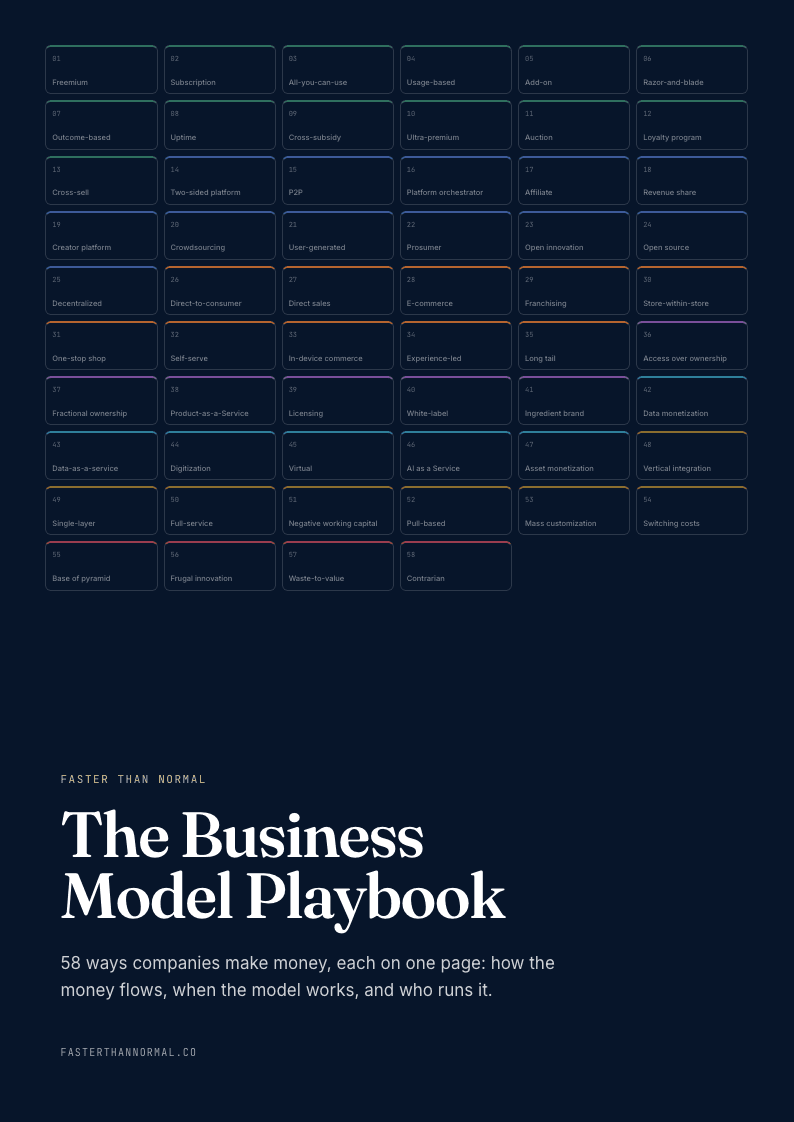
Get The Business Model Playbook
58 business models, one visual page each: how the money flows, the metrics that matter, and who runs it. Free when you join the Faster Than Normal email.
Free. No spam. Unsubscribe anytime.
Part IIIMaxims
-
Ignorance is an engineering specification. When you don't know what can't be done, you design without constraints that only exist because incumbents accepted them.
-
The user's frustration is your product brief. Glock's entire design emerged from practitioners articulating what they wished existed — not from studying what already did.
-
Subtract until failure, then add one part back. Thirty-four components where competitors used seventy. Simplicity is not a compromise; it is the performance.
-
Price signals identity. A low price says "cheap." A high price says "serious." The discount, offered privately, says "I want your business" without diminishing the brand.
-
The cop's holster is the best billboard. Institutional adoption creates credibility that no advertising can replicate. Win the authority customer first.
-
Your opponent's overreach is your marketing budget. False attacks create awareness. True facts, emerging later, create trust. The sequence is more valuable than any campaign.
-
Manufacture the moat. If your production process gives you 65 percent margins while competitors earn 30, you can outspend them on every customer acquisition lever indefinitely.
-
Regulation is a text, not a spirit. Read the grandfather clauses, the exemptions, the definitions. Build your business plan around what the law says, not what legislators intended.
-
Sell nothing about yourself. A private company that discloses nothing forces competitors to play against an adversary they cannot see. Opacity is leverage.
-
Test with your left hand. Structure every critical experiment so that the worst outcome is survivable. The point of risk management is not to avoid risk but to survive failure.
In Their Own Words
I was fighting for my life.— Gaston Glock, in a rare Forbes interview, 2003
Gaston Glock is one of the giants in handgun history, deserving of mention alongside Colt, Browning, Smith and Wesson.— Paul M. Barrett, author of Glock: The Rise of America's Gun
The attack was the best thing that happened to me. Otherwise, I would have gone on trusting him.— Gaston Glock, on the attempted assassination
Further reading
- Glock: The Rise of America's Gun by Paul M. Barrett


