


Part IThe Story
The Toothbrush and the Mirror
In the single bathroom of a crowded apartment in the Logan Fontenelle Housing Projects — six people, one toilet, a line forming every morning — a girl of eight or nine held a toothbrush to her mouth like a microphone and addressed an invisible audience. She had patter. She had timing. She had, her siblings would later attest, an unshakable conviction that the performance was real, that the bathroom mirror was a broadcast tower, that the toothbrush was the instrument through which she would speak to the world. Her brothers and sisters banged on the door. She kept talking. Everyone thought there was something wrong with her.
There were no Black women in radio. There were barely Black men in radio, at least not in Omaha, Nebraska, in the 1950s, where the girl — Catherine Elizabeth Woods, born April 22, 1947 — lay in bed each night with a transistor radio pressed to her ear, listening to the Everly Brothers and the Platters bleed through static, discovering the existence of a man called Wolfman Jack, and then, with the patience of a child tuning a dial in the dark, finding the Black disc jockeys whose voices sounded like hers. By ten she had decided. By sixteen she was pregnant, expelled from her mother's house, and — in the calculus of everyone around her — finished. By her late seventies she would be the second-richest Black woman in America, the founder and chairwoman of the largest African-American-owned media company in the United States, a company that touches 82 percent of Black households through radio, television, and digital platforms, a woman whose name is carved into the facade of a building at Howard University where future journalists learn to tell stories she made possible.
The distance between the toothbrush and the empire is forty-five years of broadcasting, thirty-two bank rejections, a sleeping bag on a conference room floor, a format called the Quiet Storm that rewired American radio, an IPO that made her the first African-American woman to chair a publicly traded corporation, and a single unbroken conviction: information is power. The story of Cathy Hughes is not, in the end, a story about radio. It is a story about what happens when a person decides — at eight, at sixteen, at thirty-two, at seventy-seven — that the audience exists before the microphone does, and builds backward from there.
By the Numbers
The Urban One Empire
55+Radio stations across 16 U.S. markets
82%Of Black American households reached
$460MEstimated net worth (Hughes)
$995KPurchase price of WOL-AM in 1980
32Bank rejections before securing a loan
1999Year of IPO — first Black woman to chair a public company
$3MWHUR revenue in Year 1 under Hughes (up from $250K)
A Trombone, an Accounting Degree, and a School for Survivors
The family into which Catherine Woods was born was itself an argument about what Black ambition could look like in mid-century America — an argument conducted simultaneously in three registers: music, numbers, and education.
Her mother, Helen Jones Woods, had been a trombonist with the International Sweethearts of Rhythm, the legendary all-women swing orchestra that barnstormed the country in the 1940s, playing venues where the audience was integrated even when the law was not, sleeping on buses because hotels wouldn't take them, blowing brass with a ferocity that earned Helen a place in the annals of American jazz. Helen was determined her daughter would follow her into music. "She was determined that I would be Beyoncé," Hughes later said, compressing several decades of maternal expectation into an anachronism. The trombone did not take. The performing instinct — the comfort before an audience, the understanding that presence is a kind of power — took completely.
Her father, William Alfred Woods, pursued a quieter revolution. He was the first African American to earn an accounting degree from Creighton University, the Jesuit institution in Omaha. While he studied, the family lived in the Logan Fontenelle Projects — named, in the cruel irony that shadows so much of American housing policy, after an Omaha chief whose people had been displaced from the very land on which the projects sat. William's accounting degree was not merely a credential; it was a methodology, a way of seeing the world in balances and probabilities. His daughter would inherit this, too. "My daddy was an accountant and he used to always talk about the law of averages," she recalled. The law of averages would become her theology of persistence: for every ninety-nine people who tell you no, the chances are that the hundredth will say yes.
And then there was her grandfather, Laurence C. Jones — a figure whose story reads like something from a different century, which it was. Jones was a successful Mississippi educator who survived a lynching attempt and went on to found the Piney Woods Country Life School in 1909, a private boarding school for African-American children in rural Mississippi that still operates today, one of only four Black boarding schools in the country. Hughes would later serve on its board of directors, closing a generational loop that connected a Mississippi schoolhouse to a NASDAQ ticker symbol.
The Near North Side of Omaha where the Woods family lived was deeply segregated but tightly knit. Black-owned businesses lined North 24th Street. Movie theaters — the Ritz, the Alhambra, the Lothrop — catered to Black audiences. It was, in the way of so many mid-century Black neighborhoods, simultaneously constrained and vibrant, a community that produced its own culture because mainstream culture had locked the door. Hughes absorbed this lesson early: if the existing institutions won't serve your people, build new ones.
She attended Duchesne Academy of the Sacred Heart, a Catholic girls' school — the first African American to do so. She was active in the local NAACP Youth Council. She was, by all accounts, a good student. Then, at sixteen, she got pregnant.
The Impetus
Her mother kicked her out. Her friends said her life was over. Hughes later recalled going "into shock." She married the baby's father, Alfred Liggins Sr., before giving birth, but the marriage lasted only two years. She was seventeen, then eighteen, then a divorced single mother in a housing project in Omaha, Nebraska, with a baby named Alfred Liggins III and no college degree.
What happened next was not what anyone predicted.
"When that baby was placed in my arms for the first time," Hughes said, "that was the defining moment in my life because that's why I became a servant of those who listen to my radio station." The sentence is revealing in its construction — she jumps straight from the maternity ward to the broadcast booth, as if the intervening decades of struggle were a foregone conclusion, as if the baby and the audience were always the same thing: people she was responsible for, people she would not abandon.
— Cathy HughesIt was the beginning. The birth of my son was an impetus to achieve. It was the reason I took my life seriously for the first time as a teenager and made a promise to myself, my son and God that he would not become a black statistic.
She enrolled in business administration courses at Creighton and the University of Nebraska at Omaha but never completed her degree — a fact that would later become the quiet foundation of her educational philanthropy, as though she spent her career building the institutions that might have changed her own trajectory. She lied about her age to get her first job at fourteen. She went to work for Mildred Brown at the Omaha Star, the Black-owned newspaper, selling advertising. It was there — in the mechanics of selling space, of persuading businesses that Black readers were worth reaching — that the media instinct first took professional form.
In 1969, at twenty-one, she began working at KOWH, the first Black-owned radio station in Omaha. She invested $10,000 of an inheritance from her father's death into the station, not because the owners were looking for investors, but because she "figured having a stake in the company would afford me more opportunities to learn the radio business and have responsibility for its success." The logic was pure Hughes: if you can't buy the microphone, buy a piece of the building the microphone sits in. Thankfully, the owners later repaid her investment in full.
But Omaha was too small. The transmitter could only reach so far. The audience she imagined — millions of Black Americans hungry for information delivered from their perspective, in their voice, on their schedule — did not exist in Nebraska. It existed in Washington.
The Quiet Storm
Tony Brown was a noted commentator, the host of what would become the longest-running television show on PBS, and the man Howard University had asked to build its new School of Communications. He was also a frequent lecturer in Omaha, where the University of Nebraska's Black students, lacking a Black-studies department, pooled their budget to bring in speakers. Hughes impressed him — with what precisely is lost to the record, though one suspects it was the same thing that impressed everyone: a velocity of conviction that made standing still feel like falling behind. In 1971, Brown offered her a job as a lecturer and administrative assistant at Howard's School of Communications. She packed up her son and moved to Washington, D.C.
What she found at Howard was not just a university but an ecosystem — a historically Black institution whose alumni included Thurgood Marshall, Zora Neale Hurston, and Toni Morrison, a campus that operated as both incubator and gathering place for the Black professional class of the eastern seaboard. Hughes arrived as a lecturer. Within two years, she had migrated to the university's radio station, WHUR-FM, where she was named General Sales Manager in 1973.
The numbers tell the story before the narrative does. In her first year as sales manager, Hughes increased WHUR's revenue from $250,000 to $3 million. Twelve-fold. In a single year. She did this through the brute mechanics of salesmanship — calling on advertisers, proving the value of the Black audience, demonstrating that the demographics existed and the purchasing power was real. By 1975, she had been promoted to Vice President and General Manager, the first woman to hold that title at any station in the nation's capital.
But her most consequential act at WHUR was not administrative. It was aesthetic.
Washington in the mid-1970s had, as Hughes later described it, "a sizable population of single, unattached young people who still wanted to feel good." She understood this audience intuitively — their loneliness, their sophistication, their desire for a sonic space that was neither the hard funk of daytime radio nor the bland wash of easy listening. Working with Melvin Lindsey, a Howard University student and disc jockey, and Jack Shuler, Hughes helped launch a late-night programming format that paired silky-voiced DJs with hours of slow, sensual R&B. They called it the Quiet Storm, after the Smokey Robinson album.
The format spread like weather. Within a few years, over 480 stations nationwide had adopted some version of the Quiet Storm. It became a subgenre of R&B itself — an entire mood, a way of being in the dark with the radio on, that millions of Americans recognized without ever knowing its origin. Hughes urged Howard to license the format. The university declined, not seeing its commercial value. It was a mistake that cost Howard millions and taught Hughes a lesson she would never forget about the gap between creating something and owning it.
"The best job that I've ever had in my life," Hughes later told Howard students, "was being in the classroom at Howard University." The sentiment was genuine. But she also knew that the classroom wasn't enough. The classroom taught; ownership determined what got taught, and to whom, and on whose terms.
Thirty-Two Nos
In 1979, Hughes married Dewey Hughes, and the two set out to buy a radio station. The plan was simple in concept and nearly impossible in execution: purchase a station, program it for Black audiences, own the means of production rather than renting a chair in someone else's building.
They found their target: WOL-AM 1450, a small, struggling station in Washington, D.C. The price was $995,000. They needed approximately $2 million when financing costs were included. They went to the banks.
The first bank said no. The second bank said no. The fifth, the tenth, the fifteenth — no, no, no. By the twentieth rejection, a less committed person might have concluded that the market was sending a signal. By the twenty-fifth, even an optimist might have recalibrated. Hughes kept going. She went to thirty-two lending institutions and heard no thirty-two times.
The thirty-third said yes.
The lender was Chemical Bank, and the interest rate was punishing — 28 percent, the kind of rate that presupposes failure and prices accordingly. Additional capital came from Syndicated Communications (Syncom), a Black-owned venture capital fund that had become the godfather investor of Black broadcasting ownership, along with other local investors. On October 3, 1980, Cathy and Dewey Hughes took possession of WOL-AM and founded Radio One.
What they found when they walked into the station was wreckage. Previous employees, disgruntled by the sale, had destroyed everything of value — equipment, records, the physical infrastructure of a broadcast operation. Hughes did what she had always done: she improvised. She ran home and grabbed LPs from her own record collection to keep the station on the air. The signal went out. The toothbrush had become a transmitter.
— Cathy HughesFor every 99 people who tell you "no," the chances are that the 100th will say "yes."
The Floor of the Conference Room
The economy tanked. The interest payments on the Chemical Bank loan were merciless at 28 percent. Hughes lost her home. She lost her car. She and her young son, Alfred — the baby who had been the impetus, now a child — moved into the radio station itself. They slept in sleeping bags on the floor of the conference room.
This is the part of the story that, in lesser tellings, becomes a sentimental parable about grit. Hughes herself refuses the sentimentality. "Never once did I feel put out or put upon because I was in a sleeping bag on the floor of the conference room," she said. "I thought I was camping out. I thought I was protecting my company." The reframing is not delusion; it is strategy. If you are going to live in your radio station, you might as well treat the proximity as an advantage. Radio is 24/7. She was there 24/7. She learned every dimension of the operation — its rhythms, its costs, its audience — by literally inhabiting it.
In 1982, the bank threatened to foreclose unless she agreed to switch to a music format. Hughes compromised: she would air music during the day but keep her talk format in the morning. The morning talk show — The Cathy Hughes Morning Show, with the theme "Information is Power" — became the station's lifeline. She hosted it herself for eleven years, not because she had always dreamed of being a talk show host, but because she couldn't afford to hire one. "No one wanted to get up at 4 o'clock in the morning" for the wages she was paying, she recalled. "And so I didn't have one option, and I decided I was doing it myself."
The format she pioneered at WOL was as significant as the Quiet Storm had been, though less aesthetically seductive: "24-Hour Talk from a Black Perspective." The premise was radical in its simplicity. Black Americans had no daily outlet for news, opinion, and conversation told from their own viewpoint. Black newspapers published weekly. Black magazines monthly. By the time Black communities received the information they needed, Hughes argued, "it was black history, not current events." She would fix this. WOL would be the daily paper, the morning conversation, the town square.
It worked. WOL became — and remains — the most listened-to talk radio station in the nation's capital. The morning show alone generated 85 percent of the company's revenue at its peak. The station turned its first profit in 1986, six years after purchase. Hughes's marriage to Dewey ended in 1987, but the company endured.
The Son and the Vault
Alfred C. Liggins III joined Radio One in 1985 as a salesman. He was twenty. He had grown up in the station — literally, on its floor — and understood the business the way a child of farmers understands weather: as the medium in which life occurs. He rose to president by 1989. His mother, watching him, made a calculation that few founders of family businesses are willing to make, and almost none make early enough.
"Parents wait too long to let go," Hughes later said. "It's so hard to give the combination to the vault to the same child who would lose the keys to the front door."
In 1994, Liggins took over day-to-day operations. In 1997, he became CEO. Hughes remained chairwoman. The transition was not ceremonial; it was strategic. Liggins brought financial sophistication — he would earn an MBA from the Wharton School of Business — and an appetite for scale that complemented his mother's instinct for audience and community. The division of labor was elegant: he ran the business; she ran the mission. "Alfred is in the media and communications business," Hughes would say. "I'm in the Black people business."
Tom Joyner, the legendary radio host whose syndicated morning show would later fall under the Urban One umbrella, articulated the partnership's logic with characteristic directness: "Alfred and Cathy are a perfect combination for the company. She cares about Black people, and he gets to focus on the shareholders. That's the way it should be."
Under Liggins's operational leadership, Radio One went on an acquisition spree. The strategy was consistent and replicable: purchase small, underperforming radio stations in urban markets, refocus their programming to serve the demographics of their communities, and grow from there. In 1987, Hughes bought WMMJ in Washington, which became profitable once she converted it to an R&B format. In 1995, Radio One acquired WKYS. By the late 1990s, the company owned dozens of stations across major markets — Baltimore, Detroit, Atlanta, Philadelphia, Houston — and had established itself as the dominant force in urban radio.
The First
On May 6, 1999, Radio One went public on the NASDAQ stock exchange. The initial public offering was for 6.5 million shares at $24 per share, raising approximately $172 million. Within seven months, the stock had climbed well above its offering price, and the company's market value approached $1.8 billion.
Cathy Hughes became the first African-American woman to chair a publicly traded corporation.
The milestone was not incidental. It was structural. A publicly traded company has access to capital markets that private companies do not — the ability to use stock as currency for acquisitions, to raise debt against a public valuation, to attract institutional investors whose mandates require listed securities. Radio One used its new access aggressively. The company acquired twelve stations from Clear Channel for $1.3 billion and additional stations in multiple cities, assembling a portfolio that would eventually number more than seventy stations in nine major markets.
But the IPO also introduced a tension that would define the next two decades of Urban One's existence: the gap between mission and market. Hughes and Liggins retained control through a dual-class share structure — they held approximately 90 percent of the company's voting stock — but as a public company, Radio One was now accountable to shareholders who might not share Hughes's conviction that "doing good" should precede "doing well." The family's solution was the dual-class structure itself: a governance architecture that allowed outside capital to flow in while keeping ultimate authority in the hands of the people who believed that Black media was not a niche market but a civic necessity.
— Cathy Hughes, on her missionMy whole goal in life has been to get pertinent information to my community that they can use to uplift and improve the quality of their lives and their lifestyle.
Multiplication
The company that started with a single AM station in Washington evolved, across the 2000s and 2010s, into a multi-platform media conglomerate whose reach extends far beyond the FM dial.
In January 2004, Radio One launched TV One in partnership with Comcast, a national cable and satellite television network billing itself as "the lifestyle and entertainment network for African-American adults." It was only the second cable entry targeting the African-American market, after Robert Johnson's BET. By 2006, TV One was available in more than 33 million households; today it reaches nearly 60 million. Hughes hosted TV One on One, interviewing prominent personalities — an extension of the morning-show instinct, the belief that conversation is itself a form of empowerment.
In 2004, Radio One also acquired a 53 percent stake in Reach Media, the Texas-based company owned by Tom Joyner, for $56.1 million — a deal that brought the Tom Joyner Morning Show and BlackAmericaWeb.com under the Radio One umbrella and marked the company's first significant presence on the internet. By 2012, the ownership stake had grown to 80 percent.
In 2008, Radio One created Interactive One (iOne Digital), a digital platform operating websites including NewsOne, Bossip, MadameNoire, HipHopWired, and Hello Beautiful — properties that collectively draw over 18 million unique monthly users. The digital arm was a hedge against the secular decline of terrestrial radio, but it was also a natural extension of the original thesis: wherever Black audiences are consuming media, Urban One should be there, speaking from their perspective.
In 2017, Radio One was renamed Urban One — a rebrand that acknowledged the company had outgrown its original medium. The same year, the company launched CLEO TV, a lifestyle and entertainment network targeting millennial and Generation X African-American women. And in a characteristically opportunistic move, Urban One acquired a nearly 7 percent stake in the $1.4 billion MGM National Harbor casino, hotel, and resort when it opened outside Washington — a real estate play that had nothing to do with media and everything to do with Hughes's instinct for where her audience spends money and time.
The transformation was not without pain. In 2006, the company sold $150 million worth of radio stations in underperforming markets. The 2008 financial crisis hit hard. Radio advertising revenue, the company's lifeblood, contracted along with the broader economy. The stock price, which had soared after the IPO, endured years of decline. By the 2020s, the company was revising its Adjusted EBITDA guidance downward — to a range of $56 million to $58 million for fiscal year 2025 — and restructuring its debt, exchanging and tendering its 7.375 percent Senior Secured Notes due in 2028.
But the company survived. And it survived as a Black-owned, family-controlled enterprise — a distinction that matters in an industry where Black ownership has historically been the exception, not the rule.
The Lion Who Learned to Read
There is an African proverb Hughes loves to quote: "Until the lion learns to read and write, the story of the hunt will always be from the hunter's perspective, and the lion will always lose."
"Well," she says, "I like to consider my company the lion who learned how to read and write."
The metaphor is apt, but it understates the case. Hughes did not merely learn to read and write; she built the printing press, the distribution network, the advertising sales team, and the subscriber base. She understood, decades before the concept became fashionable in Silicon Valley, that owning the platform is different from owning the content, and that owning both is different from owning either alone. Rev. Al Sharpton, speaking at the 2016 ceremony where Howard University renamed its School of Communications in Hughes's honor, put it more bluntly: "She took the mute off of Black America. We were on mute, we couldn't talk. She made talk radio stations. She preserved our culture; she gave us TV One. We can speak for ourselves, to ourselves, and that is an enormous contribution to our people."
The Howard honor was, as Hughes acknowledged, "like a dream." She had arrived at Howard in 1971 as an unfinished woman — no degree, a young son, a career that existed mostly in her own imagination. Forty-five years later, her name was on the building. The Cathy Hughes School of Communications now houses departments of journalism, communication studies, and media, journalism and film. Its faculty includes Pulitzer Prize winners, Emmy winners, Fulbright recipients. Its students produce award-winning newscasts and have won four consecutive Student Emmy Awards for Best Newscast. The school's mission statement reads like a distillation of Hughes's own: "to prepare graduates to exercise global leadership within and across diverse communities."
The naming was made possible by a multi-million-dollar gift from her son, Alfred Liggins III — a detail that closes the circle with a kind of narrative grace that no fiction writer would dare attempt. The teenage mother who was told her life was over raised a son who could afford to endow a school of communications named after her.
Unapologetically Black
Hughes has never been neutral, and she has never pretended to be. "As a publicly traded company, Urban One's executive team and board of directors is beholden to its shareholders," she acknowledged. "But I haven't changed my approach to the business since I moved from my hometown of Omaha, Nebraska, to Washington, D.C., in 1972."
The approach is simple: the company exists to serve Black audiences. Full stop. Not "urban" audiences — a euphemism Hughes tolerated in the company name but never in her own speech. Not "multicultural" audiences. Not "diverse" audiences. Black audiences. "I'm in the Black people business," she says, and the repetition across decades of interviews suggests not a slogan but a creed.
This single-mindedness has generated both admiration and criticism. Hughes was, at various points, accused of narrowcasting, of limiting the company's growth potential by refusing to chase broader demographics. She was questioned about programming choices, about the balance between entertainment and empowerment, about whether a company that hosts both news talk and reality television can credibly claim a civic mission.
Her response, consistent across three decades, is that authenticity and commerce are not in tension — that the best way to build a sustainable media company is to serve an audience so deeply that no competitor can replicate the relationship. "We've always done it in reverse," she told Black Enterprise. "We've always asked them" — meaning the audience — what they want, rather than telling them what they should want. The company spends, even in lean years, at least $1 million annually on audience research, a commitment that reflects her conviction that listening is the precondition for speaking.
She has also been a fierce advocate for Black ownership, not merely representation. The distinction matters. Representation means Black faces in someone else's building. Ownership means the building itself. Hughes has been outspoken about the importance of grooming Black successors, maintaining family control, and resisting the temptation to sell — a temptation that claimed many Black-owned media companies as consolidation swept the radio industry in the 1990s and 2000s.
"You do not have to lose who you are to be successful," she has said. "You don't have to lose your integrity, your goodness, your compassion, your caring and sharing of other individuals to make a dollar."
The Frequency Holds
At seventy-eight, Hughes is semi-retired but not idle. She serves on the Board of Trustees at Creighton University — her father's alma mater, the institution where William Alfred Woods became the first Black man to earn an accounting degree, the school she attended but never finished. She serves on the board of directors of the Piney Woods School, the Mississippi boarding school her grandfather founded in 1909. She is looking into the online gaming industry. She attends St. Benedict the Moor Catholic Church when she is in Omaha. She has a Rottweiler.
Urban One, under Liggins's operational command, continues to navigate the turbulence of an industry in secular decline. Terrestrial radio listenership is falling. Cable subscribers are cutting cords. Digital advertising is dominated by platforms that dwarf any media company's reach. The company's 2025 revenue through three quarters stood at $276.54 million, with net income in the $20–100 million range — numbers that reflect both the resilience of a devoted audience and the constraints of a legacy media business in the age of algorithmic distribution.
But Hughes built something that algorithms cannot easily replicate: trust. The relationship between Urban One's stations and their audiences is not transactional; it is communal. When Hurricane Katrina struck New Orleans in 2005, Hughes pointed out that cable television was useless in a disaster — the infrastructure was destroyed — but radio worked. Radio was local. Radio was immediate. Radio was the voice in the dark that told you where to go and what to do. She had been making this argument since the day she bought WOL, and the disaster proved her right.
In 2020, during the COVID-19 pandemic and the resurgence of the Black Lives Matter movement, Hughes appeared on Guy Raz's How I Built Resilience series to discuss how Black entrepreneurs could navigate the crisis. She was seventy-three. The conversation was about survival — of businesses, of communities, of the fragile infrastructure of Black economic independence. It was, in other words, a conversation she had been having since 1980.
Congresswoman Eleanor Holmes Norton, honoring Hughes on the floor of the House of Representatives in December 2020, noted that "Hughes had her sights on success from day one. Throughout her career, her piercing optimism and resilience cut through obstacles of discrimination and discouragement, clearing a path to where she now stands as one of our country's wealthiest self-made African American women."
The awards are almost too numerous to catalogue: the NAACP Chairman's Award, the NAB Broadcasting Hall of Fame (the first radio station owner so honored), the Radio Hall of Fame (inducted 2010), the Cable Hall of Fame (inducted 2020), the American Advertising Federation Hall of Fame, the Congressional Black Caucus Foundation Chair's Phoenix Award, the Ida B. Wells Living Legacy Award, the Black Music and Entertainment Walk of Fame (foundational inductee), honorary doctorates, a street corner in Northeast Washington — 4th Street and H Street NE — unofficially named "Cathy Hughes Corner."
None of which she chased. "I've never thought much about awards," she said. "I've never done anything hoping to be recognized for it."
On October 3, 2025, Urban One celebrated its forty-fifth anniversary. Hughes appeared on Get Up Mornings with Erica Campbell, one of the syndicated shows distributed by Reach Media, the very infrastructure she had built. A co-host called her "the queen and visionary behind the network." Hughes, one imagines, accepted the tribute with the same mix of warmth and impatience she has brought to every conversation for half a century — grateful for the recognition, already thinking about what comes next.
In the one bathroom of the Logan Fontenelle Housing Projects, a girl holds a toothbrush to her mouth. The signal goes out. Somewhere, someone is listening.
Part IIThe Playbook
Cathy Hughes built Urban One from a vandalized AM station into a publicly traded multimedia conglomerate reaching 82 percent of Black American households. The principles below — extracted from her decisions, her setbacks, and her language across five decades — constitute an operating manual for building a mission-driven media enterprise with no institutional backing and no margin for error.
The principles
- 1.Build the audience before you build the company.
- 2.Persist past the point of reason.
- 3.Own the platform, not just the content.
- 4.When you can't afford talent, become the talent.
- 5.Inhabit the business — literally.
- 6.Invent the format the market doesn't know it needs.
- 7.Transfer power early, not late.
- 8.Use research as religion.
- 9.Protect control through structure.
- 10.Acquire the undervalued and reposition.
- 11.Diversify the medium, not the mission.
- 12.Do good before you do well.
Principle 1
Build the audience before you build the company
Hughes did not start with a business plan for a multimedia conglomerate. She started with a conviction that Black Americans lacked a daily media outlet speaking from their perspective. The company was the vehicle; the audience relationship was the asset. Every format she created — the Quiet Storm, 24-Hour Talk from a Black Perspective — was a response to an audience need she identified before anyone else, sometimes before the audience itself could articulate it. Washington's "sizable population of single, unattached young people who still wanted to feel good" did not write letters to station managers requesting slow-jam programming. Hughes understood them anyway.
This audience-first orientation explains why Urban One has survived industry upheaval that destroyed larger companies. When your competitive advantage is not a frequency license or a distribution deal but a trust relationship with a defined community, the platform can change — from AM to FM to cable to digital — without the relationship breaking.
Tactic: Before building anything, identify the specific unserved community whose trust you can earn — and build the product as a response to their needs, not a projection of your own.
Principle 2
Persist past the point of reason
Thirty-two bank rejections. A 28 percent interest rate. A vandalized station. A sleeping bag on the floor. Hughes's story is often told as an inspirational narrative about not giving up, but the real lesson is more specific: she calibrated her persistence to the law of averages. Her father's accounting mindset gave her a framework for understanding rejection not as a moral verdict but as a statistical event. Each "no" reduced the remaining probability space. The thirty-third bank was not more virtuous than the first thirty-two; it simply occupied a different position in the distribution.
This is not blind optimism. It is disciplined refusal to interpret negative data as conclusive. Hughes did not keep approaching the same bank with the same pitch. She iterated — adjusting her proposal, targeting different institutions, eventually finding the combination of lender and terms that could work.
Tactic: Treat rejection as data, not destiny — track your attempts, refine your approach with each one, and know the minimum viable threshold at which a "yes" becomes statistically likely.
Principle 3
Own the platform, not just the content
Hughes learned this lesson at Howard. She created the Quiet Storm format, one of the most commercially successful innovations in American radio history, and urged the university to license it. Howard declined. The format spread to 480 stations. Howard captured none of the value. Hughes captured the lesson.
Every subsequent move — purchasing WOL, building Radio One, launching TV One, acquiring Reach Media, creating Interactive One — was an act of ownership, not participation. She did not want to be the best talk show host on someone else's station. She wanted to own the station, the format, the advertising relationships, and the audience data.
📡
The Ownership Ladder
Hughes's progression from employee to platform owner
| Stage | Role | Lesson |
|---|---|---|
| KOWH (1969) | Employee / investor ($10K) | Even small stakes create agency |
| WHUR (1973–79) | Sales manager → GM | Format innovation without ownership = zero capture |
| WOL (1980) | Owner | Ownership transforms the economics of effort |
| Radio One IPO (1999) | Chair, public company | Capital markets amplify ownership |
| TV One (2004) | Founder, cable network | Platform ownership is medium-agnostic |
Tactic: If you create something valuable within someone else's structure, negotiate ownership or licensing rights — or leave and build your own structure around the innovation.
Principle 4
When you can't afford talent, become the talent
Hughes became the morning show host on WOL not out of ambition but out of necessity. She couldn't pay anyone else to wake up at 4 a.m. for what she was offering. The show ran for eleven years and generated 85 percent of the company's revenue. The constraint became the competitive advantage: no hired host could replicate the owner's intimacy with the audience, the owner's willingness to use the show as a direct line to the community, the owner's personal stake in every word that went out over the air.
This principle extends beyond radio. When resources are scarce, the founder's willingness to do the work — not delegate it, not aspire to it, but do it, every morning, for eleven years — creates a bond with the customer that no amount of subsequent professionalization can fully replace.
Tactic: In the early years, fill the gap yourself rather than hiring someone mediocre — the founder's direct engagement with the audience creates a relationship that becomes the company's core asset.
Principle 5
Inhabit the business — literally
Living on the floor of WOL was not a hardship narrative. It was an immersion strategy. By being present 24/7 in a 24/7 business, Hughes developed an operational understanding that no amount of management reporting could have provided. She learned when the equipment faltered, when the audience peaked, when the advertising calls came in, what the overnight DJs said when they thought no one was listening. The sleeping bag was an MBA program with a one-person cohort.
"Radio is 24/7 and I was there 24/7 with my company," she said. The sentence is not a description of suffering. It is a description of competitive advantage.
Tactic: In the earliest phase of a venture, collapse the distance between yourself and the operation to zero — the insights you gain from total immersion will shape every subsequent decision.
Principle 6
Invent the format the market doesn't know it needs
Hughes did not iterate on existing radio formats. She created new ones. The Quiet Storm was not a refinement of existing R&B programming; it was an entirely new sonic category. "24-Hour Talk from a Black Perspective" was not a tweak of existing talk radio; it was a format that had no precedent on American airwaves. In both cases, the innovation responded to an audience reality that existing formats ignored.
The risk of format innovation is obvious: there is no proof of demand until demand exists. Hughes mitigated this risk through intimate knowledge of her audience — the single young professionals in Washington, the Black community hungering for daily news in its own voice. She did not need focus groups to confirm what she already knew from living inside the community she served.
Tactic: Don't optimize within existing categories — study the audience deeply enough to see the category that should exist but doesn't, and create it before competitors recognize the gap.
Principle 7
Transfer power early, not late
Hughes handed operational control to her son in 1994, when she was forty-seven and fully capable of running the company for another two decades. Most founders of family businesses hold on until retirement or death. Hughes recognized that early transfer has compounding benefits: the successor accumulates experience during the founder's most vital years, when the founder can still course-correct; the company avoids the succession crisis that destroys so many family enterprises; and the founder can shift to the strategic and mission-oriented work — the "Black people business" — that no one else in the organization can do.
"Parents wait too long to let go," she said. "It's so hard to give the combination to the vault to the same child who would lose the keys to the front door." The sentence acknowledges the psychological difficulty while insisting on the operational necessity.
🔑
Succession Timeline
The gradual transfer of operational authority from founder to successor
1985
Alfred Liggins III joins Radio One as a salesman at age 20
1989
Liggins promoted to president
1994
Liggins assumes day-to-day operations; Hughes remains CEO
1997
Liggins becomes CEO; Hughes becomes chairwoman
1999
IPO under Liggins's operational leadership
Tactic: Begin transferring operational authority to your successor while you are still at the peak of your own capability — the overlap period is where institutional knowledge transfers most effectively.
Principle 8
Use research as religion
Hughes's emphasis on audience research is a competitive discipline, not a corporate nicety. "In a tight year, we spend $1 million on research," she told Black Enterprise. The methodology is inverted from industry standard: rather than telling audiences what the company thinks is important, Urban One asks audiences what matters to them and programs accordingly.
This is not customer service. It is epistemology. Hughes believes — and her career demonstrates — that the primary failure mode of media companies serving minority audiences is presumption: the assumption that the programmer knows what the audience wants without asking. The antidote is not intuition (though Hughes has plenty) but systematic, ongoing inquiry.
Tactic: Invest in understanding your customers' actual needs and preferences with the same rigor you invest in product development — and invert the relationship, letting their input drive your decisions rather than the reverse.
Principle 9
Protect control through structure
When Radio One went public in 1999, Hughes and Liggins retained approximately 90 percent of the company's voting stock through a dual-class share structure. This was not an oversight or an artifact of IPO mechanics. It was a deliberate architectural decision to allow outside capital to fuel growth while preserving the family's ability to make decisions that prioritized the mission over quarterly returns.
The dual-class structure has been criticized by governance purists who argue that it insulates management from shareholder accountability. Hughes's counterargument is implicit in the company's existence: without structural protection of the mission, the pressure to maximize short-term returns would eventually erode the very thing that makes Urban One valuable — its authenticity as a Black-owned, Black-serving media company.
Tactic: If outside capital is necessary for growth, design your governance architecture to protect long-term mission alignment — the structure you build at the moment of financing determines who has power forever after.
Principle 10
Acquire the undervalued and reposition
Radio One's growth strategy was remarkably consistent: identify small, underperforming radio stations in urban markets, acquire them at distressed or discounted prices, and refocus their programming to serve the demographics of their communities. The strategy worked because Hughes possessed two assets that most acquirers lacked: deep knowledge of the underserved audience and proven format innovations (the Quiet Storm, talk from a Black perspective) that could be deployed immediately.
The WOL acquisition was the prototype: a struggling AM station, purchased for under $1 million, transformed through format innovation into the most listened-to talk station in the capital. The WMMJ acquisition in 1987 followed the same pattern. Each acquisition was a controlled experiment in the same thesis: Black audiences are underserved, and serving them well is good business.
Tactic: Look for assets that others undervalue because they don't understand the audience — if you possess that understanding, the gap between purchase price and potential is your margin of opportunity.
Principle 11
Diversify the medium, not the mission
Urban One's expansion from radio to television to digital to real estate appears, from the outside, like diversification. From the inside, it is the opposite: a single mission — serving Black audiences with information, entertainment, and empowerment — expressed through every available medium. The rebrand from Radio One to Urban One in 2017 made this explicit: the name acknowledged that the company had transcended any single platform while the "One" preserved the unity of purpose.
📊
One Mission, Multiple Platforms
Urban One's diversification strategy, 1980–present
| Platform | Launch | Audience Function |
|---|---|---|
| Radio (WOL-AM) | 1980 | Daily news, talk, community voice |
| TV One | 2004 | Lifestyle, entertainment, culture |
| Reach Media | 2004 (acquired) | Syndicated programming, national reach |
| iOne Digital | 2008 | Social content, news, digital community |
| CLEO TV | 2019 | Millennial / Gen X women of color |
| MGM National Harbor (stake) | 2016 | Hospitality, events, audience experience |
Tactic: When expanding into new platforms or verticals, ensure that every new initiative deepens your relationship with the same core audience rather than diluting it across unrelated markets.
Principle 12
Do good before you do well
"It is critical. It is essential for you to do good and do well at the same time and you must first do good before you worry about doing well." Hughes has repeated this formulation so often that it has calcified into doctrine. But the order matters. She does not say do good and do well. She says do good before you do well. The priority sequence is not rhetorical; it is operational. Every major decision at Urban One — from the original purchase of WOL to the launch of TV One to the research investment to the refusal to sell — has been filtered through the question: does this serve our community?
The skeptic might note that Hughes is extraordinarily wealthy, that Urban One is a for-profit company, that the community-service rhetoric coexists with a dual-class share structure that concentrates economic power in two people. Hughes would not disagree. She would say that the wealth is the consequence of the service, not the other way around — that the 82 percent household reach and the $460 million net worth are effects of the same cause: an unbroken commitment to an audience that has nowhere else to go.
Tactic: Define your company's service to its community as the primary objective and its financial performance as the dependent variable — then build every system, incentive, and governance structure to enforce that priority.
Free playbook
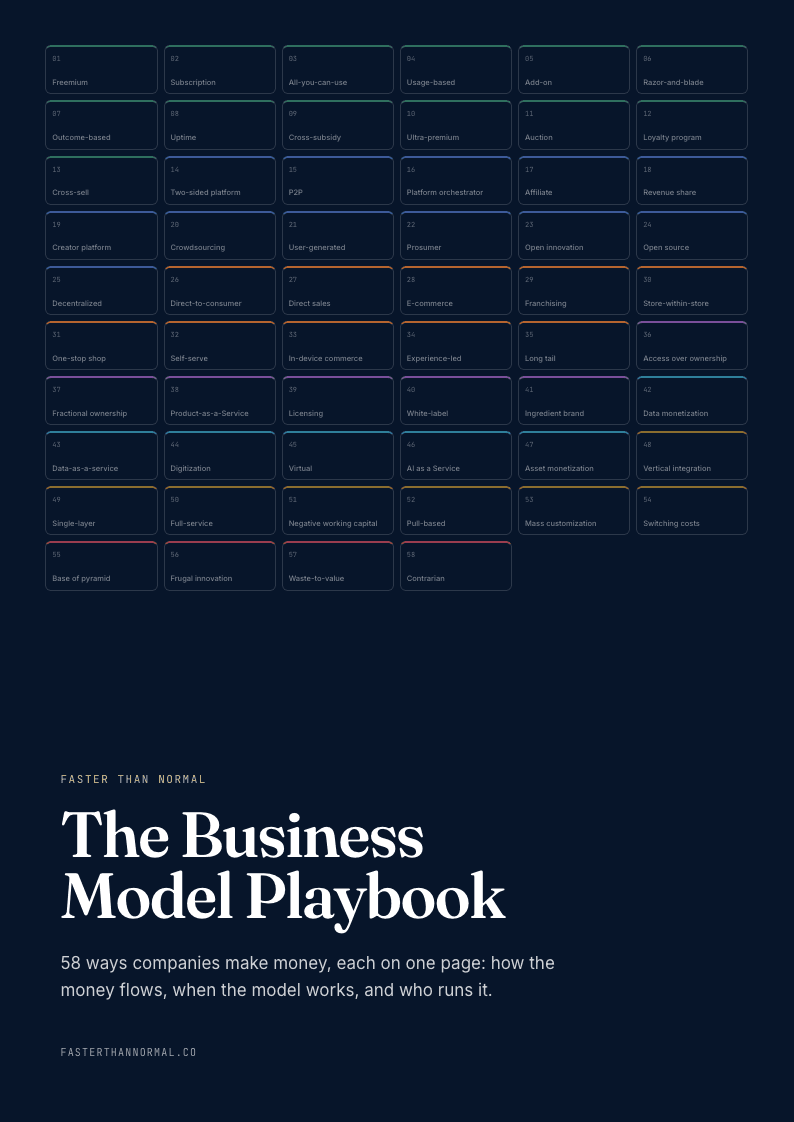
Get The Business Model Playbook
58 business models, one visual page each: how the money flows, the metrics that matter, and who runs it. Free when you join the Faster Than Normal email.
Free. No spam. Unsubscribe anytime.
Part IIIMaxims
-
The law of averages is on your side. For every ninety-nine people who tell you no, the hundredth will say yes — but only if you keep asking.
-
The audience exists before the microphone does. Understand the community you serve so deeply that you can create what they need before they ask for it.
-
Ownership is the only form of representation that compounds. Working in someone else's building teaches you the business; owning the building teaches you everything else.
-
Scarcity is a strategy, not a sentence. When you cannot afford to hire talent, become the talent — the constraints of early-stage survival create competitive advantages that outlast the constraints themselves.
-
Inhabit what you build. Total immersion in the early operation yields insights that no report, dashboard, or advisor can replicate.
-
Transfer the vault early. The best time to hand operational control to your successor is when you are still strong enough to mentor them through mistakes, not when you are too tired to notice them.
-
Research is not a budget line; it is a belief system. Ask your audience what they need rather than telling them what you think they should want.
-
Structure determines who decides. The governance architecture you build at the moment of financing determines who holds power when the mission is tested.
-
Diversify the medium, never the mission. A company can operate across radio, television, digital, and real estate and still be in one business — the business of serving its people.
-
Do good first. Wealth follows service, not the reverse — and the company that serves a community no one else will serve inherits an audience no one else can take.
In Their Own Words
Create your own space. For too long, we have educated young Black kids to get a good job. On their own, they have decided they want to have a nice business. They want to be entrepreneurs. It's the same thing with media.— The Breakfast Club
It's critical for us to tell our story from our perspective. When the company is Black-owned, you have Black decision makers, a Black perspective and Black employees.— Essence, 1998
Not to let anyone convince you that your dream, your vision to be an entrepreneur is something that you shouldn't do. What often happens is that people who are well meaning, who really care for us are afraid for us and talk us out of it.
It's interesting how God arranges your schedule. When you're helping someone else, you never run out of time, when you're just interested in helping yourself, time is real short.— OnStageDC
I wish that every African American could come here and spend a week and merge in the essence of quality that the city offers, and in my opinion, it offers that because we have a majority of African Americans in this city. The essence of excellence exists in a lot of places, but in DC it's the whole city.— OnStageDC
You should be learning everything you can about your craft. And read everything you can get your hands on about individuals who are accomplished. I probably know as much about Oprah as her staff because I read every single solitary thing.— Black Enterprise
I am so tired of Black women being misrepresented and us allowing it and participating in the misrepresentation of who we are in the media.
Information is power. When an African American community receives the information that they need and want, they'll come to the right conclusion. They will in fact be able to elevate the lifestyle and living standards of the entire community.— Cathy Hughes
The city had a sizable population of single, unattached young people who still wanted to feel good.— Cathy Hughes, on the Quiet Storm and WHUR
Parents wait too long to let go. It's so hard to give the combination to the vault to the same child who would lose the keys to the front door.— Cathy Hughes, on family succession
There's an African proverb that I love to quote: until the lion learns to read and write, the story of the hunt will always be from the hunter's perspective, and the lion will always lose. Well, I like to consider my company the lion who learned how to read and write.— Cathy Hughes, PBS documentary
Never once did I feel put out or put upon because I was in a sleeping bag on the floor of the conference room. I thought I was camping out. I thought I was protecting my company.— Cathy Hughes, on sleeping at the station


