

Part IThe Story
The Schmäh and the Mirror
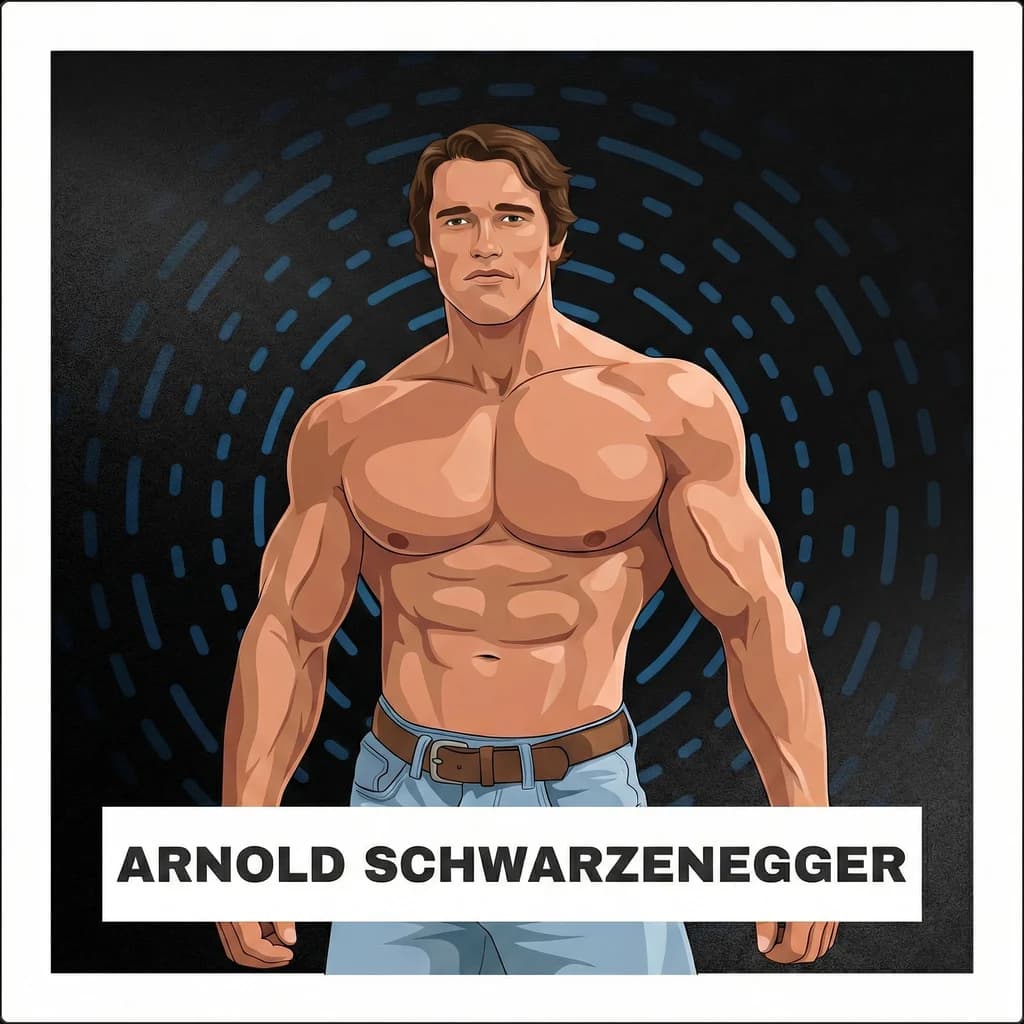
In the cabana of his six-acre Brentwood estate, a palm-sized Yorkshire terrier named Noodle curled in his lap, Arnold Schwarzenegger is telling a journalist about looking at himself naked. He has done this before — told this story, stood before the glass — so many times across so many decades that the act has become its own kind of mythology, a closed loop of self-regard that once propelled a scrawny Austrian teenager toward five Mr. Universe titles and seven Mr. Olympia crowns and now, at seventy-eight, confronts him with its inverse. "My whole life I look at the mirror and see the best-built man," he says, "and all of a sudden I see a bunch of crap." The wrinkles beneath the pectorals. The Budle — Austrian for the stomach that protrudes where once the veins ran like tributaries down his abdominals. "Where the fuck did that come from?" Rising behind his pool, an eight-foot bronze statue of Arnold at his bodybuilding prime taunts him with frozen permanence: his vision of the ideal male form, achieved and immortalized, while the man himself ages on beneath it.
This is the essential architecture of Arnold Schwarzenegger's life: the vision and the reflection, the imagined self and the actual one, the relentless gap between aspiration and reality that he has spent three-quarters of a century closing through what can only be described as applied delusion of the most productive kind. He arrived in America in 1968, a twenty-one-year-old with a body like an anatomy chart and a surname that studio executives couldn't pronounce — "We can't put Schwarz... Schwarzen... Schwarzenschnitzel on a marquee," they told him — and within two decades had become the highest-grossing action star in the world, a real-estate millionaire, a Kennedy in-law, and the governor of the most populous state in the nation. The improbability of any single one of these achievements would constitute a remarkable life; their accumulation in a single person strains credulity. But what makes Schwarzenegger genuinely strange, genuinely worth studying, is not the breadth of his accomplishment but the mechanism behind it: a capacity for self-invention so total that it blurs the line between confidence and performance, between authentic belief and what the Austrians call schmäh.
Schmäh is the word that haunts any honest accounting of Schwarzenegger. It means, roughly, the art of wrapping something in a more attractive package — not lying, exactly, but the lubrication required to sell anything, including yourself. "Everything's a schmäh," he tells the New York Times with a grin that suggests he means it and also that he doesn't. The word contains its own negation. To deploy schmäh is to acknowledge the gap between the thing and its presentation while insisting that the gap itself is the thing — that the performance of confidence is indistinguishable from confidence, that the story you tell about your life is your life. Schwarzenegger has been telling his story for so long, with such consistency and force, that the improbability has calcified into inevitability. Of course the Austrian bodybuilder became a movie star. Of course the movie star became governor. Of course. But press on the narrative and the cracks appear — the father who beat him, the steroid admissions, the household employee, the $26 billion budget deficit, the child whose existence he hid — and what emerges is something far more interesting than the triumphalist fable. What emerges is a man whose greatest talent has always been his ability to see a version of himself that doesn't yet exist and then, through brute will and strategic charm, to make reality bend toward the vision.
By the Numbers
The Austrian-American Empire
$1BEstimated net worth (Forbes, 2024)
7Mr. Olympia titles (1970–75, 1980)
$5.5BWorldwide box office gross across ~50 films
$26BCalifornia budget deficit inherited by 2009
38thGovernor of California (2003–2011)
500K+Subscribers to his daily 'Pump Club' newsletter
100M+Views on his 2022 video message to Russia
The Oak in the Ruins
Thal, Austria, 1947. The village sits near the Styrian capital of Graz, nestled among gentle hills and the green shores of the lake called Thalersee, and into this landscape — two years after the collapse of the Third Reich, in the middle of a famine — Arnold Alois Schwarzenegger was born. His father, Gustav, was a police chief, a drinker, and a former member of the Nazi Party. His mother, Aurelia, née Jadrny, was loving and enduring. The house was two stories, the atmosphere uptight, the dynamic between the brothers stark: Gustav favored Meinhard, the elder, and pitted the boys against each other. Arnold was gangly. He was the lesser son.
"It was a very uptight feeling at home," he would later say, a sentence whose understatement conceals a universe of domestic misery. Gustav beat both boys and ridiculed Arnold's early obsession with bodybuilding — "Why are you lifting these dumbbells and barbells?" — though he also, with the inadvertent precision of a bad father, planted the seed that would become Arnold's operating philosophy. Be useful, Gustav told him. Don't just lift weights for vanity. Chop wood for the poor. Shovel coal. Do something for somebody. The command was stern and small-minded and also, Arnold insists decades later, transformative. "Even when I sleep in — sometimes past 6:00 in the morning — I feel guilty because I hear my father's voice saying, 'Arnold, that's not how this country was built, by sleeping in.'"
But the Austria of Arnold's youth was a country built on silence. Styria harbored a centuries-old strain of antisemitism so deep that Jews had been evicted from the region in 1497 and banned for 350 years. The lone synagogue in Graz was destroyed in 1938; it wouldn't be rebuilt until 2000. Austrians lagged decades behind the Germans in acknowledging their role in the war, preferring to imagine themselves as Hitler's first victims rather than his enthusiastic accomplices. Gustav came home from the Eastern Front injured — he had fought at Leningrad, where the Nazi siege killed an estimated one million Russians — and drank to manage the guilt. Arnold grew up, as he put it in 2022, "surrounded by broken men drinking away their guilt over their participation in the most evil regime in history."
It was into this atmosphere of denial and damaged masculinity that a singular act of rebellion occurred. In 1961, a friend invited fourteen-year-old Arnold to Vienna to watch the World Weightlifting Championship. In the audience, he watched Yuri Petrovich Vlasov — a Russian, a Soviet, the enemy of everything his father's generation represented — become the first human being to lift 200 kilograms over his head. Somehow, the boy got backstage. "All of a sudden, there I was, a 14-year-old boy standing in front of the strongest man in the world. He reached out to shake my hand — I mean, I still had a boy's hand. He had this powerful man's hand that swallowed mine. But he was kind and he smiled at me."
Arnold went home and pinned Vlasov's photograph above his bed. Gustav told him to take it down. Find a German or an Austrian hero. They argued. Arnold did not take the photograph down. It was his first act of self-authorship — the declaration that he would choose his own models, his own aspirations, his own country of the mind. The boy from the ruins would become the man who swallowed the world.
The Body as Business Plan
The escape route was muscle.
Among the boys who swam in the Thalersee and did chin-ups on the branches of the masterful oak tree that overhung its shore — the tree that would lend him his first nickname, the "Austrian Oak" — Arnold was not the biggest. But he was the most obsessive. He started training at fifteen, was taken under the wing of former Mr. Austria Kurt Marnul at the Graz Athletic Union, and quickly discovered that bodybuilding offered something team sports never could: individual recognition. "I disliked it when we won a game and I didn't get any personal recognition," he wrote in his 1977 autobiography. "The only time I really felt rewarded was when I was singled out as being best."
The vanity is transparent and also strategic. Schwarzenegger understood, earlier than almost anyone in his generation, that the body could be leveraged as a platform — that physical achievement was not an end but a beginning, a first rung on a ladder that led to fame, which led to money, which led to power. The model was Reg Park, a British bodybuilder who had won Mr. Universe, parlayed it into Hercules movies, and used the proceeds to build a gym empire. Arnold saw a magazine cover of Park in a Hercules film and the circuit closed. "Bingo! I had my role model! If he could do it, I could do it. I'd win Mr. Universe. I'd become a movie star. I'd get rich."
This was not a vague aspiration. It was an engineering blueprint. At twenty, Schwarzenegger became the youngest person ever to win Mr. Universe. He won the title four more times. Joe Weider — the Canadian-born cofounder of the International Federation of BodyBuilders, publisher of muscle magazines, and godfather of competitive fitness, a man who had built an empire on the premise that the male body could be marketed like a consumer product — spotted Schwarzenegger's bravado and potential and brought him to America in 1968. Weider loved his humor, his accent, the sheer scale of the ambition. He wasn't wrong. Between 1970 and 1975, Schwarzenegger won Mr. Olympia six consecutive times, establishing a reign of physical dominance so complete that the competition essentially became a coronation.
— Arnold Schwarzenegger, 2023I'm not guaranteeing anybody anything. What I'm doing is saying: Look, everyone that I've talked with, that I've helped and reached out to, they learned from me the sky's the limit. If you fail, fuck it. It's not the end of the world.
But Schwarzenegger never intended to stay in bodybuilding. Even at the height of his competitive dominance, he was laying the financial groundwork for independence. Using prize money and earnings from the gym circuit, he put a down payment on an apartment building in Santa Monica in the early 1970s. "Buildings that I would buy for $500K within the year were $800K and I put only maybe $100K down," he told Tim Ferriss, "so you made 300% on your money." He traded up, bought office buildings on Main Street in Santa Monica, and became a millionaire from real estate before he ever commanded a meaningful film salary. The purpose was explicit: he watched actors in his gym who took bad roles because they were broke, who had no leverage because they had no money. "I did not rely on my movie career to make a living," he said. "That was my intention."
It was financial engineering in service of creative freedom — the bodybuilder as value investor, building a capital base so he could afford to wait for the right role. When it came, it would arrive in leather and chrome, speaking in monotone, with a shotgun in one hand and the future of Hollywood in the other.
The Machine and the Man
The story of how Arnold Schwarzenegger became the Terminator is a story about the alchemy of limitation. He went to lunch with James Cameron — a young, intense Canadian director who had written the script based on a fever dream about a chrome skeleton emerging from flames — wanting to play Kyle Reese, the human hero. Schwarzenegger had spent years fighting Hollywood's instinct to cast him as the villain; all they offered was heavies, and he wanted to establish himself as a leading man. He told Cameron his ideas for the Terminator character instead — how the machine should train blindfolded, load weapons without looking, never blink, show no emotion. "I said the guy had to train blindfolded," Arnold recalled. Cameron listened and told him he had to play the Terminator. "He was right."
The casting nearly went a different direction entirely. Lance Henriksen and O.J. Simpson — the former football star, then considered one of America's most likable celebrities — were both considered for the role. Simpson was rejected because he was deemed "too nice to portray a killer." The irony requires no commentary.
The Terminator opened on October 26, 1984, and grossed more than $78 million worldwide. It was, by any measure, Schwarzenegger's making. But the reason it worked — the reason the Austrian accent and the wooden delivery and the impossible physique coalesced into something genuinely iconic — is that Cameron understood something Schwarzenegger had been unconsciously building toward for a decade: the productive use of foreignness. Every quality that made Schwarzenegger wrong for conventional leading roles — the accent, the body, the name — made him perfect for a role in which inhuman strangeness was the entire point. "Everyone knew what was underneath the leather jacket," Schwarzenegger told the Times. "I get it, Schwarzenegger is a machine, so the body looks different than anything else; he talks like a machine with his accent. Without that, it wouldn't have worked."
The accent, which agents and executives had spent years trying to sand down, became a weapon. The German "r" — toom-ah, chop-ah — turned out to be funny, and Schwarzenegger, who had a sense of humor sharper than his public persona suggested, learned to exaggerate it. He became an apprentice to Milton Berle — Berle, the legendary comedian born Mendel Berlinger in Harlem in 1908, who had been performing in vaudeville since the age of five and who greeted Arnold's request for humor coaching with "That Nazi! I have to train him? Fuck this." But he loved Arnold. He attended his engagement party, his wedding. He wrote most of Arnold's jokes for the 1980s and 1990s. "I would get an award somewhere," Arnold recalled: "'Wow, this is amazing. As a bodybuilding champion, you get many medals, trophies, all of this, but this award, without any doubt, is the most recent.'" Berle's feedback was instant and brutal: "You said it too fast. What the fuck is the matter with you? Have you heard of timing, Schnitzel?"
The kill lines in the action films — "Stick around," "I'll be back," "Consider that a divorce" — were the synthesis: Berle's comic timing, Cameron's narrative instinct, and Schwarzenegger's uncanny ability to deliver a one-liner with a deadpan authority that made the wooden delivery part of the joke. "The guy comes around the corner and I stick him with the knife through the chest into the pole and I said, 'Stick around,'" he says, and you can hear the pleasure of a man who has found the exact intersection of his limitations and his gifts. It is, in its way, a model of strategic self-knowledge: know what you cannot do, find the genre where what you cannot do becomes what no one else can.
The Schmäh of Deal-Making
By the mid-1980s, Schwarzenegger's films were grossing more than $1 billion per decade. During this period, he was — in the precise financial sense — the most powerful person in Hollywood. "Arnold has the ultimate power in Hollywood," a studio head told Vanity Fair in 1990. "And that is, he can get a project made. His latest film, Total Recall, was in development ten years, until Arnold said yes." For saying yes to Total Recall, he received $10 million plus 15 percent of the gross.
But the deal that revealed his true financial genius was Twins, the 1988 comedy costarring Danny DeVito. When studio executives hesitated to greenlight a comedy starring an action star with a thick accent, Schwarzenegger proposed something radical: he would forgo his salary entirely and instead take nearly 20 percent of gross receipts. The film became a blockbuster, and Schwarzenegger ultimately netted over $35 million — far more than any upfront fee would have yielded. "It became such a historic deal that the studio would never, ever make that deal again," he said. The gambit was pure schmäh — wrapping a calculated financial bet in the package of confidence and generosity, making the studio feel like they were getting a bargain when in fact they were creating a precedent that would haunt them.
What Schwarzenegger understood, and what made him unusual among actors of his era, was that fame was a currency to be invested, not merely spent. His real-estate portfolio grew alongside his film career. He married Maria Shriver — NBC reporter, Kennedy niece, daughter of Eunice Kennedy Shriver, founder of the Special Olympics — in 1986, embedding himself in the most powerful Democratic dynasty in America while remaining a committed Republican. He became a U.S. citizen in 1983 and earned a BA in Business and International Economics from the University of Wisconsin-Superior. President George H.W. Bush appointed him Chair of the President's Council on Physical Fitness and Sports in 1990. Every move was synergistic. The bodybuilder became an actor became a businessman became a political figure, and each identity reinforced the others in a compound-interest spiral of celebrity and influence.
By Forbes's 2024 estimate, Schwarzenegger is worth $1 billion. Approximately $500 million came from films; roughly $170 million survived after taxes, agents, managers, and lawyers. The rest — the majority — came from real estate, investments, endorsements, and the patient compounding of capital deployed across five decades. He is the second actor ever to reach billionaire status, after Tyler Perry. But where Perry built a vertically integrated entertainment empire, Schwarzenegger built a diversified portfolio of celebrity, leveraging each new arena of fame to unlock the next. "I wanted big investments that were interesting, creative and different," he wrote in Total Recall. "Conservative bets — the kind that would generate 4 percent a year, say — didn't interest me."
The Recall and the Reckoning
On October 7, 2003, Arnold Schwarzenegger — actor, bodybuilder, businessman, immigrant — was elected the 38th Governor of California in a recall election so improbable that it read like a deleted scene from one of his own films. He was one of 135 candidates on the ballot, which included career politicians, other actors, and an adult-film star. He defeated them all with no previous political experience, a name most voters couldn't spell, and an accent most reporters couldn't transcribe. He was the first foreign-born governor of California since Irish-born John G. Downey in 1862.
The path to Sacramento had been laid decades earlier — the Republican activism of the 1990s, the Bush appointment, the Kennedy marriage that gave him bipartisan credibility — but the final catalyst was pure performance. When he announced his candidacy on The Tonight Show with Jay Leno in August 2003, he deployed the full schmäh arsenal: the disarming humor, the action-star charisma, the immigrant-dream narrative. Promising "Action! Action! Action!" he made the transition from screen to statehouse seem like a natural plot development rather than a category error.
The governorship was both his greatest act of reinvention and the arena where his limitations were most brutally exposed. On the credit side: the Global Warming Solutions Act of 2006, a landmark bipartisan agreement to reduce California's greenhouse gas emissions that remains his most consequential legislative achievement. He overhauled the workers' compensation system, cutting costs by more than 35 percent. He successfully advocated for ballot propositions reforming the state's redistricting process and political-primary format — structural reforms that outlasted his tenure and reshaped California politics. He championed school nutrition standards, after-school programs, and infrastructure investment through his Strategic Growth Plan.
On the debit side: the state's budget deficit ballooned to $26 billion by 2009. In October 2008, Schwarzenegger wrote to Treasury Secretary Hank Paulson warning that California's short-term cash flow needs — $7 billion in Revenue Anticipation Notes — "exceed the entire budget of some states" and that the state might be "forced to turn to the Federal Treasury for short-term financing." His approval ratings cratered. A 2005 special election in which he pushed several restrictive ballot measures — particularly unpopular with organized labor — was a comprehensive disaster. "In 2005, the special election, I took the wrong approach," he admitted in his second inaugural address on January 5, 2007. "But in my failure, I rediscovered my original purpose."
That speech contained a remarkable admission for a man whose public persona was built on invincibility: "Like Paul on the road to Damascus, I had an experience." The schmäh cracked, briefly, and what showed through was something more complicated — a man who had always understood winning discovering, for the first time in his public life, the education embedded in losing.
— Arnold Schwarzenegger, second inaugural address, January 5, 2007In 2005, the special election, I took the wrong approach in trying to do these things. But in my failure, I rediscovered my original purpose.
Because of term limits, he did not run for reelection in 2010. By his own estimate, he gave up $200 million in Hollywood income to serve as governor. Whether the trade was worth it depends on how you measure value — a question Schwarzenegger has spent his life answering in one direction.
The Broken House
In May 2011, Schwarzenegger and Shriver announced their separation. A few days later, it was revealed that he had fathered a child — Joseph Baena, born in 1997 — with Mildred Patricia Baena, a woman who had worked on the household staff. The disclosure was devastating and methodical: the affair had been concealed for over a decade, the child raised in proximity to the Schwarzenegger-Shriver family, the deception woven into the texture of daily domestic life. Shriver filed for divorce. The proceedings dragged on for a decade before finalizing in 2021.
In his Reddit AMA, asked what he was least proud of, Schwarzenegger answered without equivocation: "I'm least proud of the mistakes I made that caused my family pain and split us up." The answer is notable for what it acknowledges and what it elides. It names consequences but not choices. It frames the damage as the thing that happened rather than the thing he did. This is schmäh at its most instinctive — the reflexive repackaging of a catastrophic moral failure into the language of regret, which sounds like accountability but isn't quite.
David Pecker, the former publisher of the National Enquirer, testified during Donald Trump's 2024 hush-money trial that he had maintained a "catch and kill" arrangement with Schwarzenegger during his gubernatorial run — purchasing and burying stories from women who approached the tabloid. Pecker claimed that as many as forty women came forward with claims and that he spent "hundreds of thousands" of dollars suppressing them. The revelations added a transactional layer to the narrative: the schmäh wasn't just personal charm but a purchased infrastructure of silence.
What remains, after the wreckage, is a man who talks about his family with genuine tenderness — sightseeing in New York with his daughter, watching his own films with his kids because "they ask me to sit with them" — and who still cannot, or will not, fully reckon with the contradiction between the inspirational narrative he sells and the particular cruelties he has inflicted on the people closest to him. "We can be sympathetic to someone and what happened to them and also say facts are facts," a journalist says to him. "His facts are different," Schwarzenegger responds. "There's people out there who have their own facts." He is talking about someone else. He might as well be talking about himself.
The Uses of Foreignness
There is an idea of America that exists most powerfully in the minds of people who weren't born here, and Schwarzenegger has spent his life inhabiting it. "I'm most proud that I was smart enough to immigrate to the greatest country in the world where I could accomplish all of my dreams," he said, and the sentence carries the weight of genuine belief — the kind that is available only to those who chose a country rather than merely being born into one. He fell for America before he lived here, through grade-school images of skyscrapers, Cadillacs, and Hollywood. "By the time I was lucky enough to move here more than 50 years ago, I was obsessed."
This immigrant zeal gives Schwarzenegger a rhetorical authority that native-born politicians cannot access. When he stood before the United Nations in September 2007 to discuss California's climate leadership, he could speak about American innovation with the outsider's wonder that renders the familiar strange and potent. When he addressed the Russian people in March 2022, urging them to see the truth about Putin's war in Ukraine, the video was not merely a celebrity appeal — it was an Austrian boy whose father fought at Leningrad speaking to the descendants of those who suffered there, invoking a shared history of broken men and complicit nations to say: I know what it means when a government lies to you, because I grew up in the wreckage of that lie.
The video — posted across multiple social media platforms, 27.5 million views on Twitter alone in its first days, over 100 million total — was Schwarzenegger at his most effective: the bodybuilder's physicality, the actor's timing, the politician's command of narrative, all deployed in service of a message that transcended any single arena. He told the story of meeting Yuri Vlasov, the blue coffee cup, his father's injury, the argument over the photograph. He told the story of filming Red Heat in Red Square. Then he told the truth about the siege of Ukrainian cities and compared the Russian soldiers to the Nazi troops his father had marched with. The comparison was devastating precisely because it was personal, because Schwarzenegger's credibility on the subject of complicity — of nations that deny, of men who went along step by step — is beyond dispute. His father was one of those men.
The speech revealed something about Schwarzenegger that his action films and his political career had often obscured: he is a genuinely skilled communicator when the stakes are real and the schmäh drops away. The wooden delivery that makes kill lines funny makes moral arguments land with unusual force. The accent that was once a liability became, in this context, the sound of authority earned through experience rather than born into.
Somewhere in the Middle
"My question was whether you still feel at home in the Republican Party," a journalist asks.
"It doesn't matter," Schwarzenegger replies. "There was very rarely anyone like me in bodybuilding, very rarely anyone like me in acting and very rarely like me in politics. I'm me."
The answer is evasive and honest in equal measure. Schwarzenegger is a Republican who signed California's landmark greenhouse gas legislation, championed minimum wage increases, and publicly called the January 6th insurrection "stupid, crazy and evil." He is a conservative who says Hollywood's advocacy for women's rights, racial equity, and indigenous representation is "all good." He is a man who told the Economist that Trump's attempts to overturn the 2020 election "must be met with universal condemnation" and who also says, of politicians who lie about election results: "That's OK. They have to play their schmäh in their game, and it doesn't mean I have to buy into this whole thing."
The centrism is genuine but also self-serving — a position that allows him to maintain relationships across the aisle while taking responsibility for nothing beyond his own comfort. "If they want to be stuck in the ideological corner, then I say, I think I'm freer if I'm not," he says. It is the logic of a man who has always built his own ladder rather than climbed anyone else's, and it works as personal philosophy. Whether it works as politics — whether "I'm me" constitutes a sufficient response to democratic crisis — is a different question, and one Schwarzenegger seems content to leave unanswered.
What is more revealing is his advice to the Republican Party: "I encourage them to listen to the polls and make every effort to be a public servant and not a party servant." Then, when it's pointed out that poll-following is precisely what drives politicians to validate lies about January 6th and the 2020 election, he shrugs: "If politicians don't feel comfortable with the truth, that's nothing unusual. These guys can lie better than anybody."
The circularity is telling. Schwarzenegger wants politicians to listen to the people, but the people sometimes believe lies, and the politicians who amplify those lies are just playing their schmäh, and schmäh is just how the world works, and everything's a schmäh, exactly. The man who built an empire on the productive fiction of invincibility cannot quite bring himself to condemn the practice of productive fiction in others. The gap between the aspirational immigrant narrative and the pragmatic accommodation of liars is the space where Schwarzenegger lives, politically. It is, perhaps, the last contradiction he has not resolved.
The Fourth Act
At seventy-eight, Schwarzenegger is more productive than most people half his age. His Netflix action-comedy FUBAR marked his series television debut. A three-part Netflix documentary, Arnold, chronicled his life with unusual candor. His daily email newsletter, the Pump Club, has surpassed 500,000 subscribers and become, improbably, one of the more positive corners of the internet — a place where the former Terminator dispenses workout advice, nutritional guidance, and motivational philosophy to an audience hungry for his particular brand of muscular optimism. His 2023 book Be Useful: Seven Tools for Life distilled his philosophy into a self-help framework built on the foundation of his father's exhortation: be useful, do something, stop looking in the mirror.
The book's premise — that Schwarzenegger's life and outlook can be a model for others — is either inspiring or absurd depending on how seriously you take the replicability of a once-in-a-civilization trajectory. He addresses this directly: "I'm not guaranteeing anybody anything." What he is offering is a set of principles derived from experience, and the experience, whatever else you say about it, is real. He did vision the life. He did build the body. He did make the money, win the titles, get the girl, lose the girl, govern the state, crash through his own limitations the way he once crashed his Austrian army tank through the back wall of a garage — "I was pressing buttons and running the engine and making sure everything worked. Then I heard a lot of noise so I assumed something was going on outside. Then pieces of the building started to fall on my head and I realized I was in reverse and crashed through the back wall."
The anecdote, from his military service, works as metaphor for the entire career: the relentless forward motion that sometimes turns out to be reverse, the accidental destruction that accompanies obsessive focus, the trouble that follows a man who is always pressing buttons and assuming the noise is happening elsewhere.
His health has forced a reckoning with mortality he spent decades avoiding. Heart valve surgery before his fiftieth birthday. A second, more complicated procedure in 2018, when a supposedly noninvasive operation went sideways — "I woke up 16 hours later instead of four hours. And there was a tube sticking out of my mouth." A hip replacement. The serial diminishment of a body that was once his primary asset. "'You're now damaged goods,'" he recalled thinking after the first surgery. "This is the first time where I felt kind of like vulnerable, where all of a sudden the doctors say, 'No, no, you shouldn't lift that heavy anymore.'"
But the vulnerability has unlocked something. The later Schwarzenegger — the newsletter writer, the elder statesman, the man who handwrites birthday messages for strangers' grandmothers in Venezuela and responds to cancer survivors on Reddit with personal notes — is warmer, more interesting, and more honest than the action hero ever was. His 2022 video to Russia was arguably the most consequential thing he's ever done, reaching more people more deeply than any film or any policy. His commencement addresses — at the University of Houston, at USC, on Snapchat for the class of 2020 — hit a consistent note that is equal parts schmäh and sincerity: You can call me anything — Arnold, Schwarzenegger, the Austrian Oak, Schwarzy, Arnie — but don't ever, ever call me the self-made man.
"I hate when someone says, 'Oh, Schwarzenegger is the perfect example of a self-made man' because I'm not," he says, and for once the schmäh is in the denial rather than the claim. "I'm a creation of my parents. I'm a creation of my coaches, my teachers."
The Photograph Above the Bed
GQ asks him, in 2025, about masculinity — what it means to be a man in the current moment, when men seem lost and the culture seems unsure what to make of them. Schwarzenegger is initially bewildered. "Who the fuck writes about this shit?" Then he offers something uncharacteristically direct: "It's definitely not on a machine. Meaning iPads, iPhones, social media, and all that kind of stuff. A lot of guys, they spend time on that, but not where you get manliness." Where, then? "It's definitely in the gym. It's definitely doing sports, it's definitely helping other people. Having goals."
Then he says something stranger, more revealing: "I did really well when there were no machines around. It was quiet. I was out in the farmland outside of Graz, in Austria, and I had time to think and had time to visualize and had that time to digest everything. It was just a different environment."
The farmland outside of Graz. The quiet. The boy with time to think. In the silence of postwar Styria, with broken men drinking in the kitchen and the denial thick as fog, a teenager pinned a Russian weightlifter's photograph above his bed and refused to take it down. He did not yet know the word schmäh, or if he did, he hadn't yet learned to use it. He knew only that the strongest man in the world had been kind to him, had smiled, had swallowed his boy's hand in a powerful man's grip. And he knew that the life his father's generation had built — on obedience, on complicity, on the refusal to look at what they had done — was not the life he wanted.
Everything that followed — the titles, the films, the mansion, the governorship, the scandals, the billion dollars, the mini-donkey named Lulu, the eight-foot bronze statue taunting him across the pool — was, in some essential sense, the working out of that refusal. The boy who wouldn't take the photograph down became the man who built a ladder no one else had ever climbed, and at the top of it, at seventy-eight, he finds the same thing he found at fourteen: a vision of someone stronger, someone kinder, someone who could swallow his hand and smile.
The photograph is still there. Not above his bed anymore — above everything.
Part IIThe Playbook
Arnold Schwarzenegger's life offers a library of operating principles, but the obvious ones — dream big, work hard, never give up — obscure the more interesting mechanics beneath them. What follows are the specific, replicable strategies embedded in his trajectory, extracted from the particular and rendered into the general. They are not motivational slogans. They are engineering specifications.
The principles
- 1.Build financial independence before pursuing your primary ambition.
- 2.Convert liabilities into signature strengths.
- 3.Apprentice your weaknesses to masters in adjacent fields.
- 4.Structure deals to capture upside, not security.
- 5.Treat every career as a platform for the next one.
- 6.Use the outsider's perspective as an asset, not an obstacle.
- 7.Own the failure publicly to reclaim the narrative.
- 8.Engineer your own category instead of competing in existing ones.
- 9.Deploy humor as a strategic weapon in hostile environments.
- 10.Anchor identity in usefulness, not achievement.
- 11.Vision with specificity — not "success" but the exact shape of the life.
- 12.Build the comeback into the original plan.
Principle 1
Build financial independence before pursuing your primary ambition
Schwarzenegger made his first million from real estate, not bodybuilding or acting. He watched fellow actors at Gold's Gym take bad roles because they needed the paycheck, and he decided — consciously, strategically — that he would never be in that position. Using bodybuilding earnings, he bought apartment buildings in Santa Monica in the early 1970s and traded up during a "magic decade" of California real estate appreciation. By the time Conan the Barbarian launched his film career in 1982, he was already wealthy enough to say no.
This is not conventional financial advice (save before you spend). It is structural: build an economic base that decouples your creative decisions from your survival needs. Schwarzenegger could afford to wait years for the right role because he wasn't dependent on acting income. He could agree to forgo his salary on Twins because he had other income streams. The financial independence wasn't a side hustle — it was the foundation that made the primary career possible.
Tactic: Before pursuing your highest-risk ambition, build a capital base in a parallel domain that generates income independent of your primary career, so that you negotiate from strength rather than desperation.
Principle 2
Convert liabilities into signature strengths
The accent. The body. The unpronounceable name. Every quality that made Schwarzenegger wrong for conventional Hollywood stardom became, in the right context, the thing that made him irreplaceable. The accent that disqualified him from playing "all-American" roles made him perfect for a role as a machine. The physique that seemed like a novelty became the visual signature of a new genre. The name that executives couldn't put on a marquee became the most recognizable surname in global entertainment.
The conversion wasn't accidental — it required finding the right frame. Schwarzenegger didn't try to minimize his accent; he exaggerated it. He didn't try to look normal; he leveraged the impossibility of his body. "There was no way for me to compete against an Al Pacino or a Dustin Hoffman," he said. "They were speaking perfect English. They played the all-American roles. But I said, there's a room in between that." The room between the established categories was where his entire career lived.
Tactic: Audit your apparent weaknesses and ask not "How do I fix this?" but "In what context does this become the advantage no one else has?"
Principle 3
Apprentice your weaknesses to masters in adjacent fields
Schwarzenegger could not write jokes. He knew he was funny — "it comes from my sense of humor" — but he lacked the craft to translate instinct into polished material. So he apprenticed himself to Milton Berle, one of the greatest comedians in American history, and spent years learning the mechanics of timing, setup, and delivery. Berle wrote most of his speeches and one-liners for the 1980s and 1990s and, crucially, taught him how to perform comedy — the pause before the punchline, the choked-up fake before the deflation.
This wasn't networking or mentorship in the abstract. It was a specific, skill-based apprenticeship: Schwarzenegger identified a gap in his abilities, found the living master of that skill, and submitted to instruction. "He was complaining and insulting me. But anyway, he loved me." The relationship worked because both parties got something — Berle got an audience and a protégé; Schwarzenegger got a skill set that transformed his public persona from intimidating to charming.
Tactic: For each critical weakness, identify the single best practitioner alive, make yourself useful to them, and submit to their instruction — including the criticism.
Principle 4
Structure deals to capture upside, not security
The Twins deal is the paradigm: forgoing guaranteed compensation in exchange for a percentage of gross receipts. The studios thought they were getting a bargain — no salary obligation — and Schwarzenegger let them think that. The film earned over $216 million worldwide, and his take exceeded $35 million. The deal was so favorable that the studio never offered those terms again.
💰
The Twins Deal
How Schwarzenegger restructured Hollywood compensation
| Conventional approach | Schwarzenegger's approach |
|---|---|
| Negotiate highest possible upfront salary | Forgo salary entirely for ~20% of gross receipts |
| Risk borne by studio | Risk shared — aligned incentives with the film's success |
| Capped upside regardless of box office performance | Unlimited upside if the film overperformed |
| Typical payout: $10–15M at his level | Actual payout: $35M+ |
This principle extended beyond Hollywood. "Conservative bets — the kind that would generate 4 percent a year, say — didn't interest me," he wrote. His real estate investments, his career bets, even his political gambles (running in a 135-candidate recall election) all follow the same logic: concentrate risk where you have an information or effort advantage, and structure the deal to capture asymmetric upside.
Tactic: When you have conviction in an outcome and an edge others don't see, restructure the deal to reduce your guaranteed payout in exchange for a percentage of the total outcome.
Principle 5
Treat every career as a platform for the next one
Bodybuilding was the platform for acting. Acting was the platform for politics. Politics was the platform for elder statesmanship and global influence. Each stage built on and amplified the previous one, and at no point did Schwarzenegger treat any single career as terminal.
1967
Wins first Mr. Universe at age 20 — youngest ever
1968
Immigrates to the United States via Joe Weider's sponsorship
1970s
Builds real-estate portfolio in Santa Monica while competing
1977
Golden Globe for Stay Hungry; Pumping Iron brings mainstream attention
1984
The Terminator grosses $78M+ worldwide — becomes international star
1990
Named Chair, President's Council on Physical Fitness by George H.W. Bush
2003
Elected 38th Governor of California in recall election
2006
Signs Global Warming Solutions Act — landmark emissions legislation
2022
Video to Russian people generates 100M+ views — global moral authority
2023
Publishes Be Useful; Pump Club newsletter exceeds 500K subscribers
The key insight is that each transition was not a departure but a deployment. The bodybuilding fame gave him the visibility to launch an acting career. The acting wealth gave him the independence to enter politics without needing donor support. The political experience gave him credibility as an elder statesman. And the elder-statesman platform gives him a daily audience larger than many news organizations.
Tactic: Before you reach the peak of your current career, identify the next arena you want to enter and begin building the credentials, relationships, and platform you'll need to be credible in it.
Principle 6
Use the outsider's perspective as an asset, not an obstacle
Schwarzenegger's immigrant status is not incidental to his success — it is structural. As an outsider, he could see America with a clarity unavailable to those born inside it. He could speak about American values with the convert's fervor that native-born politicians cannot summon without sounding performative. And he could navigate between worlds — Austrian and American, Hollywood and Sacramento, Republican and Kennedy — precisely because he belonged fully to none of them.
His 2022 message to Russia worked because it deployed this outsider authority in both directions simultaneously: as an Austrian whose father fought at Leningrad, he had credibility with Russians; as an American immigrant, he had credibility to call out democratic backsliding. His climate advocacy leveraged California's status as a "nation-state" — his word — that could lead the world precisely because it was, like him, both inside and outside the conventional power structure.
Tactic: If you are an outsider in your field or culture, resist the urge to assimilate completely — your foreignness is a source of unique insight and rhetorical power that insiders cannot replicate.
Principle 7
Own the failure publicly to reclaim the narrative
After the comprehensive failure of his 2005 special election ballot measures, Schwarzenegger did something rare in politics: he admitted he was wrong, publicly and without qualification. "I took the wrong approach" became the foundation for a second-term pivot toward bipartisan governance that produced his most lasting legislative achievements, including the Global Warming Solutions Act.
The mechanism is counterintuitive. By naming the failure explicitly — rather than spinning, deflecting, or blaming opponents — Schwarzenegger short-circuited the attack cycle. His opponents had no ammunition to use against him because he had already used it on himself. The candor, whether genuine or strategic (or both), created a permission structure for reinvention. Having admitted error, he was freed to change course without appearing inconsistent.
Tactic: When you fail conspicuously, make a public, specific admission of error within the first news cycle — not a vague apology, but a concrete acknowledgment of what went wrong and what you'll do differently. Speed of admission determines speed of recovery.
Principle 8
Engineer your own category instead of competing in existing ones
Schwarzenegger never competed on established terms. He didn't try to be a better Al Pacino. He didn't try to be a traditional Republican. He didn't try to be a conventional governor. Instead, he identified the spaces between existing categories — between bodybuilder and actor, between action hero and comedian, between celebrity and politician — and built new categories that he could dominate by default.
"There was very rarely anyone like me in bodybuilding, very rarely anyone like me in acting and very rarely like me in politics," he says, and the repetition is not arrogance but accurate category description. The Arnold Schwarzenegger career path — Austrian bodybuilder to Hollywood megastar to California governor — literally did not exist before he created it. By building his own ladder, he ensured that the competition was always zero.
Tactic: Stop asking "How do I win in this existing category?" and start asking "What category could I create where my specific combination of attributes makes me the only credible player?"
Principle 9
Deploy humor as a strategic weapon in hostile environments
When a television reporter broke his promise and asked about bodybuilding instead of Conan the Barbarian, Schwarzenegger defused the ambush with a joke about his naked proportions so disarming that the reporter had no choice but to move on. When legislative negotiations over California's budget became toxic, Schwarzenegger mailed the opposition leader a sculpture of bull testicles with a note: "I hope you have that when we negotiate the budget because it's what we both need." When his Austrian army tank crashed through a wall, the anecdote became comedy rather than catastrophe.
The humor is not decoration — it is a control mechanism. By making people laugh, Schwarzenegger redirects their emotional state, disarms their hostility, and reclaims the frame of the conversation. Berle taught him the mechanics, but the instinct was native. "I always have a tendency when things get really intense and when people start freaking out, I try to make a joke to lighten things up."
Tactic: In any high-stakes negotiation or confrontation, prepare a disarming comedic move — a self-deprecating joke, an absurd prop, a well-timed deflection — that resets the emotional temperature and shifts control of the conversation to you.
Principle 10
Anchor identity in usefulness, not achievement
"Don't ever, ever call me the self-made man." The line appears in virtually every commencement address Schwarzenegger has given, and it carries more weight than the typical humility pose because of the specific rejection it contains: not just "I had help" but "accepting that credit would discount every single person that has helped me get here."
The shift from achievement to usefulness as the organizing principle of identity is, by Schwarzenegger's account, his most important late-career insight. The title of his book — Be Useful — traces back to his father's exhortation, but the mature version transcends the original. Gustav meant: don't be lazy. Arnold means: the purpose of your gifts is service, and the measure of your life is not what you accumulated but what you contributed.
His work with the Special Olympics, which began when he was recruited to teach bench pressing to Special Olympians and was "blown away" by the experience, illustrates the principle in action: "I went home at night and said to myself: 'It's funny that I feel so good about this. I didn't make any money, and it was not a career move.' It started there. It has not stopped since."
Tactic: When evaluating any opportunity, replace "What will this achieve for me?" with "Who will this make me useful to?" — and let the answer guide the decision.
Principle 11
Vision with specificity — not 'success' but the exact shape of the life
Schwarzenegger did not dream of "being successful." He dreamed of winning Mr. Universe, becoming a movie star, getting rich, and eventually entering politics. Each vision was specific enough to be tested against reality and concrete enough to generate actionable steps. The specificity is what made the visions operational rather than aspirational.
"When I was fifteen, I took off my clothes and looked in the mirror," he said. "When I stared at myself naked, I realized that to be perfectly proportioned I would need twenty-inch arms." The observation is both narcissistic and diagnostic — it identifies a measurable gap between the current state and the desired state, which is the precondition for any plan.
The same precision extended to career planning. He didn't want to be "an actor" — he wanted to be "another Clint Eastwood." Not "a star" but someone who could "make a million dollars a movie." When Jack LaLanne offered him $200,000 to manage a chain of gyms, he turned it down because the specificity of his vision — leading man, million-dollar salary — made the offer legible as a distraction rather than an opportunity.
Tactic: Replace abstract goals ("be successful," "make an impact") with specific, measurable outcomes that include the exact role, income, timeline, and domain — then evaluate every opportunity against that specification.
Principle 12
Build the comeback into the original plan
Schwarzenegger's 1980 return to Mr. Olympia — controversial, possibly corrupt, certainly strategic — was designed not as a bodybuilding victory but as a career accelerator. His contested win at the Sydney Opera House, broadcast by CBS Sports and documented by a film crew, generated the spectacle that helped launch Conan the Barbarian and his feature-film career. The "comeback" was the plan all along.
This pattern repeated throughout his life. The post-gubernatorial return to Hollywood was not a retreat but a redeployment. The Pump Club newsletter was not a hobby but a new distribution channel. Each apparent ending contained the seed of the next beginning, because Schwarzenegger had structured his career to make reinvention a feature rather than a bug.
The deeper principle is that exits should be designed as entries. Don't leave a career; transition to the next one. Don't retire; redeploy. The willingness to be finished with one phase — genuinely finished, not clinging — is what creates the energy and credibility for the next.
Tactic: When planning any major career move, design the exit from day one — identify what the next chapter will be, what assets from the current chapter will transfer, and how the ending of one phase will generate momentum for the beginning of the next.

Free playbook
Get The Business Model Playbook
58 business models, one visual page each: how the money flows, the metrics that matter, and who runs it. Free when you join the Faster Than Normal email.
Free. No spam. Unsubscribe anytime.
Part IIIMaxims
-
Refuse to take the photograph down. When the world tells you your aspirations are wrong — wrong model, wrong country, wrong class — the act of refusal is the first act of self-creation.
-
Your accent is your advantage. Every apparent limitation is a signal pointing toward the context in which it becomes irreplaceable. Find the frame, not the fix.
-
Be a millionaire before you need a paycheck. Financial independence is not a reward for success — it is the precondition for the creative risks that produce it.
-
Everything's a schmäh. The art of persuasion is the art of packaging, and the refusal to package is just another kind of packaging. Accept this and use it honestly.
-
Timing, Schnitzel. Delivery is not decoration — it is content. The pause before the punchline, the silence before the pivot, the structure of the sentence itself changes the meaning of the words.
-
Crash through the wall, then assess the damage. Relentless forward motion produces collateral consequences. The trick is not to avoid the crash but to survive it and tell the story well enough that the crash becomes the legend.
-
Build your own ladder. The absence of precedent is not an obstacle — it is the competitive moat. If no one has done it before, you will face no competition when you do.
-
It always seems impossible until it's done. Schwarzenegger's favorite quote, from Mandela. The insight is not inspirational but operational: impossibility is a judgment about the past, not a fact about the future.
-
Don't exist in this world — live it. The distinction between existing and living is the distinction between consuming other people's stories and generating your own.
-
The strongest man in the world was kind. Power that is cruel is merely dominance. Power that is kind — the handshake that swallows the boy's hand and smiles — is the kind that changes lives across sixty years and across borders.
In Their Own Words
Strength does not come from winning. Your struggles develop your strengths. When you go through hardships and decide not to surrender, that is strength.
You have to remember something: Everybody pities the weak; jealousy you have to earn.
What is the point of being on this Earth if you are going to be like everyone else?— Total Recall: My Unbelievably True Life Story
Life's six rules for success. 1. Trust yourself. 2. Break some rules. 3. Don't be afraid to fail. 4. Ignore the naysayers. 5. Work like hell. 6. Give something back.
For me life is continuously being hungry. The meaning of life is not simply to exist, to survive, but to move ahead, to go up, to achieve, to conquer.
Help others and give something back. I guarantee you will discover that while public service improves the lives and the world around you, its greatest reward is the enrichment and new meaning it will bring your own life.
The mind is the limit. As long as the mind can envision the fact that you can do something, you can do it, as long as you really believe 100 percent.
Start wide, expand further, and never look back.
If you work hard and play by the rules, this country is truly open to you. You can achieve anything.
Marijuana... That's not a drug, that's a plant.
Milk is for babies. When you grow up you have to drink beer.
I knew I was a winner back in the late sixties. I knew I was destined for great things.
I went home and I put his photo above my bed to inspire me when I started lifting weights. My father told me to take down that picture and to find a German or an Austrian hero. He got really angry and we argued back and forth. But I did not take the photograph down. No. Because it didn't matter to me what flag Yuri Vlasov carried.— Arnold Schwarzenegger, video message to the Russian people, March 2022
You can call me Arnold. You can call me Schwarzenegger. You can call me the Austrian Oak. You can call me Schwarzy. You can call me Arnie. But don't ever, ever call me the self-made man.— Arnold Schwarzenegger, University of Houston commencement address, 2017
I'm most proud that I was smart enough to immigrate to the greatest country in the world where I could accomplish all of my dreams. I'm least proud of the mistakes I made that caused my family pain and split us up.— Arnold Schwarzenegger, Reddit AMA, January 2014
Being useful is not just hanging back and making mistakes. It's going out and using your energy and your time for something good, which means for yourself but also and always to think about other people.— Arnold Schwarzenegger, NPR interview, October 2023
As an immigrant, as an American and as a Republican, it is my duty to speak up. I grew up in the ruins of a country that gave up on democracy and faced the consequences.— Arnold Schwarzenegger, the Economist, January 2021
Further reading
- Arnold and Me: In the Shadow of the Austrian Oak by Barbara Outland Baker
- Arnold: The Education of a Bodybuilder by Arnold Schwarzenegger
- Total Recall: My Unbelievably True Life Story by Arnold Schwarzenegger


