
Natural Sciences
Section 1
Core Idea
Determinism holds that every event is the inevitable result of prior causes. In physics, given perfect knowledge of initial conditions, the future is theoretically predictable. The business analog: outcomes are less random than they appear. Market shifts, company failures, and competitive dynamics are often the logical consequence of earlier decisions, incentives, and structural forces. Determinism doesn't mean you can predict everything — it means you should trace outcomes backward to their causes rather than attributing results to luck or genius. Understanding the causal chain gives you leverage over future outcomes.
Free playbook
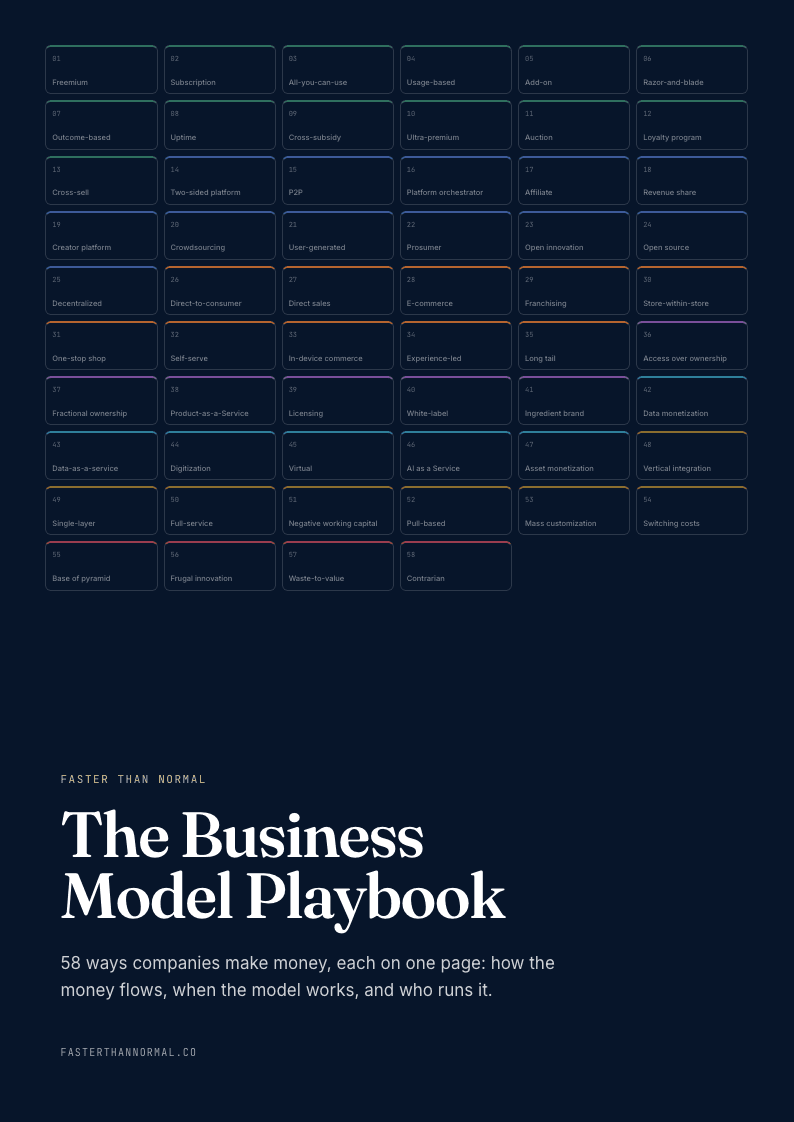
Get The Business Model Playbook
58 business models, one visual page each: how the money flows, the metrics that matter, and who runs it. Free when you join the Faster Than Normal email.
Free. No spam. Unsubscribe anytime.
Section 2
How to See It
Post-Mortem Analysis
You're seeing Determinism when a company's failure, examined in hindsight, traces neatly to decisions made years earlier — pricing structure, market selection, hiring patterns — each leading inevitably to the next.
Market Dynamics
You're seeing Determinism when an industry consolidates in exactly the way economic theory predicted — margins compress, weak players exit, the surviving firms are those with structural cost advantages. The outcome was determined by the initial conditions.
Section 3
How to Use It
Use deterministic thinking as a diagnostic tool: when you see an outcome, trace the causal chain backward. What initial conditions produced this? Then project forward: given current conditions, what outcomes are being determined right now? This doesn't require certainty — it requires discipline in mapping cause to effect.
Decision filter
"What are the initial conditions of this situation, and what outcomes do they make likely? If we don't change the inputs, is the trajectory already set?"
As a founder
When things go wrong — or right — resist attributing outcomes to luck. Trace the causal chain. What decisions, incentive structures, or market conditions made this outcome probable? Then ask: what outcomes are your current conditions determining right now? Change the inputs if you don't like the projected output.
Section 5
Founders & Leaders
Isaac NewtonPhysicist; mathematician
Newton's laws described a clockwork universe — given initial conditions, every subsequent state is determined. This vision shaped not just physics but the Enlightenment belief that understanding causes gives you power over effects. While Newton himself acknowledged limits to prediction, his framework gave humanity the confidence to engineer outcomes rather than accept fate. Founders can apply Newtonian determinism as a mindset: if you understand the forces acting on your business — competitive dynamics, incentive structures, cost curves — you can forecast trajectories and intervene before they become irreversible. The discipline is mapping causes before they produce consequences you can't undo.
Section 7
Connected Models
Reinforces
Path Dependence
Path dependence says early decisions constrain later options. Determinism explains why: each decision sets initial conditions for the next. Together they show why founders must be especially careful about early choices — they determine the trajectory.
Reinforces
Butterfly Effect
The butterfly effect shows that small changes in initial conditions can produce vastly different outcomes. This is determinism at its most humbling: the chain is causal, but sensitivity to starting conditions makes long-range prediction extremely difficult.
Tension
Chaos Theory
Chaos theory says deterministic systems can produce unpredictable behaviour. The tension: outcomes are caused, but they may not be forecastable. Determinism tells you to look for causes; chaos theory reminds you that the chain may be too complex to fully trace.
Section 8
One Key Quote
— Pierre-Simon Laplace"We may regard the present state of the universe as the effect of its past and the cause of its future."
Section 11
Summary & Further Reading
Outcomes are less random than they appear. Trace results backward to their causes and project current conditions forward to their likely consequences. Deterministic thinking is a diagnostic discipline: understand the inputs, and you can predict — and change — the outputs.