


Part IThe Story
The Circle of Excellence
One night near the turn of the millennium, at a resort in Hawaii, Therese Tucker watched a procession of winners cross a stage. SunGard Treasury Systems — the Fortune 500 IT company where she served as Chief Technology Officer — was holding its annual "Circle of Excellence" ceremony, the sales winners' trip, all pomp and plumeria. One by one the honorees collected their trophies. Every single person who walked across that stage was a middle-aged white man.
Tucker had spent more than a decade at the company, had risen through programming ranks to the top technical role, had designed systems that moved money across the planet. She was, by any reasonable measure, excellent. But watching that parade of khaki and self-congratulation, something calcified inside her. "That was the first time I was thinking, 'You know, my career is probably limited here,'" she later recalled. The insight was not that the system was unfair — she had known that since her first computer science lecture, where she was one of two women in a class of five hundred — but that the system would never accidentally correct itself. If she wanted to run something, she would have to build it.
What she built, starting with her retirement savings and a second mortgage and a couple of friends who believed in her when no venture capitalist would, became BlackLine — a company that automates the tedious, error-prone drudgery of the corporate financial close. It is not a glamorous product. It does not photograph well at conferences. It replaces spreadsheets and late nights and transposed numbers. But it now serves more than 4,400 customers in roughly 150 countries, generates approximately $687 million in annual revenue, and trades on the Nasdaq under the ticker BL. When BlackLine went public on October 28, 2016, with shares surging 39% on their first day to value the company at over $1.1 billion, Tucker became the first woman founder-CEO to take a venture-capital-backed Los Angeles startup public. Her personal fortune reached an estimated $380 million. Forbes placed her among the richest self-made women in America.
And it all started because a room full of salesmen in Hawaiian shirts showed her the ceiling.
By the Numbers
BlackLine at a Glance
$687MApproximate annual revenue (2024)
4,400+Customers worldwide
~400,000Users on the platform
$146MRaised in 2016 IPO at $17/share
$200M+Silver Lake investment in 2013
15 yearsBootstrapped before first outside capital
$0Tucker's salary for first five to six years
The Youngest of Four Girls
The farm was in Illinois — not the suburban fringe near Chicago but the real interior, where the horizon is a flat line of corn and the economy runs on factory shifts and feed prices. Therese Tucker was born the youngest of four daughters to a father who was both factory worker and farmer, born in 1920 into the teeth of the farm depression, a man who never went to college because there were no such things as school loans back then and no money besides. Her mother steered the girls toward secretarial work and nursing — practical paths, respectable ones, the kind that wouldn't embarrass anybody at church. Tucker's parents made sure she took typing and shorthand in high school so she could get a good job taking notes for someone more polished.
But there was an upside to having four daughters and no sons on a working farm: there was no free labor except the children you had. "We were never told that we couldn't do something because we were girls," Tucker said years later. She herded cows. She raised pigs. She drove tractors. She learned to change oil, swap tires, rebuild engines. The message, never explicitly given but absorbed through every chore, was that competence had nothing to do with gender — it had to do with showing up before dawn and not complaining.
Her oldest sister followed the script — secretarial job, married a factory worker, eventually divorced and became an attorney. Her second sister died of breast cancer. Her third became a nurse, then went back to school to become a nurse practitioner, chafing against the narrowness of what had been deemed appropriate. Tucker was the first in her family to attend a four-year college. Most people she knew in that small town were getting engagement rings for graduation presents and jobs at local department stores. "I thought I would die if that is all I did with my life," she said.
She enrolled at Illinois Wesleyan University as a business and French major — a combination that sounds cosmopolitan but mostly meant an 8:00 a.m. accounting class that made her addicted to coffee because she couldn't stay awake. She considered switching to art. She figured she wasn't good enough and would starve to death. Then, as a general education elective, she walked into one of the first Apple computer programming courses the college had ever offered. The classroom happened to be next door to her chemistry lecture.
The first application she ever wrote was a blinking Christmas tree made of asterisks that would turn on and off. It was trivial. It was also a revelation. "You could write some instructions for this computer and it can execute them unbelievably fast, a million times in a row," she recalled. "I fell in love." She applied to transfer to the University of Illinois at Urbana-Champaign, which had an actual computer science program. Her parents, who she later said "didn't think I was that bright," could not have understood what she was chasing. She barely understood it herself.
The Sheep and the Goats
The University of Illinois was a different country. The liberal arts warmth of Illinois Wesleyan — small classes, supportive faculty — gave way to a weed-out culture of astonishing indifference. In her first computer science class, struggling with the theoretical intensity, Tucker approached her instructor for help. His response was institutional poetry: "This is the class where we tell the sheep from the goats."
She was, again, one of the very few women. The isolation had a strange duality. "You stand out," she acknowledged. "If you're the only woman in the room, you absolutely get noticed. You do have to have a bit of a thick skin so that certain things don't bother you." She earned her degree in computer science and mathematics — a combination that required both the abstract elegance of proofs and the mechanical precision of code. It was a training ground for what she would later do: build systems that impose order on chaos.
Her first job took her to California, to Hughes Aircraft in Fullerton, building fault-detection firmware for surface-ship sonar. She was an engineer in the defense industry, writing software that listened to the ocean for threats. But the entrepreneurial bug had already bitten. There had to be something more exciting, she said. She began freelancing at twenty-three. A few years later, with a son on the way, she returned to the stability of a traditional job, joining ADS Associates — a financial software maker — as a programmer. Over more than a decade she rose through the ranks, eventually becoming Chief Technology Officer of its parent company, SunGard Treasury Systems. It was the Hawaii trip that broke the spell.
Retirement, Boredom, and the Wealth Manager's Spreadsheets
Tucker resigned from SunGard to spend more time with her two young children — she was a single mother by then. She took what she calls a sabbatical, did a large amount of yoga, got into great shape, and was bored out of her mind within a year. She had spent her entire adult life solving problems with code. Staying home felt like putting an engine in neutral.
The catalyst was prosaic. A meeting with her personal finance manager. Tucker noticed that the tax software the company was using was cumbersome, primitive, absurdly manual. She knew she could build something better. This was 2001. The dot-com bubble had just detonated. Venture capital had retreated into its bunkers. Tucker didn't even consider seeking outside funding — not out of ideological conviction but out of practical realism. "Back in those days I wouldn't have known how to have gotten outside capital," she said. "And frankly I doubt that anybody would have actually put money in."
She had tried and failed at a few startups before. She had no track record of exits. She was a woman in her forties in a field that worshipped twenty-something male founders. In 2001, the year BlackLine was born, the venture ecosystem's appetite for a middle-aged female CTO with pink hair and no prior successful startup was functionally zero. A 2012 study by Dow Jones VentureSource — published over a decade later — found that only 1.3% of venture-backed startups had a female founder. Tucker didn't need to see the statistic to know the odds.
So she did what people do when no one else believes: she bet on herself. She cashed out her retirement savings from SunGard. She maxed out her credit cards. She took out a second mortgage on her house. "If I could have figured out how to get into my kids' college funds," she said, "I would have taken that too."
Three People in a Small Office
The early years of BlackLine were a study in near-failure. Tucker started the company initially focused on wealth management software — the world she knew from her finance manager encounter. For three years, she landed one paying customer. One. She was bleeding money, burning through personal savings, and the venture capital market wanted nothing to do with her.
Then, around 2004, that single customer asked a question that would redirect the entire enterprise. Could Tucker's team build something to help manage the ten thousand spreadsheets they were struggling with for account reconciliation? The customer was willing to pay. Not a lot — but something. "I believe that most startups, the ones that are successful, are because they actually address business problems that people have," Tucker later reflected.
She pivoted. The new product addressed what turned out to be one of corporate America's most universal and underserved pain points: the financial close. Every company — public or private, small or enormous — closes its books monthly, quarterly, and annually. The process involves reconciling hundreds or thousands of accounts, matching transactions from multiple systems, hunting down discrepancies that could be as small as fifty cents, and documenting everything for auditors. Most companies did this in Excel. Thousands of spreadsheets, emailed around, printed in binders, maintained by exhausted accountants at 9:00 p.m. on the last day of the quarter. Errors were endemic. Audit failures were common. Nobody had automated it because nobody thought of accounting grunt work as a software problem.
Tucker did. She had spent her career at the intersection of technology and finance, and she saw what the market could not yet articulate: that the financial close was not a people problem but a systems problem, and systems problems could be solved with code.
The pivot was existential. By 2005, BlackLine was down to three employees. Tucker was so strapped for cash she couldn't make payroll. "I had a couple of friends that believed in me," she said. Two men — mentors, she called them — would bail her out until BlackLine got paid. "I would go and beg them for $30,000 or $40,000." That cycle of desperation continued for about a year. Without those friends, Tucker said flatly, "the company wouldn't be here. It would not be here."
— Therese TuckerI cashed out my nest egg from my options, I maxed out my credit cards, I took out a second mortgage on my house. If I could have figured out how to get into my kids' college funds, I would have taken that too.
She landed Costco as a customer early — a coup and a curse. "Here's the thing about companies," she said. "They take forever to pay." The cash flow torture of enterprise sales, where the product is delivered months before the invoice clears, nearly killed BlackLine more than once. But Costco stayed. Years later, it was still a customer.
The Cloud Before the Cloud
Tucker engineered BlackLine's transition to the cloud in 2007 — a year before the term "SaaS" had entered the mainstream corporate vocabulary and well before most finance departments would have trusted their sensitive data to someone else's servers. The timing was both prescient and commercially treacherous. Finance professionals are, by temperament and training, conservative. They deal in controls, auditability, regulatory compliance. Telling a chief accounting officer in 2007 that her reconciliation data would live on remote servers was like telling a surgeon to operate via FaceTime.
But Tucker understood something about her market that competitors — the few that existed — did not: the cloud wasn't just a delivery mechanism; it was an architectural philosophy. On-premise software required IT departments to install, maintain, and update. Cloud-based software updated automatically, scaled without hardware purchases, and could be accessed from anywhere. For a process as time-sensitive as the financial close, where accountants in New York and London and Singapore needed simultaneous access to the same data, the cloud was not merely convenient. It was transformative.
BlackLine was creating a new market. And as Tucker later told Bessemer Venture Partners' Byron Deeter on the Cloud Giants podcast, creating a new market is a slow process regardless of how much money you throw at it. "We were creating a new market," she said. "And the reality is that is a fairly slow process, no matter how much money you take and throw at it." Building brand awareness, educating the market on an entirely new offering, and persuading change-averse finance professionals to abandon their spreadsheets required patience, consistency, and an almost irrational willingness to forgo a salary. Tucker didn't pay herself for the first five or six years. When she finally did, it was $30,000 a year — about one-tenth of what she had earned at SunGard. "And I was thrilled."
The Frugality Doctrine
The bootstrapping years — from 2001 to 2013, twelve years without outside capital — were not merely a financial constraint. They were, Tucker would argue, a competitive advantage. "When you are spending your own money, you learn to do it really well," she told Deeter. "You learn that if you sign up for a trade show at the last minute, you can get a really good deal. You learn how to use your frequent flyer miles to get airplane tickets. You learn how to take every single dollar and put that dollar towards generating more revenue."
This is not the conventional Silicon Valley wisdom. The prevailing orthodoxy holds that speed wins — that the right strategy is to raise as much capital as possible, burn through it acquiring customers, and figure out profitability later. Tucker's counterargument was not ideological but empirical: in her specific case, more money would not have accelerated growth. The market was not ready for faster education. The product needed to be built by people who understood accounting deeply, not by engineers parachuted in from ad-tech. The customers she was targeting — controllers, chief accounting officers, heads of financial reporting — were not impulse buyers. They were people who made decisions slowly, by committee, after months of evaluation, and who valued stability over flash.
The frugality doctrine did something else, too. It ensured that every feature BlackLine built was one a customer had asked and paid for. There was no room for speculative product development, no luxury of building features in search of a problem. The product roadmap was dictated by the people who used it. "Let your customers dictate your product direction," Tucker advised other founders — not as a platitude but as a survival strategy.
By 2013, when private equity firm Silver Lake Sumeru — alongside ICONIQ Capital — invested more than $200 million in BlackLine, the company was already profitable, already growing, and already the dominant player in a category it had essentially invented. Tucker had initially entertained the idea of selling the entire company. "I started this process thinking I would sell the whole company and take another year off," she admitted. But the due diligence process rekindled something. She got excited about the potential of the future. "I'm so glad I stayed on."
The Bell
On October 28, 2016, Therese Tucker rang the opening bell at the Nasdaq. She was flanked by her two children. BlackLine had priced its IPO at $17 per share, raising approximately $146 million, and the stock promptly soared 39% to close at $23.70, valuing the company at more than $1.1 billion. Only about fifteen technology companies had gone public that year, well below recent levels, and BlackLine — fast-growing, profitable, occupying a category with no dominant competitor — was received with something like hunger.
"You think about it as a bit of a milestone day, not just for me, but the team that's been working hard for so long," Tucker told a reporter by phone from New York. The understatement was characteristic. She had spent fifteen years and exhausted a couple of million dollars in personal savings. She had survived on $30,000 annual salaries and $40,000 emergency loans from friends. She had been a single mother building enterprise software in a city — Los Angeles — that the tech establishment did not take seriously as a software hub. And she had pink hair.
The pink hair became a kind of signature, a visible refusal to conform that signaled something deeper. In an industry that rewards pattern-matching — young, male, hoodie-wearing, Stanford-affiliated — Tucker was none of these things. She was a farm kid from Illinois in her mid-fifties who had bootstrapped an accounting software company in Woodland Hills. The fact that she was the first woman founder-CEO to take a VC-backed LA startup public was both a triumph and an indictment. It was 2016. The statistic should not have been novel.
— Therese TuckerWe need more women CEOs of tech companies. It's disturbing we've made such little progress.
Two months before the IPO, BlackLine had been included in the inaugural Forbes Cloud 100 list — the ranking of the top private cloud companies in the world, published by Forbes in partnership with Bessemer Venture Partners and Salesforce Ventures. The inclusion was an imprimatur. The IPO was a vindication.
Hiring the Oddballs
Tucker's management philosophy is best captured in a piece of advice she has repeated in multiple forums: hire the oddballs and corporate misfits. This is not mere whimsy. It reflects a deeply held belief, forged in her own experience as a perpetual outsider, that the most valuable employees are often the ones who don't fit neatly into corporate boxes.
"At BlackLine we try to hire people that bring passion to their jobs," she said in a 2015 interview. The emphasis on passion over pedigree was deliberate. Tucker had spent her early career in environments that valorized credentials and conformity — defense contractors, Fortune 500 IT companies, the kind of places where a programming class on an Apple II would have been considered unserious. She had built her technical skills outside the elite pipeline, had never attended Stanford or MIT, had majored in business and French before stumbling into computer science. She knew from personal experience that talent takes idiosyncratic forms.
The company grew to roughly 800 employees by 2018, then continued scaling. Tucker's approach to culture was hands-on — employees described her as bringing "a perfectly balanced combination of passion, intellect, laser sharp insight, humility, receptiveness, and kindness" into meetings, making "every single person feel important." This is the kind of language that reads like corporate hagiography until you learn that the person saying it was a content writer, not a PR executive, and that Tucker routinely made time for junior employees who had ideas.
The culture question mattered because BlackLine was doing something unusual: building an enterprise software company in Los Angeles, far from the gravitational pull of San Francisco and Silicon Valley. Woodland Hills, the neighborhood where BlackLine made its headquarters, is deep in the San Fernando Valley — a place more associated with entertainment industry back offices than cloud computing. Tucker turned the geographic isolation into a recruiting advantage. Los Angeles had a deep pool of technical talent that was underserved by the local startup ecosystem, and BlackLine could offer something the Valley couldn't: a mission-driven company with a founder who had built it from nothing, in a city where the cost of living (at least in 2001) was more humane.
The Succession
By 2018, Tucker had begun planning her own obsolescence. She hired Marc Huffman as Chief Operating Officer — a seasoned SaaS executive who had spent years at Oracle's NetSuite, where he ran global sales and distribution and helped grow the business from $3 million in revenue to $1 billion. Huffman was, in Tucker's telling, the executive who could do what she could not: scale BlackLine from a $300-million-revenue company to a billion-dollar one.
The succession was methodical, almost clinical. In February 2020, Huffman was named president. That summer, Tucker took a six-week sabbatical — partly to test Huffman's readiness, partly because she had always wanted to learn to ride a motorcycle. (She did.) When the COVID-19 pandemic hit, Huffman assumed the daily leadership burden: morning meetings with the executive team, crisis communications, operational decisions that required speed and confidence. Tucker watched. She was satisfied.
On August 6, 2020, Tucker announced she would step down as CEO on January 1, 2021, transitioning to the role of executive chair. "I have to acknowledge that, after 19 years, a lot of my identity is wrapped up in this company, and in the title," she told Fortune. "I'm handing my baby off to somebody who loves that baby. But yeah, I'll probably freak out at some point."
The framing was characteristically blunt. Tucker did not dress the transition in the language of strategic evolution or corporate governance best practices. She said what it was: hard. Emotional. A partial death of self. But also necessary, because she understood her own strengths and limits. "The next stage of the company is, how do we scale this thing to a billion dollars?" she said. "And frankly, that's not my set of skills. I really enjoy the product side a lot more."
She stayed on as executive chair, then in March 2023 returned as co-CEO alongside Owen Ryan, who had been brought in as chairman. That arrangement — the founder and the professional operator sharing the top job — lasted until August 5, 2025, when BlackLine announced that Tucker would transition to the role of Founder, with Ryan continuing as sole CEO, effective October 1, 2025. In the announcement, Tucker said: "With our refreshed strategy, rapidly improving execution led by our dynamic new leadership team, and a reignited innovation engine, this is the right time for my transition to Founder." It was, after twenty-four years, a final letting go — though she remained on the board, a significant shareholder, and actively engaged with the company's largest customers and European markets.
The Problem No One Glamorizes
The thing about accounting automation is that no one puts it on the cover of Wired. Nobody makes a documentary about the reconciliation of intercompany transactions. The financial close is the plumbing of capitalism — invisible, essential, and only noticed when it breaks.
Consider what BlackLine actually does. During a typical month-end close, a large enterprise might need to reconcile thousands of accounts across dozens of subsidiaries in multiple currencies. A bank reconciliation alone could involve matching 5,000 transactions from a general ledger against bank statements, hunting down discrepancies as small as half a dollar, and documenting every variance for internal controls and external auditors. Credit card reconciliations require matching employee expense reports to card statements across hundreds of cards. Intercompany transactions between subsidiaries create a labyrinth of offsetting entries that must balance perfectly or trigger audit flags.
Before BlackLine, this was done in Excel. A single large enterprise might employ dozens of accountants who spent 70% of their time during close periods on these repetitive tasks. The risk of human error — an accountant reconciling her forty-seventh account at 9:00 p.m. accidentally transposes a number, misses a duplicate entry — was enormous. Audit firms routinely identified reconciliation failures as material weaknesses in financial controls, potentially triggering regulatory issues and stock price hits.
BlackLine's platform pulls data directly from source systems, applies rules-based matching logic, flags exceptions that need human review, and maintains a complete audit trail. For that 5,000-transaction bank reconciliation, the system automatically matches 4,850 transactions in seconds, leaving the accountant to investigate only the 150 exceptions that genuinely require judgment. What took two hours manually can be completed in minutes, with higher accuracy and better documentation.
It is boring. It is also a market worth billions. Tucker saw it because she had lived in both worlds — the technology side and the finance side — and because no one else was looking. The glamour of consumer apps and social networks blinded an entire generation of founders to the unsexy, enormous opportunity hiding inside the back offices of every Fortune 500 company.
— Therese TuckerThe beautiful thing about programming is that you can direct a computer to do something for you and you can then run that on a million computers. The power is amazing for what you can do for business with that. I fell in love with it, and it's been my entire career.
Not Naive
Tucker's feminism, if that's the right word, was practical rather than programmatic. She did not crusade. She built. But she was unflinching about what she had seen.
"I can tell you a story. It's kind of graphic and gross," she said in a 2018 interview with CNBC, preparing to share her own #MeToo moment — "one of many, actually." Then, with the dark humor of someone for whom harassment had simply been the weather: "What's so interesting is back when I was of an age to be harassed, it was pretty much part of the culture."
She had navigated decades in male-dominated environments — defense contracting, financial software, enterprise tech — and had developed what she called "a thick skin," though the phrase understates the psychic cost. The Circle of Excellence moment in Hawaii was not her first encounter with the ceiling, only her most clarifying one. She had spent years being the only woman in the room, noticed but not promoted, visible but not powerful.
When she took BlackLine public, the statistic that she was the first woman founder-CEO of a VC-backed LA startup to do so was cited everywhere. Tucker's response was not pride but frustration. "We need more women CEOs of tech companies," she said, announcing her planned step-down in 2020. "It's disturbing we've made such little progress." By then, only 15% of all US venture capital dollars invested in 2017 had gone to firms with a female founder, according to All Raise. The number had barely moved.
Tucker spoke at Harvard, Columbia, and NYU. She keynoted at SaaStr Annual 2018 to a standing-room-only crowd. She was named CEO of the Year, invited to judge the Forbes Cloud 100, and spoke at the Financial Times Women at the Top Summit in London. The awards and speaking invitations were deserved — and also, she might have noted, evidence of how few women occupied the space she did. She was invited everywhere partly because there was almost no one else to invite.
The Asterisk Tree
There is a through-line in Tucker's story that runs from the blinking Christmas tree made of asterisks on an Apple II in a college elective class to a $687-million-revenue public company that processes billions of transactions annually. It is not a straight line. It bends through sonar firmware and wealth management failures and $40,000 emergency loans and ten thousand spreadsheets and a Hawaiian awards ceremony that revealed the shape of a glass ceiling. But the through-line is this: the conviction that a machine, properly instructed, can do what humans do — faster, more accurately, at scale — and that the power of that insight is worth betting everything on.
Tucker's best piece of advice to aspiring entrepreneurs was also her cruelest: "The best advice is 'don't do it.' Because if you listen to that advice, you'll never make it." It was a Zen koan disguised as discouragement. The people who succeed, in her telling, are the ones who hear "don't do it" and feel their blood rise. "It's the people that are crazy and are determined to work themselves to death and to fail and fail and fail until they don't fail. It takes that kind of grit and determination."
On October 1, 2025, when her formal transition to the Founder role took effect, Therese Tucker was no longer running the company she had started twenty-four years earlier with her retirement savings and a second mortgage and a conviction that no one else shared. She remained on the board. She remained a significant shareholder. She remained in the market, guiding BlackLine's largest customers through their transformation journeys, with a substantial presence in Europe. Jeremy Ung, the chief technology officer — a co-founder himself — took over the product and technology organization.
But the company she had built kept doing what it had always done: pulling data from source systems, matching transactions in seconds, flagging exceptions, maintaining audit trails, replacing the tedium of spreadsheets with the precision of code. In offices across 150 countries, accountants closed their books faster and slept better because a farm kid from Illinois had once written a program to make asterisks blink on a screen and thought: the power is amazing for what you can do for business with that.
The asterisks still blink.
Part IIThe Playbook
What follows is a distillation of the principles — strategic, operational, and personal — that Therese Tucker developed over two and a half decades of building BlackLine from a self-funded startup to a publicly traded market leader. These are not abstractions. They are patterns, extracted from specific decisions and their consequences.
The principles
- 1.Bet the house — literally — when no one else will.
- 2.Create the category rather than competing in one.
- 3.Let the customer dictate the product.
- 4.Treat bootstrapping as a discipline, not a limitation.
- 5.Be early to the platform shift, even if the market isn't ready.
- 6.Solve the problem nobody wants to talk about.
- 7.Hire the oddballs.
- 8.Build where others aren't looking.
- 9.Know when your skills are no longer what the company needs.
- 10.Use exclusion as fuel, not as an excuse.
- 11.Inoculate against failure by failing first.
- 12.Never explain the ceiling — build the ladder.
Principle 1
Bet the house — literally — when no one else will
Tucker's founding capital was her retirement savings, maxed-out credit cards, and a second mortgage. This was not recklessness; it was a calculated response to a capital market that had no interest in funding a middle-aged female founder in 2001. By making herself the sole investor, she aligned incentives perfectly — every dollar wasted was a dollar she would personally never recover. The desperation created discipline.
The broader lesson is about conviction asymmetry. When an entrepreneur has deep domain expertise and the market has not yet validated the opportunity, the gap between founder conviction and investor interest can be enormous. Tucker could not close that gap with a pitch deck. She could only close it with her own money. The risk was real — she acknowledged she would have raided her children's college funds if she could have — but so was the information advantage. She had spent fifteen years inside financial software. She knew the pain point was real. She just couldn't prove it to anyone who hadn't lived it.
Tactic: When external capital won't validate your thesis, ask whether the gap is between your knowledge and the market's, or between your optimism and reality — then fund accordingly.
Principle 2
Create the category rather than competing in one
BlackLine did not enter an existing market for financial close automation. It created one. Before Tucker, the concept of automating the reconciliation and close process with dedicated software barely existed. Companies used Excel, emails, and binders. The Big Four accounting firms made money auditing the mess. Nobody was selling a solution because nobody had framed the problem as solvable through software.
Category creation is slower and more expensive than category entry, but it confers an almost insurmountable advantage: the creator defines the terms of evaluation. When BlackLine's competitors eventually appeared, they were measured against BlackLine's feature set, BlackLine's customer list, BlackLine's integration architecture. Tucker was not just the first mover; she was the standard-setter.
The tradeoff was time. Tucker's observation — "We were creating a new market, and the reality is that is a fairly slow process, no matter how much money you take and throw at it" — is a crucial corrective to the growth-at-all-costs ideology. Some markets cannot be accelerated with capital. They require education, proof points, and the gradual erosion of institutional inertia.
Tactic: If you're creating a category, plan for a longer timeline than conventional VC models allow — and structure your capital accordingly, even if it means bootstrapping.
Principle 3
Let the customer dictate the product
BlackLine's pivot from wealth management software to financial close automation was not a strategic insight from a whiteboard session. It was a customer request. The one paying customer Tucker had in 2004 asked if she could build something to manage their ten thousand reconciliation spreadsheets. Tucker said yes.
This pattern repeated throughout BlackLine's history. The product roadmap was never speculative. Every feature was built because a customer asked for it and was willing to pay for it. The bootstrapped economics enforced this — there was no R&D budget for exploratory features. Every engineering hour had to generate revenue.
The discipline of customer-led development also created a powerful feedback loop. Because BlackLine was building exactly what finance professionals needed, adoption was high, churn was low, and reference customers were abundant. When the sales team approached a new prospect, they could point to Costco, Coca-Cola, eBay, and Boeing — all of whom were using the software because it solved their specific, stated problems.
Tactic: When a customer asks you to build something adjacent to your core product — and is willing to pay for it — treat the request as a market signal, not a distraction.
Principle 4
Treat bootstrapping as a discipline, not a limitation
Tucker's twelve years without outside capital were not a fundraising failure. They were, in retrospect, a strategic choice — one that shaped the company's culture, product philosophy, and operational efficiency in ways that persisted long after Silver Lake's $200 million arrived in 2013.
$
The Frugality Flywheel
How bootstrapping created compounding advantages
| Constraint | Behavior it forced | Long-term advantage |
|---|---|---|
| No R&D budget | Only build what customers will pay for | High product-market fit, low churn |
| No marketing budget | Last-minute trade show deals, frequent flyer miles | Capital efficiency embedded in culture |
| No salary for founder | Personal urgency to generate revenue | Revenue-first mindset from day one |
| No hiring budget | Hire generalists who do multiple jobs | Cross-functional employees, flat organization |
The key insight is that frugality, once internalized, becomes a competitive moat. Companies that learn to generate revenue efficiently in their early years rarely lose that skill, even as their budgets expand. BlackLine's capital efficiency was not abandoned when Silver Lake invested — it was amplified.
Tactic: Even if you raise venture capital, operate as if you're spending your own money for the first two years — you'll build habits that compound.
Principle 5
Be early to the platform shift, even if the market isn't ready
Tucker moved BlackLine to the cloud in 2007, years before most enterprise finance departments would have considered trusting their data to remote servers. The decision was risky — her target market was the most conservative demographic in corporate America — but it was also structurally correct. Cloud delivery eliminated IT procurement cycles, enabled simultaneous global access, and created automatic update pathways that on-premise software could not match.
Being early to a platform shift is different from being early to a market. Tucker was not predicting that cloud computing would succeed (many people were predicting that). She was predicting that finance professionals specifically would adopt it — a much harder bet, given the risk aversion of the audience. Her insight was that the benefits of cloud delivery were so overwhelming for the financial close use case — where timeliness, global access, and auditability are paramount — that even conservative buyers would eventually adopt.
The "eventually" mattered. Tucker had to sustain the business through several years of market education. The bootstrapped economics gave her the patience to wait. A VC-funded competitor, under pressure to show rapid growth, might have abandoned the cloud strategy or pivoted to a more receptive market.
Tactic: When you see a platform shift that's structurally inevitable for your market, invest early — but ensure your capital structure can survive the adoption lag.
Principle 6
Solve the problem nobody wants to talk about
Nobody at a cocktail party says, "I'm building a company that automates account reconciliation." It is not a sentence that inspires awe. Tucker's genius was recognizing that the unglamorous nature of the problem was itself a competitive advantage. The sexier corners of enterprise software — CRM, marketing automation, data analytics — attracted dozens of well-funded competitors. Financial close automation attracted almost none.
The problem's invisibility also meant that incumbents — the Oracles, SAPs, and Microsofts of the world — had no incentive to build the solution. Their ERP systems generated the data that needed to be reconciled, but the reconciliation itself was considered a customer problem, not a software problem. Tucker saw the gap and filled it. By the time the incumbents recognized the opportunity, BlackLine had thousands of customers and deep integration with their systems.
Tactic: The most defensible businesses often solve problems that are too boring for competitors to notice — seek the pain point that's universal but unmentioned.
Principle 7
Hire the oddballs
Tucker's hiring philosophy was shaped by her own experience as an outsider — a farm kid who became an engineer, a single mother who became a CEO, a woman in a world of middle-aged white men. She hired people who didn't fit the standard corporate mold, who brought unconventional backgrounds and perspectives, who might have been overlooked by more conventional companies.
This wasn't charity. It was a talent arbitrage. The kind of person who thrives at a bootstrapped company in Woodland Hills — far from the VC cocktail parties and Stanford alumni networks — is, by definition, someone who doesn't need external validation to do great work. Tucker's oddballs were loyal, creative, and driven by the same chip-on-the-shoulder energy that had propelled her.
The strategy also created a distinctive culture that became a retention tool. Employees at BlackLine felt they belonged to something unusual — a company built by someone who understood what it felt like to be underestimated, and who had created an environment where being different was an asset, not a liability.
Tactic: When recruiting, look for the candidate whose resume doesn't pattern-match but whose intensity and domain curiosity are unmistakable.
Principle 8
Build where others aren't looking
Los Angeles in 2001 was not a technology hub. Silicon Valley and San Francisco dominated enterprise software; Seattle had Microsoft and Amazon; Boston had its biotech corridor. LA was entertainment, aerospace, and real estate. Building an enterprise SaaS company in Woodland Hills was, by the standards of the time, eccentric.
Tucker turned the geographic disadvantage into a moat. LA had a deep pool of technical talent — much of it trained in the defense and aerospace industries — that was underserved by the local startup ecosystem. Housing costs were (relatively) lower. Competition for engineers was less intense. And the distance from Silicon Valley's hype cycle meant that Tucker could build patiently, without the constant pressure to chase the latest trend or match the spending of better-funded competitors.
By the time BlackLine went public, it had helped establish LA as a legitimate software city, joining Snap, Cornerstone OnDemand, and others in demonstrating that great technology companies could be built outside the Bay Area.
Tactic: Consider building in a market with deep talent but thin startup ecosystems — the recruiting advantages often outweigh the networking disadvantages.
Principle 9
Know when your skills are no longer what the company needs
Tucker's decision to step down as CEO was not forced. The board wasn't pushing her out. The stock price had tripled since the IPO. She chose to leave the role because she understood, with unusual clarity, that the skills required to scale a company from $335 million to $1 billion in revenue were different from the skills required to build it from zero.
"The next stage of the company is, how do we scale this thing to a billion dollars?" she said. "And frankly, that's not my set of skills. I really enjoy the product side a lot more." This level of self-awareness is rare among founder-CEOs, who often conflate their identity with their title and resist succession until it's too late.
Tucker's approach was also procedurally rigorous. She hired her successor two years before the transition, promoted him incrementally, tested him with a six-week sabbatical, and announced the change only after he had successfully navigated a pandemic. The succession was a product launch, not a crisis response.
Tactic: Plan your own succession at the moment you feel most indispensable — that's when you have the most leverage to choose your replacement well.
Principle 10
Use exclusion as fuel, not as an excuse
Tucker was excluded from venture capital because she was a woman in her forties. She was excluded from the Circle of Excellence because she was a technologist, not a salesman. She was excluded from the "typical" career path because her parents expected her to be a secretary. At every juncture, she converted exclusion into motivation.
The key distinction is between treating exclusion as evidence that the system is broken (true but unproductive as a personal strategy) and treating it as information about where the system has gaps you can exploit. Tucker couldn't get VC funding? She bootstrapped, which gave her more control and better economics. She couldn't advance at SunGard? She built her own company, which made her a billionaire. She was the only woman in the room? She stood out, which made her memorable to customers and partners.
This is not a defense of the systems that excluded her. It is a description of how she navigated them. The distinction matters.
Tactic: When you encounter a closed door, ask whether there's an adjacent open door that leads somewhere better — exclusion often reveals arbitrage opportunities.
Principle 11
Inoculate against failure by failing first
Tucker had tried and failed at several startups before BlackLine. She had pivoted from wealth management software when it wasn't working. She had been down to three employees. She knew what failure felt like — intimately, financially, personally — and that knowledge was liberating.
"Not having a fear of failure was a huge advantage," she said. Her parents' low expectations had, paradoxically, freed her from the anxiety that paralyzes many founders. If no one expects you to succeed, the downside of failure is merely confirmation of what everyone already assumed. The upside of success is infinite.
This is a variant of Nassim Taleb's concept of antifragility: systems that gain from disorder. Tucker's early failures did not weaken her. They calibrated her risk tolerance, sharpened her pattern recognition, and inoculated her against the paralysis that accompanies the fear of losing everything — because she had already lost everything, more than once.
The tactical application is counterintuitive: seek small, survivable failures early in your career. Each one reduces the emotional cost of the next, building a tolerance that becomes invaluable when the stakes are existential.
Tactic: Pursue ventures with asymmetric upside before you have dependents and mortgages — early failure is cheap education.
Principle 12
Never explain the ceiling — build the ladder
Tucker's approach to the gender imbalance in technology was conspicuously non-theoretical. She did not write manifestos. She did not launch advocacy organizations. She built a company, took it public, and became living proof that the system's assumptions were wrong.
This is not to say she was silent. She spoke at Harvard, Columbia, the Financial Times Women at the Top Summit. She said, publicly, "We need more women CEOs of tech companies — it's disturbing we've made such little progress." But her primary argument was not rhetorical. It was existential. BlackLine's $687 million in annual revenue is a more persuasive argument for female entrepreneurship than any panel discussion.
The principle extends beyond gender. In any context where a founder faces systemic skepticism — whether based on geography, background, industry, or demographic — the most effective response is not argument but evidence. Build the thing. Let the results speak.
Tactic: When the system doubts you, don't waste energy persuading it — redirect that energy into building something the system can't ignore.
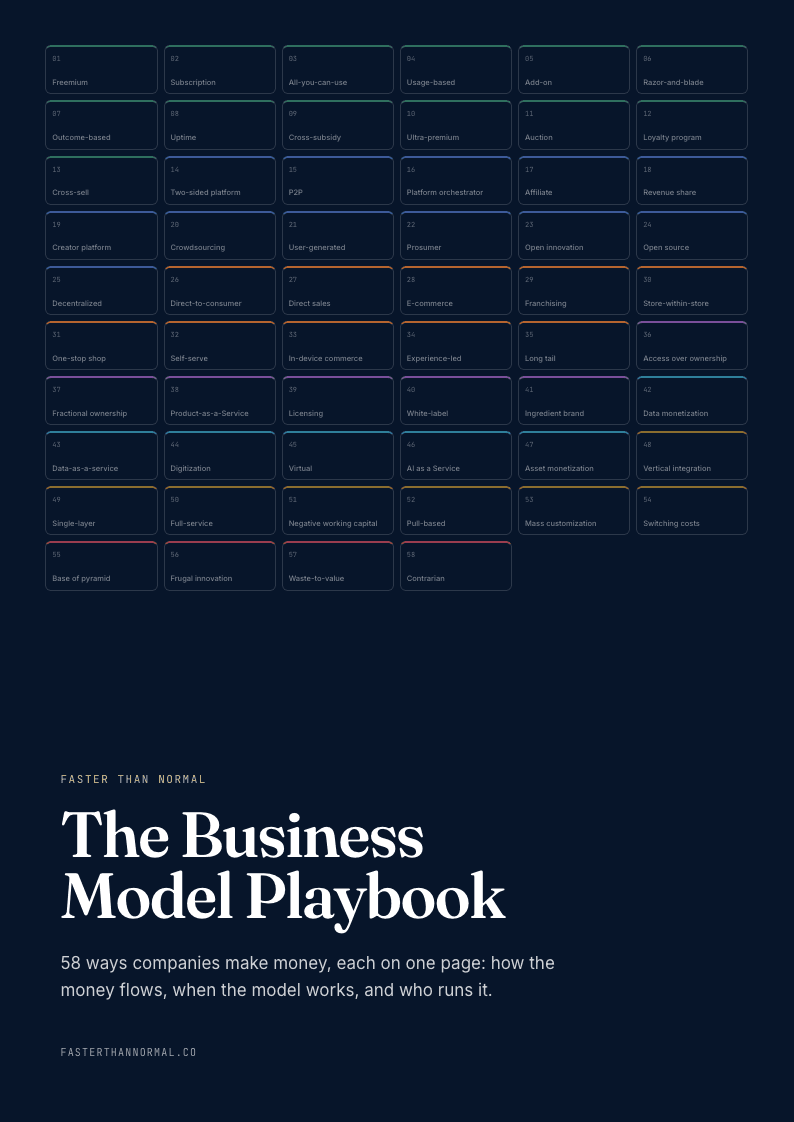
Free playbook
Get The Business Model Playbook
58 business models, one visual page each: how the money flows, the metrics that matter, and who runs it. Free when you join the Faster Than Normal email.
Free. No spam. Unsubscribe anytime.
Part IIIMaxims
-
The ceiling is a compass. When you see a room full of people who look nothing like you receiving awards, the system is telling you where its boundaries are — and where the opportunity lies outside them.
-
One customer is enough. BlackLine's pivot to financial close automation came from a single paying customer's request. You don't need market research when you have a customer willing to pay you to solve their problem.
-
Boring is a moat. The less glamorous the problem, the fewer competitors you'll face. Account reconciliation will never trend on Twitter, which is precisely why it became a multibillion-dollar market for one company.
-
Bootstrapping is not a phase — it's a philosophy. Capital efficiency learned under duress becomes a permanent competitive advantage. Spend every dollar as if it's your last, even when it isn't.
-
Domain expertise is the real unfair advantage. Tucker spent fifteen years inside financial software before starting BlackLine. She didn't need to interview customers to understand the pain point — she had lived it.
-
Frugality compounds. The habits formed when you're using frequent flyer miles and last-minute trade show deals don't disappear when you raise $200 million. They become organizational DNA.
-
Plan succession at peak strength. The worst time to choose your replacement is when you're forced to. Tucker began the process two years before the transition, tested her successor under real conditions, and stepped back by choice.
-
Geographic isolation can be a recruiting advantage. Building in a market underserved by startups means less competition for talent and lower costs — if you're willing to forgo the network effects of established hubs.
-
Fail early, fail cheaply, fail often. Tucker's pre-BlackLine failures calibrated her risk tolerance and eliminated the fear of loss that paralyzes most founders when the stakes are existential.
-
The product is the argument. When the system doubts your capacity — because of gender, age, geography, or background — the most effective rebuttal is not persuasion but evidence. Build the thing. Revenue is more convincing than rhetoric.
In Their Own Words
It's possible to build something out of nothing that has incredible value.
We've done something so unique. We've convinced more than a thousand great big companies to put their financial data into our private cloud.
When you find the right partner, the right investor, what they can do in terms of helping you grow and scale a company is just invaluable.
I've spent my whole career in B2B software. It's an area that doesn't get enough focus.
I've also always had trouble conforming, fitting into a certain mold.
Bootstrapped, because nobody in their right mind would have actually invested in us back then.
Turned out I liked it. Turned out it became who I am.
I got bored and started BlackLine. Not the best reason for starting a company.
Why have a modest ambition? Because then you accomplish it, and it's boring.— Interview with Inc.
I told my kids, had I been able to access their college savings funds, I probably would have taken that too.— Interview with Business Insider
Bootstrapped it and then in October of 2016, we actually did an IPO, which was interesting and fun and cool, but it's a lot of work, too.— SaaStr Annual 2018
I've always had trouble conforming, fitting into a certain mold.— SaaStr Annual 2018
The relentless entrepreneur funded her idea completely on her own dime until 2013.— Business Insider
I want to put a caveat on that.— SaaStr Annual 2018
The best advice is "don't do it." Because if you listen to that advice, you'll never make it. It's the people that are crazy and are determined to work themselves to death and to fail and fail and fail until they don't fail.— Therese Tucker
When you are spending your own money, you learn to do it really well. You learn that if you sign up for a trade show at the last minute, you can get a really good deal. You learn how to take every single dollar and put that dollar towards generating more revenue.— Therese Tucker
I have to acknowledge that, after 19 years, a lot of my identity is wrapped up in this company, and in the title. I'm handing my baby off to somebody who loves that baby. But yeah, I'll probably freak out at some point.— Therese Tucker
I didn't get a salary for my first five or six years at BlackLine. And when I finally did, it was $30,000 a year and it was about one-tenth of what I'd made at SunGard. And I was thrilled.— Therese Tucker


