


Part IThe Story
On April 12, 1888, a man in Paris opened his morning newspaper and read his own obituary. "The merchant of death is dead," declared the French press. "Dr. Alfred Nobel, who became rich by finding ways to kill more people faster than ever before, died yesterday." The details were wrong — it was Ludvig Nobel, Alfred's older brother, who had died in Cannes the previous day — but the misidentification scarcely mattered. What mattered was the mirror. Alfred Nobel, fifty-four years old, unmarried, dyspeptic, possessed of 355 patents and factories in twenty countries and a fortune built on the industrialization of destruction, was given the rarest of gifts: the chance to see how the world would remember him. He did not care for the reflection. Eight years later, when he actually died — alone, of a cerebral hemorrhage, in his villa in San Remo on December 10, 1896 — his will directed that the bulk of his estate, some 31.5 million Swedish kronor (roughly $265 million in today's currency), be used to endow annual prizes for those who "shall have conferred the greatest benefit to humankind" in physics, chemistry, medicine, literature, and peace. It was the largest philanthropic bequest the world had ever seen. His family was furious.
The Nobel family saga is not principally a story about the prizes, though the prizes have so thoroughly colonized the family name that everything else has been effaced. It is a story about Swedish engineers who built an oil empire in Tsarist Russia, about the strange alchemy by which explosives manufacture became synonymous with the highest aspirations of civilization, and about what happens to a dynasty when its most famous member decides, from beyond the grave, to give the fortune away. Three generations of Nobels — Immanuel, the bankrupt inventor who rebuilt himself in St. Petersburg; Ludvig, the industrial organizer who created Europe's largest oil company; and Alfred, the solitary chemist who found a way to make nitroglycerin behave — form a triptych of immigrant ambition, technical brilliance, and the peculiar loneliness of people who are better with molecules than with other human beings. Their story rhymes with the Rockefellers (the comparison was common enough to generate a book title: The Russian Rockefellers), but the parallel obscures something more interesting. The Rockefellers kept the money. The Nobels lost it — first to revolution, then to philanthropy, and finally to the strange gravity of a brand that no longer belonged to them.
By the Numbers
The Nobel Dynasty
355Patents held by Alfred Nobel at death
31.5MSwedish kronor bequeathed to Nobel Prizes (1896)
~$265MEquivalent value today of Alfred's bequest
90+Factories across 20+ countries under Alfred
12%Share of global oil production held by Branobel at peak
5Nobel Prize categories established in Alfred's will
0Family members who won a Nobel Prize
The Bankrupt Father and the Tsar's Mines
The story begins not in Stockholm's genteel quarters but in its debtors' courts. Immanuel Nobel — Alfred's father — was born in 1801 in Gävle, a coastal town north of the capital, into a family whose surname had been adopted (or invented) only a generation earlier, derived from the Latin nobilis by an ancestor with aspirations that exceeded his circumstances. Immanuel was an autodidact and a serial tinkerer, the kind of man who could design a rubber knapsack for the Swedish army one week and a rotary lathe the next, but who could not, for all his mechanical ingenuity, manage the financial side of anything. By 1837, having tried and failed at construction, rubber manufacturing, and various contraptions, he was bankrupt. His wife, Andriette Ahlsell — a shopkeeper's daughter possessed of the iron practicality her husband conspicuously lacked — was left in Stockholm with three small boys while Immanuel went to seek his fortune in the only place a bankrupt Swede with good engineering and no credit could go: Russia.
St. Petersburg in the 1840s was an empire in a hurry. Tsar Nicholas I wanted industrial modernity without the inconvenience of political liberalization, and foreign technicians were welcomed with a combination of generosity and surveillance that would persist, in various forms, for the next century and a half. Immanuel arrived with little more than drawings of an underwater mine he had conceived — a wooden cask filled with gunpowder, detonated electrically — and within a few years had talked his way into a contract with the Russian military. The timing was impeccable. The Crimean War broke out in 1853, and the British Royal Navy sailed into the Baltic. Immanuel's mines, crude but effective, were deployed in the harbor approaches to Kronstadt, the fortress island guarding St. Petersburg. They worked. Ships were damaged. The harbor held. The Tsar awarded Immanuel the Imperial Gold Medal.
The family reunited in Russia. Andriette and the three boys — Robert, Ludvig, and Alfred — joined Immanuel in St. Petersburg, and for a brief decade the Nobel household was prosperous, socially connected, and intellectually electric. Immanuel's workshop became a schoolroom. The boys were tutored privately — languages, chemistry, engineering — and Alfred, the youngest and most intellectually precocious, was sent at sixteen on a two-year study tour of Europe and America, a grand circuit that took him to Paris, where he studied under the chemist Théophile-Jules Pelouze, and possibly to the United States, though the details of that leg remain disputed. What is not disputed is that Alfred returned to St. Petersburg speaking five languages and carrying an obsession with nitroglycerin, the oily, violently unstable explosive that the Italian chemist Ascanio Sobrero had synthesized in 1847 and immediately regretted.
Then the wheel turned. The Crimean War ended. Russian military orders dried up. Immanuel, who had expanded wildly on credit, went bankrupt again. He returned to Sweden in 1859, broke and aging, dragging his wife back across the Baltic to start over once more. Robert and Ludvig stayed in Russia. Alfred oscillated between Stockholm and St. Petersburg, already drifting toward the peripatetic homelessness that would define his adult life. The father's pattern — invention, overextension, collapse, reinvention — was the inheritance each son would metabolize differently. Ludvig would learn the lesson about financial discipline. Alfred would learn the lesson about solitude. Robert would learn very little.
Nitroglycerin and the Education of Alfred Nobel
The problem with nitroglycerin was that it killed the people trying to use it before it could be made useful. Sobrero himself, scarred by a laboratory explosion, spent years lobbying against its commercial application. The substance was magnificently powerful — roughly eight times more potent than gunpowder by weight — but it was also magnificently temperamental: a sharp jolt, a change in temperature, sometimes apparently nothing at all, and the liquid detonated with catastrophic force. Alfred Nobel's contribution to history was not the discovery of nitroglycerin but the domestication of it — the slow, empirical, frequently lethal process of learning how to make an unstable substance obey.
He began experimenting with his father in Stockholm in the early 1860s, in a shed on the family property at Heleneborg. On September 3, 1864, that shed exploded. Five people died, including Alfred's youngest brother, Emil, who was twenty-one. The blast was powerful enough to be heard across the city. Stockholm's authorities banned further experiments within the city limits. Alfred, who was not in the building at the time of the explosion, moved his laboratory to a barge anchored on Lake Mälaren.
The death of Emil is the hinge point of Alfred's emotional biography, the event that hardened an already introverted young man into something colder and more driven. He rarely spoke of it. He did not stop working. Within months he had established Nitroglycerin AB, the first of his companies, and was producing the explosive commercially, shipping it in the form of a liquid packed in diatomaceous earth — what he called "dynamite," from the Greek dynamis, power — by 1867. The patent for dynamite, arguably the most consequential intellectual property of the nineteenth century after the steam engine, made Alfred wealthy. The subsequent patents for blasting gelatin (1876) and ballistite (1887) made him spectacularly so.
But here is the paradox that would define Alfred's life and, eventually, his death: he became one of the richest men in Europe by selling the means of destruction, and he loathed violence. He was a pacifist — or at least a man who fervently wished to be one. He corresponded for years with Bertha von Suttner, the Austrian peace activist (and, later, the 1905 Nobel Peace Prize laureate), who pressed him repeatedly to support the peace movement. His position was characteristically slippery: he believed that weapons of sufficient power would make war unthinkable. "My factories may well put an end to war sooner than your congresses," he wrote to her. "The day when two army camps can annihilate each other in one second, all civilized nations will recoil from war in horror and disband their forces." It is the logic of deterrence, articulated four decades before the term existed, and it is also the logic of a man making excuses.
— Alfred Nobel, in a letter to Bertha von SuttnerMy factories may well put an end to war sooner than your congresses. The day when two army camps can annihilate each other in one second, all civilized nations will recoil from war in horror and disband their forces.
Alfred was, by every surviving account, profoundly unhappy. He never married. His most significant romantic relationship — with Sophie Hess, an Austrian flower seller twenty-three years his junior, whom he supported financially for decades — was by turns tender and humiliating, their correspondence a record of mutual incomprehension across gulfs of education, temperament, and social class. He suffered from chronic headaches, depression, and the bitter irony that nitroglycerin, which he had spent his career taming, was prescribed by his doctors in small doses as a treatment for his heart condition. "It is the irony of fate that I have been prescribed nitroglycerin, to be taken internally!" he wrote to a friend. "They call it Trinitrin, so as not to scare the pharmacist and the public."
— Alfred Nobel, letter to a friend, late in lifeIt is the irony of fate that I have been prescribed nitroglycerin, to be taken internally! They call it Trinitrin, so as not to scare the pharmacist and the public.
He lived in hotel suites and rented villas, owned homes in six countries and felt at home in none. He wrote poetry — bad poetry, mostly, though he was aware it was bad — and a play, Nemesis, based on the Beatrice Cenci story, which his executors destroyed almost all copies of. He described himself, in a passage of self-laceration that reads as both self-pitying and precisely observed, as "a misanthrope, yet utterly benevolent; a super-idealist who digests philosophy more efficiently than food." He was, in short, the archetype of a particular kind of nineteenth-century European genius: brilliant, rootless, guilty, and rich.
Ludvig's Empire: Oil on the Caspian
While Alfred was making dynamite famous and himself miserable in western Europe, his older brother Ludvig was building something arguably more impressive and certainly more organizationally complex on the other side of the continent. Ludvig Nobel — heavyset, pragmatic, equipped with a strategic intelligence that Alfred's chemical brilliance sometimes obscured — had stayed in St. Petersburg after Immanuel's second bankruptcy and rebuilt the family's Russian business from scratch, manufacturing armaments for the Tsar's military. He was, by temperament and talent, the operator that Alfred never wanted to be: a man who could run factories, manage workers, negotiate with bureaucracies, and think in systems.
In 1873, Robert Nobel — the eldest brother, a man whose judgment was less reliable than either of his siblings' — traveled to the Caucasus to buy walnut wood for rifle stocks. What he found instead was oil. The region around Baku, on the western shore of the Caspian Sea, was producing crude petroleum from shallow wells in quantities that suggested something enormous underfoot. Robert, in a characteristic act of impulsive overreach, spent the rifle-stock money — 25,000 rubles of Ludvig's capital — on a small refinery instead. Ludvig was not pleased. But he was also not stupid. He went to Baku, surveyed the deposits, and decided to commit.
What followed was the creation of Branobel — the Petroleum Production Company Nobel Brothers, established in 1879 — which would become, within a decade, the largest oil company in Russia and one of the largest in the world. At its peak in the 1880s, Branobel controlled roughly 12% of global oil production, a share comparable to what Standard Oil held in the American market. Ludvig's genius was not in finding the oil but in solving the logistics of moving it. He commissioned the Zoroaster, the world's first successful oil tanker, in 1878 — a vessel designed to carry kerosene in bulk rather than in barrels, cutting transportation costs dramatically. He built pipelines, storage depots, railway tank cars, and a distribution network that stretched from Baku to St. Petersburg to the Baltic ports. Where John D. Rockefeller dominated through refining and railroad rebates, Ludvig dominated through integration: he controlled extraction, refining, transportation, and distribution in a single vertical chain.
Alfred invested in Branobel — he was the largest single shareholder after Ludvig — but took little operational role. The brothers' relationship was complex, threaded with mutual respect and a rivalry that neither quite acknowledged. Alfred was the more famous; Ludvig was the more successful businessman. Alfred made explosives; Ludvig made infrastructure. They needed each other, and they kept their distance.
Ludvig died on March 31, 1888 — in Cannes, not in St. Petersburg, where he had lived and worked for decades — and it was his death that triggered the premature obituary that would redirect Alfred's posthumous reputation. The French newspapers confused the brothers. "Le marchand de la mort est mort." Alfred read the words and understood, perhaps for the first time, the story that would be told about him unless he wrote a different ending.
The Will That Split a Family
Alfred Nobel's last will, signed on November 27, 1895, in the Swedish-Norwegian Club in Paris, was a remarkable document — remarkable for what it created, remarkable for what it destroyed, and remarkable for the sheer administrative chaos it unleashed. Written in Alfred's own hand, without legal counsel, it directed that the residue of his estate be invested in safe securities and that the interest thereon be distributed annually in the form of prizes for outstanding contributions to physics, chemistry, physiology or medicine, literature, and peace. The physics and chemistry prizes were to be awarded by the Royal Swedish Academy of Sciences; the medicine prize by the Karolinska Institute; the literature prize by the Swedish Academy; and the peace prize — pointedly — by a committee selected by the Norwegian Storting, a choice that may have reflected Alfred's admiration for Norway's more democratic political culture, or simply his desire to irritate the Swedish establishment.
The will was, by any legal standard, a mess. It named no institution as executor. It did not specify how the prize-awarding bodies should be constituted or how nominees should be selected. It gave contradictory guidance about residence requirements. And it gave almost nothing to Alfred's relatives — a collection of nephews, nieces, and more distant kin who had expected, with the confidence of people who have always expected, to inherit a large fortune.
The family contested the will. Hjalmar Nobel, Ludvig's son, led the opposition, arguing that the bequest was legally defective, that Alfred had been of unsound mind (a stretch), and that Swedish law required a testator to provide for his family. The dispute was ugly, protracted, and only partially about money; it was also about control of the Nobel name, which was already becoming something larger than any individual could own. It took three years of litigation and negotiation before the Nobel Foundation was established in 1900 and the first prizes awarded in 1901. The family received modest settlements. The name belonged to the world.
Branobel After the Nobels
The oil empire that Ludvig built survived his death by three decades, but it did not survive the Russian Revolution. By the time the Bolsheviks nationalized the oil industry in 1920, Branobel was a shadow of its former self — its wells damaged by war, its workforce scattered, its foreign shareholders powerless to prevent expropriation. Emanuel Nobel, Ludvig's son, who had run the company since the 1890s with a quiet competence that lacked his father's strategic daring, had already begun selling shares to Standard Oil of New Jersey in 1920, one of the most consequential (and least remembered) transactions in petroleum history. Standard Oil paid approximately $11.5 million for a majority stake in a company that no longer controlled its own assets — a bet, essentially, that the Bolsheviks would eventually fall or compromise. They did neither, at least not soon enough to matter.
Emanuel — a large, cultured man who collected art, funded hospitals, and believed, long after the evidence suggested otherwise, that the old Russia would return — died in 1932, in exile in Sweden. The Russian Nobels were done. The Swedish Nobels had never really been a dynasty in the first place; Alfred, the most famous of them, had no children, and his fortune now belonged to a foundation. What remained was the name. And the name, in the twentieth century, became a commodity of its own.
The Weight of Five Letters
Consider the peculiar burden of being a Nobel in the twentieth and twenty-first centuries. You carry one of the most prestigious names in human culture, but you do not control it. The Nobel Foundation, established by law and international treaty, owns the trademark. The prizes generate a halo of moral authority — the Nobel Peace Prize, the Nobel Prize in Literature — that attaches to the surname regardless of what any actual family member does. And what the family members do, occasionally, is embarrass.
In 2007, Michael Nobel — Alfred's great-grandnephew, a man whose relationship to the original fortune was genealogical rather than financial — approached the organizers of NanoTX'07, a nanotechnology conference in Dallas, with a proposal: he wanted to announce a new Nobel Prize for advances in alternative energy. He would be the featured speaker. The prize would be produced, he told the conference organizers, by Dick Clark Productions. There would be four categories, including one for "celebrities" who advanced the alternative energy cause. The appearance fee he initially requested was $25,000. He claimed to have "huge support from the Koreans, whatever that means," as Peter G. Balbus, a management consultant volunteering for the conference, recounted.
Then the fax arrived from Stockholm. The Nobel Foundation advised the conference organizers that Michael Nobel had been voted out as head of the Nobel Family Society at a meeting in August 2006 "mainly because of his unauthorized activities and involvements in the name of the Nobel Family Society." The Foundation threatened legal action. The conference organizers were, as Balbus put it, "flabbergasted." Michael Nobel was disinvited via email and phone. He did not respond.
The episode is minor in itself — a footnote, a bit of family farce — but it illuminates something essential about the Nobel legacy: the family no longer owns the name, and the name no longer needs the family. Alfred Nobel, through the act of giving his fortune away, accomplished something no Rockefeller or Carnegie or Ford ever quite managed. He severed the connection between dynasty and reputation entirely. The Nobel Prizes do not belong to the Nobels. They belong to the idea of merit, to the proposition that the highest human achievements deserve recognition untethered from bloodline, nationality, or commercial interest. Whether this was Alfred's intention or merely its consequence is, like most things about Alfred Nobel, unclear.
The Invention of Prestige
The first Nobel Prizes were awarded on December 10, 1901 — the fifth anniversary of Alfred's death — in a ceremony at the Royal Swedish Academy of Music in Stockholm. Wilhelm Röntgen received the physics prize for the discovery of X-rays. Jacobus van 't Hoff received the chemistry prize for his work on chemical dynamics and osmotic pressure. Emil von Behring received the medicine prize for serum therapy against diphtheria. Sully Prudhomme, a French poet whom almost no one reads today, received the literature prize. And Henri Dunant, founder of the Red Cross, shared the peace prize with Frédéric Passy, a French economist and pacifist.
The early prizes were controversial. Many scientists regarded them as unseemly — a commercialization of inquiry, a reduction of collective enterprise to individual celebrity. The literature prize was attacked almost from the beginning as parochial, political, or simply wrong; the 1901 selection of Prudhomme over Leo Tolstoy prompted a letter of protest signed by forty-two Swedish writers and artists. The peace prize was, and remains, the most contentious, inviting the question of whether peace is an achievement susceptible to prize-giving at all.
But the prizes endured, and their prestige compounded. By mid-century, a Nobel Prize was the single most coveted recognition in science and letters, its authority deriving not from the monetary award (which, at roughly $1 million today, is generous but not life-changing for most laureates) but from the selection process itself: anonymous nominations, deliberation by committees of peers, a decision announced with the weight of institutional permanence. Alfred Nobel, who trusted almost no one in life, had created a mechanism of trust that outlived empires.
The economics prize — formally the Sveriges Riksbank Prize in Economic Sciences in Memory of Alfred Nobel — was added in 1968, funded not by the original endowment but by Sweden's central bank. The Nobel family objected. Peter Nobel, a descendant of Ludvig, called it a misuse of the family name, arguing that Alfred had deliberately excluded economics from his will. The Foundation allowed it anyway. The name had, by then, acquired a momentum that no family objection could arrest.
— Peter Nobel, descendant of Ludvig NobelThe economics prize is a misuse of the family name. Alfred Nobel would never have approved of a prize in economics.
The Brothers as a System
Seen from sufficient distance, the three Nobel brothers form a system — each compensating for the others' deficiencies, each expressing a different relationship between genius and the world.
Immanuel was the dreamer: prolific, undisciplined, capable of seeing possibilities everywhere and managing none of them. His contribution was genetic and atmospheric — he created the conditions for brilliance without being able to capitalize on it himself. He went bankrupt twice, was rescued twice, and died in 1872 in Stockholm, having lived long enough to see Alfred become rich and Ludvig become powerful but not long enough to see either become famous.
Ludvig was the builder: methodical, strategic, gifted with the organizational intelligence that converts invention into industry. Where Immanuel had ideas and Alfred had patents, Ludvig had operations. He understood logistics, supply chains, labor management, the tedious machinery of scaling a business across a continent. He was the least remembered of the brothers — oil pipelines generate fewer headlines than explosions — and arguably the most impressive.
Alfred was the solitary: a man who worked alone, lived alone, and achieved alone. His 355 patents were the output of a mind that found chemistry more tractable than human society. He had no partners, no collaborators, no one whose name appeared alongside his on any significant invention. This solitude was both his method and his affliction. It produced dynamite. It also produced a man who, at the end, had no one to leave his fortune to and so left it to humanity.
Robert, the eldest, is the cautionary figure: the brother who had the same opportunities and fewer gifts, who spent the walnut money on oil, who contributed the initial spark for Branobel but could not sustain the flame. He died in 1896, the same year as Alfred, having spent his later decades as a gentleman farmer in Sweden, peripheral to the empires his siblings created.
⚙
The Nobel Brothers: A Comparative System
Three brothers, three relationships to invention and industry.
| Brother | Role | Key contribution | Disposition |
|---|---|---|---|
| Immanuel (1801–1872) | Inventor-dreamer | Naval mines; created conditions for sons' education | Bankrupt twice; prolific but undisciplined |
| Ludvig (1831–1888) | Industrial organizer | Branobel; world's first oil tanker | Strategic, methodical, underrecognized |
| Alfred (1833–1896) | Solitary chemist | Dynamite; 355 patents; Nobel Prizes | Brilliant, rootless, guilty |
| Robert (1829–1896) | Initial catalyst | Discovered Baku oil opportunity | Impulsive; peripheral in later life |
Sweden's Other Dynasty
The Nobel family cannot be understood apart from the culture that produced them. Sweden in the nineteenth century was a small, poor, Protestant nation on the northern edge of Europe — a country that exported timber, iron, and people, and that compensated for its lack of natural advantages with an extraordinary emphasis on engineering education and institutional trust. The Nobels were part of a broader pattern of Swedish technical families — the Ericssons, the Wallenbergs, the de Lavals — who built global enterprises from a domestic base that was, by any objective measure, too small to support them.
The Wallenbergs are the instructive comparison. Where the Nobels lost their fortune — to revolution, to philanthropy, to the centrifugal forces of a family with no clear succession — the Wallenbergs kept theirs. The Wallenberg family, which founded Stockholms Enskilda Bank in 1856 and still controls a network of industrial holdings through the Investor AB holding company, represents the path the Nobels might have taken had Ludvig lived longer, had Alfred married, had the Russian Revolution not intervened. The Wallenbergs built institutions. The Nobels built inventions. The Wallenbergs are a dynasty. The Nobels are a name.
This distinction matters because it illuminates the central tension of the Nobel story: the family's legacy is defined not by what they accumulated but by what they gave away. Alfred Nobel's decision to endow the prizes was, in dynastic terms, an act of destruction. It converted private wealth into public institution, family capital into civilizational infrastructure. No heir would sit on a Nobel board wielding inherited authority. No Nobel grandchild would control a foundation endowment. The prizes would be administered by Swedish and Norwegian academic institutions — not by Nobels.
The Chemistry of Guilt
Why did Alfred Nobel give the money away? The premature obituary is the tidy answer, and tidy answers about complex people are almost always incomplete. The obituary matters — it clearly shook him — but Alfred had been thinking about legacy and purpose for decades before 1888. His correspondence with Bertha von Suttner, which began in 1876 when she briefly served as his secretary before leaving to marry a man her family disapproved of, reveals a man who was already troubled by the uses to which his inventions were being put. He funded peace congresses. He invested in diplomatic schemes. He was not, as the caricature would have it, a munitions dealer who woke up one morning and decided to buy redemption.
The deeper answer may lie in Alfred's peculiar homelessness. He was Swedish by birth, Russian by upbringing, French by long residence, Italian by final address, and at home nowhere. He had no family of his own — no children, no lasting partner — and the extended Nobel family, scattered across Sweden and Russia, was connected by blood but not by intimacy. The prizes were, in a sense, the family Alfred chose: an endlessly renewing institution that would carry his name forward not through biological succession but through the recognition of excellence. It was an act of radical loneliness transfigured into radical generosity.
Or perhaps it was simply the chemist in him. Alfred Nobel spent his life taking unstable substances and making them useful. Nitroglycerin became dynamite. Dynamite became wealth. Wealth, in Alfred's formulation, became something that could detonate in ways he could not control — financing wars he deplored, generating a reputation he detested. The prizes were his final stabilization: a mechanism for ensuring that the explosive potential of his fortune was channeled toward precisely defined ends. Physics. Chemistry. Medicine. Literature. Peace. Five categories, five detonation chambers, each directing the blast toward construction rather than destruction.
What the Name Became
The 2016 Nobel Memorial Prize in Economics went to Oliver Hart and Bengt Holmström for their contributions to contract theory — a subject so arcane that even the NPR correspondents covering it considered skipping the episode. "Contract theory — it's two words," Jacob Goldstein said on Planet Money. "They don't even sound good separately." Yet the Nobel imprimatur transformed what would otherwise have been an utterly obscure academic recognition into global news, covered by outlets that could not have defined a Nash equilibrium under threat of death. This is the power of the brand Alfred created: it makes the invisible visible, the abstruse accessible, the unknown famous. It is, in the twenty-first century, perhaps the only remaining institution whose endorsement can cut through the noise of a saturated information landscape and command genuine, if momentary, universal attention.
The family, such as it is, exists in the penumbra of that attention. There are Nobels alive today — descendants of Ludvig and Robert, mostly — scattered across Scandinavia and beyond. Some have tried to leverage the name; the Michael Nobel episode at NanoTX'07 is the most public example, but there are others: family members lending their presence to conferences, energy initiatives, sustainability projects, trading on the residual capital of a surname they did not earn. The Nobel Foundation has been vigilant — sometimes fiercely so — in protecting the trademark, drawing clear lines between the family and the institution.
And yet the family's peripheral position is, in a way, the purest expression of Alfred's vision. He did not want a dynasty. He wanted a standard. The prizes exist to identify what is best in human endeavor, and the identification must be independent — independent of commercial interest, of national politics, and of family sentiment. The Nobel family's irrelevance to the Nobel Prizes is not a failure of the dynasty. It is the dynasty's greatest achievement, carried out by a man who understood that the most enduring form of power is the kind you give away.
Explosions, All the Way Down
The image that resolves the Nobel story is not the ceremony in Stockholm, the laureates in their white tie, the gold medallions stamped with Alfred's profile. It is the barge on Lake Mälaren in the autumn of 1864: a wooden platform floating in cold Swedish water, covered in chemical apparatus, manned by a man whose brother died in an explosion three weeks earlier and who has decided — not with courage exactly, but with something more disturbing: with the calm of someone who has already accepted the terms — to keep mixing nitroglycerin. The water laps. The chemicals hiss. Nobody is watching. The man works alone, as he will always work alone, converting instability into order, danger into utility, private grief into the machinery of progress. He does not know yet that his name will become the highest honor civilization can bestow. He does not know that his family will lose everything and that the loss will be the point. He knows only that the substance in front of him wants to explode, and that if he can just find the right proportion of kieselguhr — diatomaceous earth, the powdered skeletons of ancient diatoms — he can make it wait.
Part IIThe Playbook
The Nobel family's story spans three generations, two empires, and the creation of one of humanity's most enduring institutions. What follows are the operating principles embedded in that history — principles that speak not only to the Nobels' specific circumstances but to the broader questions of how families build, how fortunes compound, and how legacies are designed or defaulted into.
The principles
- 1.Bankruptcy is a curriculum.
- 2.Solve the logistics, not just the chemistry.
- 3.Solitude is a production function.
- 4.Misidentification as moral reckoning.
- 5.Give the fortune away to keep the name forever.
- 6.Vertical integration as competitive moat.
- 7.The operator brother matters more than the genius brother.
- 8.Design institutions, not instructions.
- 9.A brand without governance is a liability.
- 10.Immigrant arbitrage compounds across generations.
- 11.The unearned name is the most dangerous asset.
- 12.Build for the explosion you cannot predict.
Principle 1
Bankruptcy is a curriculum
Immanuel Nobel went bankrupt twice — in 1837 and again in the late 1850s — and each time the collapse taught his sons something the prosperity could not. The first bankruptcy, which sent Immanuel to Russia alone, forced the family into a posture of radical resourcefulness: Andriette held the household together in Stockholm; the boys learned early that security was contingent, that ingenuity was the only reliable asset. The second bankruptcy, which ended the Russian idyll, taught the sons that even success was reversible — that military contracts could evaporate, that empires were fickle patrons.
Alfred internalized this as emotional independence: he never built anything that required partners, employees, or institutional permanence. Ludvig internalized it as organizational discipline: he built systems designed to survive the failure of any single component. Both responses were adaptive. Both were direct consequences of watching their father fail.
The principle generalizes beyond the Nobels. Families that experience early financial adversity but maintain intellectual and emotional infrastructure — education, curiosity, high expectations — often produce children with asymmetrically high risk tolerance and creativity. The bankruptcy is the curriculum; the family culture determines whether the student passes or drops out.
Tactic: Study how formative financial adversity shaped the risk posture of founders or families you invest in — the lesson learned from early failure is often the source of later competitive advantage.
Principle 2
Solve the logistics, not just the chemistry
Alfred Nobel invented dynamite. Ludvig Nobel invented the oil tanker, the pipeline network, and the distribution system that made Branobel one of the world's largest oil companies. Alfred's contribution was a chemical insight; Ludvig's was an operational one. In commercial terms, Ludvig's achievement was arguably more valuable — moving oil cheaply across Russia created more economic surplus than any single explosive patent.
This is the perennial distinction between invention and innovation, between the laboratory and the supply chain. Alfred created a product. Ludvig created an industry. The difference is logistics: the Zoroaster, the tank cars, the storage depots, the pipeline from Baku to Batumi. Each was unglamorous. Each was indispensable. Rockefeller understood this in America; Ludvig understood it in Russia. The lesson is the same: the bottleneck is rarely in creation. It is in distribution.
Tactic: When evaluating a business, ask where the logistical moat lies — who controls the pipeline, the distribution network, the last mile — because the product inventor and the logistics innovator are rarely the same person, and the latter usually captures more value.
Principle 3
Solitude is a production function
Alfred Nobel held 355 patents. He worked alone. He had no laboratory partners, no co-inventors, no research team in the modern sense. His solitude was extreme and, by conventional wisdom, should have been a handicap — collaboration is supposed to accelerate discovery. But Alfred's isolation gave him something collaboration cannot: total ownership of the problem space, uninterrupted focus, and the freedom to pursue lines of inquiry that no committee would have approved. You do not mix nitroglycerin with diatomaceous earth because a team brainstormed it. You do it because you are alone on a barge with an obsession.
This is not an argument for hermitage as universal strategy. It is an observation that certain kinds of breakthroughs — the kind that require sustained engagement with physical danger, that demand a tolerance for catastrophic failure, that proceed not through consensus but through stubborn individual iteration — are structurally incompatible with collaborative work. Alfred's solitude was not a bug. It was the architecture of his creative process.
Tactic: Identify whether a problem requires collaborative iteration or solitary obsession, and structure the working environment accordingly — forcing collaboration on inherently solitary problems (or vice versa) destroys more value than it creates.
Principle 4
Misidentification as moral reckoning
The premature obituary of 1888 — "The merchant of death is dead" — was factually wrong in every particular except the one that mattered. Alfred Nobel was alive. But the characterization was accurate enough to wound. The incident's power lay not in its novelty but in its specificity: seeing his life summarized in a single damning phrase forced Alfred to confront the narrative that would persist if he did nothing to alter it.
Most people never get this opportunity. They die without knowing how they will be remembered, which means they cannot course-correct. Alfred's accidental access to his own obituary was, functionally, a forced strategic review — the kind of exercise that businesses conduct quarterly but individuals almost never perform on themselves. The result was the Nobel Prizes, the most consequential act of reputation engineering in history.
Tactic: Write your own obituary — or have someone else write it honestly — and use the dissonance between what you read and what you want as the basis for strategic reallocation of time, money, and attention.
Principle 5
Give the fortune away to keep the name forever
Alfred Nobel's bequest was, in dynastic terms, an act of destruction: he converted the Nobel family's accumulated capital into a public institution from which no family member would ever derive significant financial benefit. His relatives fought the will. They lost. And the result is that the Nobel name, 129 years after Alfred's death, carries more prestige than any fortune could have sustained.
The Rockefeller name survives through foundations and trusts. The Carnegie name survives through libraries and endowments. The Nobel name survives through the prizes. The difference is that the prizes are active — they generate new prestige annually, selecting laureates whose reflected glory renews the brand. Every October, when the Nobel committees announce their decisions, the family name is revived in a context of civilizational aspiration. No hereditary fortune could achieve this. No family office, however well managed, could compound reputational capital at this rate.
The counterintuitive principle: giving away the fortune was the highest-return investment the Nobels ever made. It just didn't return to the Nobels.
Tactic: When designing a legacy, consider whether reputational capital compounds faster through dynastic control or institutional independence — and be honest about which outcome you are optimizing for.
Principle 6
Vertical integration as competitive moat
Ludvig Nobel's Branobel controlled every stage of the oil value chain: extraction, refining, transportation (pipelines, tankers, rail cars), and distribution. This vertical integration was not merely an operational choice; it was a competitive strategy that made Branobel almost impossible to dislodge in the Russian market. Competitors who controlled wells but lacked transportation infrastructure were at Ludvig's mercy. Competitors who controlled refineries but lacked distribution networks were stranded.
The parallels to Rockefeller's Standard Oil are obvious — both men understood that the highest-value position in the oil industry was not the well but the chokepoint between the well and the customer. Ludvig got there independently, on the other side of the world, applying the same logic to different geography. The universality of the insight is the point: vertical integration works as a moat when the supply chain contains bottlenecks that are expensive to replicate and when control of those bottlenecks grants pricing power over participants at every other stage.
Tactic: Map the full value chain of any industry you operate in, identify which stages contain natural bottlenecks, and invest disproportionately in controlling those stages rather than spreading resources evenly.
Principle 7
The operator brother matters more than the genius brother
In the Nobel family mythology, Alfred is the protagonist: the inventor, the tortured genius, the man whose name adorns the prizes. Ludvig is a supporting character. But Branobel — the enterprise Ludvig built — employed tens of thousands of workers, generated more cumulative revenue than Alfred's dynamite empire, and represented a more sophisticated organizational achievement. Alfred invented a product. Ludvig invented a company.
This pattern recurs across family businesses: the technically brilliant founder receives the credit; the operationally gifted sibling or successor receives the phone calls at 3 a.m. The genius brother has the vision. The operator brother has the org chart, the cash flow management, the supplier relationships, and the patience to execute a fifteen-year logistics buildout. Dynasties endure when they honor both. They fracture when they valorize the genius at the operator's expense.
Tactic: In any founding team or family enterprise, explicitly identify who fills the operator role and ensure that person receives commensurate authority, equity, and recognition — because the operator is typically the one making the enterprise durable rather than merely brilliant.
Principle 8
Design institutions, not instructions
Alfred Nobel's will was notoriously imprecise. It named no executor. It offered minimal guidance on how the prizes should be selected, administered, or funded in perpetuity. This was, on one level, a failure of legal drafting. On another level, it was an act of institutional design by negative space: by not specifying procedures, Alfred left the prize-awarding bodies free to develop their own norms, standards, and traditions. The result was an institution that could adapt across centuries — surviving two world wars, the Cold War, decolonization, and the digital revolution — precisely because its founding document was a statement of values, not a manual of operations.
The comparison with more prescriptive philanthropic instruments is instructive. Foundations with detailed operational mandates often calcify around the founder's historical moment. The Nobel Foundation, freed by Alfred's vagueness, evolved. The addition of the economics prize in 1968 — controversial though it was — demonstrated the institution's capacity for self-extension. A more rigid charter would have prevented it.
Tactic: When building institutions intended to outlast you, specify values and outcomes but leave procedures flexible — the institution must be able to adapt to circumstances you cannot imagine.
Principle 9
A brand without governance is a liability
The Michael Nobel episode at NanoTX'07 — in which a family member attempted to create a new "Nobel Prize" without Foundation authorization, complete with Dick Clark Productions and a celebrity category — illustrates the danger of a high-prestige brand without centralized governance. The Nobel Foundation's vigorous response (a threatening fax, legal warnings, a public clarification that Michael had been voted out of the Nobel Family Society) was necessary precisely because the brand is so valuable that unauthorized use could dilute it irreparably.
This is the dark side of giving the fortune away: when the family no longer controls the institution, individual family members become brand risks rather than brand assets. They carry the name without carrying the authority, which means they can trade on reflected prestige in ways the institution cannot prevent except through legal action. The Nobel Foundation has managed this well — but it requires constant vigilance and a willingness to publicly discipline family members, which is awkward in any context and excruciating in a Scandinavian one.
Tactic: Any brand that has achieved institutional prestige requires formal governance structures that can constrain not just employees but family members, founders, and other individuals whose association with the brand is personal rather than contractual.
Principle 10
Immigrant arbitrage compounds across generations
Immanuel Nobel went to Russia because he was bankrupt and had nowhere else to go. What he found was a market where his skills were scarce and his ambition was rewarded. Ludvig and Alfred, raised in that foreign environment, acquired a cosmopolitan fluency — multiple languages, cross-cultural networks, comfort with displacement — that proved more valuable than any single technical skill. Alfred spoke five languages and operated factories in twenty countries. Ludvig built an oil company that required navigating Russian bureaucracy, Swedish capital markets, and international shipping routes simultaneously.
The Nobel trajectory illustrates a pattern common to immigrant business dynasties: the first generation accepts displacement as survival. The second generation converts displacement into competitive advantage. The third generation (had there been one with capital) would have been positioned to operate across borders with native fluency in multiple economic cultures. The arbitrage is not just financial — cheaper labor, untapped resources — but cognitive: the ability to see opportunities that locals miss because they are too embedded to notice them.
Tactic: Seek the environments where your skills are scarcest relative to demand, not where they are most celebrated — and recognize that the discomfort of displacement is itself a compounding asset.
Principle 11
The unearned name is the most dangerous asset
Every generation of the Nobel family after Alfred has faced the same problem: how to live with a name that confers enormous implied authority and zero operational control. Michael Nobel's attempt to launch a prize he did not own. Peter Nobel's protests against the economics prize. Various family members lending their presence to conferences and initiatives in exchange for the ambient prestige of the surname. None of these activities are criminal, but all of them carry the risk of brand dilution — and all of them are symptoms of a structural problem: when a family's most valuable asset is reputational rather than financial, every family member becomes a potential liability.
The Nobels are not unique in this. The Ford family navigates similar tensions with the Ford Foundation (which they no longer control). The Rockefeller family manages access to the Rockefeller brand through formal family governance structures. The difference is that those families retained significant financial assets alongside their reputational ones. The Nobels lost the money — to revolution, to the will, to the erosion of time — and were left with only the name. A name without capital is a costume. It can be worn, but it cannot be deployed.
Tactic: If you are building a family legacy, ensure that reputational assets and financial assets are governed by the same structures — because reputation without capital creates incentives for the worst kind of arbitrage.
Principle 12
Build for the explosion you cannot predict
Alfred Nobel spent his life managing explosions — literal ones, in his laboratories and factories, and figurative ones, in the form of wars, revolutions, and market disruptions that threatened his enterprises. Ludvig built Branobel in a country that would, within three decades, nationalize everything he owned. Alfred bequeathed his fortune to an institution that would, within a century, be contested by the very family members it was designed to transcend.
The Nobel story is, at bottom, a story about the management of volatility — about taking substances, markets, and reputations that want to explode and finding the right medium to stabilize them. Dynamite is nitroglycerin plus diatomaceous earth. The Nobel Prizes are personal fortune plus institutional independence. In both cases, the key insight is the same: you cannot eliminate the explosive potential. You can only choose the medium that directs the blast.
Tactic: For any asset — financial, reputational, organizational — that carries explosive potential, the strategic question is not how to prevent detonation but how to design the container that channels the energy productively when it inevitably blows.
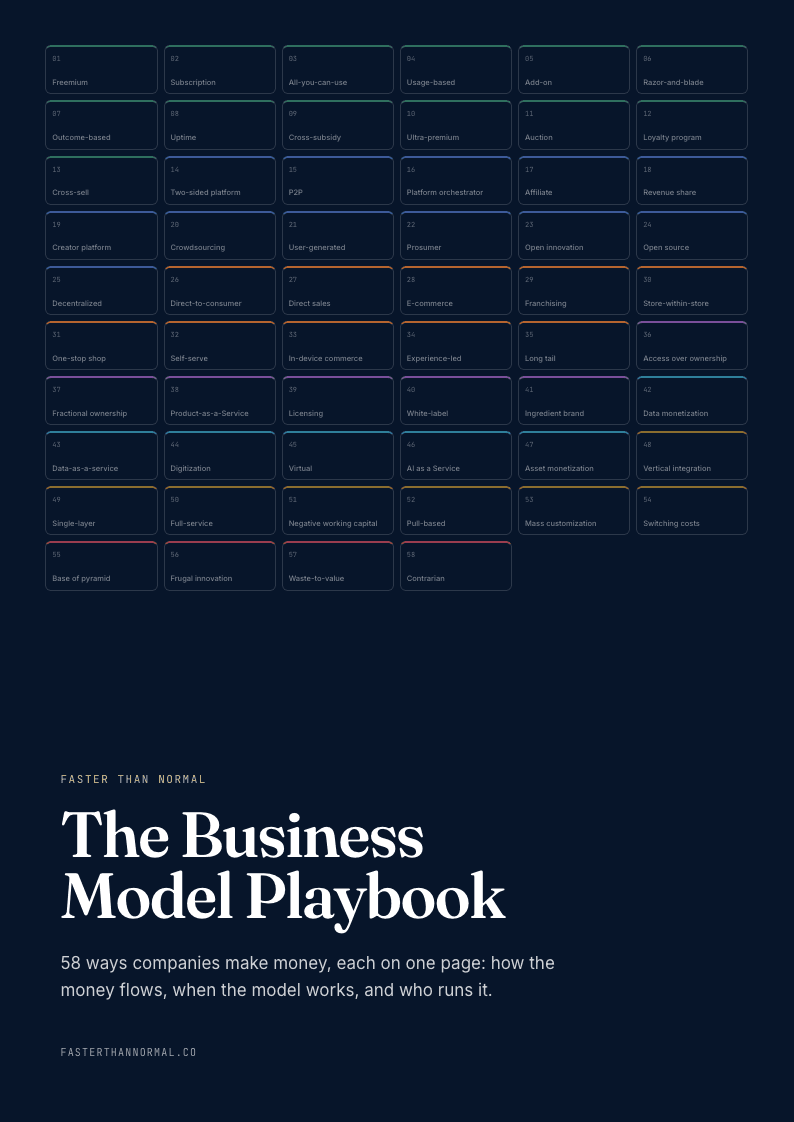
Free playbook
Get The Business Model Playbook
58 business models, one visual page each: how the money flows, the metrics that matter, and who runs it. Free when you join the Faster Than Normal email.
Free. No spam. Unsubscribe anytime.
Part IIIMaxims
-
Bankruptcy teaches what prosperity cannot. Immanuel Nobel's two failures gave his sons the risk tolerance and resourcefulness that built a dynasty — adversity, filtered through a culture of intellectual ambition, is the most reliable source of competitive advantage.
-
The bottleneck is never the invention. Alfred created dynamite; Ludvig created the infrastructure that made Branobel an empire. Distribution, logistics, and operational execution capture more value than the initial breakthrough.
-
Solitude is underrated as a production method. Alfred Nobel's 355 patents emerged from working alone. Some problems are structurally incompatible with collaboration — recognize which ones and protect the solitary space.
-
Read your own obituary before it's written. The premature obituary of 1888 gave Alfred the rarest gift: a chance to see his legacy as the world would frame it, and to rewrite the ending while he still could.
-
The highest-return investment is the one that doesn't return to you. Alfred's bequest destroyed the family fortune and created the most prestigious brand in intellectual history. Reputational compounding can exceed financial compounding — but only if you surrender control.
-
Control the chokepoint, not the well. Ludvig Nobel and John D. Rockefeller independently discovered the same truth: in commodity industries, the value accrues to whoever controls the infrastructure between production and consumption.
-
The operator is the dynasty's load-bearing wall. Genius gets the headlines; operational discipline gets the decades. Families and founding teams that undervalue the operator role build on sand.
-
Institutions outlast instructions. Alfred's vague will — specifying values but not procedures — created a more durable institution than any detailed operational mandate could have. Design for adaptation, not compliance.
-
A name you don't control is a name that controls you. The Nobel family's post-Alfred experience demonstrates that reputational assets without governance structures create perverse incentives and brand risk.
-
Displacement is a compounding asset. The Nobels' immigrant trajectory — from bankrupt Sweden to industrial Russia to global enterprise — illustrates how each generation of displacement builds cognitive and cultural capital that the next generation deploys at scale.
In Their Own Words
A heart can no more be forced to love than a stomach can be forced to digest food by persuasion.
Contentment is the only real wealth.
Good wishes alone will not ensure peace.
Hope is nature's veil for hiding truth's nakedness.
I intend to leave after my death a large fund for the promotion of the peace idea, but I am skeptical as to its results.
If I have a thousand ideas and only one turns out to be good, I am satisfied.
Lying is the greatest of all sins.
My dynamite will sooner lead to peace than a thousand world conventions.
Second to agriculture, humbug is the biggest industry of our age.
Justice is to be found only in the imagination.
Self-respect without the respect of others is like a jewel which will not stand the daylight.
Worry is the stomach's worst poison.
A misanthrope, yet utterly benevolent; a super-idealist who digests philosophy more efficiently than food.— Alfred Nobel, self-description in correspondence
We were flabbergasted.— Peter G. Balbus, on discovering Michael Nobel's unauthorized prize announcement
Mr. Nobel had been voted out as head of the Nobel Family Society mainly because of his unauthorized activities and involvements in the name of the Nobel Family Society.— The Nobel Foundation, fax to NanoTX'07 organizers, 2007
Further reading
- Alfred Nobel: A Biography by Kenne Fant
- The Russian Rockefellers: The Saga of the Nobel Family and the Russian Oil Industry by Robert W. Tolf


