


Part IThe Story
The Tasting Table
A silver-haired man in his eighties sits at a long table in Alba, a town whose air smells permanently of roasted hazelnuts. From eight in the morning until dusk — sometimes past it, sometimes through the night, sometimes on Sundays when the cathedral bells ring and his employees might reasonably expect to be left alone — he methodically tastes and tweaks recipes for new treats. He wears dark glasses because of an eye affliction, though the effect is to make him look like a Cold War intelligence chief conducting a debriefing. The circle of confectioners around him, his most trusted associates, passes samples back and forth. They taste. They argue. They adjust a ratio by a fraction of a percent and taste again. Michele Ferrero, the closest thing the twentieth century produced to a real-life Willy Wonka, is not running a company. He is running a laboratory that happens to employ tens of thousands of people across four continents and generate billions of euros in revenue. The distinction matters. To him, it was the only distinction that mattered.
He never gave a newspaper interview. Not once in eighty-nine years. He refused honorary degrees. He scrutinized prospective employees from behind a two-way mirror at the company's headquarters, a detail reported by Corriere della Sera that seems almost too novelistic to be true — the patriarch of a chocolate empire watching applicants through glass, invisible, assessing. He kept statues of the Virgin Mary in every factory and every office. He made annual pilgrimages to Lourdes. He named his most famous chocolate after a rock formation in a Catholic shrine. He said he was a socialist, then added the qualifier that would define his life's philosophy: "But I do the socialism."
When he died on Valentine's Day 2015, at his home in Monte Carlo, he was worth approximately $26.7 billion. He was Italy's richest individual. His company, still 100% family-owned, with no external shareholders and no debt, had reported revenues of €8.4 billion. He had created Nutella, Kinder, Tic Tacs, Ferrero Rocher, and Mon Chéri. He had invented roughly twenty distinct confectionery products, each occupying a market niche that had not existed before he willed it into being. He had done all of this from a small town between Turin and Genoa, in a country whose industrial culture had been shaped by Fiat and Olivetti, by men who moved to Milan or Rome, who sought the gravitational center. Ferrero stayed in Alba. He built the gravitational center there.
By the Numbers
The Ferrero Empire at Michele's Death
€8.4BAnnual revenue (2014)
$26.7BPersonal fortune (Bloomberg, 2014)
365,000 tonsNutella produced annually
~20Distinct products Michele invented
22,000+Employees worldwide
72%Global market share in chocolate spreads
0Newspaper interviews given in his lifetime
The Langhe and the Hazelnut
To understand Michele Ferrero you must understand the Langhe, and to understand the Langhe you must understand what it was before his family transformed it — which is to say, you must understand poverty. The Langhe hills roll through the southern Piedmont region of northwestern Italy, producing some of the country's finest wines (Barolo, the "king of wines," comes from vineyards minutes from Alba) and, in October, white truffles that fetch staggering prices at auction. But before the postwar economic miracle, the Langhe was a place people left. The great writer Beppe Fenoglio, born in Alba in 1922, three years before Michele, set his novels and stories against this landscape of hardship and partisan resistance. His novella La Malora — roughly, "bad luck" — captured the hunger and desperation of the region. "I write," he told his wife, "because in fifty years everybody will have forgotten how we starved here."
Fenoglio worked until his early death in 1963 exporting wine. Michele Ferrero, by that same year, was already exporting chocolate to half of Europe. They were children of the same earth, the same scarcity, but they channeled its lessons in opposite directions — one into literature, the other into loaves of hazelnut paste wrapped in tinfoil.
The other thing the Langhe produced, abundantly and cheaply, was hazelnuts. They grew on the hills in such profusion that local farmers barely knew what to do with them. This fact — this single agricultural accident of geography and climate — is the fulcrum on which the entire Ferrero story turns. Because in the Piedmont, for at least a century before Pietro Ferrero had his breakthrough, there existed a tradition called gianduja: a mixture of ground hazelnuts and chocolate, named after a local carnival character. The Piedmontese had been cutting chocolate with hazelnuts since the Napoleonic Wars, when a continental blockade against Britain created cocoa shortages across Europe. The innovation was old. What the Ferreros did was industrialize it, democratize it, and eventually make it so ubiquitous that the world forgot it had ever been a regional curiosity born of deprivation.
The Scientist and the Salesman
Pietro Ferrero, Michele's father, was born in 1898 in Farigliano, a village in the Langhe. He trained as a pastry chef and tried his luck in Turin's fashionable neighborhoods, but the big city defeated him — he couldn't make the economics work, or the clientele never materialized, or both. He retreated to Alba, opened a shop on via Maestra, the town's commercial spine, and gave it a name borrowed from a famous Milanese establishment in the Galleria Vittorio Emanuele II: "I Biffi." The name was aspirational, a small-town pastry chef reaching for metropolitan glamor. It was also a tell. Pietro Ferrero was not content to be provincial.
His friends called him "the scientist." He was a man possessed by recipe, constantly experimenting, combining ingredients, adjusting ratios. His brother Giovanni — born from the same small-town stock but wired differently — was the commercial mind, the one who saw distribution where Pietro saw formulation. Together, in 1946, they formally founded what would become the Ferrero company, but the real founding moment had occurred a few years earlier, during the war, when Pietro solved the equation that his son would spend a lifetime elaborating.
The equation was simple: chocolate was scarce and expensive; hazelnuts were abundant and cheap, roughly five times cheaper per kilogram. By combining the two — a larger proportion of hazelnuts, a smaller proportion of cocoa — Pietro created a paste he called Pasta Gianduja, later Giandujot, that could be shaped into a loaf, wrapped in aluminum foil, sliced with a knife, and eaten on bread. It cost a fraction of what real chocolate cost. The workers and children of postwar Italy, a country rebuilding from rubble, could afford it. This was not luxury chocolate repackaged for the masses. It was an entirely different product category — a chocolate substitute that tasted better than it had any economic right to.
Pietro drove a tiny Fiat Topolino through the alleys of Piedmont, making deliveries himself. By 1950 he had 200 trucks distributing gianduja across Italy. A few years later, the fleet had quintupled to a thousand — the largest commercial fleet in the country outside the Italian army. But Pietro Ferrero did not live to see this growth reach its full scale. On March 2, 1949, he collapsed and died of a heart attack. He was fifty years old. His son Michele was twenty-four.
A Letter to the Workers
The company did not pass directly to Michele. He was too young, or was thought to be. Pietro's brother Giovanni assumed operational control, aided by Pietro's widow, Piera Cillario — a woman whose role in the Ferrero story is often compressed into a footnote but who was, by multiple accounts, a steadying and creative force in the early years, the person who tasted prototypes at midnight when her husband shook her awake with a spoon. "How was it? What do you think?" Giovanni built the national sales network that would become the backbone of the company's distribution. He was the brother who made sure the product reached every corner of Italy while Pietro, in his workshop on via Ratazzi, kept tinkering.
Giovanni died in 1957. Another heart attack. Michele, now thirty-two, was alone with the enterprise his father had dreamed and his uncle had distributed. He wrote a letter to his employees. It is worth quoting in full because it established a compact — a moral framework — that governed the next fifty-eight years of the company's existence:
— Michele Ferrero, letter to employees, 1957I pledge myself to devote all my activities and all my efforts to this company. And I assure you that I shall only feel satisfied when I have managed, with concrete results, to guarantee you and your children a safe and tranquil future.
This was not boilerplate corporate sentiment. Ferrero meant it with the literalness of a man raised on Catholic social doctrine. He arranged for buses to collect workers from villages surrounding Alba and return them at shift's end. He provided free medical care, childcare, lifetime health insurance for anyone serving more than thirty years, and company outings at which employees sang a song in local Piedmontese dialect that included a line of thanks to "monsu Michele" — Mr. Michele. When floods devastated Alba in 1994, destroying parts of the company's headquarters, he refused to relocate the business. He rebuilt. The workers stayed. Francesco Fulci, president of the Ferrero Foundation, would later describe the company in language that sounds hyperbolic until you learn the turnover rate: "It's not a company, it's an oasis of happiness."
The Education of a Shy Salesman
Michele Ferrero admitted, with uncharacteristic candor, that he was not a natural salesman. The story has become foundational lore within the company. As a young man, his father sent him out to sell pots of the family's hazelnut spread to bakers in the region. He entered the first bakery and, seized by nerves, asked for two buns instead of pitching the product. He did the same at the second stop. And the third. At the fourth bakery, he walked in and found the counter unattended. In a moment that married cowardice with ingenuity, he left a few pots on the counter with a handwritten note explaining they were available on sale or return. When he came back, the baker told him every pot had sold. He needed more.
The lesson Ferrero extracted was not that he needed to overcome his shyness. It was that he had a product so good it could sell itself. This insight — that the product is the argument, that quality renders salesmanship almost redundant — became the animating conviction of his career. He would later refine it into a principle that governed everything from R&D to advertising: the product must do the work. If it doesn't, no amount of marketing can save it. If it does, marketing becomes amplification, not persuasion.
This was, in its way, a radical position in the postwar Italian business landscape, where relationships, patronage, and personal networks often mattered more than product quality. Ferrero built a company where the product was the relationship.
Mrs. Valeria Goes Shopping
Every product Michele Ferrero ever created was designed for a single imaginary person. He called her "Mrs. Valeria" — La Valeria.
She was the mother, the aunt, the wife. She went to the supermarket with a limited budget and a family to feed. She stood in the aisle and made choices based on a calculus of price, quality, trust, and something harder to name — the desire to bring a small moment of pleasure into her household. She was not wealthy. She was not poor. She was the median consumer, and Ferrero understood her with an intimacy that bordered on obsession.
Every new product had to pass the Valeria test. Would she pick it up? Could she afford it? Would it make her feel she had done something good for her family? Would the packaging speak to her — not in the language of luxury, which would alienate her, and not in the language of cheapness, which would insult her, but in the precise register of accessible quality?
This was not a focus group. Ferrero did not commission market research in the conventional sense. He inhabited the consumer's perspective. He thought about where Mrs. Valeria's eyes would fall in a supermarket aisle. He thought about what she would see at the checkout counter. In the late 1960s, when supermarkets were finally beginning to take root in Italy, he noticed something that no one else had thought to monetize: children standing bored next to their parents at the cash register. He placed mono-dose sweets — Kinder Eggs, Tic Tacs — right there, at child-eye level, where bored kids could tug on their mothers' sleeves and ask for a small reward for their patience. The placement was strategic genius disguised as common sense. The products themselves were designed to make Mrs. Valeria say yes: small, affordable, individually portioned — she could control how much her children consumed, which meant she didn't have to feel guilty about the indulgence.
— Michele FerreroNever patronize a child.
The line, reported in Gigi Padovani's Nutella World: 50 Years of Innovation, is one of the few direct quotes attributable to a man who almost never spoke publicly. It captures something essential about Ferrero's design philosophy: he respected his customers — even the very young ones — too much to condescend to them. Kinder Surprise was not a toy with chocolate attached. It was an experience. The chocolate was real chocolate. The toy was a genuine surprise. The child was treated as a person capable of delight, not a mark to be exploited.
The German Bunker and the Cherry Liqueur
The first product Ferrero took international was not Nutella. It was Mon Chéri, a bite-sized chocolate containing a cherry and kirsch, and the story of its launch in Germany in 1956 is a parable about every obstacle an Italian manufacturer faced in postwar Europe — and about the lateral thinking required to overcome them.
Michele Ferrero understood a problem with his domestic business: Italian summers were hot, and hot weather cratered chocolate sales. If the company was going to grow, it needed markets where people consumed chocolate year-round. Germany — cold, prosperous, chocolate-loving Germany — was the obvious target. But Germans did not like Italians very much in the 1950s, a legacy of Italy's separate armistice with the Allies during the war. And Germans bought chocolate in boxes, for special occasions, not as daily indulgences. The entire cultural framework of German chocolate consumption was wrong for Ferrero's product philosophy.
Ferrero set up production in a former bunker — some accounts say a former Nazi missile facility — and began a marketing campaign that amounted to a slow-motion cultural argument. He gave away Fiats as prizes. He persuaded Germans, through persistent advertising and distribution, that chocolate was not merely a holiday luxury but an everyday affordable pleasure. It worked. Germany became Ferrero's largest market and remains so today, consuming a staggering proportion of the 365,000 tons of Nutella produced annually worldwide.
Mon Chéri itself, however, flopped spectacularly in Britain. The British habit of biting into chocolate — rather than swallowing the piece whole — meant that the cherry liqueur inside the Mon Chéri burst in the consumer's mouth, creating a mess. Ferrero, characteristically, did not try to change British behavior. He designed different products for different markets. The Ferrero Rocher, launched decades later, would succeed in Britain precisely because it was engineered for biting — layers of wafer, hazelnut cream, and chocolate that held together under dental pressure.
The Renaming
The product that had begun as Pasta Gianduja, then became Giandujot, then became SuperCrema, became Nutella in 1964. The name change was partly forced by circumstance — in 1962, Italy passed a law banning superlatives like "super" in consumer product names — and partly an act of marketing genius. Michele Ferrero wanted a name that would travel across borders. He took the English word "nut" and added the Italian diminutive suffix "-ella," which conveys affection, warmth, smallness. Nutella. The word is almost onomatopoeic in its softness, its suggestion of spreading, of yielding.
But the renaming was not just cosmetic. Ferrero reformulated the product, adding more sugar and cocoa, making it richer and — critics would later argue — more addictive. He designed the iconic jar with its white lid. He created, in effect, a new product category: the breakfast spread that existed on the shelf alongside jam and butter but offered something neither could provide — the sensation of chocolate at a price that Mrs. Valeria could justify.
On April 20, 1964, the first jar of Nutella came out of the Ferrero factory in Alba. Today, 365,000 tons are produced annually in eleven factories across the world. Nutella accounts for approximately one-fifth of the Ferrero Group's total sales — roughly $3 billion — and consumes up to a quarter of the planet's entire hazelnut crop. The product that began as a wartime substitute, a workaround born of scarcity, became so dominant that it effectively is the global hazelnut market.
The Architecture of Kinder
In 1968, Michele Ferrero launched Kinder Chocolate. The insight behind it was characteristically oblique: he had noticed that mothers — Mrs. Valeria, always Mrs. Valeria — felt ambivalent about giving their children chocolate. It was a treat, yes, but it was also sugar and fat and guilt. What if a chocolate product could be positioned as more milk, less chocolate? What if it contained enough milk that a parent could feel she was providing nutrition alongside indulgence?
It was, as the Irish Times noted, "a neat marketing trick that kept costs down but also played to an emerging health-consciousness among consumers." This is true, but it undersells the creativity involved. Ferrero was not cynically exploiting health anxiety. He was designing a product that resolved a genuine emotional tension in Mrs. Valeria's decision-making. The child wanted chocolate. The mother wanted to feel responsible. Kinder Chocolate let both of them win.
Six years later, in 1974, Ferrero had the idea that would become Kinder Surprise — a hollow chocolate egg containing a small collectible toy inside. The concept drew from the Italian Easter tradition of hiding gifts inside chocolate eggs, but Ferrero's innovation was to make it available year-round. Why should the joy of discovery be confined to a single holiday? He extended the logic further: the toys inside were not junk. They were designed to be assembled, to engage children's hands and imaginations, and were developed with consultation from child development experts. Over thirty billion Kinder Surprise eggs have been sold.
The Kinder Egg was banned in the United States for decades under a 1938 Federal Food, Drug, and Cosmetic Act regulation prohibiting non-nutritive objects embedded in food products. Ferrero eventually developed Kinder Joy — a two-compartment design that separated the toy from the edible portion — to enter the American market. It was a concession to regulation, but it was also quintessentially Ferrero: he would redesign the product rather than abandon the idea.
Five Years to Bend a Wafer
The legend — and it may be legend, though multiple sources repeat it with the conviction of eyewitnesses — is that it took Michele Ferrero five years to discover how to bend the wafers that go into Ferrero Rocher chocolates. Five years. For a wafer.
Ferrero Rocher launched in 1982, after what the company describes as "a very long process of research and development for excellence." The chocolate was named after the Rocher de Massabielle, the rock grotto at Lourdes where the Virgin Mary appeared to Bernadette Soubirous. Rocher means "rock" in French. The rough golden wrapper, some have suggested, was designed to evoke the creviced surface of the grotto's stone walls. The hazelnut pieces coating the chocolate resemble the irregular peaks of rock.
Whether this is devotion or marketing or both — and in Ferrero's case the categories were never fully separable — the product itself represented an engineering achievement of remarkable sophistication. A whole roasted hazelnut, encased in a thin wafer shell, filled with hazelnut cream, coated in milk chocolate, covered in chopped hazelnuts, individually wrapped in gold foil, packaged in a transparent box that made the gold visible. Every element was deliberate. The transparency of the box communicated honesty — you can see what you're getting. The gold foil communicated aspiration — this is a gift worth giving. The price communicated accessibility — but you can actually afford it. The Alba factory produces twenty-four million Ferrero Rochers per day.
The production process is secretive to an extreme that would make a defense contractor blush. No smartphones are allowed inside the factories. No notebooks. As of 2015, few journalists had ever been invited to visit. Custom-made machines — including a bespoke hazelnut-toasting apparatus — churn out products on assembly lines whose exact configurations are proprietary. The recipes are guarded with a paranoia that rivals Coca-Cola. Ferrero reportedly had his Pocket Coffee recipe — a chocolate containing liquid espresso, designed for Italian truck drivers in the 1960s who had no access to highway coffee bars — translated into Arabic and registered in Egypt, exploiting a special trade agreement between Italy and Egypt to make industrial espionage functionally impossible.
— Michele Ferrero, on the company's 50th anniversaryWe owe Ferrero's success to Our Lady of Lourdes. Without her, we can do very little.
The Invisible Man of Monte Carlo
Sometime in the 1970s, Michele Ferrero relocated his primary residence to Monte Carlo. The reasons were plural and intertwined: Monaco's favorable tax regime, certainly, but also security. Italy in the 1970s was a country terrorized by political violence — the Red Brigades, kidnappings of industrialists, bombings. A man of Ferrero's wealth was a target. Monaco offered proximity to Italy without Italian exposure.
But the move also reflected something deeper about Ferrero's temperament. He was, by nature and conviction, invisible. He gave no interviews. He made no public speeches. He accepted no awards. He wore dark glasses that made him seem "even more remote during his rare public appearances," as The Guardian reported. He commuted by helicopter from Monte Carlo to Alba, arriving at the factory to taste and experiment, departing when the work was done. He was present in the company and absent from the world.
This was not mere eccentricity. It was a strategic choice with philosophical underpinnings. Ferrero believed that the product should be famous, not the person. He believed that publicity was a form of exposure that could only diminish the mystery and authority of the enterprise. He believed — and this is the most radical aspect of his management philosophy — that a company should be known by what it makes, not by who makes it. In an era of celebrity CEOs, of founders as brands, of the personal mythology as corporate asset, Ferrero was the anti-founder. His anonymity was his brand.
The approach extended to the company itself. Ferrero SpA, headquartered in Luxembourg, was famously reticent about its strategy and performance. Financial disclosures were minimal. Media access was nonexistent. The company's factories maintained the kind of security protocols usually associated with government installations. When the company spoke, it spoke through its products — through the gold foil and the white lid and the unmistakable jar shape, through the small transparent box and the individually wrapped Tic Tac, through the chocolate egg with the surprise inside.
The Succession and the Bicycle
In the late 1990s, Michele Ferrero handed operational control to his two sons: Pietro, the elder, and Giovanni. They served as joint chief executives — a structure that reflected the founding template of Michele's father and uncle, two brothers dividing the labor. Pietro, by several accounts, was the more operationally aggressive of the two, the one who looked outward. In 2009, he considered a bid for Cadbury, the British chocolate maker, but Michele — still the patriarch, still the gravitational center — vetoed the idea. The company had never made an acquisition. Michele believed in organic growth, in products developed internally, in the slow accretion of market share through innovation rather than the sudden expansion of purchased brands.
Then, on April 18, 2011, Pietro Ferrero collapsed and died while participating in a charity cycling event in South Africa. He was forty-seven. The cause was cardiac arrest. The Ferrero family had now lost three leaders to sudden heart failure across three generations — Pietro the founder in 1949, Giovanni the uncle in 1957, and now Pietro the grandson in 2011. The pattern was cruel, almost gothic.
Giovanni Ferrero, the surviving son — a man who once said he wrote poetry and novels in his spare time, a different sensibility than his brother's — became sole CEO. He would eventually lead the company through a period of dramatic transformation, embarking on the acquisitions his father had always resisted: Thorntons in the UK, Fannie May and Ferrara Candy in the US, Butterfinger and other brands from Nestlé's American candy portfolio, the ice cream producer Wells Enterprises. He created a parallel holding structure in Belgium called CTH Invest, through which he funneled €1.6 billion in capital for acquisitions. The company that Michele built through patient internal innovation was becoming, under Giovanni, something different — a platform for consolidation.
Giovanni articulated the philosophical bridge between the two approaches in language his father might have appreciated:
— Giovanni Ferrero, 2018Tradition is like a bow. The more we stretch the bowstring, the farther we can throw the arrows of modernity and innovation.
Sacco Conosciuto
There is a phrase embedded in Ferrero's corporate DNA that predates Michele, predates Giovanni, predates even Pietro's first experiments in the workshop on via Ratazzi. It is sacco conosciuto — "knowing what's in the bag." The phrase refers to the practice of inspecting every ingredient at every stage of production, of maintaining total traceability from farm to factory to shelf. It sounds, in the abstract, like quality control. In practice, it was closer to a theology of ingredients.
Ferrero did not simply buy hazelnuts on the open market. He built hazelnut plantations. His only acquisition during his lifetime — before the Cadbury veto, before the turn toward consolidation under Giovanni — was a Turkish hazelnut factory, purchased to secure the supply of the ingredient most precious to Nutella. (Turkey produces roughly 70% of the world's hazelnuts.) The company's vertical integration extended from raw material sourcing through manufacturing and distribution — a closed loop that insulated Ferrero from the quality vagaries of supplier networks and the competitive vulnerabilities of shared supply chains.
The machinery in Ferrero factories was custom-built. The bespoke hazelnut-toasting apparatus in Alba was designed to Ferrero's exact specifications. The production line for Ferrero Rocher — wafer hemispheres filling with cream, clamping together, coating with chocolate, coating with hazelnut pieces, wrapping in gold — was a proprietary engineering marvel that no competitor could replicate because no competitor had ever seen it operate. Even the robots, Ferrero reportedly said, were objects of wonder to him. He loved the technology, the precision, the inhuman consistency of machine-produced perfection.
But beneath the technology was an older instinct: the pastry chef's hand, the scientist's eye, the obsessive's refusal to let a single variable escape scrutiny. Michele Ferrero ran tens of thousands of experiments over the course of his career. Each one aimed at making a better product for Mrs. Valeria. Sacco conosciuto was not a corporate slogan. It was a way of being in the world — a conviction that if you knew exactly what was in the bag, you could stand behind what came out of it.
The Perfume of Alba
When Michele Ferrero died on February 14, 2015, Italian President Sergio Mattarella praised him as a titan of industry, "always ahead of his time thanks to innovative products and his tenacious work and reserved character." Thousands gathered in Alba for the funeral, held in the cathedral. A wake was held at the factory. The man who had refused every public honor in life received, in death, the public mourning of an entire town — a town that existed, in its present form, largely because he had chosen to stay.
Alba, which had been nothing but a somewhat sleepy town amidst a remote countryside, had become, by 2017, a UNESCO Creative City of Gastronomy. Since 2016, some thirty daily train connections linked it to Turin — built, it is said, at the Ferrero family's insistence, so that top executives could commute between the two cities. The factory still perfumes the air with the smell of Nutella. The Ferrero Foundation, established by Michele in 1983, operates a complex in Alba designed for approximately 3,500 former employees and their spouses — a meeting place, workshops, a library, an auditorium, gyms, exhibition halls, a nursery for current employees' children. The foundation's motto is "Work, Create, Donate." More than forty activity groups meet there, from internet skills to ceramics.
The company Michele left behind now employs more than 50,000 people, operates in more than 170 countries, and owns more than 35 brands. Under Giovanni, it has expanded into biscuits (Fox's, Delacre, Kjeldsens), sugar confections (Nerds, SweeTARTS, Trolli), and ice cream. Annual sales now approach $17 billion. Giovanni Ferrero's net worth exceeds $36 billion. The parallel holding company in Belgium controls assets of nearly €5 billion.
But the core — the hazelnut and the cocoa, the jar with the white lid, the gold-wrapped sphere, the tiny mint in its clicking container, the chocolate egg with the surprise inside — remains what Michele made it. Each product is still manufactured to the specifications of a man who spent five years bending a wafer, who woke his wife at midnight to taste chocolate, who watched job applicants through a two-way mirror, who wrote a letter to his employees promising to guarantee their children a safe future, and who kept that promise for fifty-eight years from a small town in the Langhe hills, where the hazelnuts grow thick on the slopes and the air, still, smells of Nutella.
Part IIThe Playbook
Michele Ferrero built one of the world's largest confectionery companies without acquisitions (during his tenure), without external capital, without public markets, without publicity, and without ever granting an interview. The principles below are distilled from his decisions, his products, and the organizational culture he created over nearly six decades. They are not the lessons of a typical CEO. They are the lessons of a man who believed that the product was the message, the factory was the fortress, and the customer was the only audience worth addressing.
The principles
- 1.Invent your customer, then serve her for life.
- 2.Turn constraint into category.
- 3.Let the product be the salesman.
- 4.Control the entire chain, from hazelnut to shelf.
- 5.Design for the moment of decision, not the moment of consumption.
- 6.Secrecy is a competitive moat.
- 7.Expand by solving a local problem, not by exporting a domestic success.
- 8.Never patronize the end user — especially children.
- 9.Build a company people never want to leave.
- 10.Refuse the cult of the founder.
- 11.Stay where you started.
- 12.Treat time as your most valuable ingredient.
Principle 1
Invent your customer, then serve her for life.
Ferrero did not use focus groups, consumer panels, or market research in the modern sense. He created a fictional archetype — Mrs. Valeria — and interrogated every product decision through her eyes. Would she pick it up? Could she afford it? Would it resolve the tension between her desire to indulge her family and her responsibility to manage the household budget?
This approach is the opposite of "build it and they will come" but also the opposite of data-driven product development. It is empathetic projection at scale — a single, deeply imagined customer whose needs are treated as the organizing principle of an entire corporation. The advantage is coherence. Every product in the Ferrero portfolio, from Nutella to Tic Tac to Kinder Surprise, occupies a distinct but related position in Mrs. Valeria's life. They are affordable. They are portioned. They communicate quality without luxury. They are designed for the person who buys, not just the person who consumes.
Tactic: Define a single, specific customer archetype — not a demographic segment, but a person with a name, an emotional life, and a decision-making process — and filter every product and marketing decision through her perspective.
Principle 2
Turn constraint into category.
The entire Ferrero empire exists because cocoa was expensive and hazelnuts were cheap. Pietro's original insight — substituting local abundance for global scarcity — was not merely a cost-saving measure. It created a new product category: the hazelnut-chocolate hybrid that was neither chocolate nor spread but something entirely its own. Michele extended this logic throughout his career. Kinder Chocolate emerged from the constraint of parental guilt about sugar. Tic Tacs emerged from the constraint that chocolate sales dropped in summer. Mon Chéri emerged from the constraint that Italian domestic consumption was seasonal.
The pattern is consistent: identify a structural limitation — economic, seasonal, cultural, regulatory — and design a product that transforms the limitation into the product's defining feature. The hazelnut was not a compromise. It became the signature.
Tactic: When facing a constraint — cost, regulation, cultural resistance, seasonal demand — ask not how to work around it but how to make it the defining feature of a new product or category.
Principle 3
Let the product be the salesman.
Michele Ferrero's foundational sales experience — leaving pots of spread on an unattended counter and returning to find them sold — became a corporate philosophy. If the product was good enough, it would create its own demand. This didn't mean Ferrero neglected marketing — branded trucks touring Italy, Fiat giveaways in Germany, the iconic "Ambassador's reception" campaign for Ferrero Rocher in the UK all demonstrated sophisticated promotional thinking. But marketing was always in service of the product, never a substitute for it.
The company kept its advertising agency, Pubbliregia, in-house — a decision that reflected Ferrero's conviction that only people fully immersed in the company's culture could communicate the product's essence authentically. "Advertising happens naturally when you have the product in mind and know your own story," as the agency's head, Federico Ettorre, put it. The lesson is not anti-marketing. It is that marketing divorced from product truth is noise.
Tactic: Before investing in marketing, ensure the product can sell itself on an unattended counter — that its quality, packaging, and value proposition are self-evident to the target customer.
Principle 4
Control the entire chain, from hazelnut to shelf.
🔒
Ferrero's Vertical Integration
Key elements of Ferrero's closed-loop production system
| Domain | Ferrero's Approach | Industry Norm |
|---|---|---|
| Raw materials | Own hazelnut plantations; acquired Turkish factory | Commodity market purchasing |
| Machinery | Custom-built, proprietary equipment | Off-the-shelf industrial equipment |
| Distribution | Direct-to-store sales force (from 1940s onward) | Wholesaler networks |
| Advertising | In-house agency (Pubbliregia) | External agency partnerships |
| Recipe security | Recipes in Arabic, filed in Egypt; no smartphones in factories | Standard NDAs and trade secret protections |
Ferrero's vertical integration was not a efficiency play. It was a quality play and a secrecy play simultaneously. By controlling every link in the chain — from the hazelnut grove to the custom-built toasting apparatus to the direct sales representative — Ferrero ensured that no external party could compromise quality, steal proprietary processes, or leverage supplier power. The company's concept of sacco conosciuto ("knowing what's in the bag") predated modern supply chain transparency by decades.
Tactic: Identify the elements of your value chain that most directly affect product quality and competitive differentiation, and bring them in-house — even when outsourcing would be cheaper.
Principle 5
Design for the moment of decision, not the moment of consumption.
Ferrero's placement of Kinder Eggs and Tic Tacs at supermarket checkout counters — where bored children stood next to decision-fatigued parents — was not an afterthought. It was a fundamental insight about how products actually get purchased. The design of the product (small, affordable, individually wrapped, controllable portion) was inseparable from its positioning in the physical environment of the store. Ferrero designed the purchase occasion, not just the product.
The same logic governed Ferrero Rocher's transparent box (the customer sees the gold before buying), Nutella's jar shape (recognizable from across the aisle), and Tic Tac's distinctive clicking container (audible feedback that draws attention). Every sensory cue was calibrated to the moment Mrs. Valeria encountered the product on the shelf — the two or three seconds in which her decision was made.
Tactic: Map the physical and emotional context in which your customer encounters your product, and design the product's packaging, placement, and sensory cues for that specific moment — not for the usage occasion that follows.
Principle 6
Secrecy is a competitive moat.
Ferrero's operational secrecy was extreme by any standard: recipes translated into Arabic and filed in Cairo, two-way mirrors for employee vetting, no journalists permitted inside factories, no smartphones, no notebooks. This was not paranoia for its own sake. It was the deliberate cultivation of information asymmetry as competitive advantage.
In an industry where product differentiation is slim — chocolate is chocolate, more or less — Ferrero's secrecy protected the specific processes and formulations that made his products distinctive. Competitors could analyze a Ferrero Rocher or a Nutella jar, but they could not replicate the exact production process, the exact toasting temperature, the exact layering sequence. The moat was not the recipe alone. It was the totality of process knowledge accumulated over decades, knowledge that existed only inside the company's walls.
Tactic: Identify the proprietary knowledge that most differentiates your product or service, and build institutional protections — cultural, physical, legal — that prevent its leakage, even at the cost of operational inconvenience.
Principle 7
Expand by solving a local problem, not by exporting a domestic success.
Ferrero did not take Nutella to Germany. He took Mon Chéri — a product designed for the German market's specific habits and cultural context. When Mon Chéri failed in Britain (the biting problem), he didn't try to educate British consumers. He designed products that worked with British behavior. When Kinder Surprise was banned in the US, he redesigned the egg into Kinder Joy.
The pattern: understand the target market's local constraints, cultural habits, and regulatory environment, then design or adapt a product to fit. This is the opposite of the "global brand, local execution" model favored by most multinationals. Ferrero's approach was closer to "local problem, global capability" — using the company's R&D and manufacturing prowess to create products tailored to specific markets rather than forcing a single product across borders.
Tactic: When entering a new market, start by understanding what doesn't work about existing offerings in that market, then use your capabilities to solve that specific local problem.
Principle 8
Never patronize the end user — especially children.
Kinder Surprise's toys were not disposable trinkets. They were engineered to be assembled, to engage fine motor skills, to create a genuine experience of discovery. Kinder Chocolate's individually wrapped bars were designed to fit in a child's hand, giving parents portion control while giving children agency. The smiling child on the packaging was not a cartoon character but a photograph — a real face, not a mascot.
Ferrero's respect for children as consumers — as people capable of genuine delight and deserving of genuine quality — was both ethical conviction and commercial strategy. Children who grew up with Kinder products developed brand loyalty that lasted into adulthood. The Nutella generation became exactly that: a generation that associated Ferrero products with childhood's best moments. Respect was the long game.
Tactic: Treat your most vulnerable or unsophisticated customers with the same respect for intelligence and experience that you'd offer your most demanding ones — the long-term loyalty dividend will exceed any short-term gain from condescension.
Principle 9
Build a company people never want to leave.
Ferrero's employee benefits — free transportation from surrounding villages, free medical care, lifetime health insurance, childcare, the Ferrero Foundation for retirees — produced turnover rates that were essentially zero by industry standards. Workers at the Alba factory were paid above the national average. When floods destroyed company facilities in 1994, Ferrero rebuilt in place rather than relocating.
This was not philanthropy. It was structural competitive advantage. Low turnover meant accumulated institutional knowledge, deep expertise in proprietary processes, and a workforce whose loyalty was a form of intellectual property protection. People who never left the company never took its secrets elsewhere. The "socialism" Ferrero practiced was also, in the most pragmatic sense, the most effective employee retention strategy in Italian industry.
Tactic: Calculate the true cost of employee turnover — including lost institutional knowledge, recruitment expense, and competitive risk — and redirect a meaningful portion of that cost toward benefits that make people want to stay forever.
Principle 10
Refuse the cult of the founder.
In an era when founder narratives drive valuations, media coverage, and corporate mythology, Ferrero's radical anonymity stands as a counterargument. He never gave interviews. He refused awards. He did not build a personal brand. He built a product brand — many of them — and let the products carry the company's reputation.
The advantage of this approach is resilience. A company built on founder celebrity is vulnerable to the founder's missteps, aging, or departure. A company built on product quality can survive multiple leadership transitions because the locus of value is in the product and the culture, not in a single personality. Ferrero's death in 2015 was mourned, but the company did not falter. The products continued to sell. The factory continued to perfume the air of Alba.
Tactic: Invest in making your products and culture famous rather than yourself — the company that survives your departure is more valuable than the company that depends on your presence.
Principle 11
Stay where you started.
Ferrero could have moved to Milan, to London, to New York. The economic logic of headquartering a global company in a town of 30,000 people in the Piedmont hills is, on paper, absurd. But staying in Alba gave Ferrero something no global capital could provide: total environmental control. He knew every employee. He knew the terrain. He knew the hazelnuts on the surrounding hills. The factory was five minutes from his laboratory. The culture of the company was inseparable from the culture of the town.
This geographic stubbornness also functioned as a filter. Executives who joined Ferrero had to be willing to live in or commute to Alba — a self-selecting mechanism that ensured cultural alignment and discouraged the kind of career-hopping mercenaries who populate corporate headquarters in major cities.
Tactic: Consider whether your company's location serves your culture and quality standards, not just your access to capital markets and talent pools — the right location can be the most powerful filter for the right people.
Principle 12
Treat time as your most valuable ingredient.
Five years to bend a wafer. Decades to perfect Nutella's formula. Tens of thousands of experiments, each aimed at a marginal improvement. Ferrero's relationship to time was fundamentally different from that of companies oriented toward quarterly results or growth milestones. He operated on a private company's timeline — patient, compounding, measured in generations rather than fiscal years.
The refusal to take on external shareholders or debt was not merely a financial preference. It was a temporal one. Shareholders demand returns on their timeline. Debt demands repayment on a creditor's timeline. By remaining 100% family-owned and debt-free, Ferrero ensured that the only timeline that mattered was the product's. If it took five years to get a wafer right, it took five years. If it took a generation to build a market, it took a generation.
⏳
Ferrero's Timeline vs. Industry Norms
Key product development timelines
1942
Pietro begins experimenting with hazelnut-cocoa formulations
1946
Giandujot launched commercially — 4 years of development
1964
Nutella named and reformulated — 18 years of iteration from original paste
1968
Kinder Chocolate launched — 4 years after Nutella's rebrand
1974
Kinder Surprise launched — 6 years to develop the egg concept
1982
Ferrero Rocher launched — years of R&D including the famous wafer problem
Tactic: Structure your ownership, financing, and incentive systems to give your team the time that quality demands — the companies that endure are the ones that can afford to be patient.
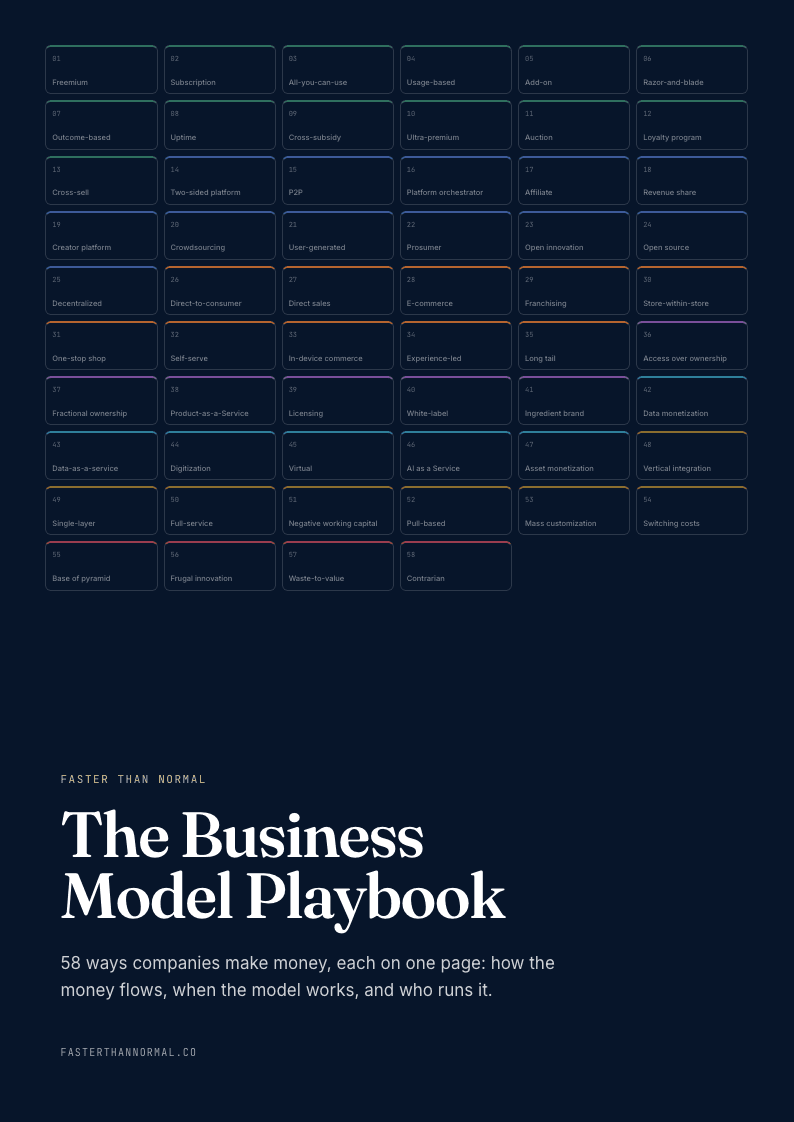
Free playbook
Get The Business Model Playbook
58 business models, one visual page each: how the money flows, the metrics that matter, and who runs it. Free when you join the Faster Than Normal email.
Free. No spam. Unsubscribe anytime.
Part IIIMaxims
-
Scarcity is the mother of category creation. The greatest product innovations don't optimize existing categories; they emerge from constraints so severe that entirely new categories are the only viable response.
-
The product that sells itself on an unattended counter is the only product worth making. If your offering requires persuasion, it requires improvement.
-
Name your customer. Not a segment, not a persona deck — a single imaginary person with a name, a budget, and an emotional life. Filter every decision through her eyes.
-
Vertical integration is not about efficiency; it's about knowledge. When you control the chain, you accumulate process knowledge that no competitor can replicate because no competitor has observed it.
-
Design for the shelf, not the mouth. The consumer's decision happens in the store aisle, not at the breakfast table. Win the three-second moment of decision, and consumption takes care of itself.
-
Secrecy compounds. Information asymmetry grows more valuable over time. The trade secrets you protect today become the institutional knowledge that defines you in a decade.
-
Let the location filter the people. Headquartering in an inconvenient place ensures that everyone who joins has chosen the mission over the metropolis.
-
Patience is a financing decision. The ownership structure that gives you the right to be slow is more valuable than the capital structure that demands you be fast.
-
Respect is the longest play in consumer goods. Treat the child as a person, the worker as a partner, the customer as intelligent — the compounding loyalty will exceed any short-term extraction.
-
The invisible founder builds the more durable company. When the institution is more famous than its leader, it can survive any succession.
In Their Own Words
The success of Ferrero we owe to Our Lady of Lourdes, without her we can do little.— 50th Anniversary of Ferrero, 1996
I pledge myself to devote all my activities and all my effort to this company. And I assure you that I shall only feel satisfied when I have managed, with concrete results, to ensure the future of this company.
I am a socialist. But I do the socialism.— Michele Ferrero
Our identity is based on our independence. If we had shareholders, they would ask us to increase turnover, but it takes time to make a good product.— Michele Ferrero, on maintaining independence
My grandfather lived to find this formula. He was completely obsessed by it. He woke up my grandmother at midnight and made her taste it with spoons, asking, 'How was it?' and 'What do you think?'— Giovanni Ferrero, on the family's founding insight


