


Part IThe Story
The Founder on the Proxy Statement
Read West Corporation's proxy statements from the early 2000s and a small detail stands out in the director biographies. Gary West, the chairman, is described as having joined the company in July 1987, "after the expiration of a noncompetition agreement" with his previous employer. His wife gets a shorter entry. Mary E. West, it says, co-founded WATS Marketing of America in 1978, stayed with that company until December 1985, and in January 1986 "founded the Company."
The company she started that January, West TeleServices, would go on to handle hundreds of millions of minutes of calls a year for banks, phone companies, software makers and infomercial marketers. It went public on Nasdaq in 1996. By 2006 it had become a conferencing, emergency-communications and customer-contact business with $1.86 billion in revenue and roughly 29,000 employees. That October, a private equity group led by Thomas H. Lee Partners and Quadrangle Group took it private, and the Wests came away with about $1.45 billion in cash.
Then they did something most founders of their generation did not. They moved to San Diego and began spending the money on a single, unglamorous goal: making healthcare cheaper and better for older Americans, especially poor ones. Through the Gary and Mary West Foundation and its sister organizations, collectively known as West Health, they have paid for a senior wellness center in downtown San Diego, California's first accredited geriatric emergency department, a program of all-inclusive care for the elderly, years of national polling on healthcare costs, and a founding stake in Civica Rx, the nonprofit generic drug company set up by hospital systems in 2018. The couple have said that everything they own will eventually go to that work.
Mary West rarely gives interviews, and much of the public record of the West fortune speaks in Gary's voice. But the filings, company histories and newspaper accounts that do exist show a clear arc. A woman who never went to college spotted early how cheap long-distance calling could reshape selling. She built three teleservices businesses in Omaha. With her husband she turned the third into one of the largest companies in its industry, and then walked away from it to fund a second career in philanthropy.
By the Numbers
Mary West's Two Careers
Jan 1986Month Mary West founded West TeleServices in Omaha (SEC proxy filings)
$102.6MRaised in West TeleServices' November 1996 IPO
$1.86BWest Corporation revenue in 2006, the year of the buyout
$42.83Per-share cash the Wests accepted in 2006, below the $48.75 paid to public holders
$11.8MGift that created UC San Diego's senior emergency care unit (2016)
$10MGary and Mary West Foundation commitment to Civica Rx (2018)
$700MMary West's net worth (Forbes, June 2025)
From Miami to the Meatpacking District
Mary West was born in Miami and moved to Omaha with her family as a teenager, partway through high school. She finished high school but did not go to college. Forbes lists her education simply as "Diploma, High School." Gary West later told the Thoroughbred Daily News that neither of their families could afford to send them.
Omaha in the 1960s was a railroad and stockyard city, and one of the country's great meatpacking centers. Mary worked as an assistant to the chief executive at the Armour and Company plant there, according to a 2019 San Diego Union-Tribune profile of her husband. Gary, who had grown up in Harlan, Iowa, where his parents ran a four-lane bowling alley, met her at a local dance. It was Mary, the paper reported, who helped him get a job at Armour, supervising the slaughter floor.
In January 1968 Gary heard on the car radio that his Army Reserve unit, the 172nd Transportation Company, was being sent to Vietnam. The couple married that year, both aged 22. He served about ten months as a machine gunner protecting supply convoys and came home in 1969. Afterwards he took a job as a staffing coordinator at Jennie Edmundson Hospital in Council Bluffs, across the Missouri River from Omaha, and was promoted to assistant hospital administrator two years later. He stayed in hospital administration for about a decade.
The hospital years matter to the later story. The Wests have repeatedly said that their philanthropy grew out of looking after their own aging parents and seeing how badly the system served older people. Gary's decade in a hospital gave him a close look at how that system worked from the inside. But in the 1970s the business idea that would make them rich came from Mary's side of the household, and it came from the telephone.
The 800 Number and a New Kind of Selling
To see why a young woman in Omaha could build a business out of answering phones, it helps to know what happened to American long-distance calling in the 1960s. AT&T's Bell System introduced Wide Area Telephone Service, or WATS, in 1961: a flat-rate plan that let a business buy a line with a bundle of long-distance calling to a set region. In 1967 AT&T launched interstate "inward WATS," which gave subscribers a toll-free number that customers could dial directly while the business paid the bill. That was the birth of the 800 number.
Adoption was slow at first. A study of the period in the journal Enterprise & Society describes early mail-order experiments with 800 service that fell flat. By the mid-1970s, though, a call-center industry was forming, and catalog and direct-response marketers were combining toll-free lines with bank credit cards and private parcel delivery. That trio of networks made it possible to sell to anyone, anywhere, at any hour, as long as someone picked up the phone.
Omaha was well placed for that business. It sat in the middle of the country, and First Data Resources, founded there in 1971, had become the first processor of bank-issued Visa and MasterCard credit cards in 1976. By the mid-1980s the city was home to several teleservices firms, including Sitel, founded in 1985.
Mary West got in early. According to the history of West Corporation in the International Directory of Company Histories, she founded a company called Mardex in 1973. A Tulsa World reporter later called it one of the first telemarketing service agencies, and it grew into one of the country's larger handlers of inbound telemarketing calls.
A Garage, a Bad Commercial, and a First Exit
In 1978 the Wests started WATS Marketing of America (also reported as WATS Telemarketing) in the garage of their Omaha house. Forbes says the idea came after the couple watched a particularly bad television commercial and decided they knew a better way to market products. West Health's own account says the same: the founders believed there was a better model for selling products on TV.
The company history credits Mary as the founder of WATS. Gary left his hospital job in 1979 to become its chairman, president and chief executive, while Mary served as vice president of finance. Later SEC filings describe both of them as co-founders. However the credit is split, the business grew fast enough that in 1980 they sold it to First Data Resources, the Omaha card processor that American Express bought 80 percent of that same year. The Wests stayed on as managers.
1980 was also the year they bought their first racehorse. At the old Ak-Sar-Ben track in Omaha they claimed a three-year-old named Joe Blow for $13,500. His trainer, Ben Glass, would go on to work for them for more than three decades, first as trainer and later as racing manager. Joe Blow raced for the Wests until he was eight and retired in 1985 with 21 wins from 118 starts, by the Thoroughbred Daily News's count. Gary later described him to the San Diego Union-Tribune as a blue-collar horse with a knee the size of a soccer ball.
Selling WATS so early gave the couple money and experience, but it came with a cost that would shape their next company. Both stayed at WATS until 1985. When they left, Gary was bound by a non-compete agreement with his old employer.
January 1986: West TeleServices
Mary West was not bound by the same restriction. In January 1986 she founded West TeleServices in Omaha, her third teleservices business according to the company history. The history names Troy Eden alongside the Wests as one of three founders. Gary joined in July 1987, once his non-compete had run out, and became chairman. Mary became vice chair of the board that year and also served as corporate secretary, the titles she held for the next two decades.
Forbes describes the early West TeleServices as a telecom company that took calls for infomercials. The late 1980s and early 1990s were the heyday of long-form television advertising, and every "call now" offer needed trained operators waiting on a bank of toll-free lines. West built that capacity and grew with its clients. By 1994 the company was handling 55 million operator-assisted calls a year. Its client list grew to include cellular carriers, office-products sellers, telecom companies, payroll processors and financial-services firms.
Much of the growth came from call centers in smaller cities with available labor. By December 1996, the company history records, West employed about 5,000 people in Texas alone and was San Antonio's fourth-largest private employer, with further sites in El Paso and Killeen. The Wests also kept some of the real estate. A 1988 lease, renewed several times, rented West an Omaha contact center on Maple Street from a partnership the couple owned and controlled, an arrangement disclosed in the company's proxy statements.
Going Public, and Trying to Go Back
In 1995 and 1996, eight teleservices companies went public in quick succession, part of what the Wall Street Journal's Greg Ip later called a flood of such offerings. West TeleServices was the last of them. On November 26, 1996, it priced shares at $18 on Nasdaq under the ticker WSTC and closed its first day at $21.88. The offering raised $102.6 million, most of it earmarked for repaying debt and notes issued to existing shareholders. After the offering the founders still controlled the company. In 2001 the Wests jointly held about 70 percent of the stock.
The timing was poor for the industry. Too many companies had built too many call centers just as some large corporations began cutting back their outsourcing contracts. Ip called it a collision between flagging demand and expanding capacity. By September 1998 all eight teleservices stocks from the IPO wave were trading below their offering prices, and West's had fallen to just over $12 in July of that year.
That July, Gary West, Mary West and Troy Eden offered about $126 million for the 14.8 percent of the company they did not already own, which would have taken West TeleServices private again. The board formed a special committee to evaluate the bid. In August the committee advised against it, and the founders dropped the plan.
Unlike many of its peers, West kept growing through the slump. In November 1997 it paid $14 million for the former MFS Communications building on Miracle Hills Drive in Omaha, which became its headquarters. It opened call centers across the South and Midwest: Tulsa, Memphis, Mobile and Texarkana in 1997, then Fayetteville, Reno, Rockford, Fort Smith, Lafayette, Carbondale and Baton Rouge in 1998. The Baton Rouge center alone initially created about 1,000 jobs. A Needham & Company analyst credited West with avoiding its competitors' overcapacity problems by offering three kinds of service: outbound calls, inbound calls, and automated interactive calls handled by computers.
The automated business became a real strength. In 1997 West handled 935 million minutes of teleservice transactions, and by late 1998 it had more than 10,000 automated voice-response ports, one of the largest installations in the industry. Those systems processed credit-card applications, customer-service requests and, above all, prepaid calling-card traffic, all without a live agent on the line.
From Call Center to Communications Company
The industry faced consumer headwinds as well as financial ones. An Arbitron survey cited by the Omaha World-Herald found that 40 percent of Americans used caller ID in 1999, up from 9 percent in 1995. Phone companies were selling call-blocking services, and people who did not want sales calls could ask the Direct Marketing Association to remove their names from calling lists. West's investor-relations chief said at the time that the company phoned only people who already had a business relationship with a client.
West's answer was to become less of a telemarketer. Around 2000 it renamed itself West Corporation. That year revenue rose 28.8 percent to $724.5 million and net income rose 41.2 percent to $70.3 million. In January 2001 it opened its first facility outside North America, an inbound customer-service center in Mumbai run with eFunds Corporation.
Then came a run of acquisitions. In 2002 West bought Tel Mark Sales, Dakotah Direct and Attention LLC. In May 2003 it acquired InterCall, a conferencing company, followed by ConferenceCall.com. It later added ECI's conference-call services and Worldwide Asset Purchasing in 2004, Sprint's conferencing assets in 2005, and in 2006 Raindance Communications and Intrado, a provider of core 911 infrastructure to phone carriers and public-safety agencies. By the end of 2006 West reported three segments (communication services, conferencing, and receivables management) and revenue of $1.86 billion, more than double the $821 million of 2002.
The Daily Racing Form later summed up the result: if you had ever called 911 or used video conferencing, you had probably dealt with part of West Corporation. A company that began by answering infomercial calls had become part of the country's communications infrastructure. The name that West eventually adopted, Intrado, came from its 911 unit.
The Sale
By late 2004 the Wests controlled most of a public company worth several billion dollars, and they were in their late fifties. Gary later told the Thoroughbred Daily News that he knew they would eventually need what he called a liquidity event, selling all or part of the business, to fund the philanthropy he and Mary had sworn to take on some day.
The 2006 merger proxy sets out in unusual detail how the sale happened. In December 2004 West's board, advised by Goldman Sachs, began studying a merger, sale or recapitalization. Lawyers for the Wests attended the board meetings. The couple told the board they would not impose any particular constraints on the process or on the type of deal. Goldman contacted 23 potential buyers. Seven private equity firms and one strategic buyer signed confidentiality agreements, and Thomas H. Lee Partners (THL) made the highest preliminary bid.
The first attempt failed. In June 2005 THL and Quadrangle offered an average of $37 a share, paying more to the public than to the Wests. A special committee of independent directors asked the couple whether they would accept that kind of split price. They said they would not at the levels then under discussion, and the process ended. That autumn they sold 5 million shares in an underwritten offering at $35, and in November 2005 they set up a trading plan to sell up to 1.8 million more over a year, which the proxy says was meant to diversify part of their holdings.
THL came back in December 2005, and a second special committee negotiated through the spring. The deal signed on May 31, 2006 and closed on October 24. Public shareholders received $48.75 a share in cash. The Wests took $42.83 a share for about 85 percent of their stock, some 33.8 million shares, and at the request of the special committee and the buyers rolled the remaining 15 percent into the new private company. The proxy says the founders agreed to the lower price at the special committee's request, so that other stockholders could receive more than an equal split would have paid them. The buyout was financed partly with a $2.1 billion term loan and $1.1 billion of new bonds. Afterwards the sponsors owned about 72 percent of West, the Wests about 25 percent, and management the rest.
According to SEC records analyzed by the Omaha World-Herald, the couple received $1.45 billion for their stake. Both resigned from the company and its board after the deal closed. That year Forbes ranked Gary West 354th on its list of the 400 richest Americans. The following year Mary West was 95th on the magazine's list of the world's 100 most powerful women. West returned to Nasdaq in March 2013 at $20 a share. In 2017 Apollo Global Management took it private again for about $5.2 billion, and in 2019 it was renamed Intrado.
A Second Career in San Diego
The Gary and Mary West Foundation was established in 2006, the year of the sale, and the couple moved to San Diego to run their philanthropy full time. Their reasons were personal. West Health says they had learned first-hand the emotional and financial toll of caring for aging family members. Forbes reported in 2015 that Mary had cared for her elderly mother. In a Forbes interview that year she put the decision simply: "We knew we wanted to help seniors."
The first flagship project was local and practical. In April 2010 the Gary and Mary West Senior Wellness Center opened in downtown San Diego, run by the nonprofit Serving Seniors and built with $4 million from the Wests, according to KPBS. The two-story building replaced a cramped senior lunch site whose lease had run out. Open every day to anyone aged 60 or over, it was equipped to serve 500 free meals a day and had full-time medical staff, fitness and enrichment classes, and a computer café staffed by teenage volunteers.
It became the part of the philanthropy most identified with Mary. Forbes reported in 2015 that every month or so she gave a cooking lesson there and served lunch to the seniors who came in.
— Mary West, Forbes, 2015It's my favorite place to visit; I light up when I go in there.
The wellness center was one piece of a much larger plan. In March 2009 the foundation committed $45 million to create the West Wireless Health Institute, with Qualcomm as founding sponsor and Scripps Health as founding healthcare affiliate. Its early aim was to get wireless medical devices validated and into clinical use. In 2011 the Wests put $100 million into the West Health Investment Fund to back healthcare technology companies, according to the Daily Racing Form. In 2012 the institute dropped "wireless" from its name, saying technology alone would not solve the cost crisis, and a Washington policy arm, the West Health Policy Center, was set up the same year. In 2013 the foundation and institute created the Center for Medical Interoperability, a separate body led by health-system chief executives, to push medical devices and software to share data.
By 2015 Forbes estimated from IRS filings that the couple had given more than $355 million since 2006 to their foundation and endowment. The magazine valued Mary West's own fortune at $610 million that year, on its first list of America's richest self-made women.
Emergency Rooms, Home Care and Generic Drugs
Over the following decade the West organizations settled on a clear target: care models that keep older people healthy and at home, backed by research showing they save money, and built so other places can copy them.
The emergency department was an early focus. In May 2016 the Wests gave $11.8 million to UC San Diego Health: a $6.3 million capital grant from the foundation to build a dedicated senior emergency care unit, and $5.5 million in planned research funding from the West Health Institute to study it. The unit opened in January 2019 inside the renamed Gary and Mary West Emergency Department at the Jacobs Medical Center in La Jolla. It was the first accredited geriatric emergency department in California, designed with calibrated lighting, non-slip floors and chairs built to help frail patients sit and stand.
— Gary West, UC San Diego Health, 2019Mary and I recognized very early on that the emergency department offers a unique opportunity to address the specific health care needs of seniors, providing better care and also reducing unnecessary costs.
In October 2019 the Gary and Mary West PACE opened in San Marcos, in north San Diego County. PACE, the Program of All-inclusive Care for the Elderly, is a national model that combines medical care, day programs, therapy, transport and social services so that frail seniors can stay out of nursing homes. The West center, funded by a foundation grant, covers nearly 20,000 square feet. Later work pushed the same ideas outward. Forbes notes that in 2023 West Health partnered with the Hospital Association of Southern California to increase the number of accredited geriatric emergency departments across the state.
The best-known bet was on drug prices. In September 2018 seven large hospital systems announced Civica Rx, a nonprofit company meant to make and supply generic injectable drugs that hospitals were chronically short of or paying inflated prices for. Three foundations joined them as governing members: Arnold Ventures (then the Laura and John Arnold Foundation), the Peterson Center on Healthcare, and the Gary and Mary West Foundation. Each committed $10 million, made up of a $1 million grant and a program-related investment, a below-market loan, of up to $9 million. Their leaders took three of Civica's ten unpaid board seats. West Health reports that by now Civica supplies more than 80 generic drugs to over 55 health systems, which together run about 1,500 hospitals.
Shelley Lyford, the foundation's president and chief executive, later described the foundation's investment rules in NEJM Catalyst. It looks for nine qualities in any grant or investment, including lasting impact, fast results, cross-sector partnership and transparency. And it counts a grant as a success only if it demonstrably lowers costs or improves care for seniors.
The organizations also fund public measurement. Since 2018 West Health has worked with Gallup on what the two describe as the largest survey of Americans' experience of healthcare costs. In 2025 the partnership was formalized as the West Health–Gallup Center for Healthcare in America.
Every West Health organization describes itself as solely funded by Gary and Mary West. Gary West has explained that as a matter of independence.
— Gary West, San Diego Union-Tribune, 2019We don't take a penny of outside money from anybody. The minute you start taking money from other people, there's an expectation of, 'OK, we gave you some money. Here's what we want you to do.'
In the same 2019 interview he said the couple put about $35 million a year into the foundation. He also said that when they die, all of their money will go to an endowment that funds West Health's work permanently. The couple have no children, as Gary told both the Union-Tribune and the Thoroughbred Daily News, and West Health describes the pledge as a commitment of their entire fortune. By West Health's count, the foundation alone has awarded outcomes-based grants totalling nearly $500 million since 2006.
That gives the philanthropy a particular shape. It does not spend down quickly like the Chuck Feeney model, and it is not a conventional grant-maker spreading money across many causes. It is closer to a permanent operating system for one issue. A foundation makes grants and program-related investments. A research institute studies the care models those grants create. A policy center in Washington takes the findings to lawmakers. And an endowment is designed, in Gary's words to the Union-Tribune, to be doing the same work a hundred years from now.
Mary West remains co-founder of all of it, and her husband consistently speaks of the work in the first person plural. Forbes's 2025 profile estimates her net worth at $700 million, gives her a "self-made score" of 8, and lists her source of wealth as telemarketing.
Pink and Black Silks
The couple's other public life has been at the racetrack, under hot pink and black diamond silks. Gary West has called racing his only hobby. He told the Thoroughbred Daily News in 2018 that Mary thoroughly enjoys watching their horses run.
From Joe Blow the stable moved up through allowance horses to national stakes runners. Rockamundo, trained by Ben Glass, won the 1993 Arkansas Derby and gave the Wests their first Kentucky Derby starter, finishing 17th of 19. Buddha, second choice for the 2002 Derby after winning the Wood Memorial, was withdrawn on the eve of the race with a bruised foot. New Year's Day won the 2013 Breeders' Cup Juvenile in only his third start, then retired injured a few weeks later. With Glass and a veterinarian they became regular leading buyers at the Keeneland September yearling sale. They concentrated on dirt horses bred for classic distances and, as Gary told the Daily Racing Form in 2013, preferred several horses at $150,000 to $450,000 over one at $1 million.
The approach paid off. West Coast, bought for $425,000, won the Travers and Pennsylvania Derby in 2017 and was voted champion three-year-old male. Game Winner, a $110,000 purchase that, by Glass's account, nobody else much liked, went unbeaten in four starts in 2018, including the Breeders' Cup Juvenile, and was named champion two-year-old male.
The couple's most famous horse brought their biggest disappointments. Maximum Security, a son of New Year's Day bred by the Wests, crossed the line first in the 2019 Kentucky Derby. After objections from two jockeys, the Churchill Downs stewards ruled that he had drifted out and interfered with other horses, placed him 17th, and declared Country House the winner. The Wests sued the Kentucky Horse Racing Commission and the stewards, arguing that the decision violated their right to due process. A federal judge dismissed the suit in November 2019, finding that Kentucky's rules make stewards' disqualification rulings final. The Sixth Circuit affirmed on August 28, 2020. Gary West said he disagreed but would not appeal further.
Maximum Security then won the inaugural $20 million Saudi Cup in February 2020. By then the Wests owned him in a 50-50 partnership with the Coolmore partners. Nine days later his trainer, Jason Servis, was among 27 people indicted in a federal horse-doping investigation. The Jockey Club of Saudi Arabia withheld the purse while it investigated, and Gary West said he agreed it was appropriate for them to do so. Servis later pleaded guilty and was sentenced to four years in prison. In 2024 the Saudi stewards found the charges against him proven, disqualified Maximum Security from the race, and redistributed the prize money.
What the Record Shows
Mary West's career is better known through her decisions than through anything she has said about them, and those decisions follow a consistent pattern.
She saw early that the toll-free number would change how things were sold. She built businesses to serve that shift before most of the country had heard of an 800 line. She sold her first company within two years, stayed on to learn, and started over in 1986 when the timing and her husband's contract allowed. With Gary she took the third company public, tried to buy it back when the market punished it, and kept building until it had moved well beyond the telemarketing it started in. When the time came to sell, the couple spent a year and a half getting a deal done and accepted less per share than their public shareholders to close it.
Then the couple pointed the proceeds at a problem they knew from their own families: the cost and fragmentation of care for older Americans. They gave money to projects that could be measured, copied and defended in public, and they kept the funding entirely their own so that no one else could set the agenda.
"We knew we wanted to help seniors," she told Forbes. The rest of her public record, from the proxy statements to the emergency room in La Jolla, shows how she went about doing it.
Part IIThe Playbook
Mary West's career falls into two halves: building and selling teleservices businesses in Omaha, then building a self-funded healthcare philanthropy in San Diego. The principles below are drawn from decisions visible in both halves: when to start, when to sell, how to grow through a downturn, how to exit fairly, and how to make charitable money behave like patient, accountable capital.
The principles
- 1.Build for the network before the crowd arrives
- 2.Treat an early sale as tuition, not a finish line
- 3.Let the partner who is free to move go first
- 4.Grow through the glut by widening what you sell
- 5.Put machines on the routine calls
- 6.Buy your way toward infrastructure
- 7.Pay for fairness when you sell
- 8.Diversify before the exit, not after
- 9.Fund the mission yourself so no one else sets the agenda
- 10.Build one model that others can copy
- 11.Use investment capital to fix broken markets
Principle 1
Build for the network before the crowd arrives
AT&T's inward WATS service made the 800 number possible in 1967, but for years few businesses knew what to do with it. The payoff came in the mid-1970s, when toll-free lines, bank credit cards and parcel delivery together made remote selling practical. Mary West was already in the business by then. She is credited with founding Mardex in 1973 and WATS Marketing in 1978, before the infomercial boom that made call handling a mass industry.
Being early meant she learned the work while volumes were small and mistakes were cheap. When television direct-response marketing exploded in the late 1980s, West TeleServices already knew how to staff, train and route calls at scale.
The lesson is about timing as much as insight. New networks, whether phone lines, payment rails or delivery systems, create jobs nobody is yet doing well. Whoever builds the capability to serve that new traffic before demand peaks gets to set the standard.
Tactic: List the networks that have recently become cheaper or more widespread in your industry, and ask what operational service their users will need at ten times today's volume. Start building that service now, while the volume is small.
Principle 2
Treat an early sale as tuition, not a finish line
The Wests sold WATS Marketing to First Data Resources in 1980, just two years after starting it in their garage. They did not walk away. They stayed on as managers until 1985, inside a company that American Express had just bought control of, and which had been the first to process bank-issued Visa and MasterCard cards.
That period gave them capital, credibility, and a view of how a larger, better-funded operator ran transaction businesses. When Mary started West TeleServices in 1986, she was on her third teleservices company and had already been through one exit.
Founders often see a first sale as either a triumph or a surrender. The Wests' record suggests a third view: an early sale can pay you to learn, as long as you keep your ambitions for the next company.
Tactic: If you sell early, negotiate a role that exposes you to the acquirer's systems and customers, and keep a written log of what you would do differently. Treat the earn-out years as a paid apprenticeship for your next company.
Principle 3
Let the partner who is free to move go first
When the Wests left WATS at the end of 1985, Gary was bound by a non-compete agreement. Mary was not. She founded West TeleServices in January 1986, and Gary joined in July 1987, after his restriction expired, to become chairman.
The sequencing let the couple start the new business immediately without breaching Gary's contract. It also shows how the partnership worked in practice. Titles and public profiles aside, each partner stepped forward when circumstances made them the right one to lead.
Founding teams often assume the most visible partner must be first through the door. Legal, financial and practical constraints differ from person to person, and the strongest teams plan around them rather than waiting for everyone to be free at once.
Tactic: Before starting a new venture with partners, map each person's restrictions: non-competes, notice periods, financial commitments. Decide who can legally and practically move first, and have that person found the company.
Principle 4
Grow through the glut by widening what you sell
By 1998 the teleservices industry had overbuilt. Eight companies had gone public in two years, capacity outran demand, and every one of those stocks was below its IPO price. West's own share price had fallen by almost half from its first-day close.
West kept expanding anyway, opening call centers across the South and Midwest. An analyst at Needham & Company explained why that worked: West did not depend on a single type of call. It offered outbound calling, inbound calling and automated interactive service. When one kind of demand slowed, the others could keep the new sites busy.
An industry glut punishes companies that sell one undifferentiated service. It can help those whose capacity can be switched to several uses.
Tactic: When your market looks oversupplied, audit how many distinct services your fixed assets can deliver. Invest in capacity only where it can serve at least two different kinds of demand.
Principle 5
Put machines on the routine calls
By late 1998 West had more than 10,000 automated voice-response ports, one of the largest installations in its industry. They handled prepaid calling-card traffic, credit-card applications and routine customer-service requests, work that needed no live operator.
Automation changed the economics of the business. Live agents are the biggest cost in a call center and the hardest to scale quickly. Moving predictable, high-volume transactions to machines let West take on huge call volumes without matching increases in headcount, and freed its trained staff for calls that needed judgment.
The same logic applies well beyond telephones. Any service business has a layer of work that is repetitive and rule-based, and the companies that automate that layer first can underprice rivals and still earn more.
Tactic: Sort your customer interactions by how often they happen and how much judgment they need. Automate the frequent, low-judgment ones first, and measure whether your people spend more of their time on the rest.
Principle 6
Buy your way toward infrastructure
Between 2002 and 2006 West bought its way out of pure telemarketing. InterCall and ConferenceCall.com made it a major conferencing provider. Sprint's conferencing assets and Raindance added scale. Intrado brought core 911 infrastructure used by phone carriers and public-safety agencies.
Each acquisition moved West toward services that customers use repeatedly and find hard to replace. By 2006 the company that began by answering infomercial calls ran part of the country's emergency-calling network. Revenue more than doubled in four years, and the business the buyers paid for in 2006 was far more durable than the one that had gone public in 1996.
Telemarketing was exposed to caller ID, do-not-call lists and clients cutting back on outsourcing. Conferencing and emergency communications were not. Using a strong balance sheet to buy into sturdier businesses is how a company escapes a declining core without betting everything on building from scratch.
Tactic: Rank your adjacent markets by how painful it would be for a customer to switch away. Put acquisition money toward the most embedded ones, even if they grow more slowly than your current business.
Principle 7
Pay for fairness when you sell
The 2006 buyout nearly failed twice. In 2005 the Wests rejected a split-price structure that would have paid them less than the public. In 2006, with a better overall price, they accepted a version of it. Public shareholders got $48.75 a share, while the Wests took $42.83 on most of their stock and rolled the rest into the new company at the special committee's request.
That concession mattered. A controlling shareholder who sells alongside the public invites suspicion that the deal was rigged in their favor. By taking less per share, the founders gave the independent directors a clear reason to back the transaction and gave public holders a premium. They still left with about $1.45 billion.
A controlling owner can often force a deal through, but a fair one tends to close faster and attract fewer lawsuits. The cost of that fairness can be priced and negotiated in advance.
Tactic: If you control a company you are selling, ask independent directors early what structure they would consider clearly fair to minority holders. Budget for giving up some of your own premium to get there.
Principle 8
Diversify before the exit, not after
While the first sale process was stalled, the Wests began reducing their concentration. In October 2005 they sold 5 million shares in an underwritten offering. In November they adopted a trading plan to sell up to 1.8 million more over the following year, which the merger proxy said was meant to diversify part of their holdings.
Those sales did not depend on a buyer turning up. They turned part of a paper fortune into cash on the founders' own schedule, using mechanisms, a registered offering and a pre-set trading plan, that kept insiders clear of accusations of timing the market.
Founders who wait for one perfect exit put their whole net worth on a single negotiation. Steady, pre-planned selling reduces that risk and strengthens your hand, because you no longer need any single deal to succeed.
Tactic: If most of your wealth is in one company, set up a pre-scheduled selling plan with your advisers well before any sale process. Sell enough that walking away from a bad offer becomes a realistic option.
Principle 9
Fund the mission yourself so no one else sets the agenda
Every West Health organization describes itself as solely funded by Gary and Mary West. Gary has explained why: outside money comes with expectations about what the recipient should do, and the couple want to do what they think is right.
Self-funding lets the organizations take positions that donors or corporate partners might resist. They back a nonprofit that competes with generic drug makers, run polls that document public anger over healthcare costs, and argue in Washington for changes to how care is delivered and paid for. It also allows long horizons. The couple have committed their whole fortune to an endowment meant to carry the work on after they are gone.
Independence costs money, but it lets an organization define its own success. For anyone who can afford it, owning the funding means owning the agenda.
Tactic: Before accepting a partner's money for a mission-driven project, write down which decisions that money could influence. If any of them are central to the mission, find a way to fund that part yourself.
Principle 10
Build one model that others can copy
The West-funded projects in San Diego (the senior wellness center, the senior emergency care unit and the PACE center) are described by West Health as care models designed to be replicated nationwide. The emergency unit came with $5.5 million of research funding so that its results could be studied and published. It then became the basis for a push to accredit more geriatric emergency departments across California.
A single well-documented model does more than a scattering of small grants. It gives other hospitals and governments something concrete to visit, evaluate and copy, and it produces evidence that can shape payment policy.
Philanthropy aimed at systems has to think like a franchise developer. The first site exists to prove the concept and write the manual, not just to serve its own neighborhood.
Tactic: When you fund a new program, set aside a fixed share of the budget for evaluation and documentation from day one. Define in advance what evidence would persuade a second site to adopt the model.
Principle 11
Use investment capital to fix broken markets
When Civica Rx was formed in 2018, the Gary and Mary West Foundation did not simply write a cheque. Its $10 million commitment was mostly a program-related investment, a below-market loan of up to $9 million alongside a $1 million grant. It came with a seat on the governing board of a nonprofit set up to take on shortages and price spikes in generic injectable drugs.
Hospitals had struggled with generic drug shortages for years, and the problem was a market failure rather than a lack of charity. Civica's model, long-term purchase commitments from hospital systems that guarantee demand for reliable manufacturers, needed working capital and governance more than donations. Investment capital gave the foundation influence and the chance to recycle its money, while the board seats helped protect the nonprofit mission.
Charitable money is usually spent once. When the problem is a broken market, the foundation can often do more by lending or investing and staying involved in how the organization is run.
Tactic: For each large grant you are considering, ask whether the recipient could eventually generate revenue. If it could, structure part of the support as a low-interest loan or investment with governance rights, and recycle the returns into the next project.
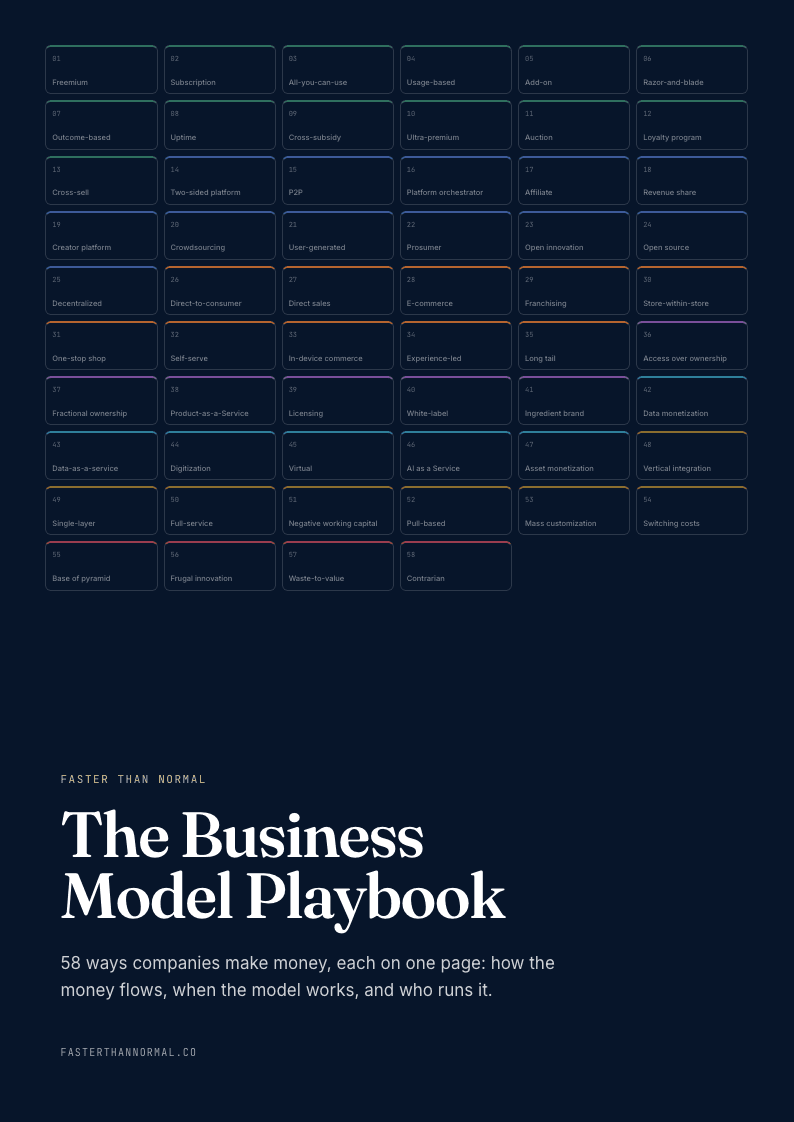
Free playbook
Get The Business Model Playbook
58 business models, one visual page each: how the money flows, the metrics that matter, and who runs it. Free when you join the Faster Than Normal email.
Free. No spam. Unsubscribe anytime.
Part IIIMaxims
- Nobody needs to see who built it. Mary West founded three telephone businesses, one of which grew to run 911 infrastructure, while rarely giving interviews; her name appeared in filings, not headlines.
- A college degree is optional; knowing the operation is not. Neither West went to college. They knew call handling from the floor up and sold that expertise to the country's largest companies.
- Downturns reveal which assets are flexible. When the teleservices boom went bust, the call centers that could handle several kinds of work kept filling up.
- The founder's stake is the last thing to sell. The Wests sold down gradually, took less than the public in the final deal, and rolled a slice into the new company rather than cashing out at the first high bid.
- A no can be part of the negotiation. Rejecting the 2005 terms ended one sale process and helped set up a better one within a year.
- Private grief can become public policy. Caring for aging parents taught the Wests where the system fails, and they built institutions aimed at exactly those failures.
- Serve lunch, then fund the study. Mary West's cooking lessons at the senior center and the research grants attached to the emergency department come from the same instinct: stay close to the people and measure the results.
- Measure the anger. Years of Gallup polling on healthcare costs turn private frustration into data that lawmakers cannot easily dismiss.
- Stewards make final calls. The 2019 Derby taught the Wests that some decisions cannot be appealed, and that sometimes the right move is to accept the ruling and get on with the next race.
In Their Own Words
Too much of a good thing can be wonderful.
I never loved another person the way I loved myself.
I used to be Snow White, but I drifted.
Ladies who play with fire must remember that smoke gets in their eyes.
I wrote the story myself. It's about a girl who lost her reputation and never missed it.
Marriage is a fine institution, but I'm not ready for an institution.
Good sex is like good bridge. If you don't have a good partner, you'd better have a good hand.
I generally avoid temptation unless I can't resist it.
When I'm good, I'm very good. When I'm bad, I'm better.
A man can be short and dumpy and getting bald but if he has fire, women will like him.
Everyone has the right to run his own life - even if you're heading for a crash.
Cultivate your curves – they may be dangerous but they won't be avoided.
I only like two kinds of men, domestic and imported.
A dame that knows the ropes isn't likely to get tied up.
You are never too old to become younger!
Anything worth doing is worth doing slowly.
The nonprofit drug company Civica Rx says it now serves more than 50 U.S. health systems that operate more than 1,200 hospitals as it begins its third year in operation.— Bruce Japsen, Forbes (September 2020)
Mary West built one of the largest private fortunes in American healthcare — and remained nearly invisible while doing it.— Forbes profile context
The most durable competitive advantages are the ones your competitors don't even realize exist — because they are embedded in relationships, operational knowledge, and regulatory expertise that cannot be replicated by raising a round of financing.— Inferred from career pattern
Build the infrastructure. Own the pipes. Let others argue about what flows through them.— The structural logic of West's career


