


Part IThe Story
The Secret of Them Pents
The letter arrived in San Francisco sometime in the summer of 1872, written in the rough hand of a tailor who could barely spell. "The secret of them Pents is the Rivits that I put in those Pockets," Jacob Davis wrote to his cloth supplier, a prosperous dry goods merchant named Levi Strauss, "and I found the demand so large that I cannot make them up fast enough." Davis needed $68 to file a patent. He did not have it. What he had was an idea — copper rivets hammered into the stress points of denim work pants — and the desperate intuition that someone with capital might see what he saw. Strauss, sitting in his Battery Street offices above a wholesale empire built on bolts of fabric and imported linens, recognized the opportunity instantly. He agreed to fund the patent, brought Davis to San Francisco to oversee production, and within months had transformed himself from a middleman selling other people's goods into a manufacturer selling his own. The patent was granted on May 20, 1873. The product was called "waist overalls." The customers called them Levi's.
That a Bavarian Jewish immigrant who never stitched a seam in his life became the most famous name in the history of American clothing — more famous than the tailor who actually invented the garment — is one of those ironies that tells you something about what America rewards. Not invention, exactly. Distribution. Not the idea itself but the infrastructure to bring it to market, the commercial instinct to see past a misspelled letter to the fortune underneath, and the brand-building discipline to ensure that when the patent expired seventeen years later, it wouldn't matter, because the name on everyone's lips was already Levi's.
This is the story of a man who sold dry goods during the Gold Rush while everyone else dug for gold, who built a brand before the word existed, who gave away money as fast as he made it and died without heirs — leaving behind not children but a company, a name stitched into the back pocket of the most democratic garment ever made, and a philosophy of generosity that his descendants still practice more than 170 years later, funding scholarships, fighting poverty, and — in one case — running the city of San Francisco.
By the Numbers
Levi Strauss & Co.
1853Year founded in San Francisco
$6.4BAnnual revenue (fiscal 2024)
171Years in continuous operation
$101BGlobal denim market (2024)
110+Countries where Levi's products are sold
501The lot number that became the world's most iconic jean
$5Levi Strauss's first charitable donation (1854)
Loeb Becomes Levi
He was born Loeb Strauss on February 26, 1829, in the small Franconian town of Buttenheim, in what was then the Kingdom of Bavaria. The youngest of seven children — three brothers, three sisters — he arrived into a world that had no particular interest in his ambitions. Jews in Bavaria lived under a dense lattice of restrictions: banned from certain shops and public spaces, confined to designated areas, subjected to special taxes, and — most critically for a family of merchants — limited in their economic activities by laws designed to keep them marginal. His father, Hirsch Strauss, sold dry goods. His mother, Rebecca, was Hirsch's second wife, having married into a household with four existing children. The family was not destitute, but they were constrained in the way that all Bavarian Jews were constrained — by the invisible ceiling of a society that tolerated their presence without welcoming it.
Hirsch had dreamed of America for years. Two of his older sons, Jonas and Louis, had already made the crossing, establishing themselves in New York's Lower East Side as peddlers and then as operators of a small dry goods business, J. Strauss Brother & Co. When Hirsch died of tuberculosis in 1845 or 1846 — the records are imprecise — the remaining family's decision was essentially made for them. In 1847, Rebecca Strauss gathered her two youngest daughters and her eighteen-year-old son Loeb and boarded a ship bound for New York.
Somewhere between Bavaria and Manhattan — or perhaps shortly after arriving — Loeb became Levi. The name change was not unusual for immigrants of the period, a kind of phonetic assimilation that signaled readiness for the new country. But there is something almost too neat about it: the shedding of the old name like an outgrown garment, the assumption of the new one that would, within three decades, be stitched into more pockets than any other word in the English language. As one observer later noted, the world should be grateful: if he hadn't changed his name, we'd all be wearing "Loeb's."
He spent the next six years learning English, learning the business, and learning America. He worked alongside Jonas and Louis in their dry goods operation, absorbing the rhythms of wholesale trade — the relationships with suppliers, the logistics of inventory, the delicate calculus of credit and trust that governed merchant life in mid-nineteenth-century New York. He applied for citizenship. He waited. And then, in January 1853, when news of the California Gold Rush had turned San Francisco from a sleepy port into the most frenzied boomtown on the continent, the Strauss brothers decided to open a West Coast branch. Levi, twenty-four years old and freshly naturalized, was the one they sent.
The Man Who Didn't Dig
He traveled to San Francisco via the Isthmus of Panama — the standard route for those who could afford to avoid the overland trail — and arrived on March 14, 1853, into a city that was less a city than a construction site with pretensions. San Francisco in 1853 was a place where fortunes were made and lost in weeks, where wooden buildings went up and burned down with metronomic regularity, and where the primary economic activity was not mining gold but selling things to people who mined gold. Levi Strauss understood this distinction immediately, and it defined his career.
He did not come to California to dig. He came to sell. He established a wholesale dry goods business under his own name — Levi Strauss & Co. — and positioned himself as the West Coast representative of the family firm in New York. The business model was straightforward: import clothing, fabric, blankets, handkerchiefs, and other dry goods from the East Coast and Europe, then distribute them to the small general stores proliferating across California, Nevada, Oregon, and the wider West. His customers were not miners directly but the merchants who served miners — and cowboys, and railroad workers, and farmers, and the entire expanding population of the American frontier.
It was, in the parlance of a later era, a platform business. Strauss sat at the nexus of supply and demand, connecting Eastern manufacturers with Western retailers, taking a margin on every bolt of cloth and every crate of buttons that passed through his warehouse. By 1866, the business had grown large enough to require expanded headquarters at 14-16 Battery Street, where it would remain for four decades. Levi Strauss was, by any measure, a successful and respected San Francisco businessman — but he was not yet famous. He was not yet the man whose name would become a metonym for an entire category of clothing. He was just a merchant, and a good one.
What distinguished him, even before the riveted pants, was his understanding of something that most of his contemporaries missed: that the real gold in a gold rush is infrastructure. The miners who struck it rich were the exceptions. The merchants who supplied them — the men who sold picks and pans and canvas and denim — were the rule. Strauss had the temperament for this kind of steady, compounding success: patient, methodical, relationship-driven, more interested in building a durable business than in chasing a spectacular windfall. He was, in the deepest sense, a wholesaler — a man who understood that the way to wealth was not through the product itself but through the system that delivered it.
— Jacob Davis, letter to Levi Strauss, 1872The secret of them Pents is the Rivits that I put in those Pockets and I found the demand so large that I cannot make them up fast enough.
A Tailor in Reno
Jacob Davis was born Jacob Youphes in 1831 in Riga, on the Baltic Sea, in what is now Latvia. Like Strauss, he was a German-speaking Jew who had crossed an ocean to escape the limitations of the Old World. Unlike Strauss, he was not a merchant but a maker — a tailor by training and by temperament, a man whose hands understood cloth the way a musician's hands understand an instrument. He arrived in the United States in 1854, a year after Strauss reached San Francisco, and spent the next decade and a half in a restless, almost picaresque trajectory across the American landscape: a tailor shop in New York, another in Augusta, Maine, a stint in San Francisco, a gold rush detour to British Columbia's Fraser River in 1858, nine years in Western Canada, then back to San Francisco by ship in January 1867, then Virginia City, Nevada — where he opened a cigar store, failed, and returned to tailoring within three months — and finally, in June 1868, Reno.
Reno in 1868 was a railroad town, raw and functional, the kind of place where a tailor could make a living fabricating wagon covers, tents, and work clothes from heavy-duty materials. Davis opened his shop at 31 Virginia Street, less than a block from where the famous Reno Arch now stands, and began purchasing supplies from Levi Strauss & Co.: denim, duck cloth, thread. He was a regular customer, unremarkable in every way except one — he could not stop tinkering.
The origin story, as Davis himself told it under oath in a later patent-infringement case, is almost absurdly domestic. In January 1871, a woman came to his shop needing work pants for her husband, a man too large for ready-made clothes and too ill to visit the shop himself. She tied knots in a piece of string to indicate his measurements, paid Davis $3 in advance, and asked him to make the trousers "as strong as possible." Davis cut the pants from white duck cloth purchased from Levi Strauss & Co. When he finished, he noticed copper rivets lying on his workbench — rivets he normally used to attach straps to horse blankets for local teamsters. "The thought struck me to fasten the pockets with rivets," he testified. "I had never thought of it before."
It was one of those moments that looks inevitable in retrospect and was entirely accidental in real time. The riveted pants were a sensation. Word spread through Reno's working community. In the following eighteen months, Davis made and sold 200 pairs — some of white duck, some of denim — to laborers desperate for clothing that could survive the brutal physical demands of frontier work. But Davis was a tailor, not a businessman. He could see that his idea was valuable. He could also see that anyone could copy it. He needed a patent, and a patent cost $68 — roughly $2,000 in today's money — which he did not have. So he wrote to his cloth supplier, and his cloth supplier said yes.
Patent Number 139,121
The patent application, filed jointly by Jacob Davis and Levi Strauss & Co., was approved on May 20, 1873, under the title "Improvement in Fastening Pocket-Openings." The patent covered a method rather than a pair of pants: the use of metal rivets to reinforce the points of strain where pockets meet seams, where buttons meet fly, where the daily violence of manual labor concentrates its force on cloth. The distinction matters. Strauss had patented a technology, and he then built a system to deploy it.
Davis moved to San Francisco to oversee production. The arrangement was telling: Davis was hired as a shop supervisor, later promoted to plant manager. He was not a partner in any meaningful equity sense. He was an employee. Strauss owned the company, the patent, the brand, the distribution network, and the customer relationships. Davis owned his skill. It was an arrangement that would recur throughout American business history — the inventor who creates the breakthrough and the operator who captures the value — and in this case, as in most, the operator's name is the one that endured.
At first, the waist overalls were sewn by seamstresses working out of their homes, a common manufacturing arrangement in the garment trade. But demand grew quickly enough that by the 1880s, Strauss had opened his own factory. The pants were marketed relentlessly to working men: miners, loggers, railroad workers, farmers, cowhands, sailors. The pitch was durability. These were the toughest pants on the market, and Strauss intended to prove it — the company's famous "Two Horse" logo, depicting two horses trying and failing to pull apart a pair of riveted pants, became one of the earliest examples of what we would now call brand storytelling aimed at a specific customer pain point.
Around 1890, the company assigned the lot number 501 to its original riveted denim jean — the design that Davis had first created in his Reno shop nearly two decades earlier. The number itself was arbitrary, a warehouse designation. It would become, over the next century and a third, the most famous product number in the history of American consumer goods.
— PBS American ExperienceYou might think that Levi Strauss invented jeans. In reality he is the man who brought them to market and made millions.
Strauss, crucially, was already thinking about what would happen when the patent expired. Seventeen years of exclusivity would end in 1890, and he knew that competitors would immediately begin manufacturing their own riveted pants. His response was not to panic but to prepare. He invested heavily in brand identity — trademarks, visual iconography, the orange double-stitched arcuate design on the back pockets (registered as US trademark 1,139,254 and still in use today), the Two Horse logo. He understood that his primary customers, laborers, were often immigrants who did not read English, so he developed a visual brand language that transcended literacy. He went after competitors aggressively, establishing legal precedents for trademark enforcement that would protect the company long after the patent itself was a historical artifact. This was brand-building before the concept had a name, and in its way it was more innovative than the rivet itself.
Uncle Levi and the Orphans
There is a photograph of Levi Strauss from around 1890 — a portly, bearded man in a dark suit, looking every inch the prosperous Victorian merchant. He never married. He had no children. His four nephews — Jacob, Louis, Abraham, and Sigmund Stern, the sons of his sister Fanny and her husband David Stern — were his heirs, his surrogate family, and eventually his successors. He was known to them, and to the wider community, as "Uncle Levi."
The absence of a wife and children in the life of a wealthy nineteenth-century merchant is conspicuous but unexplained. The historical record offers no love affairs, no scandals, no explanation at all. What it does offer is a portrait of a man who channeled the energy that others directed toward family into two pursuits: business and philanthropy.
His first charitable donation came in 1854 — just one year after he arrived in San Francisco — when he gave $5 to the Orphan Asylum Society. Five dollars in 1854 was approximately $170 in today's money, a modest sum for a man whose business was already thriving. But the gesture established a pattern that would intensify throughout his life. He gave to the Eureka Benevolent Society. He gave to the Hebrew Board of Relief. He was a founding member of the Society for the Prevention of Cruelty to Children. He worshipped at Temple Emanu-El and served on the advisory board of its Sisterhood for Personal Service. When the Great Chicago Fire of 1871 devastated that city, Levi Strauss & Co. donated $100 to the Chicago Relief Fund.
In 1897, five years before his death, he endowed twenty-eight perpetual scholarships at the University of California, Berkeley — half of which were designated for women, a remarkable stipulation for the era. Those scholarships are still awarded today, more than 125 years later, a continuous thread connecting a Bavarian immigrant's sense of obligation to the annual ritual of opening envelopes in the financial aid office.
The San Francisco Call's headline on the occasion of his death, on September 26, 1902, at the age of seventy-three, reads like a eulogy written by someone who actually knew the man: "His Life Devoted Not Only to Fostering the Highest Commercial Conditions, But to the Moral, Social and Educational Welfare and Development of the Young Men and Women of the State." The prose is Victorian, florid, excessive by modern standards. But the sentiment is precise. Strauss had built a business and a brand, yes. He had also built something harder to quantify — a culture of giving that was woven into the company's identity from the beginning, not grafted on later as a PR strategy.
He left the business to his four nephews. Sigmund Stern's descendants still control the company today. In 2024, Daniel Lurie — a great-great-great-nephew of Levi Strauss, and the founder of Tipping Point Community, an anti-poverty nonprofit that has invested more than $440 million in Bay Area services — was elected mayor of San Francisco. The family had passed down a philosophy along with the money.
The Fire and After
On April 18, 1906, four years after Levi Strauss's death, the San Francisco earthquake and the fires that followed destroyed the company's headquarters and both of its factories. Nearly all of the company's early records were incinerated — correspondence, ledgers, manufacturing documents, the granular paper trail of the first three decades of blue jeans. This archival void is why so much of the company's founding narrative relies on Davis's testimony in patent cases and on the handful of documents that survived: the original patent papers, a few invoices, scattered advertisements.
The company's response to the disaster revealed the institutional character that Strauss had built. Rather than retrench, the Stern nephews extended credit to their wholesale customers — the small-store owners across the West who had lost their own inventories — so those businesses could get back on their feet. Employee salaries were continued. Temporary headquarters and a showroom were opened to keep people working. A new factory was built at 250 Valencia Street. New headquarters rose on Battery Street. The message, implicit but unmistakable, was that the company would treat its partners and employees the way Levi Strauss had always treated the community: as obligations, not costs.
This philosophy — that a company's responsibilities extend beyond its shareholders to its workers, its partners, and its city — would become, over the next century, the defining feature of Levi Strauss & Co.'s corporate identity. It was stakeholder capitalism avant la lettre, practiced not as theory but as instinct, rooted not in business school case studies but in the lived experience of a Jewish immigrant who understood what it meant to be vulnerable, to be dependent on the goodwill of others, to need a community in order to survive.
By the 1920s, Levi's denim waist overalls were the top-selling men's work pant in the United States. The product had transcended its original market of miners and laborers, migrating into the wardrobes of ranch hands, rodeo riders, and eventually — through the cultural alchemy of Hollywood Westerns — into the American imagination itself.
From Workwear to Counter-Culture to Commodity
The transformation of Levi's from workwear to cultural icon is a story that Levi Strauss himself did not live to see, but it is inseparable from his legacy. In the 1930s, dude ranches in the American West introduced blue jeans to wealthy Eastern tourists, who discovered that the pants they bought as vacation souvenirs felt strangely liberating — democratic, unpretentious, an escape from the class signifiers of urban clothing. In the 1950s, Marlon Brando wore jeans in The Wild One and James Dean wore them in Rebel Without a Cause, and suddenly denim was not just working-class but rebellious. Schools banned them. Parents worried. Four thousand motorcycle riders roared into Hollister, California, wearing leather jackets and blue jeans, and the garment crossed from utility into mythology.
The 1960s and 1970s completed the metamorphosis. Jeans became the uniform of the counterculture — of civil rights marchers and Vietnam protesters, of Woodstock attendees and commune dwellers, of everyone who wanted to signal that they rejected the establishment while still wearing pants. The Levi's 501, with its button fly and straight leg and orange stitching, was the canonical jean, the Platonic ideal from which all variations descended. By the time the company sold its billionth pair, the 501 had appeared on the bodies of miners, cowboys, rebels, hippies, punks, and investment bankers on casual Fridays. It was the most egalitarian garment in the history of clothing.
"It doesn't matter your economic or social class," observed Shawn Grain Carter, a professor at the Fashion Institute of Technology. "It doesn't matter what your views are in terms of the political spectrum. Everybody wears denim."
But universality is a double-edged gift. By the late 1990s and early 2000s, Levi Strauss & Co. had become — there is no diplomatic way to say this — a bit sleepy. The company that had once defined cool was now competing with Gap and Abercrombie & Fitch for the casual-clothing dollar, watching Calvin Klein and Wrangler and a dozen premium denim brands eat into its market share. Revenue peaked at over $7 billion in the mid-1990s and then declined, year after year, as the company failed to keep pace with shifting consumer tastes. The 501 was still iconic, but iconic is not the same as relevant. The brand was coasting on heritage while the market moved on.
The Chip Bergh Reclamation
In late 2010, a headhunter called Chip Bergh. Bergh was a Procter & Gamble lifer — twenty-eight years in brand management, including leading the integration of P&G's $57 billion acquisition of Gillette and then running that division for six years. He had been fielding CEO offers for a while. Most of them weren't interesting. "I rolled my eyes — how many times had I heard that before?" he later recalled. "'OK, what is it?' I asked. 'Levi Strauss,' she replied. My one-word response: 'Wow.'"
Bergh arrived at Levi's in September 2011 and found a company that was, by his own assessment, in crisis. Revenue had been declining for years. The brand had lost its connection to younger consumers. The organizational culture was complacent. "The house was on fire," he later said. His approach was blunt: cut costs, focus the product line, invest in direct-to-consumer retail, and — most importantly — restore the brand's cultural relevance.
The turnaround was neither instant nor linear, but it was real. Bergh moved the company's innovation center from Turkey to Silicon Valley, signaling a commitment to sustainable chemistry and waterless manufacturing techniques. He pushed the company to take public stances on politically charged issues — gun violence, voting rights, social justice — a strategy that was risky for a mass-market brand but consistent with the company's founding philosophy. "When faced with difficult decisions," he said, "Levi's will make choices that place them on the right side of history." He shepherded the company through its IPO in March 2019, returning Levi Strauss & Co. to public markets for the first time in decades. The NYSE loosened its dress code for the occasion.
By the time Bergh announced his retirement in 2023, Levi's was a fundamentally different company — profitable, culturally engaged, and growing. Revenue had stabilized and begun to climb. The direct-to-consumer business was expanding. The brand felt alive again. His biggest mistake, he said, in a moment of self-criticism, was "not firing people who needed to go soon enough."
— Chip Bergh, CEO of Levi Strauss & Co. (2011–2024)I'm a brand guy. I spent 28 years at Procter & Gamble in brand management. Then the headhunter said, "Levi Strauss." My one-word response: "Wow."
Denim Dresses and the Mannequin Armada
Michelle Gass became CEO of Levi Strauss & Co. in January 2024, following an unusual apprenticeship: she had joined the company as president in 2023, spending months working alongside Bergh in an arrangement that was less transition than tutorial. Before Levi's, she had run Kohl's for four and a half years, a tenure that ended poorly — she proved unable to stem that chain's deterioration. Before that, she had spent years at Starbucks, where she helped build the company's loyalty program and digital strategy. The Levi's job was, in a sense, a second chance — an opportunity to demonstrate capabilities that Kohl's had failed to showcase.
Her mandate was to transform Levi's from a jeans company into a "head-to-toe denim lifestyle" brand. The phrase sounds like marketing jargon, but the strategy behind it is concrete and consequential. Levi's had long been defined — and constrained — by a single product category. Gass wanted to sell not just jeans but denim dresses, chambray shirts, Western tops, T-shirts, puffers, accessories. She wanted to double the women's business, which constituted a third of total revenue. ("Our view is, there's no reason why it shouldn't be half our business," CFO Harmit Singh said.) She wanted to shift the revenue mix from wholesale — selling to Walmart, Target, and department stores — to direct-to-consumer, through Levi's own stores and e-commerce platform.
The flagship store in New York's Times Square became a laboratory for this vision. Instead of racks and shelves, the store deployed what can only be described as a mannequin armada — figures dressed in complete "looks," suggesting outfits rather than individual items, training shoppers to think of Levi's as a wardrobe rather than a pocket. Graphic T-shirts depicted Western vignettes with lassos and cowboys. Denim dresses hung beside jean jackets. The Canadian tuxedo — denim on denim, once derided — was presented as a legitimate style choice. "Our Western tops are having a moment right now," Gass told Fortune, walking the floor in a dark-blue jean jacket and straight-leg black jeans. "I'm not sure this Western trend is going to last forever, but as it is happening, we want to be driving it."
Then came Beyoncé. In March 2024, her album Cowboy Carter included a single called "Levii's Jeans" featuring Post Malone. The company had not commissioned the song. It had not paid for the placement. One of the most popular artists on the planet had simply name-dropped a 171-year-old denim brand in a track about Black Western culture, handing Levi's the kind of cultural currency that no advertising budget can buy. The company moved fast — building a campaign around the endorsement, leaning into its rodeo heritage, showing up at the Cowboy Christmas trade show during the National Finals Rodeo, releasing a 2024 Pride Collection inspired by LGBTQIA+ rodeo culture from the 1970s to the present.
Revenue rose 3% in fiscal 2024, to $6.4 billion. DTC net revenues increased 8%, with e-commerce up 19%. The 501 grew 16% in DTC. Women's Western shirts surged 40%. These are not transformational numbers, not yet. The company remains far from the $9 billion to $10 billion revenue mark it had promised Wall Street. But the trajectory is upward, and the strategy — simplify the product line, grow direct-to-consumer, expand beyond jeans, win women — is coherent in a way that Levi's strategy hasn't been in decades.
Tariffs and the Thread That Holds
In 2025, as the United States enacted its most comprehensive tariffs in nearly a century, Levi's emerged as something of a standout. The company's structural advantages were real: approximately 60% of its business was international, meaning the tariff burden fell disproportionately on more domestically exposed competitors. Its supply chain was already diversified. Its inventory management had been tightened under Gass's leadership.
"There's only so much you can absorb from the tariffs, because they're just very high," Gass told the Business of Fashion, in a statement remarkable for its plainness. The company's response was three-pronged: surgical pricing increases on targeted products, a pullback on promotional discounting ("less of your '20 percent off' events or 'friends and family'"), and premium pricing for genuinely new products where consumers were willing to pay more for innovation. In October 2025, Levi's reported a 7% year-on-year increase in quarterly sales, with margins above guidance.
The tariff crisis also accelerated a deeper transformation. The company cut slower-selling SKUs — the proliferating variations of the 501 that had cluttered the product line — and simplified its design process. "We rationalised the collections," Gass told Il Sole 24 ORE, "particularly those of jeans, starting with the 501, because over the years the SKUs had multiplied and in some cases, even within the same market or geographical area, had overlapped." She sold Dockers, the company's long-held khaki brand, to Authentic Brands Group for over $310 million, freeing resources and focus for the core denim business.
There is a through line here, connecting the 1906 earthquake response — extend credit, keep employees paid, rebuild — to the tariff response of 2025: absorb the shock, protect the relationships, simplify, and move forward. The specific crises change. The institutional character does not.
The Scholarship and the Mayor
In 1897, Levi Strauss endowed twenty-eight perpetual scholarships at the University of California, Berkeley, half designated for women. He was sixty-eight years old, five years from death, and the gesture fit the pattern of his giving: practical, generous, forward-looking, and deliberately inclusive in a way that his contemporaries would have found unusual. The scholarships are still awarded today. The Levi Strauss Scholarship at Berkeley is one of the oldest continuously funded scholarship programs in the state of California.
More than a century later, Daniel Lurie — born into the Strauss-Stern family fortune, great-great-great-nephew of the founder — chose to deploy his inheritance not in the company but in the city the company had helped build. In 2005, he founded Tipping Point Community, an anti-poverty nonprofit that, over the next two decades, would invest more than $440 million in housing, early childhood education, and employment services across the Bay Area. In 2013, as chairman of the city's host committee, he persuaded the NFL to bring the Super Bowl to the Bay Area when Levi's Stadium in Santa Clara was still under construction. In November 2024, he was elected mayor of San Francisco.
"We took our business community for granted," Lurie said at the Fortune Brainstorm AI conference in December 2024. "We said, 'We can just keep punishing you...and you're going to stay.' Well, that didn't happen. People fled."
The line could have been spoken by his ancestor. Levi Strauss understood, in the marrow of his immigrant experience, that communities are not permanent — that they must be tended, invested in, defended. That a successful business owes something to the place that made its success possible. That generosity is not charity but strategy, the deepest kind, the kind that compounds across generations until it becomes indistinguishable from identity.
A Bavarian Jewish immigrant arrives in San Francisco with nothing but a connection to the family dry goods business and an instinct for what working people need. He builds a wholesale empire, recognizes an inventor's genius, funds a patent, creates a brand, gives away money to orphans and students, and dies without heirs — leaving everything to his nephews, who extend credit after earthquakes and continue the giving, who pass the company and the philosophy to their children, who pass it to theirs, until eventually one descendant is running the city itself, deploying hundreds of millions against poverty, and another descendant — the company — is selling $6.4 billion worth of denim to the world, still stitching the same orange thread into the same back pocket, still stamped with the same name.
The 501 is 151 years old. The rivets are still there. The name on the label is still Levi's. On a mannequin in Times Square, a denim dress hangs beside a jean jacket, and somewhere in Reno, on North Virginia Street, there is a spot — unmarked, unremarkable — where a tailor once hammered copper rivets into a pair of white duck pants because they were lying on his table and the thought struck him. He needed $68. His cloth supplier said yes.
Part IIThe Playbook
Levi Strauss never wrote a memoir, never gave a TED talk, never articulated a management philosophy in the language of modern business. He died in 1902, a decade before the word "branding" entered common usage. But his decisions — made over half a century of building and running a company — constitute a playbook that reads as clearly as any case study, and with considerably more staying power. What follows are the principles embedded in those decisions, extracted not from what he said but from what he did.
The principles
- 1.Sell the picks, not dig for gold.
- 2.Recognize the inventor; own the infrastructure.
- 3.Build the brand before you need it.
- 4.Design for the illiterate.
- 5.Treat generosity as compounding capital.
- 6.Let the patent expire; make the name irreplaceable.
- 7.Respond to crisis by extending credit.
- 8.Stay private until the culture is unbreakable.
- 9.Simplify under pressure.
- 10.Let culture claim you; don't claim culture.
- 11.Build for succession, not for yourself.
- 12.The most democratic product wins the longest game.
Principle 1
Sell the picks, not dig for gold.
Levi Strauss arrived in San Francisco during the most famous gold rush in history and never touched a pan. While tens of thousands of men destroyed their bodies and bank accounts chasing nuggets, Strauss built a wholesale distribution business serving the merchants who served the miners. He positioned himself at the infrastructure layer of the economy — importing dry goods from the East and selling them to the small stores proliferating across the Western states. When the gold ran out, the miners went home. The merchants stayed. And Strauss, who had built relationships with those merchants, stayed longer than all of them.
The insight is timeless: in any boom, the most durable fortunes accrue not to the participants but to the suppliers of participants. The picks-and-shovels strategy has little to do with cowardice or risk aversion; it comes from understanding which layer of the value chain has the most defensible margins and the longest duration. Strauss's dry goods business would have been successful without the blue jean. The blue jean made it legendary, but the infrastructure made it possible.
Tactic: In any market frenzy, identify the recurring need that persists regardless of which individual participants win or lose, and build there.
Principle 2
Recognize the inventor; own the infrastructure.
Jacob Davis invented the riveted jean. Levi Strauss funded the patent, hired Davis as an employee, built the factory, established the distribution network, and put his name on the product. Davis died wealthy but obscure. Strauss became the most famous name in the history of American clothing.
This is not a story about exploitation — Davis was well compensated and spent his career at the company. It is a story about the relative value of invention versus commercialization. Davis had an idea. Strauss had a system: suppliers, customers, warehouses, capital, brand relationships, and the commercial instinct to see a misspelled letter for what it was — not a request for $68, but an invitation to build an empire. The ability to recognize someone else's breakthrough and integrate it into an existing infrastructure is itself a form of genius, one that the mythology of innovation consistently undervalues.
Tactic: When evaluating an opportunity, ask not "Did I invent this?" but "Do I have the system to scale it?" The most consequential decisions are often about saying yes to someone else's idea.
Principle 3
Build the brand before you need it.
Strauss knew that his patent on riveted pants would expire in 1890, and that competitors would immediately flood the market with identical products. Rather than trying to extend the patent or litigate endlessly, he invested the seventeen years of exclusivity in building a brand that would survive the loss of legal protection. Trademarks, visual iconography, the Two Horse logo, the orange arcuate stitching — all were developed and registered while the patent was still active, creating layers of defensibility that outlasted the patent by more than a century.
This is the distinction between a product company and a brand company. A product company's moat is its patent. A brand company's moat is its identity. Strauss built both, but he understood which one was permanent.
🔒
Moat Architecture
How Strauss layered defensibility beyond the patent
| Defense Layer | Duration | Status (2025) |
|---|---|---|
| Patent (riveted pockets) | 17 years (1873–1890) | Expired |
| Two Horse Brand logo | 150+ years | Active |
| Arcuate stitching trademark | 150+ years | Active |
| 501 product number | 135+ years | Active |
| Red Tab trademark | 90+ years | Active |
Tactic: Treat any period of competitive exclusivity — a patent, a first-mover advantage, a unique relationship — as borrowed time, and use it to build the brand assets that will endure after the exclusivity ends.
Principle 4
Design for the illiterate.
Strauss's primary customers in the 1870s and 1880s were miners, railroad workers, cowboys, and immigrants — many of whom could not read English. Rather than limiting himself to text-based marketing, he developed a visual brand language that transcended literacy: the Two Horse logo (a graphic demonstration of the product's durability), the distinctive orange stitching, the leather patch. These visual identifiers communicated quality and authenticity without requiring a single word.
The principle extends far beyond its nineteenth-century context. Every great consumer brand eventually discovers that its most powerful signals are non-verbal — the Nike swoosh, the Apple silhouette, the Tiffany blue. Strauss arrived at this insight a century before semiotics became a marketing discipline, driven not by theory but by the practical necessity of communicating with customers who spoke dozens of languages and read none of them fluently.
Tactic: Design your brand's most important signals to communicate without words. If your product's value proposition requires a paragraph to explain, you haven't finished designing it.
Principle 5
Treat generosity as compounding capital.
Levi Strauss's first charitable donation — $5 to the San Francisco Orphan Asylum in 1854 — came one year after he arrived in the city, before his business was established, before the blue jean existed, before he had any reason to believe he would become wealthy. The giving was instinctive rather than strategic in the modern sense, rooted in the Jewish tradition of tzedakah and in the lived experience of a man who had depended on community support during his own immigration.
But it compounded. Each donation deepened Strauss's ties to San Francisco's civic and philanthropic networks. Each act of generosity strengthened his reputation as a trustworthy community member — which, in a frontier economy where trust was the primary currency of business, had direct commercial value. By the 1890s, Strauss was one of the most respected men in San Francisco, a status that was inseparable from his generosity. When he endowed twenty-eight perpetual scholarships at UC Berkeley in 1897, he was investing in the long-term welfare of the state — and, not incidentally, in the long-term reputation of his company.
The compounding continues. Daniel Lurie, his descendant, founded Tipping Point Community, which has invested more than $440 million in anti-poverty initiatives. The Levi Strauss Foundation remains one of the most active corporate philanthropies in the United States. The company's voter registration initiatives — a tradition that began when the founder gave employees days off to vote in the federal elections of 1864 — now reach more than 2,000 companies through the nonpartisan Time to Vote campaign.
Tactic: Begin giving before you can afford to, and never stop. Generosity builds social capital that compounds invisibly and pays dividends in trust, reputation, and institutional resilience.
Principle 6
Let the patent expire; make the name irreplaceable.
When the rivet patent expired in 1890, dozens of competitors entered the market with identical products. It didn't matter. By then, "Levi's" was not a brand name but a generic term for riveted work pants, the way "Kleenex" would later become synonymous with facial tissue. The company's trademark portfolio, visual identity, and distribution relationships constituted a moat that no competitor could cross simply by copying the product.
This is the deepest lesson in Strauss's playbook: intellectual property is temporary, but brand equity is permanent — if you use the protected period to build it. Too many companies cling to patent protection as their primary competitive strategy, litigating furiously while failing to build the softer, more durable assets that will matter when the protection ends. Strauss did the opposite. He used the patent as a scaffold, and when the scaffold came down, the building stood on its own.
Tactic: Ask yourself: if your patent, your exclusive contract, or your first-mover advantage disappeared tomorrow, would customers still choose you? If the answer is no, you're building on borrowed time.
Principle 7
Respond to crisis by extending credit.
When the 1906 San Francisco earthquake destroyed Levi Strauss & Co.'s headquarters and both factories, the Stern nephews who ran the company made a decision that defined its character for the next century. They extended credit to their wholesale customers — the small-store owners who had also lost everything — so those businesses could restock and reopen. They continued employee salaries during the rebuilding period. They opened temporary facilities to keep people working.
The logic was relational more than altruistic. Levi Strauss & Co. understood that its business was not a collection of transactions but a network of relationships, and that a crisis that destroyed those relationships would be far more costly than the inventory and infrastructure that could be rebuilt. By extending credit when no one would have blamed them for pulling back, they cemented the loyalty of their partners for a generation.
The same logic informed Chip Bergh's decision to maintain the company's values-led positioning through the politically polarized 2010s and 2020s — taking stances on gun violence and voting rights that risked alienating some customers but deepened the bond with others. And it informed Michelle Gass's tariff strategy in 2025: absorb what you can, protect the relationships, simplify, move forward.
Tactic: In a crisis, your first instinct should be to invest in your most important relationships, not protect your balance sheet. The balance sheet recovers. Lost trust does not.
Principle 8
Stay private until the culture is unbreakable.
Levi Strauss & Co. remained a family-controlled, privately held company for most of its history. When Chip Bergh took it public in March 2019, the dual-class share structure ensured that the Haas family (descendants of the Stern nephews) retained voting control, with family shareholders receiving ten votes per share. The IPO raised capital without surrendering governance.
The extended period of private ownership allowed the company to make decisions that public markets would have punished: investing in sustainability before it was fashionable, taking political stances that risked boycotts, maintaining a commitment to stakeholder capitalism that predated the term by a century. By the time the company went public, its culture was so deeply embedded — in its hiring practices, its philanthropic commitments, its approach to community engagement — that public market pressures could dent but not displace it.
"During the IPO, Levi's kept emphasizing its values," Bergh later said. "We wanted to make sure investors were on the same page about sustainability initiatives, gun violence, and that Levi's will always be a values-led company."
Tactic: If your company's culture is your competitive advantage, protect it from premature exposure to short-term market pressures. Go public only when the culture is strong enough to survive the scrutiny.
Principle 9
Simplify under pressure.
When Michelle Gass took over as CEO in 2024, one of her first moves was to rationalize the product line — cutting the proliferating SKUs that had cluttered the Levi's catalog, streamlining the design process, and selling the Dockers brand for over $310 million. When tariffs hit in 2025, the company accelerated this simplification: cutting slower-selling products, reducing design complexity, and pulling back on promotional discounting.
The instinct to simplify under pressure runs counter to the natural corporate tendency to add — more products, more initiatives, more hedges against uncertainty. Gass understood that complexity is a tax on execution, and that the moments of greatest external turbulence are precisely the moments when internal simplicity matters most.
"As a leader in the retail industry, it's very complex," Gass said. "You have to be really thoughtful on how you navigate it." Her answer was not to match complexity with complexity but to meet it with clarity: fewer products, higher margins, more direct customer relationships.
Tactic: When external complexity increases, reduce internal complexity. Cut products, streamline processes, and focus resources on the things that are actually working.
Principle 10
Let culture claim you; don't claim culture.
Levi's did not commission Beyoncé's "Levii's Jeans." It did not pay for the placement. It did not engineer the Western fashion trend that made cowboy hats and bootcut jeans suddenly ubiquitous in 2024. What the company did was position itself — through 150 years of authentic association with Western culture, working-class identity, and democratic fashion — so that when culture came calling, the brand was ready to receive it.
This is the opposite of how most companies approach cultural marketing, which typically involves identifying a trend, hiring an agency, and manufacturing an association. Levi's advantage is that its cultural associations are not manufactured. They are historical. The brand was worn by actual cowboys, actual miners, actual rebels. When Beyoncé name-dropped Levi's, she was not endorsing a brand. She was referencing a cultural artifact. The company's job was simply to amplify what had already happened organically.
Tactic: Invest in authentic, long-term cultural positioning rather than reactive trend-chasing. The brands that culture claims are the ones that were already there when culture arrived.
Principle 11
Build for succession, not for yourself.
Levi Strauss never married, never had children, and left his entire business to his four nephews. The choice was deliberate: an institution that would outlast him, a family enterprise rather than a personal fortune, with a philosophical foundation strong enough to survive generational transitions.
The succession worked. The Stern nephews managed the company through the 1906 earthquake and into the twentieth century. Their descendants maintained family control through more than a century of social, economic, and cultural upheaval. The dual-class share structure that protected the family's governance rights during the 2019 IPO was a direct descendant of Strauss's original instinct: build something that lasts, and give it to people who will carry the values forward.
👔
Six Generations of Stewardship
From Bavarian immigrant to San Francisco mayor
1853
Levi Strauss founds wholesale dry goods business in San Francisco.
1873
Patent awarded for riveted pants; manufacturing begins.
1902
Strauss dies; business passes to Stern nephews.
1906
Nephews rebuild after earthquake; extend credit to partners.
2005
Daniel Lurie founds Tipping Point Community ($440M+ invested).
2019
Company IPO; family retains voting control via dual-class shares.
2024
Lurie elected mayor of San Francisco.
Tactic: Design your organization's governance, culture, and incentive structures to survive your departure. The test of a builder is not what the company does while you're there, but what it does after you're gone.
Principle 12
The most democratic product wins the longest game.
Blue jeans are the most egalitarian garment in the history of clothing. They are worn by miners and movie stars, by presidents and protesters, by children in schoolyards and octogenarians in retirement homes. They cross every boundary of class, race, gender, geography, and politics. This universality is not accidental — it is the product of a design so fundamentally utilitarian, so stripped of pretension, so resistant to obsolescence that it has survived every fashion cycle for a century and a half.
Levi Strauss did not set out to create the world's most democratic garment. He set out to sell durable work pants to laborers. But the durability itself was democratic — it meant that a $3 pair of riveted pants could last for years, that quality was available to people who could not afford to replace their clothing frequently. The rivet was a technology of inclusion. And the brand that carried it became, almost inevitably, a symbol of the same.
The global denim market reached $101 billion in 2024, up 28% from 2020. Levi's remains at the center of it — not because it is the cheapest or the trendiest, but because it is the most authentic. The 501, patented in 1873, is still in production. It is still growing. In the second quarter of 2024, it grew 16% in direct-to-consumer channels. One hundred and fifty-one years after Jacob Davis hammered copper rivets into a pair of white duck pants in Reno, the design is still selling. The most enduring garment in American fashion is also the most democratic. That is not a coincidence.
Tactic: Build products that serve the widest possible range of customers without diluting quality. Universality is the ultimate competitive moat — the product that everyone needs is the product that no one outgrows.
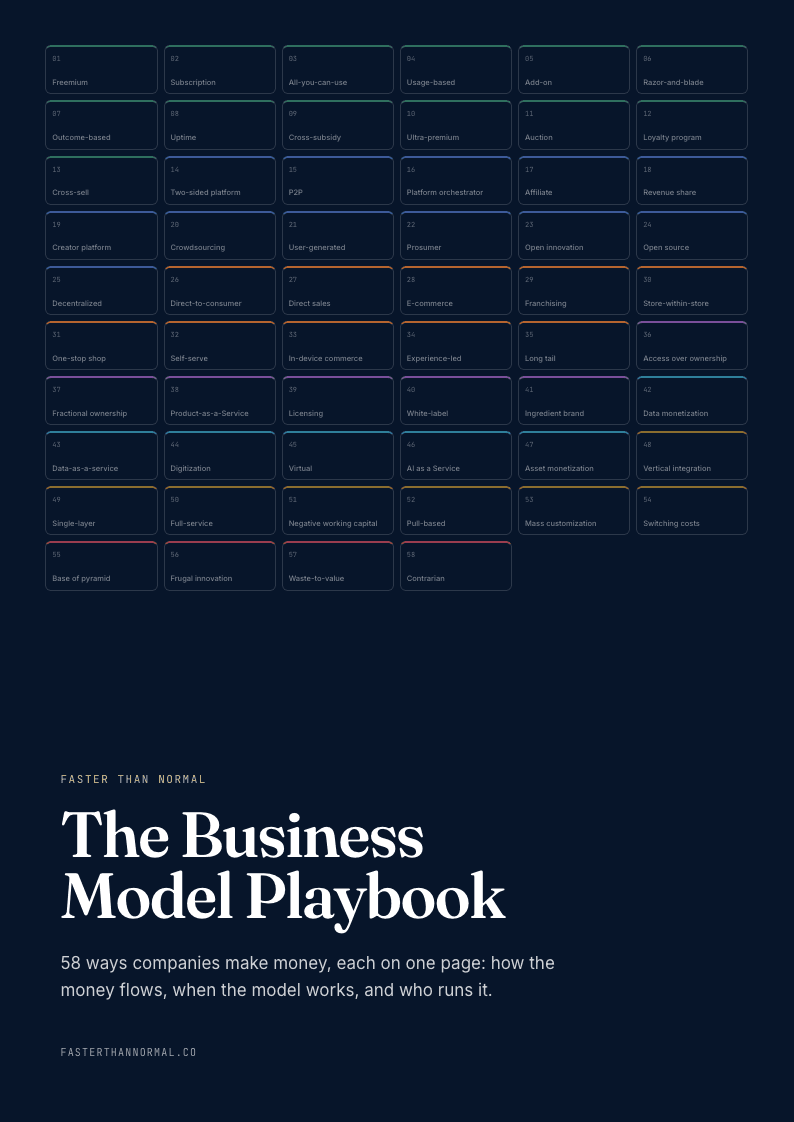
Free playbook
Get The Business Model Playbook
58 business models, one visual page each: how the money flows, the metrics that matter, and who runs it. Free when you join the Faster Than Normal email.
Free. No spam. Unsubscribe anytime.
Part IIIMaxims
-
Read the demand, not the spelling. Davis's letter was misspelled and came from a tailor who could not raise $68. It also reported that he could not make the pants fast enough. That second fact was what counted.
-
The fix may already be on your bench. The rivets Davis used on the pants were the ones he kept for horse-blanket straps. He had never thought of using them on pockets until he did.
-
A salary buys out the name. Davis became an employee, then a plant manager, and died wealthy but obscure. The person who owns the patent, the factory, and the customers is the one history remembers.
-
You don't get to choose which asset becomes iconic. The number 501 was an arbitrary warehouse lot. Consistency over a century is what turned it into the most famous product number in American retail.
-
Iconic is not the same as relevant. Revenue peaked above $7 billion in the mid-1990s and then fell for years while the brand coasted on heritage. A garment everyone wears can still become a brand no one gets excited about.
-
The next market may arrive as a tourist. Wealthy Easterners at 1930s dude ranches bought workwear as souvenirs and took it home as leisurewear. The move from utility to fashion began with customers the company had never tried to reach.
-
Cut the discounts before the products. Faced with tariffs in 2025, Levi's raised prices on selected products and ran fewer "20 percent off" and friends-and-family events. It protected its margins without teaching customers to wait for a sale.
-
A handoff works better as an apprenticeship. Michelle Gass spent months as president working alongside Chip Bergh before she became CEO. The overlap gave her a view of the company from inside before she had to run it.
-
Slow firing is a common regret. Bergh named his biggest mistake at Levi's as "not firing people who needed to go soon enough." In a turnaround, keeping the wrong people costs more than the discomfort of letting them go.
-
Communities leave when taken for granted. "We took our business community for granted," said Daniel Lurie of San Francisco. "People fled." A place, like a customer, has to be tended by the people who depend on it.
In Their Own Words
We can understand, too, that natural species are chosen not because they are 'good to eat' but because they are 'good to think.
An expert knows all the answers - if you ask the right questions.
Objects are what matter. Only they carry the evidence that throughout the centuries something really happened among human beings.
Gifts make slaves.
If the composer withholds more than we anticipate, we experience a delicious falling sensation; we feel we have been torn from a stable point on the musical ladder and thrust into the void.
In the old days, people used to risk their lives in India or in the Americas in order to bring back products which now seem to us to have been of comically little worth.
So when the pants were done — the rivets were lying on the table — and the thought struck me to fasten the pockets with rivets. I had never thought of it before.— Jacob Davis, testimony in patent-infringement case, c. 1874
His Life Devoted Not Only to Fostering the Highest Commercial Conditions, But to the Moral, Social and Educational Welfare and Development of the Young Men and Women of the State.— The San Francisco Call, obituary of Levi Strauss, September 1902
When faced with difficult decisions, Levi's will make choices that place them on the right side of history.— Chip Bergh, CEO of Levi Strauss & Co. (2011–2024)
There's only so much you can absorb from the tariffs, because they're just very high.— Michelle Gass, CEO of Levi Strauss & Co., 2025
We took our business community for granted. We said, "We can just keep punishing you...and you're going to stay." Well, that didn't happen. People fled.— Daniel Lurie, Mayor of San Francisco, 2024
Further reading
- Levi Strauss: The Man Who Gave Blue Jeans to the World by Lynn Downey


