
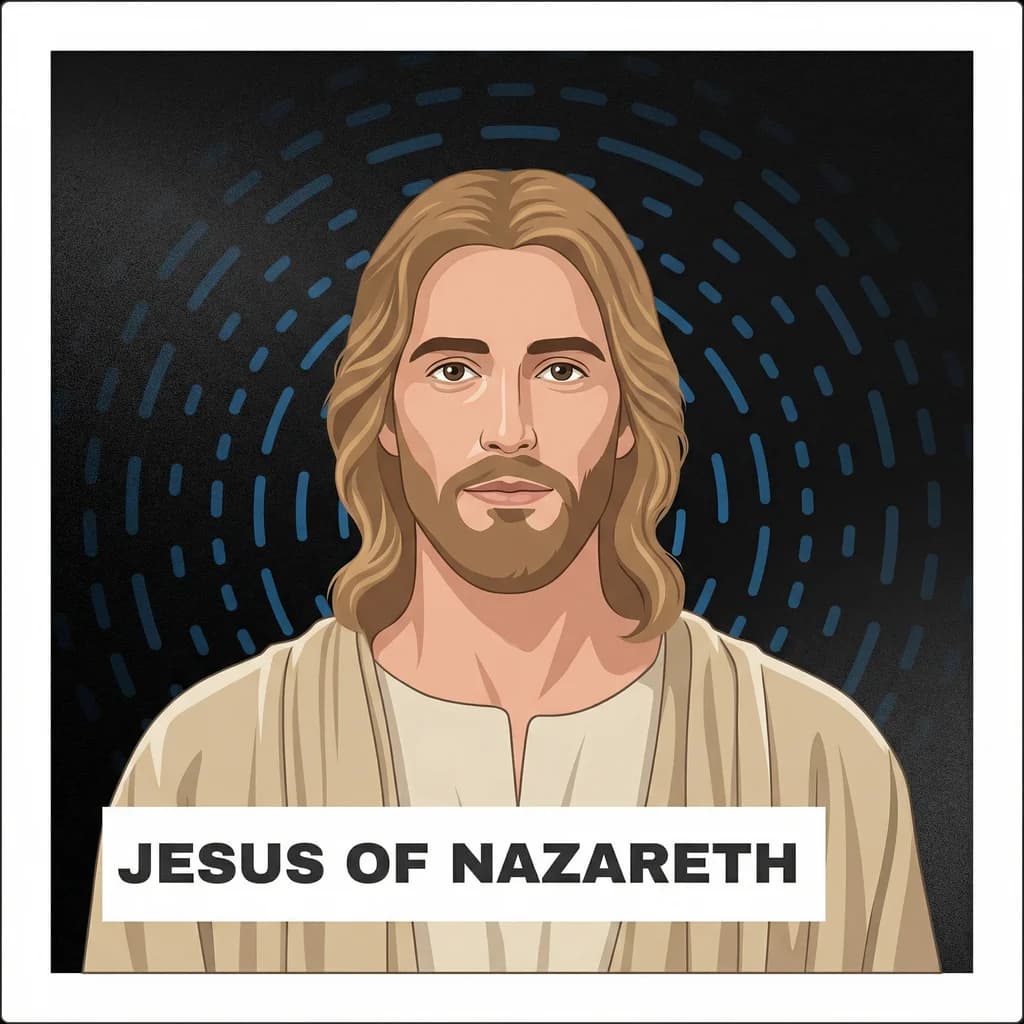

Part IThe Story
The Penny on the Table
Somewhere around the year 30 of the Common Era—the precision is false but the range is not—a group of men who had been sent to entrap an itinerant Galilean preacher asked him, in the precincts of the Jerusalem Temple, whether it was lawful to pay tribute to Caesar. The question was a trap of elegant simplicity: say yes, and you lose the crowd; say no, and you invite a charge of sedition. The preacher, who had been teaching in Jerusalem for perhaps a few days—the sources disagree on the timeline but converge on the tension—asked to see a coin. They produced a silver denarius, the "penny" of the King James Bible. Whose image was on it? Caesar's, they said. Then give to Caesar what is Caesar's, he replied, and to God what is God's.
The brilliance of the maneuver, as Adam Gopnik noted in the New Yorker, was that it turned the question back on the questioner "in mock-innocence." The answer, Gopnik observes, is a tautology that leaves the real question open: What exactly belongs to Caesar, and what belongs to God? That question has been hanging for two thousand years, and every generation—every empire, every revolution, every tax code—has attempted to answer it, and every answer has proved provisional. The man who posed it was executed shortly thereafter by the Roman state. The Gospels say his body was placed in a tomb; some historians, notably John Dominic Crossan, have argued that, like most victims of crucifixion, he may never have been buried at all. Within three centuries of his death, the emperor Constantine had legalized the church that worshipped him (the Edict of Milan, 313); by 380, under Theodosius I, Nicene Christianity was the official religion of the Roman Empire.
This is the paradox at the center of any honest encounter with Jesus of Nazareth: by many measures the most consequential life in Western history is also one of the most thinly documented. We have no writings from his hand. No surviving source mentions him while he is alive. The language he spoke—Aramaic, a Semitic tongue—is not the language in which any of his words survive. Everything we possess was written decades after his death, in Greek, by authors whom most critical scholars do not believe were eyewitnesses (the names now attached to the Gospels were added later). Most or all of the Gospels were written around or after the Roman destruction of the Jerusalem Temple in 70 CE, a catastrophe for first-century Judaism whose trauma is hard to separate from the texts it produced. The Gospels are not modern biographies. Summarizing the argument Bart Ehrman has made across a series of lucid books, Gopnik describes them as written "as testaments of faith, not chronicles of biography, shaped to fit a prophecy rather than report a profile."
And yet. Something happened. Someone was there. Nearly all historians of antiquity, whatever their own beliefs, agree that Jesus existed, that he was baptized by John, and that he was crucified under Pontius Pilate—and the movement that followed was real, enormous, and world-altering. As the writer Reza Aslan put it in the opening line of Zealot, "It is a miracle that we know anything at all about the man called Jesus of Nazareth."
By the Numbers
The Galilean
c. 6–4 BCEApproximate year of birth—Bethlehem in Matthew and Luke; many historians favor Nazareth
c. 30–33 CEApproximate year of death, Jerusalem
~1–3 yearsEstimated duration of public ministry
12Core disciples, a number most scholars link to the twelve tribes of Israel
4Canonical Gospels, written roughly 35–70 years after his death
2.3 billionChristians worldwide in 2020 (Pew Research Center)
0Words written in his own hand
The Village No One Had Heard Of
Nazareth in the first century was not a place that mattered. The village does not appear in the Hebrew Bible, the Mishnah, the Talmud, or Josephus's detailed chronicles of Jewish Palestine. The Gospel of John preserves an insult that reads like a proverb: "Can anything good come out of Nazareth?" Archaeological work led by Ken Dark of the University of Reading—summarized in his Archaeology of Jesus' Nazareth (Oxford University Press, 2023)—has revealed a small Jewish village on a limestone hillside in Lower Galilee whose household objects, pointedly, were all of Jewish manufacture. Surveys of the valley between Nazareth and Sepphoris, less than five miles away, found that sites near Sepphoris used imported Roman-style pottery and amphorae, while those near Nazareth did not. Dark interprets this as a deliberate choice—perhaps reflecting a more conservative approach to Jewish purity—and as one of the clearest cultural boundaries between acceptance and rejection of Roman material culture anywhere in the Empire.
This matters because it challenges a persistent romantic notion—that the young Jesus, walking to Sepphoris as a laborer, would have absorbed Greek philosophy, Roman theater, and the cosmopolitan currents of the Mediterranean world. Dark's evidence points the other way: the boy who grew up in that hillside village grew up in a devoutly Jewish community that kept its distance from the Hellenized city nearby.
His father, Joseph, was a tektōn—the Greek word has been rendered "carpenter" for two millennia, but it could mean stoneworker, builder, general craftsman, or day laborer. The ambiguity does not change the economic reality: the family worked with their hands. They were not destitute—some of Jesus's later disciples owned fishing boats and houses—but they were not prosperous. E.P. Sanders places families like this in the broad middle of Palestinian Jewish society: people who could pay their taxes and make pilgrimage to the Temple in Jerusalem, but who had little cushion against catastrophe.
Of Jesus's childhood and early adulthood, we know almost nothing. Luke offers a single anecdote—the twelve-year-old astonishing the teachers in the Temple with his understanding—and then silence. Nearly three decades of a life, vanished into the limestone and dust of a Galilean village. The "hidden years," as they are sometimes called, are hidden because, to the wider world, he was nobody.
The Desert, the River, the Voice
He appears, fully grown, at the Jordan River, sometime around the year 28 or 29 CE (Luke dates John's preaching to the fifteenth year of the emperor Tiberius). He has come south from Galilee to find a man named John, who is living in the wilderness, eating locusts and wild honey, and performing ritual immersions in the river. John the Baptizer, as some scholars prefer to call him, giving a better sense of the flat-footed active form of the original Greek, was an eschatological prophet of a type that first-century Palestine produced with some regularity. He preached that the present age was ending, that God would soon intervene in human history, that a day of judgment was at hand, and that people had better repent while they still could.
John's baptism was not a gentle pastoral sacrament. It was a prophetic act of repentance in the face of coming judgment—a public declaration that you had turned your life around. And Jesus submitted to it.
This single act—Jesus allowing himself to be baptized by John—is accepted as historical by the great majority of critical New Testament scholars, and for a reason that reveals the strange, inverted logic of Gospel criticism. The criterion of embarrassment holds that details the early Church would have preferred to suppress, but which were too well established to deny, are probably authentic. And Jesus's baptism by John raised hard questions for early Christian theology. If Jesus was the Son of God, why did he need a baptism of repentance? Why did he appear to play a supporting role to John? Mark, Matthew, and Luke all narrate the baptism, and the later accounts visibly handle it with care: in Matthew, John protests that Jesus should be baptizing him (3:14); Luke reports John's imprisonment first and then mentions the baptism only in passing (3:19–22). The Gospel of John does not narrate the baptism at all; it gives instead the Baptist's testimony that he saw the Spirit descend on Jesus (1:29–34). That the tradition survived these evident discomforts is strong evidence that it actually happened.
Mark, almost surely the oldest Gospel and usually dated to around 70 CE, handles the moment with characteristic bluntness. Jesus is baptized. The heavens tear open. A voice speaks: "You are my Son, whom I love; with you I am well pleased." But notice the pronoun: you. In Mark, the voice speaks to Jesus, not about him. Some early manuscripts of Luke have the voice quote Psalm 2: "You are my Son; today I have begotten you." Matthew turns the declaration outward—"This is my Son"—announcing to the onlookers what Mark addresses to one man.
For many critical scholars, these differences are the fossil record of a theology in formation: communities of believers retelling the scene at the river in light of what they had come to believe about the risen Christ.
The Era of Apocalyptic Expectation
To understand what Jesus was doing—and what he thought he was doing—you have to understand the world in which he did it, and that world was tense.
Palestine in the first century was part of the Roman sphere, governed through a patchwork of client kings, tetrarchs, and prefects who kept order on behalf of a distant emperor. Herod the Great had ruled Jewish Palestine as Rome's client king from 37 to 4 BCE, a period of grand construction projects and savage paranoia. When he died in 4 BCE—around the time most scholars place Jesus's birth, since Matthew sets it in Herod's reign—his kingdom was divided among his sons, and the division went badly. His son Archelaus proved so unpopular that the emperor Augustus deposed him in 6 CE and placed Judea under a Roman prefect, backed, by Sanders's estimate, by roughly three thousand auxiliary soldiers recruited largely from nearby non-Jewish cities. During Jesus's public career, that prefect was Pontius Pilate, who governed from about 26 to 36 CE. The Jewish writers Philo and Josephus portray him as harsh and provocative, and he was eventually recalled to Rome after his troops attacked a Samaritan gathering.
The daily governance of Jerusalem fell largely to the high priest, Caiaphas, who held the office from approximately 18 to 36 CE—an unusually long tenure that suggests he was skilled at the difficult work of mediating between a restive populace and a foreign power. He and Pilate worked together for a decade.
Into this environment came a succession of would-be messiahs, prophets, and rebels. Reza Aslan, in Zealot: The Life and Times of Jesus of Nazareth, catalogs them: Athronges, a shepherd who crowned himself king in 4 BCE and was cut down with his followers by Roman troops. Theudas, who according to Acts gathered about four hundred followers before he was killed; Josephus says the Romans cut off his head. The mysterious figure known only as "the Egyptian," who led a crowd from the desert toward Jerusalem and saw many of them killed or captured. Judas the Galilean. Simon of Peraea. The Samaritan prophet whose armed followers, Josephus reports, were attacked by Pilate's troops at Mount Gerizim, with their leaders executed afterward. Many of these figures met violent ends at the hands of Rome or its client rulers.
Crucifixion was Rome's most feared instrument. It was used above all for slaves, bandits, and rebels—those judged to threaten public order. The procedure was deliberately, theatrically horrible: the victim was stripped, paraded publicly, whipped, then nailed or bound to a wooden cross and left to die over hours or days; sometimes the legs were broken to hasten death. The corpse was often left exposed. Josephus, the first-century Jewish historian, tells us he once begged a Roman commander to have three of his friends taken down from crosses; only one survived.
This was the death that awaited anyone Rome judged to be a pretender to kingship. Whether Jesus claimed the title of Messiah himself is still debated by scholars; that others claimed it for him, and that Rome executed him as "King of the Jews," is widely accepted.
The Feaster and the Table
What was new about him?
The question is the engine of two thousand years of scholarship, and the answers are necessarily partial, contested, provisional. But a few things come through the thicket of textual uncertainty with unusual force.
John Dominic Crossan—Irish-born, trained in the Servite order, a former Catholic priest who left the priesthood in 1969 to marry, co-founder of the Jesus Seminar, and among the most provocative historical-Jesus scholars of the late twentieth century—built much of his reconstruction around a surprisingly mundane observation: the man ate with people.
— Jesus of Nazareth, Gospel of Mark 2:17It is not the healthy who need a doctor, but the sick. I have not come to call the righteous, but sinners.
The Gospels themselves preserve the contrast with John the Baptist. John, critics said, came "neither eating nor drinking"; the Son of Man came "eating and drinking," and was called "a glutton and a drunkard, a friend of tax collectors and sinners" (Matthew 11:18–19). In Crossan's reading, developed most fully in The Historical Jesus: The Life of a Mediterranean Jewish Peasant, Jesus's table fellowship was among the most radical elements of his life. First-century Mediterranean society was organized by rules of commensality—who eats with whom, at whose table, in what order—that encoded its social hierarchies. To eat with someone was to recognize them.
Jesus, the Gospels report, crossed these lines repeatedly. He ate with tax collectors and "sinners." He fed crowds rather than instructing them how to fast. John's Gospel has him turn water into wine at a wedding in Cana. And the Gospels and Paul place the origin of the ritual Christians call the Eucharist—bread and wine shared as his body and blood—at a final meal with his followers.
His teaching on purity was equally pointed: "Nothing outside a person can defile them by going into them. Rather, it is what comes out of a person that defiles them" (Mark 7:15). That would have startled many pious Jews of his day, for whom the dietary laws were a divine commandment. Scholars disagree about how far Jesus meant it: Mark adds his own comment that Jesus thereby "declared all foods clean," but E.P. Sanders notes that the early Church later argued bitterly over food laws, which suggests Jesus had not clearly abolished them.
He was not a hedonist. He was not an ascetic. He was something harder to categorize: a teacher who, in the Gospels' portrait, located the sacred in the most ordinary human acts and insisted that the lines separating worthy from unworthy, insider from outsider, had been drawn in the wrong places.
The Parables That Never Quite Close
His teaching style was distinctive and, by all accounts, arresting. The Gospels preserve it in enough detail that a consistent voice emerges even through decades of oral transmission, translation from Aramaic to Greek, and editorial shaping.
He was epigrammatic. He was enigmatic. In Mark especially, he is often impatient. Gopnik hears "a wild gaiety" in his moral teachings and "a brash, sidewise indifference to conventional ideas of goodness." His parables—the Prodigal Son, the Good Samaritan, the Mustard Seed, the Workers in the Vineyard—set up clear narrative expectations and then overturn them. The dutiful son is not the one who gets the feast. The last hired are paid the same as the first. The good neighbor turns out to be the despised Samaritan. The tiny seed becomes the largest of garden plants.
They are designed to unsettle—to overturn the listener's assumptions about merit and reward, about who is in and who is out. The literary critic Frank Kermode, in his pioneering 1979 study The Genesis of Secrecy, read Mark in particular as a text that keeps its secret: a story whose central mystery the reader is never allowed fully to possess.
— Gospel of Thomas, saying 42Be passersby.
That compressed exhortation comes from the non-canonical Gospel of Thomas, a collection of sayings most scholars date to the second century, though some argue it preserves earlier material. Gopnik reads it as a call to hold lightly to home, place, and ritual—to be wanderers. Whatever its origin, it echoes a theme the canonical Gospels share: the kingdom of God is not a location so much as a way of living.
Diarmaid MacCulloch, in his history Christianity: The First Three Thousand Years, points out that Jesus addressed God as Abba, Father—an intimacy that stood out among prophets, even if the popular gloss "Daddy" has been challenged by scholars such as James Barr. MacCulloch also notes that the phrase rendered in the King James Version as the solemn "Verily I say unto you" (literally "Amen, I say to you") was an idiosyncratic verbal habit rather than an oracular formula. In this reading, the Jesus of the earliest sources sounds less like a remote oracle and more like a brilliant, urgent, sometimes exasperated teacher.
In Mark, that impatience is palpable. "Do you have eyes but fail to see?" he asks his own disciples. The English actor Alec McCowen used to perform the entire Gospel of Mark as a one-man show, and Gopnik recalls that his Jesus came alive as a recognizable human type: the charismatic leader of an oppressed people, verbally quick, given to enigmatic paradoxes and parables that refuse to resolve.
The Kingdom and the Cliff
The hardest problem for historians is that this same teacher who told these luminous stories also, in the earliest sources, proclaimed that God's kingdom was about to arrive.
"Truly I tell you, some who are standing here will not taste death before they see that the kingdom of God has come with power," Jesus says in Mark 9:1. Paul, whose letters predate the Gospels, also seems to have expected the end within his own lifetime: in his earliest surviving letter he writes of "we who are still alive, who are left until the coming of the Lord" (1 Thessalonians 4:15).
Many critical historians—from Albert Schweitzer to E.P. Sanders, Paula Fredriksen, and Bart Ehrman—conclude that Jesus was an apocalyptic prophet who expected God to transform the world soon, and that this expectation was not fulfilled in the way his first followers anticipated. Other scholars, including Crossan and Marcus Borg, argue that the apocalyptic sayings were largely added by the early Church. Christian interpreters have long read such passages differently again: as fulfilled in the Transfiguration that immediately follows in Mark, in the resurrection and the coming of the Spirit, or as describing a kingdom already present in part and still to come. Gopnik, writing from a skeptical vantage, argues that much of what followed was built on "an apology for what went wrong"; believers see instead a deepening understanding of what the kingdom meant.
However one reads it, the apocalyptic prophet and the wisdom teacher are not as contradictory as they first appear. Aslan argues that in first-century Jewish expectation, religion and politics were inseparable: "Simply saying 'I am the messiah' was a treasonable offense. If you are claiming to ring in the kingdom of God, you are also claiming to ring out the kingdom of Caesar." A charismatic prophet, Gopnik observes, is precisely "someone whose aura of personal conviction manages to reconcile a hard doctrine with a humane manner"—and the history of oppressed peoples is full of leaders who moved between the comforting and the catastrophic, the fire sermon and the shared meal.
The Week That Broke the World
Sometime between 29 and 33 CE—30 and 33 are the dates most often proposed—Jesus traveled to Jerusalem at Passover. What happened in the next few days is the most narrated sequence of events in Western history, and much of it cannot be independently verified.
What most historians accept is this: he entered the city in a way that his followers, and apparently the authorities, took as significant. He went to the Temple—the spiritual center of Jewish life—and caused a disturbance. The Gospels describe him overturning the tables of the money changers and driving out the sellers. Aslan reads this as a direct challenge to Rome; most specialists, including Sanders and Fredriksen, read it as a prophetic sign directed at the Temple establishment, and as the event that precipitated his arrest. As Sanders put it, the gun may already have been cocked, but it was the Temple demonstration that pulled the trigger.
He was arrested. The Gospels say he was brought before the high priest and then before Pontius Pilate. The accounts of the proceedings differ, but most historians conclude that Rome executed him as a would-be "King of the Jews"—the charge the Gospels say was posted on the cross, a title at once religious and political. Joseph Weiler, the NYU legal scholar who has taught a seminar on the trial of Jesus, has called his appearance before the Jewish council "arguably the most famous trial in Western civilization," noting that at least four hundred books have been written about the trial alone.
Pilate sentenced him to crucifixion. This is one of the facts about Jesus's life that virtually every historian, believer and skeptic alike, considers secure; it is attested not only in the Gospels but by the Roman historian Tacitus.
The director Paul Verhoeven—who, improbably, is a member of the Jesus Seminar—has imagined, following Crossan, an opening scene for a film about Jesus that captures the context: a man being nailed to a cross, two companion crosses in view, then the camera pulling back to reveal hundreds more. The year is 4 BCE, when, according to Josephus, the Roman governor Varus crucified two thousand Jewish rebels after Herod's death. Jesus, born around that time, would likely have grown up hearing what those crosses meant.
The Cry
In Mark, the earliest account, the death scene is harrowing and austere. There is no resurrection appearance. There is a man dying on a cross, and there is a cry:
Eloi, Eloi, lema sabachthani?
My God, my God, why have you forsaken me?
Matthew keeps the cry, which quotes the opening line of Psalm 22. Luke and John do not include it, giving instead other last words: "Father, into your hands I commit my spirit" in Luke, and "It is finished" in John. In Mark, it is the last intelligible thing Jesus says. Most textual scholars conclude that the verses showing him risen (Mark 16:9–20) were added later; the earliest manuscripts end with an empty tomb and frightened women who "said nothing to anyone, because they were afraid."
— Jesus of Nazareth, Gospel of Mark 15:34My God, my God, why have you forsaken me?
Readers have heard the cry in very different ways. For Gopnik, it means that "the Jesus faith begins with a failure of faith." Many Christian interpreters note that Psalm 22, which opens with these words, ends in vindication and praise, and hear in the cry both real anguish and continuing trust. The historian cannot settle that question. What can be said is that Mark, the earliest Gospel, chose not to soften it.
The Empty Tomb and the Full Church
What happened next is the dividing line not just between belief and unbelief but between two different ways of reading history.
The disciples became convinced that Jesus had risen from the dead. Paul, writing in the 50s CE—within about two decades of the crucifixion, and before any Gospel was composed—passes on a tradition he says he himself received: that Christ "appeared to Cephas, and then to the Twelve. After that, he appeared to more than five hundred of the brothers and sisters at the same time, most of whom are still living" (1 Corinthians 15:5–6). The phrasing implies that many witnesses could still be asked.
Historians cannot adjudicate a miracle, and they differ on how to explain these experiences; believers hold that the resurrection happened. But that Jesus's earliest followers sincerely believed he had been raised is accepted by scholars across the spectrum, and the movement that belief generated was real. Within a generation, communities of Jesus-followers had spread across the eastern Mediterranean and reached Rome. By 313, Christianity was legal throughout the Empire; by 380, it was the Empire's official religion. Today some 2.3 billion people identify as Christians.
The theological debates that followed were intense. At the Council of Nicaea in 325, bishops opposing the teaching of the Alexandrian priest Arius declared the Son homoousios—"of the same substance"—with the Father. In the decades after, a mediating party proposed homoiousios, "of similar substance"; the dispute over a single letter ran through the mid-fourth century until the Council of Constantinople in 381 reaffirmed the Nicene term. Philip Jenkins's Jesus Wars takes up the next round—the fifth-century councils of Ephesus and Chalcedon, which argued over how the divine and human natures were united in Christ—and emphasizes that these were also struggles over power among patriarchs, emperors, and cities, in which doctrinal formulas could serve as badges of allegiance. Historians of theology would add that the participants also cared intensely about the ideas themselves; the two readings are not mutually exclusive.
Gopnik sees a persistent "twoness" at the heart of the Christian story—the historical Jesus and the Christ of faith, the teacher of the open table and the judge of the last day. "All faiths have fights," he writes, "but … few have so many super-subtle shadings of dogma: wine or blood, flesh or wafer, one God in three spirits or three Gods in one."
The Evidence Beyond the Text
Outside the New Testament, the historical evidence for Jesus of Nazareth is thin but not nonexistent, and its thinness reflects his social position. He was not the kind of person the Roman world documented. He held no office. He commanded no army. He wrote nothing down.
The earliest non-Christian reference comes from the Jewish historian Josephus, writing around 94 CE—roughly sixty years after the crucifixion. In a brief passage in his Antiquities of the Jews, Josephus mentions "James, the brother of Jesus, the one they call messiah," whom the high priest Ananus had unlawfully condemned to stoning. Aslan reads the phrase as derisive; other scholars take it as a neutral way of specifying which Jesus was meant. Either way, the passage assumes the audience already knows who Jesus is. As Aslan writes in Zealot: "The passage proves not only that 'Jesus, the one they call messiah' probably existed, but that by the year 94 C.E., when the Antiquities was written, he was widely recognized as the founder of a new and enduring movement." A longer passage about Jesus in the same work, the Testimonium Flavianum, survives in a form most scholars believe Christian copyists embellished, though many think Josephus wrote a core of it.
The Roman historian Tacitus, writing around 116 CE, provides the second major non-Christian reference. Describing Nero's persecution of Christians after the fire of Rome in 64 CE, Tacitus notes that "Christus, from whom the name had its origin, suffered the extreme penalty during the reign of Tiberius at the hands of one of our procurators, Pontius Pilatus." (An inscription found at Caesarea in 1961 shows Pilate's actual title was prefect.) The passage drips with contempt for the "most mischievous superstition," and most scholars regard that hostility as a mark of authenticity: a Christian interpolator would hardly have described the faith that way.
Early Christian writers close to the apostolic generation—Clement of Rome (c. 96 CE), Ignatius of Antioch (c. 110 CE), and Polycarp of Smyrna (whose surviving letter dates to c. 110–140 CE, and who was said to have known the apostle John)—all attest to a figure who lived, taught, was crucified under Pontius Pilate, and was believed to have risen. These are not disinterested sources. But no ancient opponent of the movement disputed that he had lived. As Lawrence Mykytiuk of Purdue University puts it, "Jewish rabbis who did not like Jesus or his followers accused him of being a magician and leading people astray, but they never said he didn't exist."
The Portrait Historians Draw
E.P. Sanders—the Duke University religion professor whose The Historical Figure of Jesus remains one of the most rigorous and readable scholarly accounts—framed the challenge this way: we cannot recover the precise words Jesus spoke or the exact details of his daily life, but we can reconstruct with reasonable confidence the world in which he lived, and from that reconstruction, a portrait emerges.
The portrait is of a man who was thoroughly Jewish—who taught in synagogues, preached from Jewish scripture, kept Jewish festivals, made pilgrimage to the Temple, and lived and died within the religious and political horizons of first-century Judaism. "The single most important thing to remember about Jesus," Aslan said in a Reddit AMA, "is that he was [a] Jew. Now that seems obvious but if it's true then it means that everything he said or did must be viewed in its Jewish context."
In the mainstream reconstruction associated with Sanders, Fredriksen, Ehrman, and John P. Meier, he was a prophet who proclaimed the coming kingdom of God. He was a teacher whose parables still astonish. His open table and his challenge to conventional ideas of status unsettled the existing order, though Sanders argues he did not reject the Jewish law itself. Nearly all the sources, including hostile ones, remember him as a healer and exorcist; most historians accept that he was known for such deeds, while what actually happened lies beyond what historical method can determine. And he inspired in his followers a devotion strong enough to survive his public execution and become a global faith.
For historians who conclude that Jesus expected the kingdom's imminent arrival, a further paradox follows: the delay did not end the movement. It prompted the early communities to reflect more deeply—on who Jesus was, on the meaning of his death, on how to live together in the meantime—and the institutions they built proved remarkably durable. Believers, for their part, see that durability as the fruit of the resurrection and the Spirit rather than of disappointment. Both readings agree on the historical outcome.
Philip Pullman, the novelist, tried in The Good Man Jesus and the Scoundrel Christ to separate the two strands—the wise teacher from the divine redeemer—by literally splitting them into twin brothers. Gopnik found the effort sincere but finally impossible: "This fixed, steady twoness at the heart of the Christian story can't be wished away by liberal hope any more than it could be resolved by theological hair-splitting. Its intractability is part of the intoxication of belief."
The Argument That Never Ends
Gopnik points to a telling pair from the last century: W.H. Auden, whom he calls the best Christian poet of the age, and William Empson, the most articulate anti-Christian polemicist, near-contemporaries of very similar temperament. Auden, Gopnik writes, chose Christianity for the absolute democracy of its vision—in it, "neither Jew nor German, East nor West, boy nor girl, smart nor dumb, boss nor worker." Empson, from the 1940s onward, attacked what he saw as a morality reduced "to keeping the taboos imposed by an infinite malignity." The same tradition produced both responses; that, in Gopnik's telling, is the point.
Reza Aslan—born into a nominally Muslim family in Iran, a convert to evangelical Christianity as a teenager, who drifted from that faith while studying religion in college and later returned to Islam—addressed readers unsettled by his book on Reddit: "If your faith is strong, then nothing I say should be able to shake it. So relax. Pick up the book. Debate its arguments. But don't be afraid."
— John Dominic Crossan, The Historical JesusThere were always historians who said it could not be done because of historical problems. There were always theologians who said it should not be done because of theological objections. And there were always scholars who said the former when they meant the latter.
The argument persists because the questions are real. Authority can circumscribe it, but it has never ended it. The impulse of some orthodoxies has been to treat the wrangling as a sign of weakness; the impulse of much modern theology, Gopnik notes, is to embrace it as a sign of life.
Thomas Jefferson compiled his own version of the Gospels, with the ethical teachings left in and the miracles cut out. Albert Schweitzer, the great polymath, concluded his 1906 study—known in English as The Quest of the Historical Jesus—with the image of an apocalyptic prophet whose expectations went unfulfilled, and then spent the rest of his life serving that prophet's memory in a hospital in equatorial Africa. John Dominic Crossan reconstructed Jesus as a nonviolent Jewish peasant radical confronting Roman oppression and argued that the resurrection should be read as metaphor rather than fact; N.T. Wright, among many others, has argued at equal length for the opposite. Rudolf Bultmann insisted we could know very little about the historical Jesus and then wrote one of the most influential books about him. The man keeps escaping the categories designed to contain him.
Aslan, asked on Reddit what would happen to religion if aliens arrived on Earth, answered: "We would simply absorb their reality into our religious traditions the way we have done with every major scientific breakthrough." He might have been describing the history of Jesus scholarship itself—an endless process of reinterpretation that has been running since his first followers proclaimed him risen.
Beyond the words, beyond the scholarship, beyond the councils and the archaeological digs and the two-thousand-year argument about the nature of the divine, there is still that scene at the river—a man walking into the water, submitting to a ritual of repentance at the hands of a desert prophet. In Mark, the heavens tear. The historian can say only that a Galilean from a village few had heard of was baptized in the Jordan, and that the world after that moment was not the same world. On the far bank, the wilderness. Ahead of him, the road, the crowds, the parables, the table, the garden, the cross. Behind him, just the water, closing over the place where he had stood.
Part IIThe Playbook
What can leaders today learn from the life of a first-century Jewish teacher? The question needs care. For billions of people, Jesus is not a case study but the center of their faith, and nothing here is meant to reduce that faith to technique. But historians of early Christianity—among them Wayne Meeks, Rodney Stark, and Larry Hurtado—have long studied, in historical terms, how a small movement with no wealth, no army, and no writings from its founder spread across the Roman world within a few centuries. The lessons below draw on that scholarship and on the Gospel portraits as texts. They are about communication, community, and conviction—not about theology.
The principles
- 1.Begin from the margin, not the center.
- 2.Learn inside a tradition before you lead.
- 3.Build community around the shared table.
- 4.Teach in stories that invite interpretation.
- 5.Lead through visible acts of service.
- 6.Hold the mission steady when expectations change.
- 7.Build for twelve, not for twelve thousand.
- 8.Answer hostile questions with better questions.
- 9.Let teaching live in people, not only in documents.
- 10.Hold to your convictions under pressure.
- 11.Leave room for more than one reading.
Principle 1
Begin from the margin, not the center.
Nazareth was so obscure that no surviving text before the Gospels mentions it. Its residents were villagers who, on Ken Dark's evidence, kept their distance from the cosmopolitan city nearby. Jesus did not emerge from the Jerusalem elite, the Temple priesthood, or the Hellenized urban class. He came from the geographic and social periphery of Jewish Palestine.
In the Gospel portraits, this was not a disadvantage. It gave him credibility with the people he addressed—the poor, the sick, the peasant majority. A message that "the last will be first, and the first will be last" (Matthew 20:16) carries a different weight when it comes from someone who shares the listeners' circumstances. The Beatitudes are not an abstraction when spoken by a man who worked with his hands.
Tactic: Stay close to the people you mean to serve, and speak from shared experience rather than from above—credibility comes from knowing their lives firsthand.
Principle 2
Learn inside a tradition before you lead.
Jesus did not begin his public career with an announcement. He began it by accepting someone else's baptism—John's ritual immersion in the Jordan River. According to Mark, only after John's arrest did he begin preaching in Galilee (Mark 1:14), carrying forward John's call to repentance in his own voice.
This is a pattern that recurs across consequential lives: learning a tradition deeply before reshaping it. Paul was trained as a Pharisee (Philippians 3:5) before becoming an apostle. Martin Luther was an Augustinian friar and professor of theology before he became the Church's most consequential critic. Time spent inside a tradition builds understanding, humility, and standing.
Tactic: Before setting out on your own, spend real time learning inside an existing tradition or organization, and acknowledge publicly what you owe it.
One of the most striking features of Jesus's ministry, as Crossan and others have emphasized, was social: he used meals to embody the inclusion he preached. In a culture where commensality—who eats with whom—encoded social rank, his willingness to eat with tax collectors and "sinners" drew criticism precisely because it signaled acceptance.
The lesson is about the power of shared, informal spaces. The table—the common meal, the gathering where rank recedes—is where trust is built and where barriers come down not through argument but through presence.
🍞
The Politics of the Table
How commensality functioned in the Gospel portraits
| Convention | Jesus's Practice |
|---|---|
| Eat with social and religious equals | Ate with tax collectors and "sinners" (Mark 2:15–16) |
| Dietary purity as a mark of devotion | "Nothing outside a person can defile them by going into them" (Mark 7:15) |
| Fasting as mark of spiritual seriousness | Feasting as sign of the kingdom's nearness (Mark 2:18–19) |
| Emphasis on ritual purity | Emphasis on moral purity of the heart |
Tactic: Make shared meals and informal gatherings a regular part of how your group builds trust, and use them to include people whom formal settings tend to leave out.
Principle 4
Teach in stories that invite interpretation.
The parables are not simple moral lessons. The Prodigal Son welcomes home the son who squandered everything. The Good Samaritan makes a despised outsider the model of neighborliness. The Workers in the Vineyard pays everyone the same. These stories unsettle the listener's assumptions and invite them to rethink.
That is part of why they endure. A story that raises a question stays with the listener and invites ongoing reflection and conversation, and the Gospels themselves show hearers puzzling over the parables' meaning (Mark 4:10–13). Two thousand years later, they are still being discussed.
Tactic: When communicating something important, use stories that prompt people to think for themselves—understanding people reach on their own tends to go deeper than instructions they receive.
Principle 5
Lead through visible acts of service.
The Gospels portray Jesus not only preaching a reversal of status but enacting it. John's Gospel has him wash his disciples' feet, a task usually left to servants (John 13). He welcomed children, who had little status, as models for entering the kingdom (Mark 10:13–16). He told a rich man to sell his possessions and give to the poor (Mark 10:21). "Whoever wants to become great among you must be your servant," he tells his disciples in Mark 10:43.
Each act made the teaching concrete. Values that are demonstrated are harder to misunderstand than values that are only described.
Tactic: Don't just state your values—model them in visible, sometimes humbling ways, especially toward the people with the least standing in your organization.
Principle 6
Hold the mission steady when expectations change.
The earliest Christian communities expected Jesus's return soon; Paul's first letter speaks of "we who are still alive" at the Lord's coming. As the decades passed, historians note, those communities did not dissolve. They reflected, wrote, and organized for a longer future—producing the Gospels, forms of leadership, and practices of worship that sustained them for generations. Historians such as Ehrman and Sanders read this as adaptation to an unfulfilled expectation; Christian theologians read it as a deepening understanding of what had been promised. On either reading, the communities held to their core commitments while revising their sense of timing.
Tactic: When events don't unfold on the timeline you expected, revisit your assumptions openly with your community—keep the core commitments, and adapt the plans built around them.
Principle 7
Build for twelve, not for twelve thousand.
Jesus attracted crowds, but the Gospels show him investing most deeply in a small circle. The Twelve—a number that, Sanders argues, symbolized the restoration of Israel's twelve tribes—were not chosen for rank. Several were fishermen. At least one was a tax collector. The Gospels portray them as often confused and sometimes faithless. Yet he taught them privately, ate with them, traveled with them, and explained to them what he taught the crowds in parables.
After the crucifixion, according to Paul's letters and Acts, members of that inner circle—Peter above all—were among the leaders of the first community in Jerusalem (Galatians 1–2). The small group, not the crowd, carried the movement forward.
Tactic: Invest disproportionate time and care in a small core group rather than only pursuing broad reach—lasting movements depend on the depth of commitment of the few who carry them.
Principle 8
Answer hostile questions with better questions.
The tribute question—"Give to Caesar what is Caesar's"—is the best-known example of Jesus answering a trap by reframing it. When the chief priests, teachers of the law, and elders demanded to know by what authority he acted, he asked them whether John's baptism was from heaven or from men—a question they could not answer without cost (Mark 11:27–33). In the story of the woman accused of adultery—a passage absent from the earliest manuscripts of John—he meets a demand to endorse stoning by inviting whoever is without sin to throw the first stone.
In each case, a hostile challenge became an occasion to clarify what he stood for, without the answer being dictated by the questioner's terms.
Tactic: When challenged in bad faith, don't simply defend yourself—step back, identify the real question, and answer in a way that shows what you actually value.
Principle 9
Let teaching live in people, not only in documents.
Jesus wrote nothing. His teaching was carried first by people—remembered, retold, and applied in new settings—before it was written down. The early Church ultimately preserved four Gospels rather than harmonizing them into one, and each speaks to a different community with a distinct emphasis. Aslan, in a Reddit AMA, made the point bluntly: "The people who wrote and compiled the Gospels were NOT literalists. If they were they would not have canonized four gospels which contradict each other on numerous facts of Jesus' life."
Believers and historians interpret that diversity differently, but it helped the tradition speak across languages and cultures its first hearers could not have imagined.
Tactic: Invest in people who deeply understand your mission, not just in written rules—leave enough room for future leaders to apply the core purpose to circumstances you cannot foresee.
Principle 10
Hold to your convictions under pressure.
The Gospels portray Jesus going to Jerusalem at Passover, the most volatile moment in the city's year, aware of the danger. Mark's account of Gethsemane shows him praying that the cup might pass from him, and then accepting it: "Yet not what I will, but what you will" (Mark 14:36). Whatever one believes about the meaning of his death, the portrait is of someone who did not abandon his mission to secure his own safety.
History offers many examples of leaders whose steadfastness under pressure, even at great personal cost, shaped how their followers understood and carried on their work. The Gospel accounts are among the most influential of them.
Tactic: Decide in advance which principles you will not trade for safety or approval, and be honest with yourself and others that holding them may carry real cost.
Principle 11
Leave room for more than one reading.
Attempts to reduce Jesus to a single figure—only a wise teacher, only a political revolutionary, only an apocalyptic prophet—have repeatedly run up against the richness of the sources. Different readers, working from the same texts, have found very different emphases.
Jefferson found a moral philosopher. Schweitzer found an apocalyptic prophet. Liberation theologians found a champion of the poor. Evangelical preachers proclaim a personal savior. Crossan found a nonviolent Jewish radical. Auden found a vision of absolute democracy. Christians across the centuries have confessed him as Lord. The texts have sustained all these readings.
For leaders, the lesson is modest: missions that endure tend to have a core that is clear enough to hold people together and rich enough that different people can find genuine meaning in it.
Tactic: Define your mission's core clearly, but resist narrowing it to a single slogan—leave room for different stakeholders to find their own genuine connection to it.

Free playbook
Get The Business Model Playbook
58 business models, one visual page each: how the money flows, the metrics that matter, and who runs it. Free when you join the Faster Than Normal email.
Free. No spam. Unsubscribe anytime.
Part IIIMaxims
-
The margin can be the message. A message about lifting up the overlooked carries unusual credibility when it comes from someone who shares their circumstances.
-
Learn before you lead. Time spent inside a tradition earns the understanding and standing needed to renew it.
-
Eat with the people you want to reach. Shared meals dissolve barriers that arguments often reinforce.
-
Stories that ask outlast statements that tell. A parable that provokes a question lodges deeper than a lecture that supplies an answer.
-
Serve where others can see. Visible acts of humility communicate values more clearly than any manifesto.
-
Hold the core, adapt the timeline. Communities that endure revise their expectations without abandoning their commitments.
-
Invest in the twelve, not the twelve thousand. Depth of commitment in a small circle carries a mission further than breadth of awareness in a crowd.
-
Answer the real question. A hostile challenge, reframed, can become the clearest statement of what you stand for.
-
Let the mission live in people. What is carried by committed people can adapt to new circumstances in a way that rules alone cannot.
-
Know what you will not trade. Convictions show their worth when holding them is costly.
-
Leave room for more than one reading. A mission rich enough to hold different perspectives can speak to many people across many generations.
In Their Own Words
Repent, for the kingdom of heaven is at hand.— Matthew 4:17
Follow me, and I will make you fishers of men.— Matthew 4:19; Mark 1:17
Enter by the narrow gate.— Matthew 7:13–14
If anyone would come after me, let him deny himself and take up his cross and follow me.— Mark 8:34; Matthew 16:24; Luke 9:23
For the Son of Man came to seek and to save the lost.— Luke 19:10
Blessed are the poor in spirit, for theirs is the kingdom of heaven.— Matthew 5:3
Blessed are those who mourn, for they shall be comforted.— Matthew 5:4
Blessed are the meek, for they shall inherit the earth.— Matthew 5:5
Whoever does the will of my Father in heaven is my brother and sister and mother.— Matthew 12:50
Do to others what you would have them do to you.— Matthew 7:12
Ask and it will be given to you; seek and you will find; knock and the door will be opened to you.— Matthew 7:7
Do not worry about tomorrow, for tomorrow will worry about itself.— Matthew 6:34
The sharpest opposition in the Gospels is between John the Faster and Jesus the Feaster.— John Dominic Crossan, The Historical Jesus
Render to Caesar the things that are Caesar's, and to God the things that are God's.— Jesus of Nazareth, Gospel of Mark 12:17
The single most important thing to remember about Jesus is that he was a Jew. Now that seems obvious but if it's true then it means that everything he said or did must be viewed in its Jewish context.— Reza Aslan, Reddit AMA, July 29, 2013
The argument is the reality, and the absence of certainty the certainty.— Adam Gopnik, 'What Did Jesus Do?', The New Yorker, May 2010
If your faith is strong, then nothing I say should be able to shake it. So relax. Pick up the book. Debate its arguments. But don't be afraid.— Reza Aslan, Reddit AMA, July 29, 2013
Further reading
- Jesus: A Biography from a Believer by Paul Johnson


