


Part IThe Story
The Problem of the Name
There are, at last count, at least seven David Siegels who matter enough to confuse a search engine. There is the David Siegel who built a 90,000-square-foot palace outside Orlando and threatened to fire his employees if Barack Obama won reelection — the timeshare king, the one married to Jackie, the one from the documentary. There is the David Siegel who co-founded Two Sigma Investments, the quantitative hedge fund managing hundreds of billions, who studied artificial intelligence at MIT in the 1980s before most people knew what the letters stood for. There is the David Siegel who ran Meetup, the platform for organizing strangers into communities, who wrote a book called Decide & Conquer about the forty-four decisions that define leadership. There is the David Siegel who directed films — What Maisie Knew, Montana Story, The Friend — alongside his creative partner Scott McGehee, two men who have collaborated so seamlessly for decades that the auteur theory cracks open in their presence. There is the David Siegel who wrote Creating Killer Web Sites in 1995, one of the first books to treat web design as a discipline rather than a novelty, translated into sixteen languages before most households had dial-up. There is the David Siegel who sits on the board of the United States Trotting Association and argues publicly with his own chairman about horse racing regulation. There is, or was, the David Siegel who was a fire captain in Green Bay, Wisconsin, and who wrote a history of the department's origins in the 1871 firestorm.
This is not a profile about one David Siegel. It is, in some unruly and ungovernable way, about all of them — about the strange fact that a single name, common enough to be unremarkable, has attached itself to a timeshare empire and a quant revolution and a web design manual and a film about Henry James and a community platform and a horse racing debate and a fire department memoir. The name becomes a kind of Rorschach test for American ambition: say "David Siegel" and the listener's response tells you more about the listener than about any particular David.
But if this profile has a center of gravity, it is the two David Siegels whose stories rhyme most interestingly — whose trajectories, separated by geography, education, temperament, and virtually everything else, nevertheless trace the same arc of American reinvention. One built the largest privately held timeshare company in the world from a sixteen-unit property near Disney World. The other built one of the most sophisticated quantitative investment firms on the planet from a conviction that computers could make better decisions than humans. One died in April 2025 at eighty-nine, survived by nine children and a foundation born of grief. The other continues to sit on the MIT Corporation and fund research into artificial intelligence. One was the subject of a devastating documentary about wealth and its fragility. The other has spent a career in deliberate obscurity, emerging only to discuss the future of machine learning at the World Economic Forum.
Between them, they hold up two mirrors to the same country.
By the Numbers
The Two Siegels — and Others
90,000 sq ftSize of Westgate Siegel's unfinished Orlando mansion
$5MSpent on marble alone for 'Versailles'
22Westgate Resorts properties across the U.S.
13,500+Rooms under the Westgate brand at peak
16Languages into which 'Creating Killer Web Sites' was translated
57M+Members on Meetup's platform worldwide
190Countries where Meetup operates
Sixteen Units West of the Gate
The origin story of Westgate Resorts has the quality of a fable told too many times to retain its rough edges, but the core facts resist embellishment because they are, on their own terms, sufficiently improbable. In 1982, David A. Siegel — born 1935, died April 5, 2025 — built a modest sixteen-unit property in Orlando, Florida. The name was not aspirational but geographical: the property sat one mile west of the gate of Disney's Magic Kingdom. Westgate Vacation Villas. A man selling proximity to someone else's dream.
The timeshare business, then as now, occupies an awkward position in the American commercial imagination — somewhere between real estate and carnival barking, a legitimate industry that has never quite shed its reputation for aggressive salesmanship and bait-and-switch offers. Siegel understood this dissonance and leaned into it. He did not try to make timeshares respectable. He tried to make them enormous. Through the 1990s and 2000s, Westgate expanded with the relentlessness of a franchise operation and the ambition of a resort empire: Newport Beachside Hotel & Resort in Miami Beach (1995), Westgate Lakes Resort & Spa in Orlando (1996), properties in Gatlinburg and Las Vegas and Myrtle Beach and Park City and Branson and Williamsburg. By the mid-2000s, CFI/Westgate had become one of the largest privately held corporations in Central Florida.
The business model was elegantly leveraged, which is another way of saying it was a trap waiting to spring. Westgate customers borrowed money from the company to pay for their vacation time-shares. Westgate, in turn, borrowed from the banks at lower interest rates. The spread was the profit. The entire architecture depended on one thing: the banks continuing to lend.
In 2004, Siegel and his wife Jackie — a former Mrs. Florida America, thirty-one years his junior, and mother to seven of his thirteen children — began construction on what would be the largest single-family home in America. Ninety thousand square feet. Ten kitchens, though Jackie didn't cook. Thirty bathrooms. A bowling alley. A roller rink. The design drew inspiration from the Palace of Versailles and, in a detail too perfect to be invented, from the Paris Las Vegas hotel on the Strip. Five million dollars in marble. A closet that a documentary filmmaker mistook for a bedroom.
The Collapse and the Camera
Lauren Greenfield — a documentary photographer and filmmaker who had spent her career chronicling the aesthetics of American wealth, from the teenage social hierarchies of Los Angeles private schools to the body modification industry — met Jackie Siegel in 2007 at a Donatella Versace shoot for Elle magazine. Jackie was there as one of Versace's best customers. Greenfield was there to photograph the designer. The two women connected, and Greenfield saw her next project.
What began as a film about the American dream became, in 2008, something else entirely. When the credit markets seized, the banks stopped lending. Westgate's entire financial architecture — customer loans financed by institutional borrowing — collapsed inward. Compounding the crisis was the PH Towers Westgate, a fifty-two-story luxury resort in Las Vegas that had consumed $400 million of Siegel's personal money. "I didn't think people like them would be affected by the economic crisis," Greenfield later told the Forward. "I assumed that people with this kind of wealth would have a lot of money on the side — a cushion, some protection. It wasn't until later that David told me he had signed personally for all the loans."
The resulting documentary, The Queen of Versailles (2012), won Greenfield the best director award at Sundance and turned the Siegels into symbols — of excess, of hubris, of the financial crisis's democratic cruelty, or of the resilience of the American hustler, depending on who was watching. The film's most devastating image: the lights going out at the top of the Las Vegas tower, the "Westgate" name stripped from the building, the PH Towers becoming just the PH Towers.
— David A. Siegel, CNBC interview, October 2012If any new taxes are levied on me, or my company, as our current president plans, I will have no choice but to reduce the size of this company. You can find me in the Caribbean sitting on the beach… with no employees to worry about.
The email Siegel sent to his employees in October 2012, weeks before the presidential election, went viral in the way that things went viral in 2012 — forwarded, screenshotted, debated on cable news. He told CNBC the reaction inside the company had been "mostly positive." He said he wasn't threatening his workers or telling them how to vote, merely educating them. Whether this distinction was meaningful depended, again, on who was listening.
What is certain is that Siegel did not, in fact, relocate to the Caribbean. He rebuilt. Westgate survived the crisis, emerged leaner, and continued to operate as one of the largest privately held timeshare companies in the world. In 2014, Siegel acquired the historic Las Vegas Hilton and rebranded it as the Westgate Las Vegas Resort & Casino — a move that, in narrative terms, closed the loop: the man who had lost his name on a Las Vegas tower now owned a different Las Vegas tower entirely.
Victoria's Voice
On June 6, 2015, Victoria "Rikki" Siegel died of a drug overdose. She was eighteen years old.
The details, as her parents later shared them in the book Victoria's Voice: Our Daughter's Losing Battle with Drug Abuse, are the details of a story that has become terrifyingly common in America — so common that its commonness is itself the horror. Victoria had been prescribed Xanax at fifteen for anxiety, some of it stemming from the family's public exposure through the documentary. She became withdrawn. She struggled in school. She moved into a guest house on the family property after graduating high school. Her parents did not know the full extent of her addiction until they read her diary after her death.
Jackie Siegel's introduction to the book carries the weight of a confession: "In hindsight, you might wonder how I couldn't have known how addicted she was. But I didn't. All of the warning signs were there, but I just didn't see them. Teens can be masters of deception."
The Siegels founded the Victoria's Voice Foundation, dedicated to drug education and addiction prevention. When David Siegel died on April 5, 2025, the family requested donations to the foundation in lieu of flowers. The ninety-thousand-square-foot house — Versailles, the symbol, the punchline, the aspiration — had never been completed. It had sustained over $10 million in damage from Hurricane Ian in 2022.
There is a temptation to draw a clean moral line from the house to the crisis to the death to the foundation — to make it a parable about the wages of excess. The temptation should be resisted. Grief is not a narrative device. The Siegels' story resists the shape people want to impose on it because the people at the center of it kept living past the frames that contained them — past the documentary, past the viral email, past the hurricane, past the overdose. David Siegel continued running Westgate Resorts until shortly before his death, when he stepped down as CEO but remained executive chairman and president. He was survived by his wife, nine children, and several grandchildren.
The Other David Siegel, or: What Computers Want
In an entirely different register of American life, another David Siegel — David M. Siegel, SM '86, PhD '91 — was nine years old when he took his first computer programming class at New York University. This would have been approximately 1970, give or take, the very early dawn of what he later called "the first wave of computer innovation." He watched 2001: A Space Odyssey and recognized, with the certainty that only children and visionaries possess, that computers would be doing extraordinary things in his lifetime. He decided he wanted in.
By high school, he had found his first paid job: teaching other children how to program and design computers. He studied electrical engineering and computer science at Princeton, graduating in 1983. "Then my dream came true," he has said. "I actually got into the AI Lab at MIT. I couldn't believe it."
At MIT's Artificial Intelligence Laboratory, Siegel worked on the Utah/MIT Dextrous Hand, a robotic hand designed to behave like a human hand. The project was a synecdoche for the ambition of the entire lab — the belief that machines could be made to replicate the nuances of human capability, starting with the most fundamental: grasp, grip, manipulation. "Everyone was imagining the future," Siegel recalled. "It was a remarkably creative environment, and it was so inspiring to have found this group of people who shared my belief that there's no limit to what computers will eventually be able to do."
He earned his master's and doctoral degrees from MIT and, in the early 1990s, co-founded Two Sigma Investments — not because he was passionate about finance, he has been careful to clarify, but because financial markets represented "a data-driven problem — really the perfect problem for computers." The distinction matters. Siegel did not go to Wall Street to make money. He went to Wall Street because Wall Street had the data.
— David M. Siegel, MIT School of ScienceIt wasn't my passion to get involved in finance; really my passion was to get computers to do increasingly sophisticated things.
Two Sigma grew into a juggernaut of quantitative finance — a firm that drives "transformations across the financial services industry in investment management, venture capital, private equity, and real estate," according to the World Economic Forum's own description, which has the blandness of institutional prose but the advantage of accuracy. Siegel's title is co-chairman. His public profile is deliberately minimal. He does not appear in documentaries.
The Philanthropist's Conviction
Where the Westgate David Siegel converted grief into advocacy — the Victoria's Voice Foundation as an act of public mourning — the Two Sigma David Siegel converted conviction into institution-building with the methodical patience of a man who thinks in decades.
In 2011, he founded the Siegel Family Endowment "to support organizations and leaders that will understand and shape the impact of technology on society." The language is deliberately broad, a canvas rather than a prescription. His philanthropic efforts have concentrated on education, science, and technology — the triad he considers foundational to civilizational progress. He co-founded the Scratch Foundation with Mitchel Resnick, a professor of learning research at the MIT Media Lab, to support the visual programming language that has taught millions of children to code. He joined the advisory committee for MIT's Center for Brains, Minds and Machines (CBMM), funded by the National Science Foundation. He played an integral role in developing the MIT Quest for Intelligence, a cross-disciplinary initiative to advance the study and engineering of intelligence.
In early 2024, he founded Open Athena, a nonprofit that bridges the gap between academic research and the AI frontier by "empowering universities with elite AI and data engineering talent to allow groundbreaking discoveries at scale." He sits on the boards of Khan Academy, Carnegie Hall, Re:Build Manufacturing, and NYC FIRST. He is a member of the Executive Committee of the MIT Corporation.
The portfolio of commitments tells a story about a particular theory of change: that the levers that matter most are educational infrastructure, research capacity, and the cultivation of technical talent. Not policy advocacy. Not electoral politics. Not the Caribbean-beach brand of political threat that characterized his namesake's most viral moment. The Two Sigma Siegel builds institutions that outlast individuals. The Westgate Siegel built structures — literal structures, made of marble and steel — that outlasted their financial justification.
The Web Designer, the Filmmaker, and the Community Builder
Then there are the others. The supporting cast of David Siegels, each of whom merits more than a footnote.
The web designer David Siegel — an author, consultant, and investor based in Silicon Valley — designed his first website in 1993, began blogging in 1994 (before the word existed), and started one of the first web-design and strategy firms the same year. His 1995 book Creating Killer Web Sites was translated into sixteen languages and became, for an entire generation of designers, the text that legitimized their emerging profession. He followed it with Secrets of Successful Web Sites (1997), Creating Killer Web Sites II (1998), Futurize Your Enterprise (1999), and Pull (2010). He has delivered over a hundred speeches on the internet and business. He also — in one of those biographical details that resists summarization — lectures professionally on dark chocolate and has been conducting professional chocolate tastings since 2002. He is now, in his own description, "an AI thought leader leading an AI startup he hopes will pave the way for the agentic economy." His worst investment, as he told Andrew Stotz's podcast in January 2026, was a longevity coaching business: "A great idea without real demand is still a bad investment."
The filmmaker David Siegel — who holds an MFA in painting and photography from the Rhode Island School of Design — has been making films with Scott McGehee since the early 1990s. Neither went to film school; their partnership grew out of conversations and "a broad and general love of movies." McGehee was studying Japanese Film History in the rhetoric department at Berkeley. Siegel was painting. They began making short films together and never stopped. Their collaboration, as Siegel has described it, operates on a principle of shared taste and productive disagreement: "If we do disagree on something and neither one of us can see the other's point of view, it's because we need to find a third idea that's better than either of the ones we started with." Their friend Steven Soderbergh famously declines the proprietary "A film by" credit, a stance Siegel endorses. The auteur theory, he argues, "is for the most part not true" — not because directors don't guide their films, but because the collaborative nature of filmmaking "just needs to be talked about in a different way."
And then there is the Meetup David Siegel — born in Fort Campbell, Kentucky, the son of a neurologist who built the largest neurological practice in Connecticut, a man who started his career in human resources ("pretty uncommon for someone to go from HR to becoming a CEO"), who earned his BA in Philosophy, Politics & Economics and his MBA from the University of Pennsylvania's Wharton School, who worked at DoubleClick in the late 1990s under the mentorship of Kevin Ryan, who became president of Seeking Alpha, then CEO of Investopedia, and then CEO of Meetup, "the world's largest platform for finding and building community." He teaches entrepreneurship and strategic planning as an adjunct professor at Columbia University. He wrote Decide & Conquer: 44 Decisions That Make or Break All Leaders. He hosts a podcast called Keep Connected, dedicated to the power of community.
Meetup, the platform he ran, was founded in the wake of September 11, 2001 — an act of institutional engineering in response to loneliness, a technology designed to get people off the internet and into rooms together. Under Siegel's leadership, it grew to fifty-seven million members in 190 countries. "The most beneficial 50 minutes you've ever spent," said one podcast host who interviewed him, in the kind of hyperbole that community builders attract.
The Name as Accident and as Metaphor
There is no reason, biologically or philosophically, why so many consequential Americans should share this name. David is the most popular male name for baby boomers. Siegel — from the German for "seal" or "signet" — is common enough in Jewish and German-American families to guarantee collisions. The overlap is pure accident.
And yet the accidents accumulate into something like a pattern. Every David Siegel in this profile built something. The timeshare king built resorts and an unfinished palace. The quant built algorithms and endowments. The web designer built websites and books and chocolate tastings. The filmmaker built collaborative partnerships and films about damaged families. The Meetup CEO built communities and a leadership framework. Even the fire captain in Green Bay built a book about the department that shaped his life.
What they share is not vision or temperament or politics — the Westgate Siegel sent anti-Obama emails while the Two Sigma Siegel funded educational nonprofits; the filmmaker Siegel makes intimate character studies while the web designer Siegel evangelizes for the agentic economy. What they share is a conviction that the thing they are building matters, and a willingness to build it at a scale that makes the building itself a kind of argument.
The timeshare king's ninety-thousand-square-foot house was never just a house. It was a thesis about what American success looks like — or, after 2008, a thesis about what American success costs. The quant's hedge fund was never just a hedge fund. It was a proof of concept for a worldview: that data, properly understood, could make better decisions than human intuition. The Meetup CEO's platform was never just a platform. It was a bet that loneliness — the defining pathology of the twenty-first century — could be engineered away through community.
The Architecture of Reinvention
The Westgate David Siegel rebuilt after 2008. He acquired the Las Vegas Hilton in 2014. He continued to expand Westgate through the 2010s and into the 2020s. He lost his daughter and turned grief into a foundation. He stepped down as CEO shortly before his death. The trajectory, viewed from above, has the shape of a life that refused to accept any single narrative's verdict — not the documentary's, not the financial crisis's, not even his own viral email's.
The Two Sigma David Siegel, meanwhile, has spent the 2020s deepening his investment in institutional infrastructure. Open Athena, launched in early 2024, represents a bet that the bottleneck in AI progress is not compute or capital but the ability of universities to attract and retain engineering talent. It is a characteristically Siegelian move — addressing a structural problem rather than a symptomatic one.
The web designer David Siegel pivoted from web design to semantic web evangelism to blockchain to AI, each pivot arriving slightly ahead of the mainstream discourse. His career is a seismograph of technological fashion, but also — if you are being generous, and the evidence suggests generosity is warranted — a record of genuine intellectual restlessness. A man who started blogging before the word existed is unlikely to be chasing trends. He is more likely living slightly ahead of the curve and being mistaken for a trend-chaser by people who only see the curve in retrospect.
The Meetup David Siegel, having run one of the internet's most unusual companies — a technology platform whose core product is getting people to stop using technology — has taught at Columbia and written about leadership with the earnest conviction of a man who believes frameworks can save organizations from themselves. His book's title, Decide & Conquer, captures his worldview in three words: the gap between ambition and execution is decision-making.
The Palace, the Algorithm, and the Chocolate Tasting
What does it mean that the same name sits atop a timeshare empire and a quant fund, a web design manual and a film about a Henry James novel, a community platform and a horse racing debate?
It means nothing. Or it means everything. It means that America is a country large enough and chaotic enough to produce, in a single generation, multiple men with identical names who build empires in entirely different materials — marble and algorithms and pixels and celluloid and community and dark chocolate — and who never, as far as the public record indicates, confuse one another or collide. They operate in parallel universes that share a name and nothing else.
Except this: each one took the raw material of his particular moment — the Florida real estate boom, the MIT AI Lab of the 1980s, the early web of the 1990s, the post-9/11 loneliness epidemic, the auteur-theory debates of independent cinema — and built something at a scale that outstripped the original context. Each one's ambition exceeded the boundaries of the domain he started in. The timeshare salesman became a political symbol. The computer scientist became a philanthropist reshaping education policy. The web designer became an AI thought leader. The community builder became a leadership theorist. The filmmaker became a quiet advocate for collaborative art-making as a corrective to American individualism.
The name "David Siegel" is, in the end, a container — a vessel that different men fill with different materials and different meanings, but that retains, across all its iterations, the same essential shape: someone building something, at scale, with conviction, regardless of whether the world asked for it.
— David M. Siegel (Two Sigma), MIT School of ScienceI just want them to be able to move as quickly as they can to make breakthroughs in understanding natural and artificial intelligence. The faster they can make progress, the more benefits we can bring to the world.
In one of the last images available of the Westgate David Siegel's life — the foundation, the unfinished house, the nine children, the empire that survived its own near-death — and in the ongoing work of the Two Sigma David Siegel — the endowments, the boards, the quiet conviction that computing will eventually do everything — there is the same irreducible American confidence: that building is its own justification. That scale is a form of argument. That the name on the building, or the fund, or the book, or the platform, matters less than the fact that the building exists at all.
The marble in the unfinished palace. The robot hand at MIT. The website designed in 1993. The community of fifty-seven million strangers. The film about a child caught between warring parents. The chocolate tasting, improbably, since 2002.
All of it, somehow, David Siegel.
Part IIThe Playbook
What follows is a synthesis of principles distilled from the collective careers of the David Siegels profiled above — the timeshare king, the quant, the web designer, the filmmaker, the community builder. Where their approaches converge, the principles are strongest. Where they diverge, the divergence itself is instructive.
The principles
- 1.Build in the material of your moment.
- 2.Sign personally for the risk.
- 3.Use computers where humans are worst.
- 4.Let grief become infrastructure.
- 5.Name the thing for what it is, not what you want it to be.
- 6.Collaborate as if the auteur theory is false.
- 7.Arrive before the vocabulary exists.
- 8.Treat philanthropy as systems engineering.
- 9.Cross industries to see problems in three dimensions.
- 10.Build the institution that outlasts you.
- 11.Accept that the narrative will be imposed on you.
Principle 1
Build in the material of your moment.
The timeshare David Siegel built in Florida real estate in the 1980s because that was what Florida offered: land near Disney, tourists with disposable income, a regulatory environment friendly to aggressive salesmanship. The Two Sigma David Siegel built in quantitative finance in the 1990s because that was what MIT's AI Lab had prepared him for: data-driven problems that rewarded computational sophistication. The web designer David Siegel built websites in 1993 because the web existed and almost nobody else was treating it as a design medium.
None of them tried to build in a material that was alien to their moment. The genius was not in the material itself but in recognizing its potential before others did — seeing the sixteen-unit property as the seed of a national resort empire, seeing financial markets as "really the perfect problem for computers," seeing the early web as a canvas rather than a curiosity.
Tactic: Inventory the raw materials — technologies, markets, regulatory environments, cultural shifts — that are uniquely available to you right now, and build with those rather than chasing materials from someone else's moment.
Principle 2
Sign personally for the risk.
David A. Siegel signed personally for all of Westgate's loans. When Lauren Greenfield discovered this, it reframed the entire documentary: the Siegels weren't merely wealthy people enduring an economic downturn. They were leveraged to the point of personal ruin. The decision to guarantee the debt was either reckless or courageous — or, most likely, both simultaneously.
But it is also the reason Siegel controlled Westgate entirely. He never took the company public. He never ceded governance to outside investors. The personal guarantee was the price of personal control, and personal control was the price of being able to rebuild on his own terms after 2008, to acquire the Las Vegas Hilton in 2014, to keep the company private through four decades of expansion.
The Two Sigma Siegel made a different but structurally analogous choice: he built a firm premised on the conviction that computers could outperform human judgment in financial markets, a thesis that required enormous upfront investment in technology and talent before any returns materialized. The risk was reputational and intellectual rather than financial in the same direct sense, but the commitment was total.
Tactic: Before seeking outside capital or risk-sharing structures, ask what you would be willing to guarantee personally — and what control that guarantee would preserve.
Principle 3
Use computers where humans are worst.
David M. Siegel did not go to Wall Street because he loved finance. He went because financial markets represented a domain where human decision-making was demonstrably unreliable — riddled with cognitive biases, emotional volatility, and information-processing limits — and where computational approaches could therefore create disproportionate value. "It wasn't my passion to get involved in finance; really my passion was to get computers to do increasingly sophisticated things."
This is a deceptively simple insight with enormous implications: the highest-value applications of technology are not in domains where humans are already competent but in domains where they are systematically bad. The Utah/MIT Dextrous Hand project was about replicating human capability. Two Sigma was about replacing human incapability.
🧠
Where Computers Beat Humans
Domains where systematic human weaknesses create opportunities for computational approaches
| Human weakness | Computational advantage | Domain example |
|---|---|---|
| Emotional bias in decisions | Algorithmic consistency | Investment management |
| Limited pattern recognition at scale | Processing massive datasets | Drug discovery |
| Inconsistent quality under fatigue | Tireless execution | Manufacturing QA |
| Anchoring to recent experience | Historical data integration | Risk assessment |
Tactic: When evaluating where to apply technology, map the systematic failures of human judgment in your domain rather than asking where technology is most impressive.
Principle 4
Let grief become infrastructure.
The Victoria's Voice Foundation is not a memorial. It is an organization — with programs, partnerships, and a mission that extends beyond the family that created it. When the Westgate David Siegel died in 2025, the family directed donations to the foundation rather than to any personal tribute. The conversion of private grief into public infrastructure is one of the most demanding acts of will a person can perform, because it requires treating the worst thing that ever happened to you as raw material for something that might prevent it from happening to someone else.
This is not unique to the Siegels — many foundations arise from tragedy — but the specificity of their approach matters. They published Victoria's diary. They told the story of the Xanax prescription at fifteen, the withdrawal, the guest house, the deception. They made public the exact mechanism of the failure: a teenager prescribed benzodiazepines for anxiety, a family that didn't see the warning signs, the terrible commonness of the story. The willingness to expose the private details of their own failure as parents was itself a form of infrastructure — it gave other parents a template for recognition.
Tactic: When confronting organizational or personal failure, ask not just what went wrong but what structure — what institution, program, or public account — would prevent the same failure for others.
Principle 5
Name the thing for what it is, not what you want it to be.
Westgate Vacation Villas. Named for its location: one mile west of the gate of Disney's Magic Kingdom. Not "Paradise Palms" or "Royal Retreat" or any of the aspirational nonsense that real estate developers typically deploy. The name told the customer exactly what they were getting: a place near Disney. The honesty of the name was, paradoxically, the company's most effective marketing.
The irony, of course, is that the family home was named "Versailles" — the most aspirational name imaginable, a reference to the palace of an absolutist monarch. But the home was a personal indulgence, not a business. When it came to the business, Siegel was ruthlessly descriptive.
The Meetup David Siegel, running a platform called "Meetup," operated in a similar register: the product was what the name said. You meet up. The simplicity of the name was the product's greatest asset, because it made the value proposition immediately legible to anyone in any culture. Fifty-seven million members in 190 countries is what happens when the name does not require explanation.
Tactic: Name your product or company for what it does, not for what you hope it represents. Clarity scales; aspiration confuses.
Principle 6
Collaborate as if the auteur theory is false.
The filmmaker David Siegel and Scott McGehee have worked together for over thirty years. Their method — arguing until they find "a third idea that's better than either of the ones we started with" — is a model of productive disagreement that most organizations claim to want and almost none achieve. The key is their framing: disagreement is not a sign that one person is wrong. It is a sign that neither person has yet seen the full picture.
This reframing transforms conflict from a zero-sum competition (whose idea wins?) into a generative process (what idea don't we see yet?). It requires two preconditions: sufficient shared taste to ensure that both parties are working toward the same standard, and sufficient mutual respect to believe that the other person's objection contains information rather than mere obstruction.
Their friend Soderbergh's refusal of the "A film by" credit is the institutional expression of this principle. Siegel endorses it explicitly: "The auteur theory, the way it is spoken of in a very singular way — filmmaking as being derived from a very singular voice — is for the most part not true."
Tactic: When your team reaches an impasse, treat it as evidence that a better idea exists — not that someone needs to concede. Structure your process to seek the third option.
Principle 7
Arrive before the vocabulary exists.
The web designer David Siegel designed his first website in 1993, started blogging in 1994 ("before the term was invented"), and started one of the first web-design firms the same year. He wrote the first major book on web design in 1995. He was lecturing on the semantic web in 1998, a decade before it became a mainstream concept. He has since moved into blockchain and AI thought leadership, each time arriving before the industry has fully developed the language to describe what he's doing.
There is a risk to this approach: you can be so early that the market doesn't exist. (His longevity coaching business — "a great idea without real demand" — is the cautionary tale.) But the upside of arriving before the vocabulary exists is that you get to define the vocabulary. Creating Killer Web Sites didn't just teach web design; it established the terms in which web design would be discussed. When you write the first book in a field, you write the field's catechism.
Tactic: If you find yourself struggling to describe what you're building in existing industry language, that's not a sign of confusion — it may be a sign you're early enough to define the category.
Principle 8
Treat philanthropy as systems engineering.
The Two Sigma David Siegel's philanthropic portfolio is not a scatter-shot of charitable donations. It is a system: Scratch Foundation (teaching children to code), CBMM (studying intelligence), MIT Quest for Intelligence (engineering intelligence), Open Athena (bridging academia and industry AI talent), Khan Academy (democratizing education), Carnegie Hall (cultural infrastructure), Re:Build Manufacturing (domestic manufacturing capacity), NYC FIRST (youth STEM engagement).
Each investment reinforces the others. Children who learn to code through Scratch become the students who populate MIT's programs. MIT's intelligence research feeds Two Sigma's commercial applications. Open Athena's university partnerships create talent pipelines for both academic research and industry. The philanthropic portfolio is, in essence, a supply chain for human capital — an infrastructure for producing the kind of people who can advance the kind of work Siegel believes matters.
🔗
The Siegel Philanthropic System
How each philanthropic investment reinforces the others
Pipeline
Scratch Foundation → Khan Academy → NYC FIRST: Building technical literacy from childhood
Research
CBMM → MIT Quest for Intelligence: Advancing fundamental understanding of natural and artificial intelligence
Bridge
Open Athena (2024): Connecting university research with frontier AI engineering talent
Application
Two Sigma → Re:Build Manufacturing: Converting research into commercial and industrial value
Tactic: Design your philanthropic or investment portfolio as a system where each commitment creates conditions that make other commitments more effective.
Principle 9
Cross industries to see problems in three dimensions.
The Meetup David Siegel's career trajectory — from human resources to digital advertising (DoubleClick) to financial media (Seeking Alpha, Investopedia) to community technology (Meetup) — looks, at first glance, like the résumé of someone who can't commit. He has described it differently: "When you're able to work for a variety of different companies and industries, it allows you to take a very different approach to a problem and see things not just from a sales, marketing or product perspective, but see the relationship between different industries or challenges and come up with an authentic solution."
The key phrase is "the relationship between different industries." A person who has only worked in one industry can see a problem's depth. A person who has worked in five can see its width. The Meetup Siegel brought to community technology a perspective shaped by HR (how people organize), digital advertising (how attention scales), and financial media (how information creates trust). Each prior industry deposited a layer of pattern recognition that made the next industry's problems more legible.
Tactic: When hiring or building your own career, optimize for breadth of domain exposure — not because specialization doesn't matter, but because the most valuable insights come from the intersections.
Principle 10
Build the institution that outlasts you.
David A. Siegel died on April 5, 2025. Westgate Resorts continued to operate. The Victoria's Voice Foundation continued to function. David M. Siegel, though very much alive, has built his philanthropic and institutional commitments — the MIT Corporation seat, the Scratch Foundation, Open Athena — to be resilient to his personal involvement.
The filmmaker David Siegel and Scott McGehee explicitly reject the premise of singular authorship. Their films are not "David Siegel films." They are McGehee-Siegel films, and the hyphenation is the point: the work cannot be attributed to either individual alone.
The Meetup David Siegel, in his book and teaching, emphasizes decision-making frameworks over individual charisma. The framework, if properly constructed, works regardless of who operates it — which is, in a sense, the entire premise of Meetup itself: a platform that enables communities to form and function independent of any single organizer.
The principle is the same across all of them: build the thing that doesn't need you. The house may never be finished, but the foundation — in both senses — endures.
Tactic: For every initiative you lead, ask: does this depend on my continued presence, or have I built structures that allow it to function — and even improve — without me?
Principle 11
Accept that the narrative will be imposed on you.
The Westgate David Siegel became, through The Queen of Versailles, a symbol of American excess. He became, through his email, a symbol of employer overreach. He became, through Victoria's death, a symbol of the opioid crisis's democratic cruelty. None of these narratives was the one he would have chosen for himself. All of them were, in different ways, partially true and partially reductive.
The Two Sigma David Siegel has avoided narrative imposition by avoiding publicity — a strategy available to those who don't build ninety-thousand-square-foot houses. The web designer David Siegel has embraced narrative multiplicity, reinventing himself so frequently that no single story can stick. The filmmaker David Siegel has made narrative itself his subject — his films explore how children and families construct stories about themselves that may or may not correspond to reality.
The lesson is not that you can control the story. You cannot. The lesson is that you can choose how to respond to the story that is told about you: by rebuilding (the Westgate Siegel), by withdrawing (the Two Sigma Siegel), by rewriting (the web designer Siegel), or by interrogating the nature of storytelling itself (the filmmaker Siegel). Each response is valid. None is sufficient.
Tactic: Prepare for the moment when the public narrative about you diverges from your self-understanding. Decide in advance whether you will fight the narrative, ignore it, redirect it, or outlast it — and commit to that strategy.
Free playbook
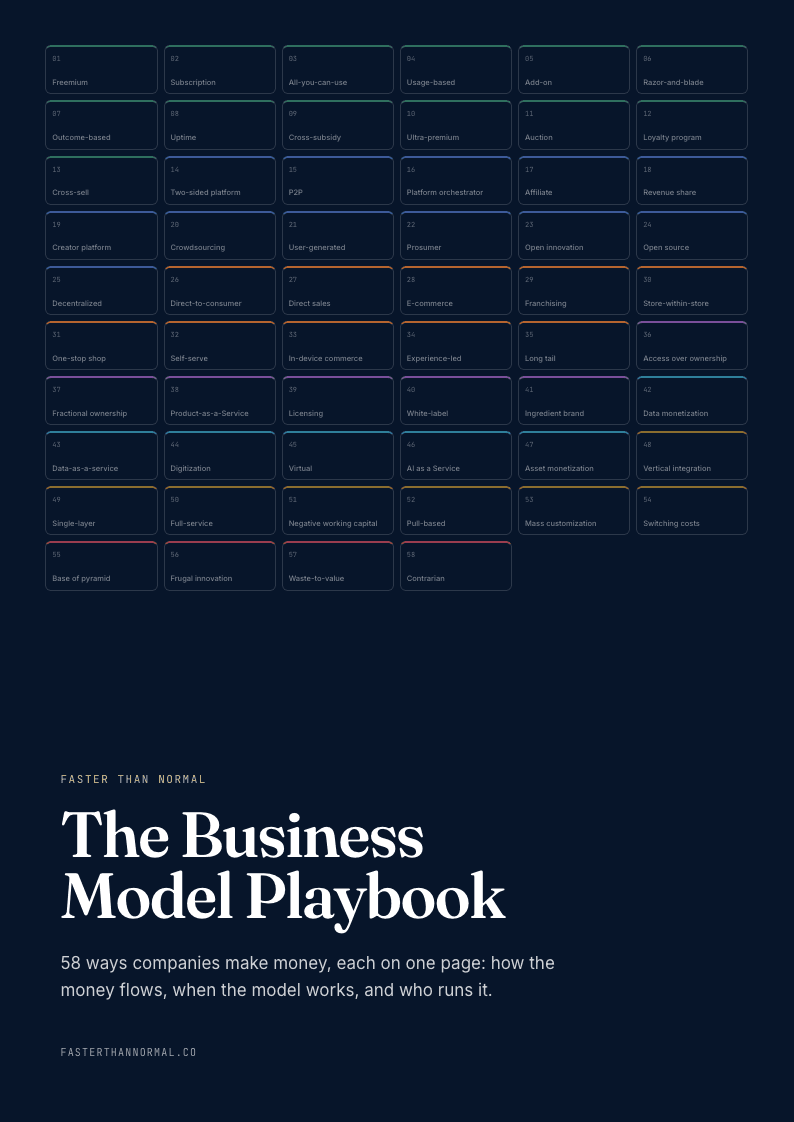
Get The Business Model Playbook
58 business models, one visual page each: how the money flows, the metrics that matter, and who runs it. Free when you join the Faster Than Normal email.
Free. No spam. Unsubscribe anytime.
Part IIIMaxims
-
Name the thing honestly. Westgate was named for its geography, not its aspirations — and the clarity scaled to a national brand. Aspiration confuses; description sells.
-
The perfect problem for computers is the one humans systematically get wrong. Don't apply technology where humans are competent. Apply it where they are reliably irrational.
-
Personal guarantees buy personal control. Signing for the debt is terrifying, but it is also the price of never answering to a board you didn't choose.
-
Grief can become infrastructure, but only if you publish the failure. The Siegels shared their daughter's diary and their own blindness. The exposure was the mechanism of prevention.
-
Disagree until you find the third idea. When two smart people can't agree, the answer is not compromise — it's an option neither has yet imagined.
-
Arrive before the vocabulary exists. If you have to invent the language to describe what you're building, you may be defining the category rather than entering it.
-
Philanthropy is supply-chain management for human capital. Each grant should create conditions that make other grants more productive.
-
Cross industries to see in three dimensions. Specialization reveals depth; breadth reveals the relationships between problems.
-
Build the thing that doesn't need you. The foundation, the framework, the platform, the partnership — the measure of what you've built is whether it works on the day you walk away.
-
The narrative will be imposed on you regardless. You cannot control the story. You can only choose your response: rebuild, withdraw, rewrite, or interrogate the nature of stories themselves.
In Their Own Words
The Web itself doesn't as much change the way we do things as it changes the ease with which we do things. And that changes the way we do everything.
I have enough money for the rest of my life and enough to leave a good inheritance for our kids.
The United States is like a big company, and we need a CEO to run it.
Business is at the heart of America and always has been.
I haven't bought a yacht or an island or even a palm tree.
I was making so much money I didn't care. I didn't know what to do with the money.
Lots of small business men have been contacting me to say they wish they had the nerve to say what I said.
I can't tell anyone to vote.
When you lead a purpose-driven life, you make a difference in the world.
Bravery is relative. What looks bold from the outside may simply feel obvious once you know your why.— Post about moving to Israel
Decisions rooted in clear core values are easy to make.— Post about moving to Israel
Family has always come first.— Post about moving to Israel
I always said that wherever the kids moved to, that's where we'd live.— Post about moving to Israel
The three fundamentals are number one, life. Your life has a purpose.
You build more bridges of harmony and crave more joy, happiness, peace and love in the world.
Unlock the power in the secrets of everyday words and terms.
We need to address the issue of loneliness.
You can use these insights to further your personal growth and connect with like-minded people everywhere.
Life doesn't have to be hard.
You make the world a better place when you are the best you.
Most of the people in early computing, the very first thing they started to imagine was some form of artificial intelligence.— David M. Siegel (Two Sigma), MIT School of Science
I was coming to work today and actually had an employee stop in the parking lot, get out of their car, and come over and say we're behind you and believe in what you're doing.— David A. Siegel (Westgate Resorts), CNBC, October 10, 2012
The auteur theory, the way it is spoken of in a very singular way — filmmaking as being derived from a very singular voice — is for the most part not true.— David Siegel (filmmaker), Film International interview
When you're able to work for a variety of different companies and industries, it allows you to take a very different approach to a problem and see things not just from a sales, marketing or product perspective, but see the relationship between different industries or challenges and come up with an authentic solution.— David Siegel (Meetup CEO), Changing Lives Podcast
A great idea without real demand is still a bad investment.— David Siegel (web designer/entrepreneur), My Worst Investment Ever Podcast


