

Janice Bryant Howroyd, Christopher Nolan's Hand Drawn Plot Map For His Film Inception and Internal Obstacles To Progress
When Janice Bryant Howroyd borrowed $900 from her mother in 1978, she wasn't thinking about becoming the first Black woman to build a billion-dollar company. She was thinking about survival — and refusing to let racism and sexism write the ending to her story. Today, ActOne Group operates in 35 countries and generates over $1.8 billion in annual revenue. The trajectory from small-town North Carolina to global workforce solutions empire offers lessons that transcend demographics.
The Architecture of Refusal
Howroyd's early framework was deceptively simple: "Racism and sexism depend on lies to be persistent." This wasn't philosophical posturing. It was operational clarity. When structural barriers are built on false premises, persistence becomes a competitive advantage.
Her initial resistance wasn't strategic — it was instinctive. "While I didn't know it then, it was to some degree just my sassy resistance to facing defeat that provided me the oomph to get started." That resistance became methodology. The woman who started with $900 borrowed from her mother built ActOne Group by treating every interaction as a learning opportunity.
"Everyone knows something of value to me that I don't already know," Howroyd explains. "With respect, I try to always show humanity, and embrace and invite them." This isn't corporate speak. It's intelligence gathering disguised as empathy.
The Double-Return Philosophy
Howroyd's success formula centers on simultaneous optimization: "Doing well and doing good at the same time, I believe it sincerely is a fail-proof formula for self-healing, self-generation, and selflessness." The language is elevated, but the mechanics are straightforward — every business decision must generate both financial returns and social value.
This approach solved two problems. First, it differentiated ActOne Group in a commoditized industry. Second, it created sustainable competitive moats through stakeholder loyalty. When your business model includes "giving forward," customer retention improves. So does employee engagement. The moral dimension becomes operational advantage.
McDonald's: The Real Estate Company That Sells Burgers
Most people misunderstand McDonald's business model. They see golden arches and think fast food. Ray Kroc saw something else entirely: "We are not technically in the food business. We are in the real estate business."
The McDonald brothers had the operational innovation — their 1948 "Speedee Service System" streamlined production around burgers, fries, and shakes. But Kroc had the scaling insight. When he joined as franchise agent in 1954, he wasn't just selling restaurant concepts. He was building a real estate empire.
The Franchising Balance
Kroc solved the central tension in franchising: How do you maintain control while incentivizing ownership behavior? His answer was architectural. Give franchisees enough autonomy to feel like business owners, but maintain absolute control over location, branding, and core operations.
"The organization cannot trust the individual; the individual must trust the organization," Kroc observed. This wasn't cynicism. It was systems thinking. Individual operators need freedom to adapt to local conditions. But brand consistency requires central authority over non-negotiable elements.
The result: McDonald's went from 700 restaurants in 1965 to over 39,000 locations today, serving 69 million customers daily. The franchise model didn't just scale operations — it scaled capital. Franchisees funded expansion while McDonald's maintained control through real estate ownership.
Location selection became competitive moat. McDonald's doesn't just occupy prime real estate — they control it. Franchisees lease from the corporation, creating steady income streams independent of operational performance. This dual revenue structure insulates McDonald's from restaurant-level volatility while ensuring geographic dominance.
Christopher Nolan's Inception Map: Visual Complexity Management
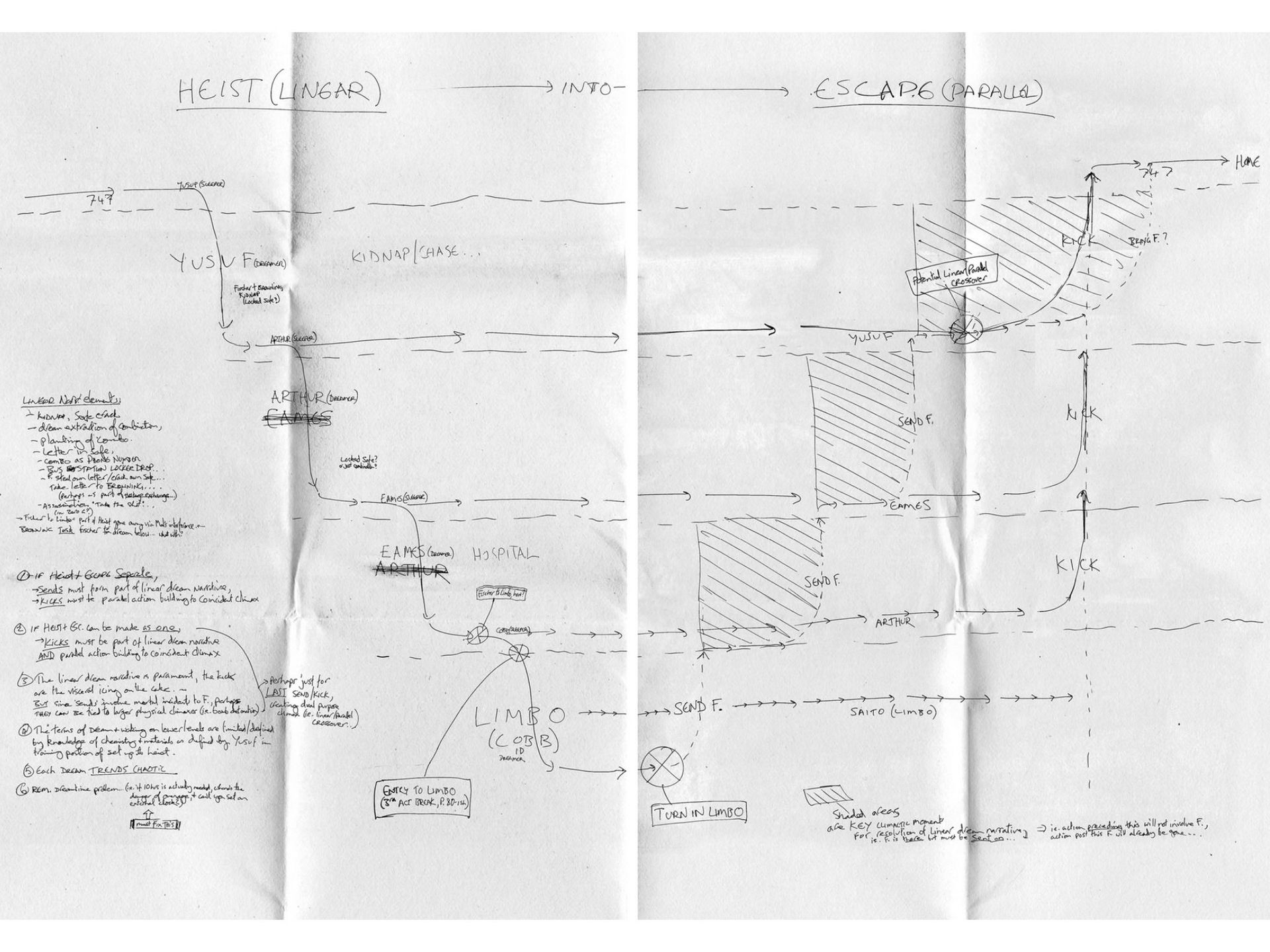
Nolan's hand-drawn plot map for Inception reveals something fundamental about managing narrative complexity. The film operates across four dream levels simultaneously, each with different time scales and physics. Tracking character motivations and plot mechanics across these dimensions required external scaffolding.
The map isn't beautiful. It's functional. Boxes and arrows and scribbled notes — the visual equivalent of working memory extended onto paper. This is how you manage cognitive load when the system exceeds mental capacity.
The principle scales beyond filmmaking. Any project with multiple interconnected variables benefits from visual mapping. Strategy documents. Product roadmaps. Organizational redesigns. When complexity exceeds what you can hold in your head, externalize the architecture.
The Knowledge of Enough
Kurt Vonnegut's story about Joseph Heller captures something essential about success metrics:
True story, Word of Honor: Joseph Heller, an important and funny writer now dead, and I were at a party given by a billionaire on Shelter Island. I said, "Joe, how does it make you feel to know that our host only yesterday may have made more money than your novel 'Catch-22' has earned in its entire history?" And Joe said, "I've got something he can never have." And I said, "What on earth could that be, Joe?" And Joe said, "The knowledge that I've got enough."
Heller understood something the billionaire didn't: wealth optimization has diminishing returns, but satisfaction optimization doesn't. The billionaire was trapped in relative wealth competition. Heller had solved the sufficiency equation.
This isn't anti-ambition. It's sustainable ambition. When you know what enough looks like, you can optimize for satisfaction rather than accumulation. The knowledge of enough becomes strategic advantage — it frees cognitive resources for higher-order problems.
Internal Obstacles to Progress
Most obstacles to progress aren't external. They're internal resistance patterns that masquerade as rational analysis. Steven Pressfield identifies this as "Resistance" — the internal force that prevents creative and professional advancement.
Resistance appears as perfectionism. As procrastination. As endless preparation without execution. As imposter syndrome. As analysis paralysis. The common thread: these patterns feel protective, but they're actually self-sabotage mechanisms.
The antidote isn't motivation. It's recognition. When you can identify resistance patterns, you can work around them. Ship before you're ready. Start before you feel qualified. Progress becomes a practice of consistent advancement despite internal friction.
Leadership Through Inspiration
Simon Sinek's research on leadership reveals that great leaders inspire action by starting with "why" rather than "what" or "how." People don't buy what you do — they buy why you do it. This applies to teams, customers, and stakeholders.
The pattern appears across industries. Apple doesn't sell computers — they sell thinking differently. Tesla doesn't sell cars — they sell sustainable transportation. The product is the proof of concept for the underlying mission.
When your "why" is clear, decision-making simplifies. Strategy becomes the expression of purpose rather than reactive problem-solving. Teams align around shared meaning rather than just shared objectives.
One Question
What are you excessively curious about — curious to a degree that would bore most other people?
This question identifies potential specialization areas. Excessive curiosity signals intrinsic motivation. When you're curious beyond social expectations, you're willing to invest time and attention that others won't. This creates expertise asymmetries.
Your excessive curiosities reveal your natural research directions. They point toward problems you'll solve not because you have to, but because you can't help yourself. That's where sustainable competitive advantage lives.

Free playbook
Get The Business Model Playbook
58 business models, one visual page each: how the money flows, the metrics that matter, and who runs it. Free when you join the Faster Than Normal email.
Free. No spam. Unsubscribe anytime.