
Economics & Markets
Section 1
The Core Idea
Zero is not just another price. When the price drops from a small positive amount to zero, demand jumps by more than the same-sized drop from a higher price. The zero-price effect: people treat "free" as a category of its own. They overconsume free goods, overweight free options in choices, and are more willing to try something when the price is zero. The effect is disproportionate to the tiny difference between "almost free" and "free."
Why? Several mechanisms. Mental accounting: zero is a natural reference point; there's no "cost" to log. Affect: free triggers a positive emotional response that positive prices don't. Risk: with zero, there's no loss if the product disappoints. Transaction cost: no payment step lowers friction. Together they make free a powerful lever for acquisition, trial, and switching. The strategic use: offer free to get attention, trial, or adoption; then monetise elsewhere (upsell, ads, data) or use free as a loss leader.
Dan Ariely and others demonstrated the effect in experiments. Dropping price from 1 cent to zero increased demand more than dropping from 2 cents to 1 cent. The discontinuity at zero holds across product categories and cultures. It's one reason freemium works: free tiers remove the price barrier and capture users who would never pay a small amount upfront. It's also why "free shipping" thresholds exist — moving the effective price of shipping to zero at a threshold drives more conversion than a proportional discount on the product.
The trap: free can attract the wrong users, cannibalise paid demand, or create expectations that make later monetisation harder. Use zero deliberately — for trial, for network effects, for lock-in — not by default. And when you're on the receiving end, ask whether you're overvaluing "free" relative to the actual benefit.
The effect is robust across contexts but not universal. When "free" is clearly lower quality (e.g. free tier with heavy limits), the jump in demand can be smaller. When the comparison is between two free options, the zero-price effect doesn't apply in the same way — the leverage is at the boundary between "some cost" and "no cost." The strategic use is to place that boundary where it drives the behaviour you want: trial, signup, or upgrade.
Free playbook
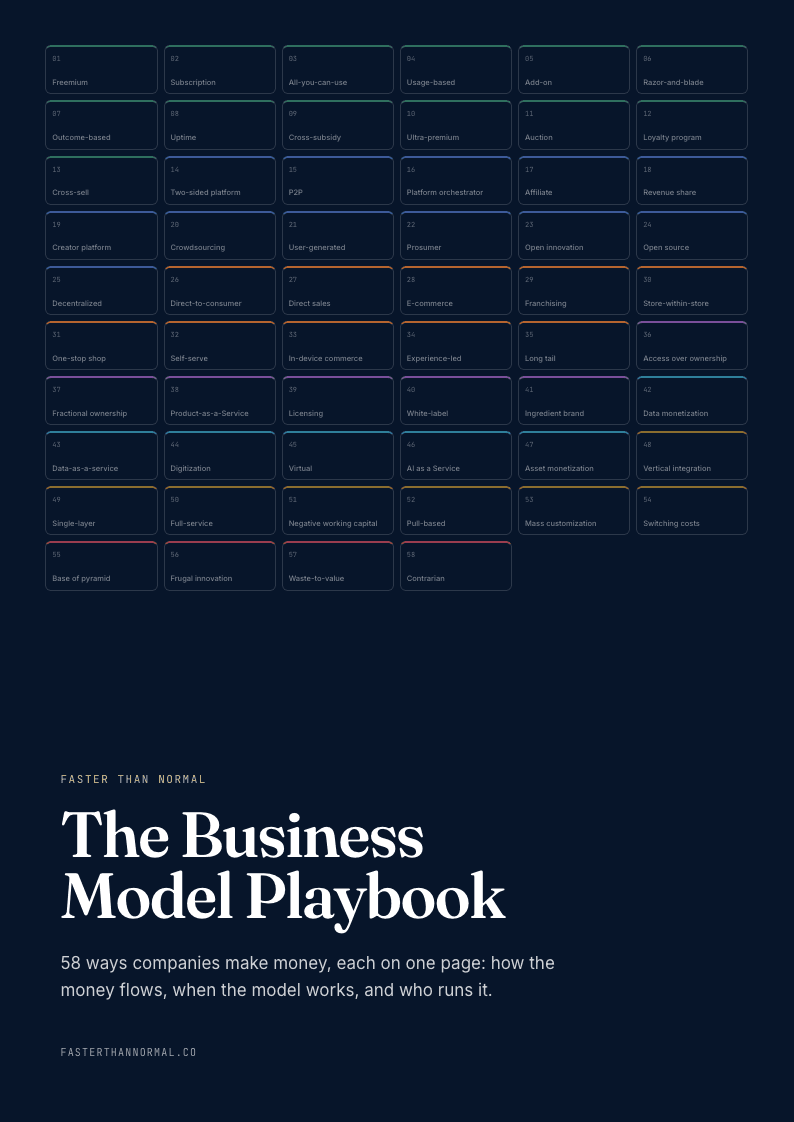
Get The Business Model Playbook
58 business models, one visual page each: how the money flows, the metrics that matter, and who runs it. Free when you join the Faster Than Normal email.
Free. No spam. Unsubscribe anytime.
Section 2
How to See It
The zero-price effect appears whenever a product or benefit is offered at zero and demand or choice shifts sharply compared to a small positive price. Look for free tiers, free trials, free shipping, and "free" as a marketing hook.
Business
You're seeing Zero Price Effect when a SaaS company offers a free tier and conversion from free to paid is low, but signups explode. The free tier removes the price barrier; many users would never have paid $5/month to try. The company captures attention and usage at zero, then monetises a subset. The jump in demand at zero is disproportionate to the foregone $5.
Technology
You're seeing Zero Price Effect when an app is free with in-app purchases vs paid upfront. Users who would balk at $2.99 download the free app and then spend $10 on IAP. Zero at the gate changes the mental frame: the user isn't "paying for an app," they're "trying something free" and occasionally spending. The same $10 feels different when the entry price is zero.
Investing
You're seeing Zero Price Effect when a broker offers zero-commission trading. Moving from $5 to $0 drove a wave of retail adoption; the marginal cost of $5 was small, but zero changed the category. Free trading became a customer-acquisition strategy; monetisation shifted to order flow and margin lending.
Markets
You're seeing Zero Price Effect when "free shipping" at a purchase threshold increases basket size more than a discount of equal cost. Shoppers work to cross the threshold to make shipping "free" — they treat zero as a goal. The same dollar discount applied to the product would often produce less lift.
Section 3
How to Use It
Decision filter
"When you want trial, signups, or switching, consider making the entry price zero rather than 'low.' When you're evaluating a free offer, ask: would I pay a small amount for this? If not, the zero may be distorting my choice."
As a founder
Use free to break the adoption barrier — free tier, free trial, free tool. The zero-price effect means you'll get more users at free than at any small positive price. Design the funnel so you monetise after adoption: upsell, premium, or indirect value (data, ecosystem). Avoid making everything free; reserve zero for acquisition and conversion, not for the whole product.
As an investor
Companies that leverage zero (freemium, free trial, free tier) can capture attention and users that would never convert at a low positive price. The question is whether they can monetise that user base. Zero is a tactic, not a business model. Evaluate unit economics and conversion from free to paid.
As a decision-maker
When you're the buyer, free can distort choice. You may take a free option that's worse than a cheap paid option because zero feels like "no cost." Run the comparison as if the free option had a small price — would you still choose it? When you're the seller, use zero where you want maximum trial and adoption; price where you want to capture value.
Common misapplication: Assuming free is always the right acquisition tool. Free attracts marginal users and can cannibalise paid. Use it where trial and scale matter; avoid it where you need quality or commitment.
Second misapplication: Ignoring the cost of free. Free has costs — support, infrastructure, opportunity cost. The zero-price effect describes demand; it doesn't make free costless. Model the full economics.
Section 4
The Mechanism
Section 5
Founders & Leaders in Action
Reed HastingsCo-founder & CEO, Netflix
Netflix used free trials (effectively zero for a period) to overcome the adoption barrier. The zero-price effect: users who wouldn't pay $10 to try a new service would try it for free. Once in, usage and habit made conversion to paid more likely. Free trial was the acquisition lever; subscription was the monetisation.
Jeff BezosFounder & CEO, Amazon, 1994–2021
Amazon's free shipping threshold (e.g. over $25 or $35) leverages the zero-price effect. Shoppers add items to reach the threshold so shipping becomes "free." The same dollar amount as a product discount would not produce as much lift. Zero is the psychological target; the threshold drives basket size and Prime adoption.
Section 6
Visual Explanation
Zero Price Effect — Demand jumps disproportionately when price goes from small positive to zero. Free is a category; people overconsume and overweight free options. Use zero for trial and acquisition; monetise elsewhere.
Section 7
Connected Models
The zero-price effect sits at the intersection of pricing, behavioural economics, and acquisition strategy. The models below either explain the psychology (anchoring, framing, mental accounting), implement it (freemium, free), or relate to loss/risk (loss aversion).
Reinforces
Anchoring
Zero is a powerful anchor. When the reference price is zero, any positive price is a "loss" or cost. Anchoring on free makes small positive prices feel larger than they are. The zero-price effect is partly anchoring: zero sets the reference.
Reinforces
Framing Effect
"Free" frames the offer differently than "$0.00" or "no charge." Framing affects choice. The zero-price effect is a framing effect at the price point: the free frame triggers different evaluation and behaviour than a very low price.
Tension
Loss Aversion
Loss aversion says losses loom larger than gains. At zero, there's no monetary loss from trying. Moving to a positive price introduces a potential loss. The tension: zero removes loss from the equation; that's why demand spikes. But once paying, loss aversion can make churn or downgrade feel painful.
Tension
Mental Accounting
Mental accounting: people bucket money and costs. Zero fits in a "no cost" bucket. The tension: from a strict economic view, a tiny price is almost the same as zero, but mental accounting treats them differently. The zero-price effect is mental accounting in action.
Leads-to
Freemium
Freemium is the business-model application of the zero-price effect. Free tier or free trial captures users at zero; premium or paid conversion monetises a subset. The model only works if the demand jump at zero is large enough and conversion covers the cost of free users.
Leads-to
Free
The "Free" mental model (TANSTAAFL, there ain't no such thing as a free lunch) cautions that free has hidden costs. The zero-price effect describes demand behaviour at zero. Together: use free to capture demand, but design for real economics — someone pays, or you monetise elsewhere.
Section 8
One Key Quote
— Chris Anderson, Free: The Future of a Radical Price (2009)"Free is a word with an extraordinary ability to reset consumer expectations, create new markets, and break old ones."
Anderson popularised the strategic use of free in digital business. The quote captures the behavioural reset: free doesn't just lower price, it changes the frame. Expectations, trial, and adoption all shift. Use that reset deliberately.
Section 9
Analyst's Take
Faster Than Normal — Editorial View
Zero is a category, not a number. The jump from "almost free" to "free" drives more behaviour change than equivalent price cuts elsewhere. Use zero where you want maximum trial and signups — free tier, free trial, free shipping threshold.
Freemium works because of the zero-price effect. Many users would never pay a small amount to try; at zero they try. The key is conversion and unit economics. Free is the top of the funnel, not the business model.
When you're the buyer, correct for the effect. Free can make you overvalue an option. Ask: would I pay $5 for this? If not, you may be overconsuming or over-choosing free. Don't let zero distort your allocation of time or attention.
Free has costs. Support, infrastructure, opportunity cost. The zero-price effect is about demand, not cost. Model the full picture before making everything free.
Zero is a tactic, not a strategy. Use it to get trial, attention, or adoption. Then monetise through conversion, premium, or indirect value. Companies that make "free" the whole strategy without a path to revenue often fail. The zero-price effect explains why free works for acquisition; it doesn't justify free forever without a business model.
Summary: Demand and choice jump disproportionately when price goes to zero. Use zero for acquisition and trial; monetise elsewhere. Correct for the effect when evaluating free offers so it doesn't distort your choices.
Section 10
Test Yourself
Is this mental model at work here?
Scenario 1
A SaaS company sees a big jump in signups when it moves from a $5/month trial to a free trial. Conversion to paid is similar.
Scenario 2
A user chooses a free app over a $2.99 app that has better reviews. She says she 'doesn't want to pay for apps.'
Scenario 3
A retailer offers free shipping on orders over $50. Basket size increases when customers add items to reach the threshold.
Scenario 4
Two products are both free. A user picks one because it has better features.
Section 11
Top Resources
01
Paper
Experimental demonstration of the demand discontinuity at zero.
02
Book
Strategic use of free in digital and physical products.
03
Book
Covers the zero-price effect and related behavioural pricing.
04
Paper
Foundational paper on mental accounting; zero fits the "no cost" bucket and shifts choice.
05
Book
Practical pricing and the role of free trials, freemium, and zero in acquisition and conversion.