

Larry Ellison, Peter Kaufman On "Simple" and Self-Doubt & Limiting Beliefs
In 1944, Lawrence Joseph Ellison was born to a nineteen-year-old unwed mother in the Bronx, given up for adoption nine months later to his great-aunt and uncle on the South Side of Chicago. By age twelve, he'd learned his adoptive father wasn't his biological father — a revelation that would define his relationship with authority, success, and the compulsive need to prove everyone wrong. The boy who couldn't finish college would build Oracle Corporation into a $350 billion database empire, amass a fortune exceeding $150 billion, and purchase 98% of the Hawaiian island of Lanai not because he needed more real estate, but because owning an entire island felt appropriately audacious.
What drives someone to that level of conquest? Ellison has been remarkably candid about the engine: "Great achievers are driven, not so much by the pursuit of success, but by the fear of failure." It's the confession of a man who spent decades trying to outrun the boy who was given away, the student who dropped out twice, the programmer who started three companies before Oracle because the previous attempts weren't quite right. Fear as fuel — not the paralytic kind, but the clarifying sort that strips away everything except the work that matters.
— Larry EllisonI have had all of the disadvantages required for success.
The line contains Ellison's entire philosophy compressed into a single paradox. Disadvantages as advantages. Obstacles as curriculum. Most people see abandonment, academic failure, and early career setbacks as evidence they should lower their expectations. Ellison saw them as proof that traditional paths weren't built for him anyway — so why not build his own? When you start with nothing to lose, the risk calculus changes. The worst-case scenario has already happened.
The Architecture of Relentless Vision
Oracle's dominance wasn't built on superior technology alone but on Ellison's willingness to bet everything on ideas everyone else called impossible. In the early 1980s, when IBM controlled enterprise computing with the iron fist of proprietary systems, Ellison read a research paper about relational databases — academic theory with no commercial application yet — and decided to build a company around making that theory work at scale. The rational move would have been incremental improvement to existing systems. Ellison's move was to declare war on IBM's entire approach to data management.
"When you innovate, you've got to be prepared for everyone telling you you're nuts," he said. Oracle's first customers were essentially paying to be beta testers for unproven technology, buying into Ellison's vision that data would become the most valuable asset in business — twenty years before that became conventional wisdom. The company nearly went bankrupt multiple times in the 1990s because Ellison kept pushing into territories where the technology didn't yet exist, forcing his engineers to build solutions that were theoretically possible but practically uncharted.
That pattern — theoretical possibility pursued with ruthless practical execution — became Oracle's signature. While competitors focused on perfecting existing database systems, Ellison was already building the infrastructure for problems companies didn't know they had yet. Internet-scale data management. Cloud computing architecture. Autonomous databases that could manage themselves. Each bet required Oracle to master technology that didn't fully exist when they started building it.
The audacity wasn't random. It was systematic — a man who had learned early that playing it safe guaranteed mediocrity, and mediocrity guaranteed invisibility. Better to fail spectacularly attempting something impossible than succeed marginally at something predictable.
Sony's Miniaturization Obsession
On May 7, 1946, in the bombed-out ruins of post-war Tokyo, two men started a company with twenty employees, 190,000 yen in capital, and a rice cooker that didn't work. Masaru Ibuka, the engineer, and Akio Morita, the physicist, had met during wartime military research projects and discovered a shared obsession: making technology smaller, simpler, and more personal. Their first commercially successful product was Japan's first tape recorder in 1950 — itself a miniaturization of bulky American recording equipment that filled entire rooms.
The pattern they established — take existing technology, shrink it, improve it, make it accessible — would define Sony for the next seventy-five years. The world's first transistor radio in 1955. The Trinitron color television in 1968. The Walkman in 1979, which Morita created not based on market research but because he wanted to listen to music while walking and couldn't find a device small enough to carry comfortably.
— Akio MoritaThe Walkman was not based on market research. It was the result of my desire to listen to music while walking.
The Walkman exemplified Sony's core insight: the most profound technological advances often look trivial to outsiders. Who needs to carry their music collection? But Morita understood something deeper about human behavior — that convenience and portability would ultimately matter more than fidelity or capacity. The Walkman wasn't just smaller; it was fundamentally different, creating a new relationship between people and their media.
That willingness to bet on seemingly frivolous improvements — making things smaller, more portable, more personal — required Sony to develop manufacturing capabilities no one else possessed. Miniaturization isn't just about engineering; it's about precision at scales where traditional manufacturing breaks down. Sony had to master semiconductor fabrication, battery technology, precision optics, and materials science simultaneously because shrinking complex devices meant solving problems across multiple disciplines.
By the time Sony launched the PlayStation in 1994, they had decades of experience making powerful technology fit in smaller packages. Ken Kutaragi, the PlayStation's architect, approached gaming consoles the same way Morita had approached tape recorders: how do you pack maximum performance into the smallest, most affordable form factor possible? The PlayStation succeeded not just because of superior graphics or game selection, but because Sony had spent fifty years learning how to make complex technology feel effortless.
Einstein's Hierarchy of Simple
Peter Kaufman, Chairman and CEO of Glenair, tells the story of Einstein's five levels of cognitive prowess as if it's a magic trick — because it is. The setup leads you to expect genius at the top, wisdom as the pinnacle, some variation on intellectual sophistication as the highest human achievement. Then comes the revelation that undoes everything: simple transcends genius.
The insight cuts against every instinct we have about complexity and intelligence. We associate sophistication with difficulty, expertise with jargon, mastery with ornate displays of knowledge. But Einstein — who spent his career translating the most complex phenomena in the universe into equations elegant enough to fit on a chalkboard — understood that true understanding means being able to explain anything to anyone. Complexity is often just confusion disguised as sophistication.
— Peter KaufmanSimple transcends genius.
Kaufman's point isn't that simple solutions are easy to find. They're the hardest to find. Simplicity requires stripping away everything non-essential until only the core mechanism remains — like Ellison reducing database management to a few fundamental principles that could scale from startup to enterprise, or Sony reducing the entire music experience to a device you could clip to your belt.
The companies that endure are the ones that master this reduction: Apple turning computing into intuitive gestures. Amazon reducing commerce to one-click ordering. Google reducing information access to a single search box. Each looks obvious in retrospect because true simplicity feels inevitable once you see it. But achieving that inevitability required genius-level understanding of all the complexity they chose to hide.
The thread connecting these stories isn't just success — it's the specific kind of clarity that emerges when someone stops trying to impress people and starts trying to solve problems. Ellison's fear of failure forcing him to focus only on what actually worked. Sony's miniaturization obsession teaching them to eliminate everything unnecessary. Einstein's recognition that the most profound truths were also the most accessible.
In a world that mistakes complexity for intelligence, motion for progress, and busyness for productivity, perhaps the highest-leverage skill is the ability to see past all the noise to the thing that actually matters. That's not simple thinking. That's thinking so clear it looks simple from the outside.
Free playbook
Get The Business Model Playbook
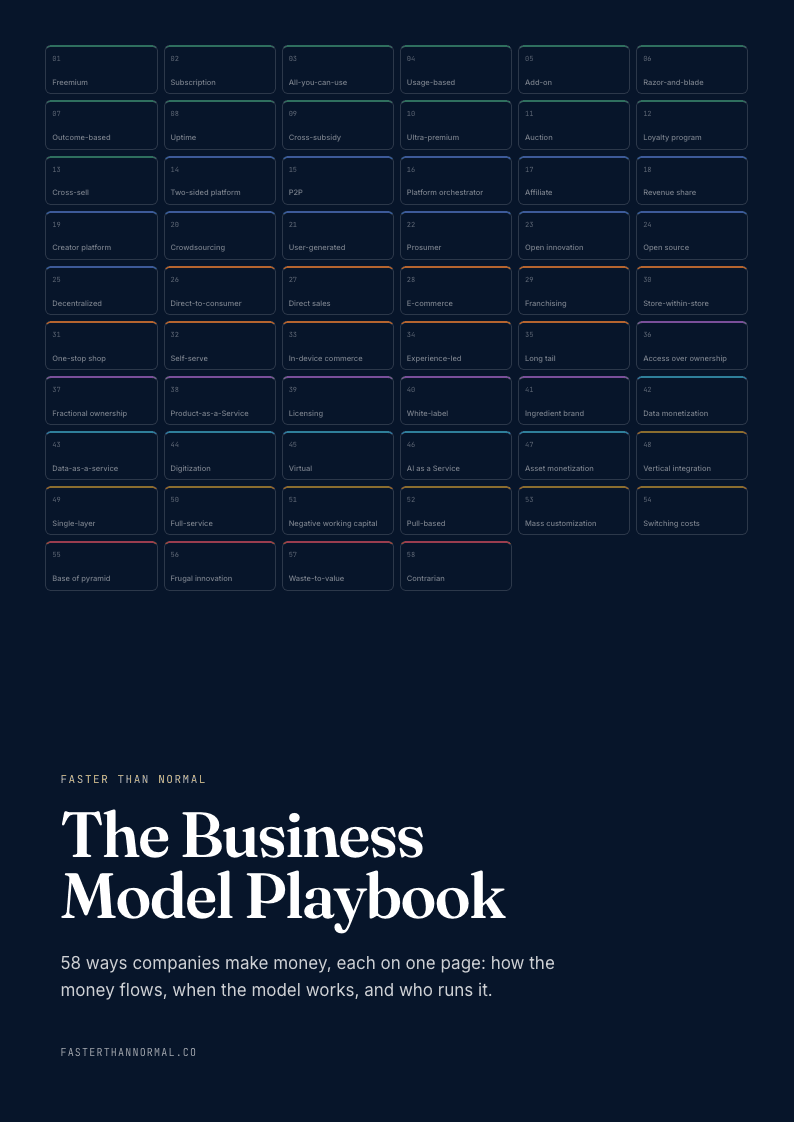
58 business models, one visual page each: how the money flows, the metrics that matter, and who runs it. Free when you join the Faster Than Normal email.
Free. No spam. Unsubscribe anytime.