

How to Minimize Regret Using Jeff Bezos’s Regret Minimization Framework
In 1994, Jeff Bezos held a coveted position at a Wall Street investment firm. Senior Vice President at 30. Six-figure salary. A trajectory that promised wealth and prestige. Yet when he stumbled upon data showing the internet's explosive 2,300% annual growth, everything changed. Not the numbers themselves — but what they represented. The largest commercial opportunity in human history, unfolding in real time.
Bezos faced the classic founder's dilemma: abandon security for uncertainty. His solution became one of the most powerful decision-making frameworks in business. He projected himself to age 80 and asked a simple question: "Will I regret not trying this?"
The answer was immediate. He left Wall Street, drove across the country, and started Amazon from a garage in Bellevue, Washington. The company he believed had only a 30% chance of success is now worth $2 trillion.
The Framework's Core Logic
Bezos's Regret Minimization Framework operates on a fundamental insight about human psychology: regret compounds over time, but immediate discomfort fades. The framework forces you to evaluate decisions through your future self's perspective, not your present fears.
The mechanism is deceptively simple. When facing a consequential choice, ask: "Which action would my 80-year-old self most regret not having taken?"
Your immediate response reveals your true preference. Hesitation itself is data — it suggests you're already leaning toward change but lack the analytical justification to act.
The framework's power lies in its time arbitrage. Short-term costs feel visceral and immediate. Long-term opportunity costs remain abstract until it's too late to act. By forcing yourself to inhabit your future perspective, you correct for present bias and loss aversion.
The Framework in Practice
Consider the graduate school decision. The immediate calculus appears straightforward: opportunity cost of earnings versus enhanced future prospects. But the framework cuts through this surface analysis.
Ask yourself: "Will I regret going to graduate school when I'm 80?" Then the inverse: "Will I regret not going?"
One question will generate a faster, more confident response. That's your answer.
The framework transfers across contexts because regret follows predictable patterns. We rarely regret attempting something that aligned with our values, even if we failed. We consistently regret opportunities we declined from fear or inertia.
Identifying Future Regret
The framework's weakness is regret's subjectivity. How do you predict what your future self will value?
Values alignment. Decisions that contradict your core principles generate lasting regret regardless of outcome. Success built on compromised values feels hollow at 80.
Pattern recognition. Examine similar past decisions. The choices you're proudest of reveal your regret-minimization priorities. If you've never regretted taking calculated risks, that's predictive data.
Consultation without delegation. Seek perspectives from those who've faced similar decisions, but don't outsource the choice. Their regrets aren't yours.
Multiple frameworks convergence. Apply expected utility theory or decision trees to the same problem. If multiple analytical approaches suggest the same action, confidence increases.
Intuitive validation. Your immediate gut response to "Will I regret this?" often proves more accurate than extended deliberation. Trust it.
Fear Setting as Implementation Tool
The framework identifies the optimal choice. Fear setting enables execution.
Fear setting, popularized by Tim Ferriss, systematically examines worst-case scenarios to reduce anxiety-driven paralysis. It's analytical risk assessment applied to personal decisions.
Define Phase
List 10-20 specific worst-case outcomes if you take the action. Not vague fears — concrete scenarios. "I might fail" becomes "I might exhaust my savings within 18 months and need to move back with family while rebuilding my career."
Specificity reduces fear's power. Abstract threats feel insurmountable. Defined problems have solutions.
Prevent Phase
For each scenario, identify preventive measures. How could you reduce the probability of this outcome? What preparation would minimize impact?
Returning to family becomes less threatening when you've maintained relationships and saved six months of expenses. Career rebuilding becomes manageable when you've preserved industry contacts and documented your achievements.
Repair Phase
Assume the worst happens. How would you recover? What concrete steps would restore your position?
The repair phase reveals a crucial insight: most career and personal setbacks are temporary if you maintain competence and relationships. Recovery paths exist for nearly every scenario that doesn't involve permanent physical harm.
Positive Visualization
After exhaustively examining downside risks, catalog the upside potential. What are the possible benefits of attempting this path?
Include financial, professional, personal, and spiritual dimensions. Often, the attempt itself — regardless of outcome — generates learning and network effects that prove valuable.
Cost of Inaction
Project your life trajectory if you maintain status quo. Where will you be in six months, one year, three years if you avoid this decision?
This step typically reveals the framework's central insight: inaction has costs too. They're just less visible because they accumulate gradually.
A Personal Application
The author faced this choice directly — leaving a prestigious investment banking position without a clear alternative path. The immediate costs were obvious: reduced income, career uncertainty, lifestyle adjustments.
But the regret minimization analysis was unambiguous. Staying would establish a precedent of choosing security over alignment. At 80, the money saved by staying wouldn't matter. The opportunities foregone would.
The decision became straightforward once framed correctly. Not "Should I leave a good job?" but "Will I regret not pursuing what I actually want?"
Terror remained. But terror isn't disqualifying information — it often indicates you're considering something significant enough to matter.
The Framework's Limitations
Regret minimization works best for high-stakes, irreversible decisions where delayed action eliminates options. It's less useful for routine choices or situations where you can easily course-correct.
The framework also assumes you can meaningfully predict your future values. If your priorities might fundamentally shift, the analysis becomes less reliable.
Finally, some decisions require considering impacts beyond your personal regret. Family obligations, team commitments, and community responsibilities create constraints the framework doesn't address.
Implementation Protocol
Choose a decision you've been avoiding or deliberating extensively. Apply the complete process:
First, rapid regret assessment: "Will I regret not taking this action when I'm 80?"
Second, systematic fear setting across all four phases.
Third, comparison analysis: cost of action versus cost of inaction over multiple time horizons.
The combination typically reveals a clear preference. If it doesn't, you may be dealing with a false binary — look for third options or sequence the decisions differently.
The Compounding Nature of Aligned Decisions
Bezos's framework worked not because Amazon succeeded, but because it aligned with his values and intellectual curiosity. Even if Amazon had failed, he would have learned about internet commerce, built relevant networks, and maintained self-respect for attempting something meaningful.
That's the framework's deepest insight: aligned decisions compound positively regardless of immediate outcomes. Misaligned decisions compound negatively even when they appear successful.
Your 80-year-old self cares less about individual wins and losses than about whether you consistently chose growth over comfort, authenticity over approval, and meaningful work over mere security.
The question isn't whether you'll succeed. It's whether you'll try.
Free playbook
Get The Business Model Playbook
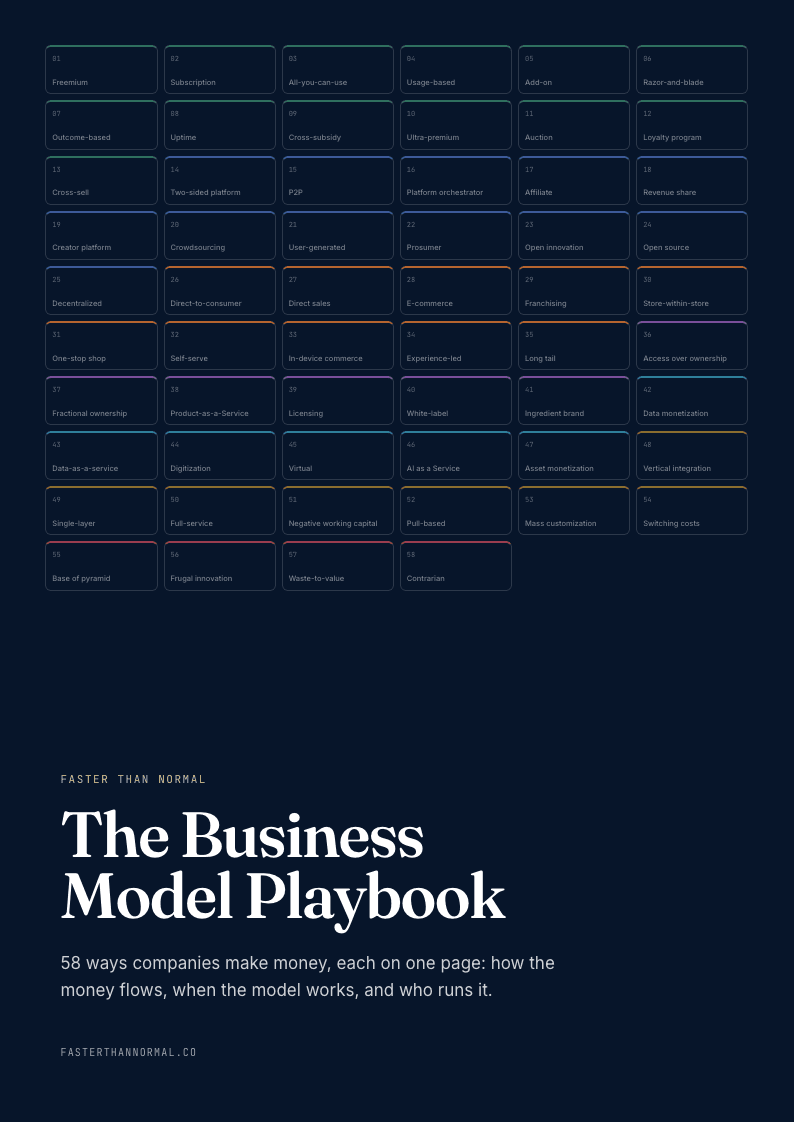
58 business models, one visual page each: how the money flows, the metrics that matter, and who runs it. Free when you join the Faster Than Normal email.
Free. No spam. Unsubscribe anytime.