

20 Maxims For A Fulfilling Life from Dee Hock
Dee Hock built a $360 billion empire from the chaos of competing banks and credit cards. More than Visa's founder, he was a philosopher who saw organizational patterns where others saw only problems. The man who created the world's first truly decentralized global network left behind wisdom that cuts deeper than business strategy—maxims for living that emerged from decades of wrestling with power, money, and human nature at the highest levels.
These twenty principles offer something rarer than tactical advice: a coherent worldview forged in the crucible of building something unprecedented. They reveal how a mind capable of reimagining global commerce approached the fundamental questions of how to live well.
On Dreams and Truth
No dream is so great as the person you might become by remaining true to it.
The transformation matters more than the achievement. Hock understood that pursuing an impossible vision changes you in ways that achieving a modest goal never could. The $360 billion network he built was secondary to who he became while building it.
It is a wise man who knows whether he is in complete error or deluded by partial truth.
The most dangerous position isn't being completely wrong—it's being partially right. Complete error is obvious. Partial truth feels like vindication while leading you astray. Hock built Visa by questioning his own certainties, especially when they felt most solid.
On Influence and Action
There is nothing that can't be imposed on an indifferent many by a dedicated few.
The mathematics of change are brutal in their simplicity. Passion always defeats apathy, regardless of numbers. Hock's insight: most people don't care deeply about most things most of the time. That indifference creates the opening for those who do care to reshape everything.
That which is growing looks only ahead; that which is declining looks only behind.
Growth requires amnesia about past methods. Decline is nostalgia mistaken for strategy. Visa succeeded because Hock refused to perfect the existing system—he abandoned it entirely for something that didn't yet exist.
On Help and Advice
Advice is as abundant as help is rare.
People who ask for advice more often need help but rarely get it. People who ask for help rarely need advice but often get it.
It is a kindness to the world to be liberal with help and chary with advice.
The advice-help distinction reveals why most leadership fails. Advice costs nothing and changes nothing. Help requires sacrifice and produces results. Yet leaders default to the cheaper option while congratulating themselves on their generosity.
On Judgment and Perspective
We judge others harshly by the standards we profess rather than those we practice. Yet we resent it bitterly when they return the favor.
Hypocrisy isn't a bug in human judgment—it's a feature. We need ideals we can't meet and the ability to overlook our failures while noticing others'. Hock's genius was seeing this pattern clearly enough to design organizations that worked with human nature rather than against it.
Wisdom finds humor in everything; old, barren reason alone is deadly serious.
Seriousness is often the enemy of serious work. Humor signals perspective—the ability to see your current crisis as one moment in a larger pattern. Hock could laugh at himself while building something unprecedented because he understood the absurdity of any single human attempting such a thing.
On Money and Ethics
Who takes a step bereft of love walks to death in shrouds of calculation to lie forever embalmed by money in a mausoleum of things.
Ethics pale when money growls.
Hock spent his career surrounded by the highest concentrations of wealth and power on the planet. His warning isn't moral posturing—it's field observation. He watched brilliant people become hollowed out by optimization, reduced to algorithms pursuing metrics that meant nothing.
Those who despise people are the most desperate to be favorably recognized by them.
The psychology of wealth concentration in a single sentence. Contempt and neediness aren't opposites—they're the same impulse expressed differently. Hock designed Visa to work with human nature rather than demanding people transcend it.
On Growth and Decline
When life is frightening or distasteful, scholarship is always a suitable sanctuary.
Academic retreat as psychological defense mechanism. When reality becomes uncomfortable, we flee to theory. Hock valued learning but understood when it became avoidance. Building Visa required staying engaged with uncomfortable realities rather than studying them from a distance.
If you never test your courage and strength, how can you measure the validity of your fears?
Fear without data is just imagination. Most of what we avoid isn't dangerous—it's uncertain. The only way to distinguish real threats from phantom ones is to engage directly with what scares us.
On Work and Purpose
This day brought health, moderation, someone to love, work to be done, and a clear sky under which to do it. What more could anyone want?
Gratitude from someone who had everything by conventional measures. Health, love, meaningful work, and clear conditions for doing it. Hock's definition of abundance contained nothing that money could buy directly.
On Character and Communication
Condemnation debases the condemner far more than the condemned.
Humility and generosity have no enemies.
Character reveals itself not in what you build but in how you treat those who can't help you build it. Hock understood that arrogance and stinginess create resistance that ultimately undermines even brilliant strategies.
One should not read like a dog obeying its master, but like an eagle hunting its prey.
You can give no greater gift than to speak and write that which is useful to your own heart.
Learning as predation, not submission. Seek what you need, ignore what you don't. Write what matters to you—utility to yourself guarantees authenticity, and authenticity is the only scarce resource in an information-saturated world.
On Time and Expectation
The pleasures of youth are the pains of old age, just as the pleasures of old age are the pains of youth.
Temporal arbitrage in human experience. What feels essential at twenty feels embarrassing at sixty. What seems boring at twenty feels precious at sixty. Understanding this pattern allows you to make better decisions about what to pursue when.
Like fishermen, we constantly cast the lure of expectation ahead of us, hoping to hook a desired piece of the future. Something unimaginable always takes the bait.
The ultimate planning insight from someone who built the world's largest payments network. You can't predict what you'll catch, but you can position yourself in waters where good things swim. Preparation plus serendipity, not prediction plus execution.
The Synthesis
Happiness may be difficult, but it is not complicated. Dismiss desire, discard opinion, honor the past, trust the future, and treasure the moment.
Hock's final maxim contains his entire philosophy. Difficulty versus complication—the difference between something hard to do and something hard to understand. Happiness requires emotional discipline but no complex theory.
The five practices form a complete system: releasing attachment to outcomes, ignoring others' judgments, learning from history without being trapped by it, maintaining optimism about what's coming, and finding contentment in current reality.
These aren't platitudes from a business guru—they're operational principles from someone who functioned at the highest levels of global commerce while remaining, by all accounts, remarkably centered. The man who turned banking chaos into elegant order understood that personal chaos required the same approach: clear principles, consistently applied, regardless of external circumstances.
For deeper exploration of Hock's thinking on organizational design and leadership, visit deewhock.com.
Free playbook
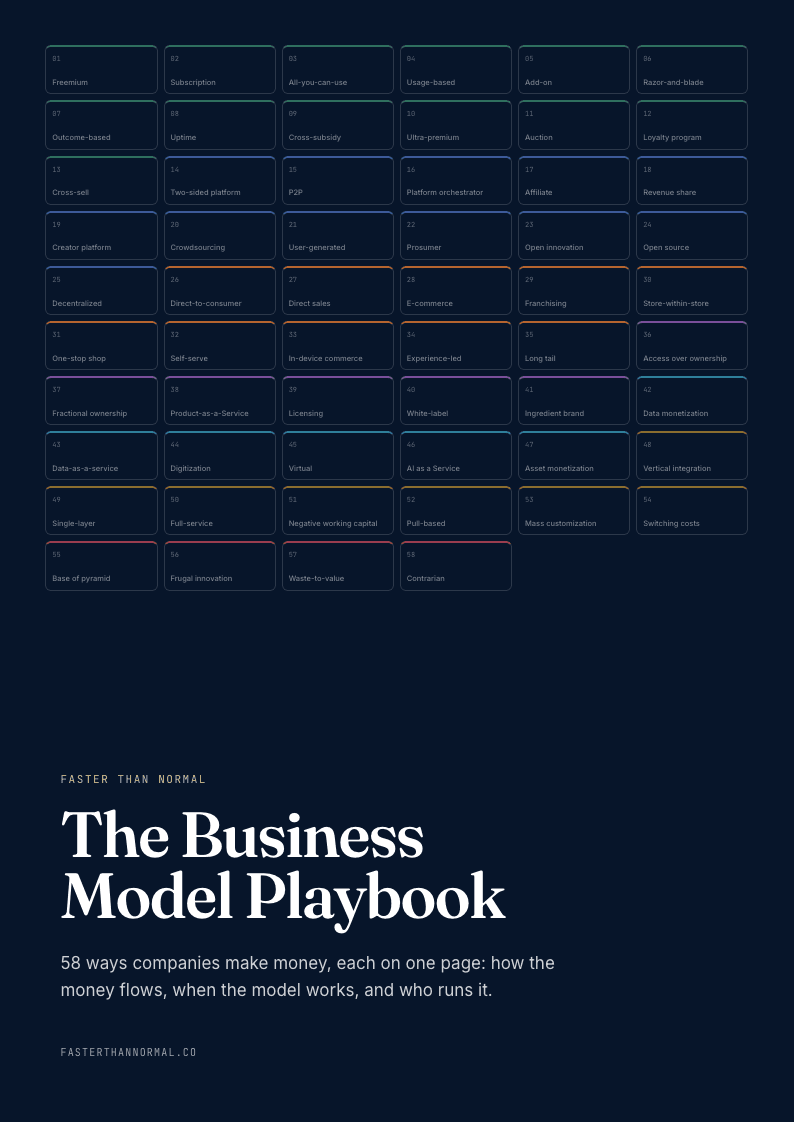
Get The Business Model Playbook
58 business models, one visual page each: how the money flows, the metrics that matter, and who runs it. Free when you join the Faster Than Normal email.
Free. No spam. Unsubscribe anytime.