

15 Timeless Lessons On Investing And Building Wealth
The conventional wisdom on wealth building reads like a pamphlet from 1987. Save more. Spend less. Buy index funds. Wait forty years. Nick Maggiulli's "Just Keep Buying" cuts through this tired orthodoxy with fifteen insights that actually matter for operators building real wealth in the 2020s.
The Income-First Imperative
Forget the latte factor. The most consistent path to wealth isn't optimizing your Starbucks budget—it's growing your income and deploying that income into assets that produce more income. This seems obvious until you realize how much energy gets wasted on expense optimization theater.
Everyone should audit their spending periodically to eliminate waste. But the obsession with cutting discretionary expenses misses the larger point: your earning potential has no ceiling, while your expense cutting hits a floor quickly. A software engineer who doubles their compensation from $150K to $300K creates more wealth in one career move than a decade of coupon clipping.
The corollary: focus your time where the leverage is highest. If your expected savings exceed your expected investment income, optimize for earnings growth. If they're roughly equal, split your attention. If your portfolio generates more than your salary, you've crossed into a different game entirely.
The Strategic Deployment of Debt
Debt isn't inherently good or bad—it's a tool that amplifies outcomes. Those who benefit most from leverage are those who can choose when to use it. If you can deploy debt strategically to reduce risk or increase returns, you may gain an edge. If debt is forced upon you by circumstances, it becomes a constraint.
The distinction matters more than the absolute numbers. A founder who takes a mortgage at 3% while keeping liquidity for their next venture thinks differently about debt than someone stretching to afford payments on depreciating assets.
Home Ownership as Strategic Decision
The right time to buy a home isn't when rates are low or when your landlord raises rent. Buy when three conditions align: you plan to stay in that location for at least ten years, your personal and professional life has stabilized, and you can genuinely afford it.
This framework eliminates most of the noise around timing markets or optimizing mortgage structures. Geographic stability, life stability, financial capacity. Everything else is secondary.
The Mathematics of Financial Independence
Save 25 times your expected annual spending. When you reach this threshold, you can retire. Alternatively, find the point where your monthly investment income exceeds your monthly expenses.
These aren't lifestyle prescriptions—they're mathematical realities. The 4% withdrawal rate underlying the 25x multiple has held across different market regimes, though it assumes a traditional retirement timeline. For those building businesses or pursuing non-linear income paths, the framework still applies but the inputs change.
Against Market Timing
Since markets rise most of the time, every day you wait to invest typically means paying higher prices later. The best market timing strategy is no timing strategy—deploy capital as soon as you have it.
This principle extends beyond individual stock purchases to broader capital allocation decisions. When choosing between investing a lump sum immediately versus dollar-cost averaging over time, immediate deployment wins across asset classes, time periods, and valuation regimes. While you wait for your preferred entry point, you forfeit compound growth as markets climb without you.
The psychological comfort of dollar-cost averaging comes at a measurable opportunity cost. Markets don't wait for your readiness.
The Selling Problem
Only three reasons justify selling an investment: rebalancing your portfolio, exiting a concentrated position, or meeting financial needs. Everything else is speculation disguised as strategy.
Selling creates tax consequences and interrupts compounding. Since markets trend upward over time, the optimal approach is to buy quickly but sell slowly. When you do sell, never liquidate everything at once—the combination of tax implications and potential regret if prices surge makes staged exits superior.
Find a selling methodology and execute it consistently. Whether that means 10% chunks quarterly, selling half while letting the remainder ride, or some other systematic approach, the specific method matters less than having one and sticking to it.
The Regret Minimization Framework
Whatever wealth you accumulate, someone else will have more. If you optimize purely for financial outcomes, you optimize for a game you cannot win—there's always another bracket above yours.
This isn't therapeutic advice disguised as investment wisdom. It's a practical recognition that wealth is a tool, not a destination. The founders who understand this tend to make better long-term decisions because they're not chasing relative status markers that shift constantly.
These fifteen lessons, distilled from Maggiulli's "Just Keep Buying," offer a different approach to wealth building than the standard personal finance playbook. They assume you're building something, not just optimizing consumption. They prioritize growth over safety, strategic thinking over rule-following, and mathematical reality over psychological comfort.
The principles work whether you're deploying your first $10,000 or your first $10 million. The amounts change. The logic doesn't.
Free playbook
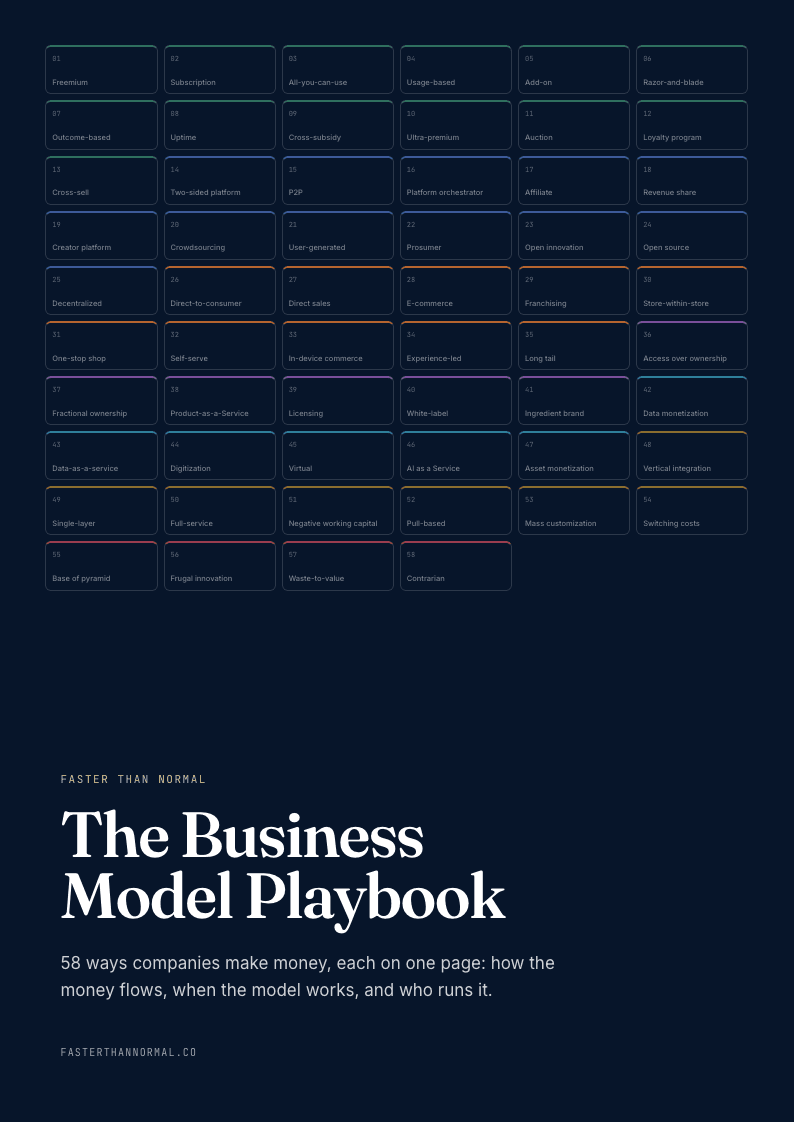
Get The Business Model Playbook
58 business models, one visual page each: how the money flows, the metrics that matter, and who runs it. Free when you join the Faster Than Normal email.
Free. No spam. Unsubscribe anytime.