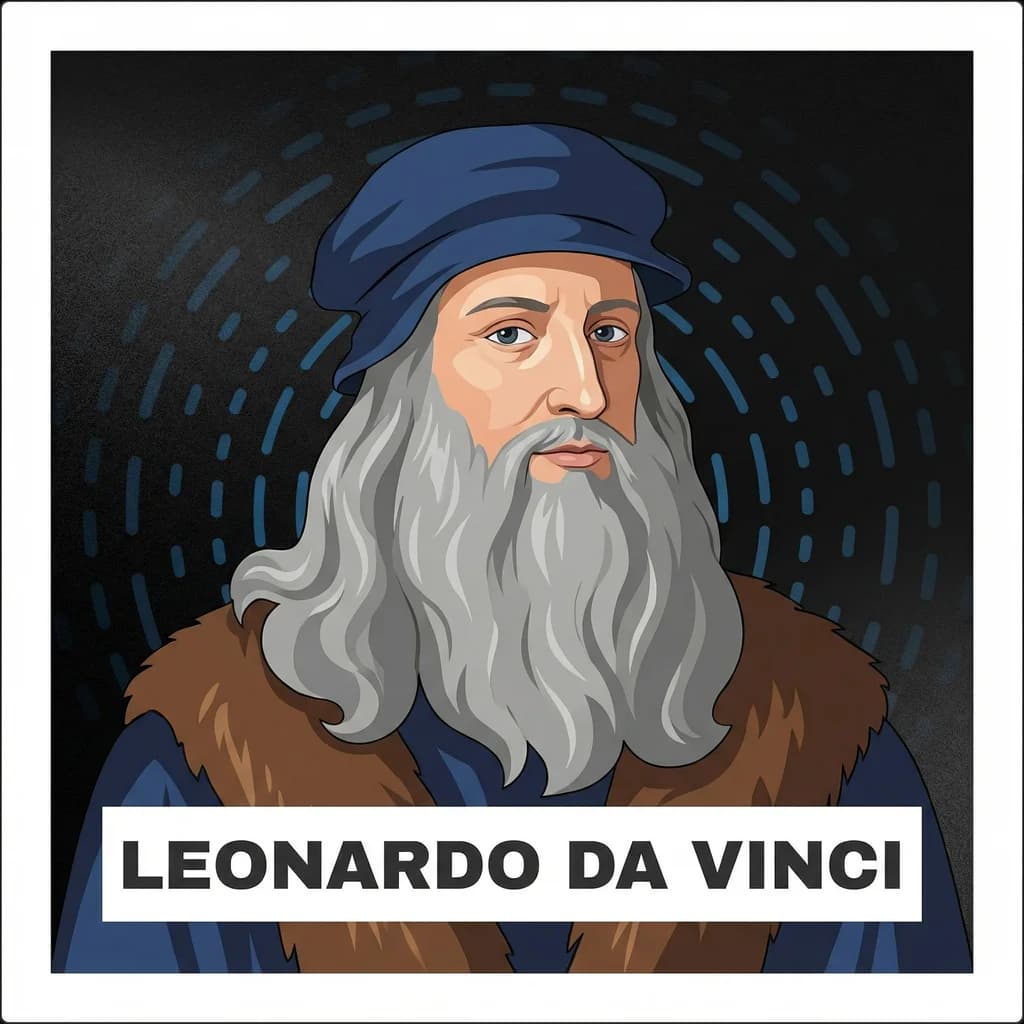
The Job Application
Sometime around 1482—the exact date remains a matter of scholarly dispute that has consumed archivists from Milan to Berlin—a thirty-year-old Florentine painter who had yet to complete a single major commission sat down and dictated an eleven-paragraph letter to the most dangerous man in northern Italy. The letter was not written in Leonardo's own hand; his mirror script, running right to left in a habit that baffled contemporaries and has tormented paleographers ever since, would have been illegible to a duke. Instead, a professional copyist transcribed the pitch onto a sheet now preserved as folio 1082 recto of the Codex Atlanticus in Milan's Biblioteca Ambrosiana. The first ten paragraphs said nothing about painting. "I have a sort of extremely light and strong bridges, adapted to be most easily carried," the letter began, then escalated through portable cannons, fortress-destroying mines, covered vehicles "safe and unassailable," and catapults of "wonderful efficiency not in general use." Only in the eleventh paragraph, almost as an afterthought, did the applicant mention that he could "execute sculpture in marble, bronze, and clay. Likewise in painting, I can do everything possible as well as any other, whosoever he may be."
The recipient was Ludovico Sforza, who effectively ruled Milan despite lacking legitimate title—he would not formally become Duke until 1494, after poisoning his nephew—and who needed engineers more than artists, his city perpetually under threat from rival powers. The applicant was Leonardo di ser Piero da Vinci, illegitimate son of a Florentine notary, a man who at thirty had abandoned two important commissions, been twice anonymously accused of sodomy, and been conspicuously omitted from Lorenzo de' Medici's list of Florence's finest painters sent to the Pope. He owned almost nothing. He had finished almost nothing. He was, by the conventional metrics of his profession, a failure.
That letter—part résumé, part fantasy, part act of self-invention so audacious it borders on fiction—is the skeleton key to Leonardo da Vinci. Not because it reveals his military engineering skills, which were largely theoretical and whose devices, when modern engineers built them for television in 2002, did not work. But because it reveals the central operating principle of a mind that refused every boundary the Renaissance tried to impose: the conviction that knowing how to see—saper vedere, as he would later write—was a single discipline that subsumed painting, engineering, anatomy, hydraulics, optics, and the mechanics of human flight. The letter is a lie about capabilities and a truth about ambition. It is the founding document of an empire of curiosity.
Five centuries later, more than seven thousand pages of his notebooks survive, dispersed across Windsor Castle, the Institut de France, the British Library, the Biblioteca Ambrosiana, and
Bill Gates's private collection. Fewer than twenty paintings are securely attributed to his hand. Two of them—
The Last Supper and the
Mona Lisa—are among the most recognized images in human civilization. The notebooks contain everything else: anatomical dissections centuries ahead of their time, studies of bird flight that anticipated aerodynamics, urban planning blueprints that foresaw modern sanitation, water vortex analyses that would not be surpassed until the twentieth century, grocery lists, recipes for hair dye, and a single haunting childhood memory involving a bird's tail. He intended to publish. He never got around to it. There was always something more to learn.
By the Numbers
The Leonardo Archive
7,200+Surviving notebook pages, dispersed across Europe
~20Paintings securely attributed to his hand
30Corpses he dissected by his own count
17Years spent in Milan during his first residency
$450.3MAuction price for Salvator Mundi (2017), highest for any artwork
16Occupations attributed to him by modern scholars
67Age at death, May 2, 1519, in Cloux, France
The Bastard's Advantage
He was born on April 15, 1452, near the tiny Tuscan hill town of Vinci, to parents who were not married and never would be. His father, Ser Piero da Vinci, was a Florentine notary—the third in a dynastic line of notaries—ambitious, well-connected, and apparently untroubled by the arrangement. His mother was, for centuries, a mystery. We knew her first name, Caterina, and nothing else. Speculation ran wild: she was a slave, possibly North African, possibly Asian, which would make Leonardo mixed-race and add another credential to his already overstuffed twenty-first-century résumé. Then, in 2017, the documentary scholar Martin Kemp—an Oxford emeritus professor who had spent decades separating Leonardo fact from Leonardo fantasy, and who possessed the rare scholarly temperament of preferring a proven fact to an attractive theory—published findings with Giuseppe Pallanti establishing Caterina as a sixteen-year-old orphan from a neighboring hamlet, quickly married off to a local farmer to avoid awkward situations.
Leonardo was baptized at the church of Santa Croce in Vinci in a well-attended ceremony. Illegitimacy carried legal limitations but no particular stigma; the historian Jacob Burckhardt called this era "a golden age for bastards." The boy grew up mostly with his father's family, while Caterina—who soon had other children—lived a short distance away. His uncle, a man with a particular appreciation for the natural world, helped raise him. He received the rudimentary education available to a country boy: reading, writing, arithmetic. No Latin, the key language of learned authority. No university. No classical schooling stuffing his head with medieval scholasticism.
This was the accident that made everything possible. Had Leonardo been legitimate, he would have been funneled into the notary business like his father, grandfather, and great-grandfather before him. Had he been schooled in the traditional curriculum, he might have become another puffed-up scholar relying on received ideas—exactly the type he would later deride. Instead, he was free. He called himself omo sanza lettere—"a man without letters"—and wore it not as stigma but as badge. "He who can go to the fountain does not go to the water-jar," he wrote. Experience was his master. The world was his text.
Left-handed, he had trouble writing except in reverse, from right to left, each letter backward on the page—perhaps a trick to keep from smearing his ink, perhaps for keeping secrets, but a habit no one seems to have bothered correcting. Vasari, his first major biographer, would observe that "he wrote backwards, in rude characters, and with the left hand, so that any one who is not practised in reading them, cannot understand them." The mirror script has generated endless mystification, but the explanation is probably mundane: he was a lefty accommodating his own physiology. All he could certainly do, from the earliest age, was draw.
The Workshop of Everything
He moved to Florence at about the age of twelve, shortly after his father's first wife and their only child died. The exact year is uncertain—so much about Leonardo is uncertain, a biographical fog he seemed to cultivate or at least never dispel—but by the mid-1460s he was living with Ser Piero in a city that must have detonated something inside him. Florence was enormously wealthy, its streets a living gallery of works by Donatello, Ghiberti, and Brunelleschi, the revolutionary generation just passed. There were more wood-carvers in town than butchers. Room after room in the newly built palazzi of the rising merchant class waited to be filled with art. And at the center of this ecosystem stood the workshop of Andrea del Verrocchio.
Verrocchio—whose name meant "true eye," a coincidence Leonardo would have appreciated—ran not a painting studio but a creative factory. His bottega produced paintings, sculptures, metalwork, pageant designs, and engineering projects. It was here that the young apprentices learned to solder the copper ball that crowned Brunelleschi's dome on the Florence cathedral, using mirrors to concentrate sunlight. It was here that Leonardo posed, possibly, for Verrocchio's bronze David—"a slightly effeminate and strikingly pretty boy of about fourteen," in Walter Isaacson's description—whose face bears the hint of a smile that would become Leonardo's lifelong obsession. And it was here, working alongside the sculptor Antonio Pollaiuolo in the adjacent workshop, that Leonardo began the anatomical studies that would eventually consume him.
He stayed with Verrocchio for roughly a decade, far longer than the usual apprenticeship. The prolonged residency puzzles biographers who expect conventional ambition—the young genius striking out on his own—but makes perfect sense for someone whose curiosity was already roaming beyond any single discipline. In Verrocchio's shop, there were no silos. You painted one day, cast bronze the next, designed a parade float the day after that. The cross-pollination was the education.
His earliest surviving masterwork confirms it. In Verrocchio's painting The Baptism of Christ, the master's hardy, pug-nosed angel stares in wonder at the rapt creature beside him—one of the earliest works of Leonardo, its noble profile trailing a cascade of golden curls. The divide between the two figures is technical as well as imaginative: Leonardo used oil paint, not old-fashioned egg-based tempera, and applied it in multiple thin layers, each a luminescent veil, so that his angel appears to be modelled in light. Vasari claimed that Verrocchio gave up painting when he saw what his pupil had done. An exaggeration, certainly. But the unprecedented nature of the talent was real.
In 1472, Leonardo was accepted into the painters' guild of Florence. He was twenty. And in 1476, he was arrested.
The Accusation and the Caged Birds
The crime that Renaissance Florence was really trying to control was sodomy—so notoriously prevalent that contemporary German slang for a homosexual was Florenzer. Designated boxes placed throughout the city allowed citizens to make anonymous denunciations. In April 1476, Leonardo was named as one of four men who had practiced "such wickedness" with the seventeen-year-old apprentice of a local goldsmith. He was arrested. The possible punishments included a large fine, public humiliation, exile, burning at the stake.
The case was dismissed two months later for lack of corroborating witnesses. A second accusation followed shortly after. Then silence. We do not know what happened inside Leonardo during those weeks—he left no diary, no confession, no record of inner turmoil. But it is impossible not to notice that in the years immediately following, he made drawings of two fantastical inventions: a machine meant "to open a prison from the inside" and another for tearing bars off windows. And it is tempting to connect the experience, however obliquely, with the habit his contemporaries later cited as a mark of his character: buying caged birds from the market just to set them free.
Intellectual passion drives out sensuality.
The charges may have caused a break with his father, who by now had remarried and would go on to produce several legitimate sons—an estimated twenty-two half-siblings in all. They may also have contributed to the evident disfavor of Lorenzo de' Medici, Florence's most important patron, who in 1481 provided the Pope with a list of the city's best painters for the newly built Sistine Chapel. Botticelli, Perugino, Ghirlandaio made the cut. Leonardo did not. He had never painted in fresco, the durable technique favored for wall paintings. He was already known for leaving things unfinished. And by 1483, he had abandoned two important commissions—including the Adoration of the Magi, one of his first substantial commissions—and departed for Milan.
He was thirty years old and had accomplished little. He carried with him only drawings, notebooks, and an unshakeable conviction that he could do everything.
The Dandy Engineer
Milan was a new life, and Leonardo dressed for it. He became something of a dandy, wearing pinks and purples, satins and velvets, his hands scented with lavender. He walked the streets with an entourage of well-dressed assistants, staging debates in town squares, riding off to Pavia with mathematician friends to investigate how the proportions of the human body might relate to the proportions of a church. The hedonistic court life of Ludovico Sforza suited him. Even the damp Lombard weather—its blue-gray mists so different from Tuscan sunlight—suited him. It became the weather of his paintings.
His job application had promised military engineering. What he actually did, for years, was fix plumbing problems and design elaborate pageants—theatrical spectacles that were a hallmark of Ludovico's regime, a form of family propaganda rendered in silk and fire. This sort of work was ephemeral, leaving almost nothing behind, and art historians have often fretted that he was wasting his time. But Leonardo understood something they did not: pageantry was where fantasy and engineering met. The mechanical angels descending from rafters on spiral screws—those ingegni, ingenious devices—blurred the line between imagination and reality. The aerial screw that everyone later called his "helicopter" was, originally, a stage mechanism. He loved the spiral form of the curve. He loved making things fly. First for the theater, then for the world.
It was in Milan that he began to keep notebooks in earnest. Kenneth Clark, whose study of Leonardo written in the 1930s remains indispensable, observed that the range of his activities led him to write down his ideas in his strange right-to-left script, beginning with simple pieces of machinery and ending with the world. On any given page, you might find a sketch of figures at a table that could inform The Last Supper, a set design for a play, a flying machine that was both theatrical prop and genuine engineering attempt, a mathematical problem about squaring the circle, and a recipe for boiling certain nuts in oil to produce blond hair dye. The notebooks are not a diary. They contain none of the self-exploration of Augustine or Thoreau. They are the record of a mind that could not stop looking.
Describe what sneezing is, what yawning is, the falling sickness, spasm, paralysis, shivering with cold, sweating, fatigue, hunger, sleep, thirst, lust.
He also made lists. Every week, he catalogued the books he wanted to buy—"Get the Euclid," "Get the new translation at the stationers by the bridge"—benefiting from the explosion of cheap printed books that Gutenberg's press had unleashed across Italy. Born in 1452, just as print arrived, Leonardo was among the first generation to teach themselves from books. He devoured texts on Euclid, Vitruvius, Alberti, military engineering, medicine. But he always checked the books against experience. Saper vedere. Knowing how to see.
The Painting That Was Already Dying
The Duke finally gave him a major commission in the mid-1490s: a wall painting of the Last Supper for the refectory of Santa Maria delle Grazie, the church Ludovico had chosen for his tomb. The scale was enormous—twenty-nine feet wide, fifteen feet tall. And Leonardo was in a predicament about technique.
He liked to work slowly. He liked to rethink, to add layer upon layer, to stand before the wall for half an hour and then make two brush strokes and disappear. "You have to let your ideas marinate," he reportedly said. None of this was possible with fresco, which dried quickly and bonded permanently to wet plaster. But he was not sure how to make his preferred medium—oil paint—bond to a dry stone wall. Experimenting, he concocted an untested mixture of oil and tempera applied over a base of his own devising, and sometime around 1495 he went to work.
What he produced, over approximately three years, was not merely a depiction of Christ's final meal but a theatrical staging of maximum emotional complexity. Unlike every previous Last Supper—of which there were hundreds—Leonardo did not simply capture a moment. He understood that no instant of time is disconnected: every moment contains what came before it and what will follow. His Christ has just spoken—"One of you will betray me"—and the announcement ripples outward through the twelve apostles in waves of shock, denial, grief, and rage, each reaction specific to a temperament Leonardo had studied for years in his notebooks. The composition is a masterpiece of controlled chaos: Christ sits in lonely, transfigured serenity at the center, framed by a halo-like architectural opening, while around him the apostles erupt into an emotional storm. Only Judas, both part of the group and excluded from it, shares the terrible knowledge.
The perspective was revolutionary. Leonardo used an accelerated vanishing point to make the painted room appear deeper than the actual refectory wall, so that when diners looked up from their own meal, the depicted room seemed to extend their own space. It was, as Walter Isaacson has argued, essentially augmented reality—interactive theater painted on plaster.
The painting was completed by early 1498. It was flaking off the wall by 1517. Leonardo was alive then, and would have known.
Thief Liar Obstinate Greedy
With these four exasperated words, written in 1491 after a decade in Milan, Leonardo described the figure with whom he had the most enduring relationship of his life. Gian Giacomo Caprotti was ten years old when he entered the workshop the previous year—a poor boy of extraordinary beauty, brought in as servant, model, and painting apprentice. He stayed for twenty-eight years. He resembled one of Leonardo's angels. Vasari wrote about his beauty and particularly about his "lovely curling hair which Leonardo adored." But he was in the habit of stealing purses, silverpoint pens, and anything else within reach, so Leonardo gave him the nickname Salaì—Little Devil—and that is how history knows him.
It seems fair to assume they became lovers when Salaì was in his teens. Another early biographer, Giovanni Paolo Lomazzo, writing around 1560, invented a dialogue in which Leonardo replies to the question of whether he and Salaì ever played "that 'backside game' which Florentines love so much" with a boisterous affirmative: "Many times!" Modern scholars have identified drawings presumably of Salaì at a later age, when the hair is still curly but the chin is weak and the flesh already somewhat slack. If he does not entirely impress us, he continued to impress Leonardo, whose most touching portrait shows the maturing man sketched lightly, almost absentmindedly, around a drawing of the human heart.
The relationship raises questions that Leonardo's notebooks refuse to answer. "Intellectual passion drives out sensuality," he wrote—a sentence that could describe an afternoon's experience or a lifetime's philosophy. Freud, in a small and largely discredited 1910 study, believed the notebooks themselves were evidence of sexual energy redirected into obsessional research. It is impossible to know. What survives is the fact of proximity: twenty-eight years.
When Leonardo finally left for France near the end of his life, Salaì stayed in Milan. The conventional reading, endorsed by most biographers including Isaacson, is that he was essentially cut off—Leonardo's will left him only half a property. But a document brought to light in 1999 by the scholar Bertrand Jestaz tells a different story: in 1518, while Leonardo was still alive, the French king's treasurer in Milan issued a small fortune to Salaì in exchange for a group of paintings, a sum so large they can only have been Leonardo's originals. The art historian Laure Fagnart plausibly concludes that Leonardo left so little to Salaì in his will because he had already provided for him very well. The two interpretations say very different things about Leonardo's character. One makes him cold. The other makes him generous in the way that mattered most to both men—through art.
The Rivalry and the Sack of Walnuts
Back in Florence by 1500, greeted as a great master come home, Leonardo accepted a commission for a patriotic battle scene on a wall of the city's Great Council Hall. He completed a preparatory cartoon that was among the most powerful works he ever made—The Battle of Anghiari, a vision of men's faces savagely twisted and horses tearing at one another's flesh, one horse screaming in pain like something out of a Renaissance Guernica. But just as he was preparing to paint, the city government commissioned Michelangelo to paint another wall in the same room. The competition was deliberate. Florence wanted its two greatest artists in direct confrontation.
Michelangelo Buonarroti—gruff, ill-kempt, sleeping in his boots, celibate by his own tormented account, sculpting with a fury that seemed to channel his severely repressed sexuality into stone—loathed Leonardo. The animus was personal and aesthetic. Michelangelo's hard-edged line, even in painting, was deliberately antithetical to Leonardo's softened atmospherics. At one point, Michelangelo insulted Leonardo on the street with a taunt about the unfinished bronze horse, reportedly leaving the older artist standing red-faced. A witness found it worth noting that Leonardo, ever beautiful in his person, was wearing a rose-pink tunic. One imagines how maddening Michelangelo found the peacock clothes, the perfumed air, the swank entourage.
Leonardo delighted in adding fuel. When the city convened a meeting in early 1504 to decide where Michelangelo's nearly completed David should stand, all the important artists attended. Leonardo alone objected to the figure's exposed nudity and pronounced the need for "decent ornament." A tiny sketch he made on the spot shows the statue with its offending member neatly hidden behind what Isaacson describes as "a bronze leaf." The man whose notebooks contain a section titled "On the Penis"—arguing against "covering and concealing something that deserves to be adorned and displayed with ceremony"—was clearly not truly offended. He was trolling. His objections prevailed anyway. The genitals of the marble colossus were covered for some forty years.
Michelangelo responded with a cartoon of naked, twisting, extremely well-muscled men caught bathing—a provocation so deliberate it barely pretended to be a battle scene. Leonardo commented dryly that certain artists made figures so conspicuously muscled they resembled "a sack of walnuts." But neither painting was ever completed. Leonardo's experimental paint refused to adhere to the wall. Michelangelo was summoned to Rome by the Pope. All that remains of either work are a few sublime preparatory drawings and later copies. The monumental cartoons are both lost.
The Smile That Flickers
Among the paintings Leonardo took away with him when he fled back to Milan in 1506 was the portrait later known as the
Mona Lisa, begun around 1503. Most scholars agree that it represents Lisa del Giocondo—née Gherardini—the wife of a Florentine silk merchant. A marginal note dated October 1503, discovered in 2005 at Heidelberg University, written by Agostino Vespucci, a secretary to
Niccolò Machiavelli, confirms that Leonardo was working on "the head of Lisa del Giocondo" at that time. The note compares Leonardo to the ancient painter Apelles, who perfected the head and bust of his Venus with "the most elaborate art" but left the rest of her body unfinished. Vespucci knew what he was seeing.
Why Leonardo accepted this commission while evading requests from the Marchioness of Mantua—one of the most powerful women in Italy, who pestered him for years—remains a mystery. Some theories point to family friendships. Others suggest that Leonardo wanted to paint this relatively obscure woman precisely because her obscurity gave him freedom: freedom to experiment, to perfect, to never deliver. He carried the painting with him for sixteen years, from Florence to Milan to Rome to France, adding small perfecting strokes and glazes until it was by his deathbed.
The smile is the culmination. On one notebook page, Leonardo dissected the muscles of more than thirty human faces, peeling the skin from cadavers to delineate every muscle touching the lips—why the lower lip can move separately from the upper lip but not the reverse. He traced every nerve to determine whether it originated in the brain or the spinal cord. On the fifteenth page of these dissection notes, at the top, there is a faint sketch: the first attempt at the smile of the Mona Lisa. Just the lips, smiling from the page.
He had also dissected the human eye. He understood that light hitting the center of the retina perceives detail, while light at the edges sees mainly shadows. If you look directly at the corners of the Mona Lisa's lips, a tiny detail turns downward slightly. But the shadows turn upward. The smile is elusive: you see it best when you are not looking for it. Move your eyes to her forehead, her chin, her cheek, and suddenly it lights up. It is, in the most literal sense, interactive—augmented reality painted in oil on a poplar panel, four centuries before the term existed.
It's a psychological drama that you and I get to interact with. Nobody has come close to painting a painting like that.
The Body as Cosmos
By his own count, Leonardo dissected thirty corpses in his lifetime. He worked on dissection tables in Milan, then at hospitals in Florence and Rome, and in Pavia, where he collaborated with the physician-anatomist Marcantonio della Torre. His anatomical drawings—layer after layer showing muscles, then nerves, then organs—essentially invented modern scientific illustration. He represented parts of the body in transparent layers that afforded an "insight" into the organ by using sections in perspective, reproducing muscles as "strings," indicating hidden parts by dotted lines. The drawings were, as he proudly emphasized, superior to descriptive words.
His most celebrated anatomical image required no dissection at all. The Vitruvian Man—the naked figure inscribed simultaneously in a circle and a square, arms and legs in two positions—was drawn around 1490 in collaboration with friends, including the mathematician Luca Pacioli and the architect Giacomo Andrea da Ferrara. It is both a mathematical proposition and a spiritual statement: the human body as microcosm of the universe. "Man has been called by the ancients a lesser world," Leonardo wrote, "and indeed the name is well applied; because, as man is composed of earth, water, air, and fire…this body of the earth is similar." Feet firmly planted, the figure fits within a square. Spread-eagled, it fits within a circle. The navel is the center of the circle; the genitals are the center of the square. It is a drawing about proportion, about how we fit into creation, and it has become—not accidentally—the universal symbol for the fusion of art and science.
But it was his study of the heart that produced his most astonishing finding. Working from his understanding of fluid dynamics—how water flows, swirls, and eddies—Leonardo challenged the prevailing theory of the aortic valve. Conventional wisdom held that blood pushing upward from the heart chamber through the valve would close it by direct pressure. Leonardo argued this was impossible: the valve would crumple. Instead, he proposed that when blood flows from a large ventricle into a narrower vessel, it creates a vortex—a swirl—whose centrifugal force opens the membrane that becomes the valve. He drew the mechanism in exquisite detail. It was not confirmed until approximately fifteen years ago, when magnetic resonance imaging proved him right.
The Last Party
The French invaded Milan in 1499, driving Ludovico out. Leonardo, ever pragmatic about patrons, was soon on cozy terms with the occupying force. He worked briefly for Cesare Borgia as military engineer—inspecting fortresses, making maps, designing weapons, possibly spying for Florence—lasting eight months in the service of a warlord whose trail of slaughter rattled even Machiavelli. He returned to Florence. He went back to Milan. He spent three mostly miserable years in Rome, where his reputation for not finishing things meant he no longer received big commissions, a situation he generally felt as relief except when confronted with the galling achievements of Michelangelo and Raphael as papal favorites.
Francesco Melzi—aristocratic, educated, serious, devoted—had entered Leonardo's life in Milan around 1506 and become something between amanuensis and son. When political changes forced Leonardo to leave Italy, Melzi followed. Salaì did not. In late 1516, at the age of sixty-five, Leonardo accepted the invitation of the young French King Francis I to enter his service. He bore the title Premier peintre, architecte et méchanicien du Roi—First painter, architect, and engineer to the King—and was given a small château called Cloux, near the royal summer palace at Amboise. The king, just twenty-one, lived a few hundred yards away and visited often. He wanted, essentially, to bask in Leonardo's wisdom. For the first time in his life, Leonardo had a patron who demanded nothing but his presence.
He still staged pageants. He still pondered geometric puzzles. His last certain work was not a painting but a party he put on in his gardens in the summer of 1518, in honor of the King. There was an enormous canopy of sky-blue cloth decorated with gold stars, supported on columns covered with ivy. There was music. A spectacle titled "Paradiso" was performed, with players costumed as the planets, surrounded by the sun, the moon, and the twelve celestial signs. Four hundred torches were set burning so that, as a letter-writer of the time recalled, "the night was chased away."
We get a last glimpse of him in 1517, frail but still in possession of a portrait of "a certain Florentine lady" and two other paintings. He showed off his notebooks, calling them "an infinity of volumes," and the account continues: "If these were to be brought to light they would be both useful and delightful." None had been brought to light by the time he died on May 2, 1519. The task fell to Melzi, who inherited most of the estate, notebooks included. He managed to organize the notes on painting and did his careful best. A single lifetime was not enough.
His last notebook page—the very last we have—shows four drawings of a right triangle with varying leg lengths, triangles inside shaded areas, yet another attempt to square the circle. The final line dribbles off. It says: "But the soup is getting cold."
In the morning, after the party, all of it was gone.