
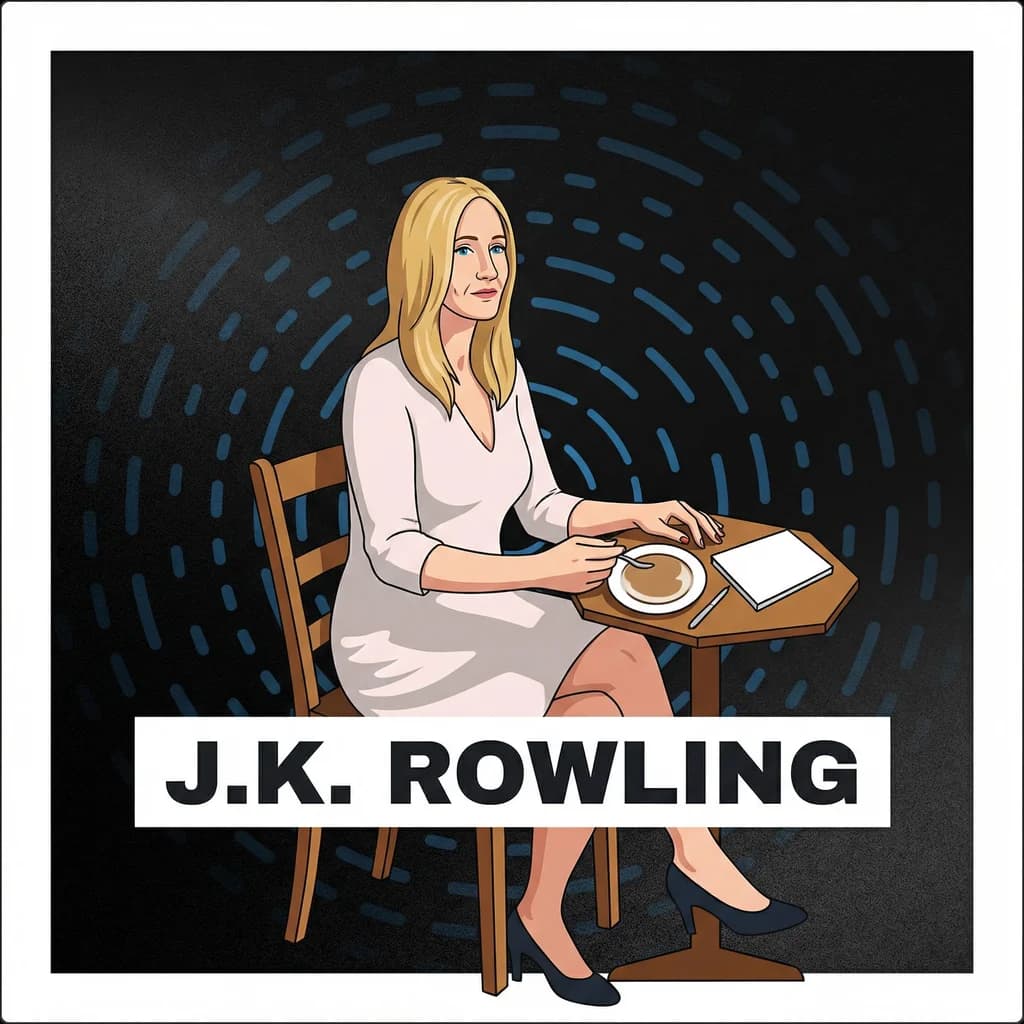

Part IThe Story
The Delayed Train
Somewhere between Manchester and London King's Cross, in the summer of 1990, a train stopped moving and a woman's life didn't. The delay — its length unrecorded, its cause forgotten — would turn out to matter a great deal to British publishing. Joanne Rowling, twenty-four years old, penless for once in her life, sat in her seat and watched a boy walk into her mind fully formed: scarred, orphaned, magical, unaware of his own power. "Harry just strolled into my head," she would say later, as if describing not an act of creation but an encounter. Ideas, she has observed, come in different ways — sometimes a word arrives first, sometimes a character limps out of the subconscious — but this one came as a physical rush, a torrent of images and plot architecture that she could only sit still and receive. She had no pen. She had to rely on imagining the details. Most of them ended up in the books.
What happened next took seventeen years — five to write the first novel, one to find an agent, one more to find a publisher, and then a decade during which the resulting seven-book series sold over 600 million copies, was translated into 85 languages, generated $7.7 billion in box-office revenue across eight films, spawned theme parks on three continents, a billion-dollar video game, a long-running stage production, and made its author the first novelist in history to become a billionaire. Then she gave away so much money that she fell off the Forbes billionaires list. Then she earned it back. Then she became one of the most polarizing public figures in the English-speaking world — not for anything she wrote in her novels, but for what she typed on social media about the definition of the word "woman."
The arc is almost too neat, too literary: the single mother on welfare who becomes the richest author alive, who builds a fantasy empire on the theme of love conquering power, who then deploys her own immense power in a culture war that has fractured her relationship with the very actors who brought her characters to life. It is a story about imagination and its limits, about what happens when the creator of a beloved fictional world insists on inhabiting the real one on her own uncompromising terms. It is, depending on who is telling it, either a story of extraordinary moral courage or of catastrophic self-destruction by a woman who had everything and could not stop talking.
Both versions miss something essential.
By the Numbers
The Wizarding Empire
600M+Harry Potter books sold worldwide
$7.7BWorldwide box office for eight Harry Potter films
$1.2BEstimated net worth (Forbes, 2025)
$1.1BRevenue from Hogwarts Legacy video game (2023)
85Languages into which the books have been translated
~£200MEstimated total charitable donations (The Sunday Times)
A Rabbit Called 'Rabbit'
She was born Joanne Rowling on July 31, 1965, at Yate General Hospital near Bristol, to parents who had both come from impoverished backgrounds and neither of whom had been to university. Her father, Peter, was an aircraft engineer at the Rolls Royce factory in Bristol — precise, mechanical work that would have no obvious bearing on his daughter's career except perhaps as something to rebel against. Her mother, Anne, was a science technician in the chemistry department at Wyedean Comprehensive, the school where Jo herself would later study. Anne would be diagnosed with multiple sclerosis when Jo was a teenager. She would die in 1990, at forty-five, before any of the Harry Potter books were published. The death would haunt the series — those orphan narratives, those absent mothers, those moments when Harry sees his parents in the Mirror of Erised — and it would haunt the author, too, in ways she has described as both devastating and generative.
"I lived for books," Rowling has said of her childhood in Gloucestershire and then Chepstow, Gwent, on the English-Welsh border. "I was your basic common-or-garden bookworm, complete with freckles and National Health spectacles." She wrote her first book at six — a story about a rabbit, called "Rabbit" — and at eleven produced a novel about seven cursed diamonds and the people who owned them. The ambition was evident even then: not a story, but a novel. Not one diamond, but seven. Not a standalone, but a structure. The woman who would one day plot all seven Harry Potter books before the first was published was, at eleven, already thinking in series.
Her grandfather, she told the Washington Post in 1999, was "a complete fantasist." "He would tell outrageous lies to everyone. I think maybe that's where I got my imagination." And from the time she was six, she knew. "All I ever wanted to do was be a writer." Her parents, understandably, hoped for something more practical. They took the view that an overactive imagination was an amusing personal quirk that would never pay a mortgage or secure a pension. A compromise was reached that satisfied nobody: she enrolled at the University of Exeter to study Modern Languages. "Hardly had my parents' car rounded the corner at the end of the road," she later told the Harvard graduating class of 2008, "than I ditched German and scuttled off down the Classics corridor." She cannot remember telling her parents she was studying Classics. They might well have found out for the first time on graduation day.
The Classics, it turned out, would pay off spectacularly. Many of the spells in the Harry Potter series — Lumos, Expelliarmus, Expecto Patronum — are rooted in Latin. Her parents, she told Harvard, "could have been hard put to name one subject less useful than Greek mythology when it came to securing the keys to an executive bathroom." She clocked up a £50 fine for overdue library books at Exeter, reading voraciously outside her syllabus. Her course included a year in Paris. After graduating in 1986, she moved to London and took a series of jobs, including one as a researcher at Amnesty International, where she read hastily scribbled letters smuggled out of totalitarian regimes by men and women risking imprisonment. "My small participation in that process," she said later, "was one of the most humbling and inspiring experiences of my life."
She was not yet a writer, not in any professional sense. She was twenty-four and had been writing for nearly two decades — "if you include all the embarrassing teenage rubbish" — but had never finished a novel. There was something called The Private Joke that occupied her for a couple of years; she still liked the premise but was too young, she realized, to write credibly about characters in their early forties. There were two other adult novels that went nowhere. She was working at jobs that had nothing to do with literature, carrying around a secret identity like one of her future characters.
Then, in 1990, two things happened. That summer, a train was delayed. And on December 30, her mother died.
The Suitcase and the Three Chapters
The years between 1990 and 1997 constitute the mythological core of the Rowling story, the period that transformed a bereaved young woman with a notebook into one of the most commercially successful authors in human history. The myth — refined through hundreds of interviews, simplified by tabloid headlines, reduced to a bumper sticker about single mothers and welfare checks — obscures a more complicated reality. Rowling was not simply waiting to be discovered. She was executing a plan of extraordinary ambition under conditions of almost total adversity.
After her mother's death and the breakup of a seven-year relationship with a boyfriend whose name has never been made public — a man in whose company she had invented Quidditch, in a small hotel in Manchester, after a row — she moved to Porto, Portugal, to teach English as a foreign language. The escape had a desperate quality: grief for her mother, the wreckage of a long relationship, the need to be somewhere else entirely. In Porto, she worked afternoons and evenings, writing in the mornings. She married a Portuguese journalist named Jorge Arantes in 1992. Their daughter, Jessica — named for Jessica Mitford, the aristocratic rebel and investigative journalist whom Rowling had admired since her teens — was born in 1993. The marriage was, by Rowling's own account, a disaster. She has spoken of it only in the most careful terms, but in a 2023 podcast interview she described losing a pregnancy during the relationship, calling it "hugely traumatic, physically and emotionally," and described the union itself as something entered in the wake of compounding losses.
She left Portugal in 1993 with Jessica and a suitcase containing the first three chapters of Harry Potter and the Philosopher's Stone. She chose Edinburgh because her sister Di lived there, and Edinburgh is where the story — both Harry's and Rowling's — truly begins. She was, by any conventional measure, destitute. She went on welfare. She sought treatment for clinical depression, which she has described as a "cold absence of feeling" — a flatness that would later inform the Dementors, those hooded figures in the Potter novels that drain all hope and happiness from their victims. "I think I had tendencies toward depression from quite young," she has said. "It's not an 'I'm so sad' feeling. It's an 'I'm so numb, I can't feel anything' feeling." She trained as a teacher, completed a postgraduate certificate in education at Moray House, and taught French in Edinburgh schools.
But she kept writing. In cafés, mostly, while Jessica slept in her pram. She wrote at Nicolson's Café on South Bridge. She wrote at the Elephant House on George IV Bridge, which would later market itself as "the birthplace of Harry Potter" — a claim Rowling has gently disputed. She wrote at the café in the Traverse Theatre, where she once crossed paths with a young director named John Tiffany, who would, years later, direct Harry Potter and the Cursed Child. "When we met for the first time about Cursed Child," she recalled, "I stared at him, thinking, he looks so familiar, where have I met him? And he told me, and the whole thing felt oddly fated."
She has described the appeal of cafés in terms that make the practice sound less romantic than resourceful: "You don't have to make your own coffee, you don't have to feel like you're in solitary confinement and if you have writers block, you can get up and walk to the next café." The best writing café, she has said, is "crowded enough to allow you blend in, but not too crowded that you have to share a table with someone else." She was hiding in plain sight, an unemployed single mother writing a children's fantasy novel about a boy who doesn't know he's special — in a country where children's books starring male protagonists were considered unfashionable, boarding-school settings were anathema, and no kids' book was supposed to be longer than 45,000 words. She was breaking every rule.
— J.K. RowlingI found success by stumbling off alone in a direction most people thought was a dead end, breaking all the 1990s shibboleths about children's books in the process.
The manuscript took five years to complete. Within that span, her mother had died, she had moved to Portugal, married, had a child, left her husband, returned to Britain, gone on welfare, been treated for depression, trained as a teacher, and written the most commercially successful children's novel of the twentieth century. She has acknowledged that the writing was not continuous — she kept putting the manuscript away for months at a time, convinced it was rubbish. Part of the reason for the seven-year gap between conceiving Harry Potter on that delayed train and seeing him in print was this cycle of abandon and return, the harshest critic inside her own head. "These days I can usually calm that particular critic down by feeding her a biscuit and giving her a break," she wrote years later.
When she finally finished the manuscript, she sent the first three chapters to a number of literary agents. One of them — Christopher Little, who ran a small agency in Fulham — wrote back asking to see the rest. "It was honestly the best letter I had ever received in my life," Rowling has said. She has ranked that moment just below the birth of her daughter Jessica as the most important of her life. Little then spent a year trying to sell the book. Twelve publishers turned it down. The rejections accumulated with a relentlessness that might have broken someone with less experience of failure. Rowling has said she pinned her first rejection letter to her kitchen wall.
Then Bloomsbury said yes.
£2,500 and the Scottish Arts Council
The terms of the deal were modest to the point of being almost insulting in retrospect. Bloomsbury Children's Books offered Rowling approximately £2,500 — roughly $4,000 — for the rights to Harry Potter and the Philosopher's Stone. Her editor, Barry Cunningham, reportedly advised her to get a day job, since children's book authors rarely made much money. The book was published in June 1997 under the name J.K. Rowling. The "K" stood for Kathleen, her paternal grandmother's name, added at the publisher's request because, as Rowling has drily noted, "they said it would make the books more appealing to boys." A book by an obviously female author, the reasoning went, might not appeal to the target audience. Born Joanne Rowling — no middle name — she became J.K. Rowling to solve a marketing problem. She would later adopt a second pseudonym, Robert Galbraith, to solve a different one.
The initial print run was modest: approximately 500 copies, 300 of which went to libraries. (Those first editions are now worth tens of thousands of pounds each.) The book won the Nestlé Smarties Book Prize and the British Book Award for Children's Book of the Year. Scholastic paid $105,000 for the American rights — an extraordinary sum for a debut children's novel from an unknown British author — and published the book in the United States in September 1998 under the slightly altered title Harry Potter and the Sorcerer's Stone, the word "Philosopher" deemed too obscure for an American audience. Rowling received a grant of £8,000 from the Scottish Arts Council to continue work on the second volume.
By January 1999, when the journalist Rosemary Goring met her for Scotland on Sunday, Rowling was thirty-three, had published two books, and was being compared to C.S. Lewis, Roald Dahl, and Robert Louis Stevenson. She cringed at such comparisons. She had dyed her hair from auburn to blonde to avoid being recognized, leaving the dark roots showing. She still took the bus into Edinburgh. "Clearly the material side of success has yet to permeate," Goring noted. It was said that she would be a millionaire by forty. The actual trajectory was considerably more dramatic than that.
Warner Bros. optioned the film rights in 1998, the year the first book reached American shelves. Scholastic's $105,000 bet was already looking prescient. By the summer of 2000, the first three books had earned approximately $480 million in three years, with over 35 million copies in print in 35 languages. Harry Potter and the Goblet of Fire, the fourth volume, was released in July 2000 with a first printing of 5.3 million copies. It became the fastest-selling book in publishing history at that point. The fifth volume, Harry Potter and the Order of the Phoenix, arrived in June 2003. The sixth, Harry Potter and the Half-Blood Prince, sold 6.9 million copies in the United States in its first twenty-four hours. The seventh and final volume, Harry Potter and the Deathly Hallows, was the most pre-ordered book in history at Barnes & Noble, Borders, and Amazon.com before its July 2007 release.
Rowling wrote the ending of Deathly Hallows in a suite at the Balmoral Hotel in Edinburgh — she had started the series in cafés on welfare and finished it in one of the city's finest luxury hotels. In fifteen years, she had gone from the woman nobody noticed writing in Nicolson's Café to the most famous living author in the world. She was, by then, richer than the Queen of England.
The Architecture of Seven
The commercial phenomenon obscures something that deserves more attention: the quality of the engineering. Rowling did not stumble into a seven-book series. She planned it from the start — the overall arc, the mysteries planted in book one that would not be resolved until book seven, the character trajectories, the thematic architecture. "From the start I knew there would be seven books," she has written, "and I had the whole story plotted out early on." She wrote mostly in longhand and built up a mass of notes, many scribbled on odd scraps of paper, that constituted a kind of bible for a fictional universe of staggering internal consistency.
The scale of this planning is difficult to convey. Each book covers one year at Hogwarts, with the protagonist aging from eleven to seventeen across the series. Each functions as a self-contained mystery — who opened the Chamber of Secrets? who put Harry's name in the Goblet of Fire? — while simultaneously advancing a larger narrative about Harry's relationship with Voldemort and the nature of sacrifice. Rowling embedded clues in early volumes that would not pay off for years: the heavy locket nobody can open at Grimmauld Place in book five, the significance of the Deathly Hallows, the truth about Snape. She constructed a fictional world with its own history, economy, politics, legal system, sports, cuisine, taxonomy of magical creatures, and educational curriculum — and kept it all consistent across 4,224 pages and seventeen years of writing.
— J.K. Rowling, on her creative processI see it as there's a lake and there's a shed. The shed more properly should be called a workshop. I've always imagined that there's something living in that lake that chucks me things that I catch and take to my shed and work on them.
"I planned this book to a degree that I have never planned a novel before," she told NPR about Career of Evil, the third Cormoran Strike novel, which is a remarkable admission from an author who began planning a seven-book series as a twenty-four-year-old on a delayed train. The distinction she draws is between the lake — the subconscious, the place where characters walk out unbidden and ideas arrive while making gravy — and the shed, which is the workshop where those raw materials are shaped, tested, and built into something structurally sound. "The best writers," she has said, "have an amazing lake and a phenomenal shed. Something that borders on a palace. They are amazing prose technicians, but they also have that bizarre ability to pull out the idea that no one else has ever quite done before."
What Rowling built with Harry Potter was not just a story but a platform — a fictional world capacious enough to support an indefinite number of stories, adaptations, and extensions. This was not, at the outset, a commercial strategy. It was a writer's instinct for world-building, for the kind of obsessive internal consistency that J.R.R. Tolkien brought to Middle-earth and that Rowling, who loved The Lord of the Rings, brought to the wizarding world. But it had enormous commercial consequences. A world this detailed, this internally coherent, could be extended — into films, theme parks, video games, companion books, a stage play, a television series — without losing its identity, because the identity was embedded in the architecture, not merely in the prose.
The Invisible Hand of IP
Warner Bros. saw the potential before almost anyone else, licensing the film rights while the series was still in its infancy. The resulting eight films — released between 2001 and 2011, directed variously by Chris Columbus, Alfonso Cuarón, Mike Newell, and David Yates — grossed $7.7 billion at the worldwide box office. They transformed the child actors Daniel Radcliffe, Emma Watson, and Rupert Grint into global stars and made the adult British acting establishment — Alan Rickman as Snape, Maggie Smith as McGonagall, Ralph Fiennes as Voldemort, Gary Oldman as Sirius Black, Helena Bonham Carter as Bellatrix Lestrange — into residents of a shared fictional universe that millions of viewers felt they personally inhabited.
But Rowling, crucially, retained control of her intellectual property. She owns the IP rights and licenses them through her own company, managed by the Blair Partnership. This means she earns from every adaptation, every merchandise line, every theme park ticket sold under the Harry Potter name. The Wizarding World of Harry Potter at Universal parks — in Orlando, Hollywood, Osaka, and Beijing — generates hundreds of millions in annual revenue. The stage production Harry Potter and the Cursed Child, which premiered in London in 2016 and transferred to Broadway in 2018, has become one of the most commercially successful plays ever staged. In 2023, the video game Hogwarts Legacy grossed over $1.1 billion, making it one of the year's best-selling titles. Rowling doesn't directly profit from the game but earns through licensing fees as the creator of the universe.
The business structure is unusual for an author. Most writers sell rights and move on. Rowling retained leverage. Forbes estimates she has earned more than $80 million per year from the sales of her books and the vast litany of Potterverse brand extensions — movies, television, theme parks, video games, theater, and merchandise. She was a fixture on the Forbes billionaires list from 2004 to 2011, during the height of Pottermania, until new reporting in 2012 uncovered $160 million in philanthropic giving, which dropped her below the billion-dollar threshold. She has since rebuilt her fortune to an estimated $1.2 billion, according to Forbes estimates in 2025. She is widely described as the first author to reach billionaire status.
A new HBO series adaptation of the Harry Potter books went into production in the summer of 2025 and is expected to run for a decade and to "mint a whole new generation of fans," in Forbes' phrase. Rowling will serve as executive producer and retains creative control. Forbes estimates she could earn about $20 million per year from the series alone. HBO chief Casey Bloys said in November 2024 that she was "very, very involved in the process selecting the writer and the director." When asked about Rowling's politics, Bloys offered: "She's entitled to those views. And if you want to debate her, you can go on Twitter."
In the nearly three decades since Philosopher's Stone debuted, Rowling has built the Potterverse into a franchise that is likely to run as long as Sherlock Holmes and James Bond. She accomplished this not through corporate infrastructure but through the disciplined maintenance of creative authority — an author who never ceded the ultimate decision to the studio, the producer, or the marketer.
📊
The Potterverse Revenue Machine
Major revenue streams from the Wizarding World franchise.
| Revenue Stream | Scale |
|---|---|
| Book sales (7 core novels + companions) | 600M+ copies, 85 languages |
| Film franchise (8 films, 2001–2011) | $7.7B worldwide box office |
| Stage: Harry Potter and the Cursed Child | London, Broadway and international productions |
| Video game: Hogwarts Legacy (2023) | $1.1B+ gross revenue |
| Theme parks (Universal Orlando, Hollywood, Osaka, Beijing) | Hundreds of millions annually |
| HBO TV series (in production) | ~$20M/year to Rowling (est.) |
| Fantastic Beasts films (2016, 2018, 2022) | $1.5B+ worldwide box office |
Robert Galbraith and the Problem of the Second Act
What do you do after you've written the most successful series in the history of children's literature? Rowling's answer was both conventional and subversive: she wrote something else, and she made sure nobody knew it was her.
Her first post-Potter book, The Casual Vacancy (2012), was an adult novel — a contemporary social satire set in a small English town, dealing with class, local politics, and the petty cruelties of parish life. It was reviewed with the impossible expectations that attach to any Rowling publication and received a mixed critical reception, though it sold well enough to be adapted into a BBC miniseries in 2015. The book was interesting precisely because it was so aggressively un-Potterish: no magic, no wonder, no children. It was as if Rowling were answering the question that had followed her for a decade — can she write anything else? — by writing the most different thing she could imagine.
But the more radical experiment came in 2013, when it was revealed that she had published a crime novel, The Cuckoo's Calling, under the pseudonym Robert Galbraith. The book's protagonist, Cormoran Strike, is a disabled war veteran and private detective — a man, amputee, son of a rock star, as far from a boy wizard as possible. Rowling had submitted the manuscript through a process in which neither her editor nor her publisher initially knew the author's identity. "My publisher didn't know who I was when they first saw it," she told NPR. The book received strong reviews and modest sales. Then a journalist discovered the truth, and everything changed.
The Galbraith experiment was, in a sense, the purest test of Rowling's ability. Stripped of the name, the brand, the expectations, the pre-orders — could the work stand on its own? The initial reviews suggest it could. The subsequent sales — the series reached its eighth novel, The Hallmarked Man, in 2025, and has a BBC television adaptation — suggest the market agrees. But the experiment also revealed something about Rowling's relationship to fame. She described the appeal of the pseudonym in terms that echoed her love of writing in cafés before anyone knew who she was:
— J.K. Rowling, on writing as Robert GalbraithPotter was incredible, and I am so grateful for what happened with Harry Potter. Having said that, there was a phenomenal amount of pressure that went with being the writer of Harry Potter, and that aspect of publishing those books I do not particularly miss. So you can probably understand the appeal of going away and creating something very different, and just letting it stand or fall on its own merits.
The Strike novels are, in many ways, Rowling's most revealing work. The detective is not autobiographical — "he's a disabled veteran, he's a man, obviously" — but there are things she likes in him, things she feels they share: "He has a very strong work ethic. He is a tryer, in all circumstances. And at the point where we meet him in the very first book, he is absolutely on his uppers, in a way that I too have experienced, in that he is as poor as you can be without being homeless." The series also explores fame through a sidelong lens. Strike is the son of a famous rock star, which means he has "all of the drawbacks of being associated with fame and none of the advantages." Rowling has acknowledged that this comes directly from her own experience: "The people around the famous person often pay a price without reaping many of the rewards. And I find that an interesting area, and obviously yes that very much comes from my own experience."
The research for these books has taken Rowling into dark territory. For Career of Evil, which involves a psychopathic killer, she studied serial murderers extensively. "This is the first time ever that a book has literally given me nightmares," she told NPR. "And it wasn't the writing of the novel that gave me nightmares, it was the research." She read accounts left by Ted Bundy — "he was articulate on the subject of how he felt about women" — that "greatly informed the perspective of the killer." The violence against women in the book is baroque and deliberate, and Rowling was insistent on giving the survivor, Robin Ellacott — Strike's secretary-turned-partner, a woman who was assaulted in her past — her full humanity. "As Robin says in the book, this does not define her. She is many, many, many, many things."
The Cage-Bed and the Fortune
In the summer of 2004, Rowling was reading The Sunday Times when a photograph stopped her. A small shaven-headed boy, about five years old, his face pressed against wire mesh in what appeared to be a cage. Her initial reaction, she has said, was to turn the page. She was pregnant with her youngest child. She made herself read the article. The boy was named Vasek Knotek, and he lived in the Raby care home near Prague — one of hundreds of inhumane and archaic institutions across Eastern Europe that were a cruel remnant of Soviet rule. Each day at 11 a.m. the screaming began, as the child was locked back in his cage-bed after a brief period of feeding and washing.
"I know I'm hardly unusual in this," Rowling has said, "but I have a particularly visceral reaction to seeing children abandoned, abused and alone. The image of that little boy screaming through what looked like chicken wire was so distressing. It remains burnt into my brain." She lobbied the Czech ambassador to the UK and the Czech prime minister. She wrote to Baroness Nicholson of Winterbourne, a former director of fundraising for Save the Children. Together they formed the Children's High Level Group, later renamed Lumos — after the charm in Rowling's books that illuminates the end of a wand, shining light into the darkest places — in 2010. In the twenty-one years since, Rowling has donated £63 million to Lumos, either directly or through the Harry Potter franchise, helping more than 280,000 children across Eastern Europe, Haiti, Colombia, and Ukraine.
Lumos is only part of the picture. The Sunday Times calculates that Rowling has donated almost £200 million to three main causes: Lumos, the Volant Charitable Trust (her broad philanthropic vehicle), and the Anne Rowling Regenerative Neurology Clinic at the University of Edinburgh, named for her mother and focused on multiple sclerosis research. It was this philanthropy — roughly $160 million uncovered by Forbes' reporting in 2012 — that dropped her from the billionaires list, making her, by one widely circulated account, the first billionaire to fall off the Forbes list due to charitable giving.
She has never talked publicly about her philanthropy in any comprehensive way until a 2025 interview with The Sunday Times, and even then she was reluctant. "Nobody who hasn't been poor can understand what it means," she said. The phrase has the compressed force of something long thought about and rarely spoken. It connects the woman on welfare in Edinburgh to one of the wealthiest writers alive — because they are, in Rowling's telling, the same woman, one who knows exactly what poverty feels like and who therefore understands both the moral weight of wealth and its absurdity.
In April 2025, after the UK Supreme Court ruled that the legal definition of a woman in the Equality Act is based on biological sex, Rowling posted a photograph of herself on a yacht, holding a cocktail and smoking a cigar, with the caption: "I love it when a plan comes together." Supporters celebrated the post; critics condemned it as gloating.
'People Who Menstruate'
The sentence that changed everything — or at least changed Rowling's public identity irrevocably — was composed in June 2020, during the COVID-19 pandemic, in response to an article headline that referenced "people who menstruate." Rowling tweeted: "'People who menstruate.' I'm sure there used to be a word for those people. Someone help me out. Wumben? Wimpund? Woomud?"
The tweet was, in its construction, recognizably the work of a writer who had built a career on witty, barbed prose. It was also, depending on one's position in the gender-identity debate, either a defense of biological reality or an attack on transgender people's right to exist. Rowling followed the tweet with a longer statement: "If sex isn't real, the lived reality of women globally is erased. I know and love trans people but erasing the concept of sex removes the ability of so many to meaningfully discuss their lives."
What followed was a conflagration. Daniel Radcliffe, who had played Harry Potter from the age of eleven, publicly opposed Rowling: "Transgender women are women." Emma Watson posted her support for the trans community. Rupert Grint, who had played Ron Weasley, issued a careful but clear statement. Rowling's relationship with the actors who had embodied her characters — whom she had known since they were children — fractured publicly. Others from the Potter films defended her: Ralph Fiennes expressed sympathy for her position, Helena Bonham Carter voiced support, and Robbie Coltrane — who had played Hagrid and who died in 2022 — dismissed the criticism.
The full essay Rowling published on her website in June 2020, a 3,670-word piece titled "J.K. Rowling Writes about Her Reasons for Speaking Out on Sex and Gender Issues," is the most revealing public document she has produced outside her fiction. In it, she describes a longstanding professional and personal interest in gender-identity issues — partly because her female detective, Robin Ellacott, is "of an age to be interested in, and affected by, these issues herself," and partly for intensely personal reasons that she discloses in the essay: she is a survivor of domestic abuse and sexual assault. The essay is detailed and unapologetic. Her supporters regard it as a reasoned argument; many trans people and advocacy groups regard its central claims as mistaken and harmful.
She has not backed down. In the years since, she has posted on X (formerly Twitter) multiple times daily in support of what she calls sex-based rights, frequently engaging with critics and commenters. She donated £70,000 to For Women Scotland's crowdfunding for the legal challenge that culminated in the April 2025 Supreme Court ruling. She has been labeled a TERF — trans-exclusionary radical feminist — a term she rejects. She has faced death threats, rape threats, and public burning of her books.
In a podcast interview, she addressed the accusation that she had "ruined her legacy" directly: "I never set out to upset anyone. However, I was not uncomfortable with getting off my pedestal. And what has interested me over the last ten years and certainly in the last few years — 'You've ruined your legacy. You could have been beloved forever, but you chose to say this.' And I think: you could not have misunderstood me more profoundly. I do not walk around my house, thinking about my legacy. What a pompous way to live your life. Whatever, I'll be dead. I care about now. I care about the living."
The Sorting Hat Never Gets It Wrong
In 2005, on the night of the midnight release of Harry Potter and the Half-Blood Prince, Melissa Anelli — then the twenty-five-year-old web mistress of the fan site The Leaky Cauldron, a young woman from Staten Island who had built her adult identity around the world Rowling had created — arrived at Edinburgh Castle to find the building's ancient walls illuminated with the book's cover. Rowling had personally summoned Anelli and another fan-site proprietor, Emerson Spartz of MuggleNet, for an interview at her home the following day. They had twelve hours to read the 650-page book. They arrived at Rowling's ivy-covered Victorian stone mansion — a place that had become something of a fortress, with an eight-foot wall, an electronic gate, and CCTV cameras installed after a stalker had shown up repeatedly — and were ushered into her office, an outbuilding with honey-colored wood and floor-to-ceiling windows.
The interview ran close to two hours. Rowling answered questions about the internal mechanics of her fictional world with the unhesitating authority of someone who had lived inside it for fifteen years. "Has the Sorting Hat ever been wrong?" Spartz asked. "No," Rowling said. Unequivocal. She gave Anelli a gold ring shaped like a snake with emerald eyes, with a note thanking her for her "invaluable protectiveness towards Harry and his fans."
Fifteen years later, in the summer of 2020, The Leaky Cauldron and MuggleNet joined forces again — to condemn J.K. Rowling.
The schism between Rowling and a significant portion of her own fandom is one of the stranger episodes in the history of modern literary culture. She created a world that millions of readers experienced as a moral education — a story about tolerance, about the wrongness of purity ideology, about choosing what is right over what is easy — and then, in the view of many of those same readers, betrayed the principles of her own work. The counterargument, advanced by Rowling herself and by her defenders, is that she is doing precisely what Dumbledore counseled: making the hard choice, saying the unpopular thing, standing up for what she believes is true regardless of the consequences.
Both sides claim Rowling. Both sides claim Harry.
What is undeniable is the scale of the conflict and the apparent absence of any commercial consequence. The Potterverse has continued to expand. The HBO series is moving forward. The books continue to sell. Whatever damage the controversy has done to Rowling's reputation in certain quarters, it has not visibly dented the business.
The Room in the Garden
She writes in a room in her garden in Edinburgh — a small outbuilding, about a minute's walk from the house, with a central workspace, a kettle, a sink, and a bathroom the size of a cupboard. The radio is usually tuned to classical music. She finds human voices distracting. She drinks eight or nine mugs of tea during a writing day. She prefers eating things that won't ruin the keyboard when dropped. "Popcorn's ideal."
The earlier she starts, the more productive she is. If she begins around nine, she can work through to about three before needing more than a short break. She has pulled a couple of all-nighters on the Fantastic Beasts screenplays but otherwise tries to keep her writing to daylight hours. She describes herself as solitary by nature — "novels and I suit each other perfectly" — and says the collaborations she has been involved in have been "pure joy, mainly because of the people involved."
There is something in this description — the garden room, the tea, the popcorn, the classical music — that resists the grandiosity of her public persona. It is a portrait of a writer who has arranged her life to protect the conditions under which the work gets made. The room in the garden is only a minute from the house, but it is a separate structure, a deliberate boundary. She used to love writing in cafés and "gave it up reluctantly, but part of the point of being alone in a crowd was being happily anonymous and free to people-watch, and when you're the one being watched, you become too self-conscious to work." The fame that the café writing helped create destroyed the conditions that made the café writing possible. Now she writes alone, in a room in her garden, in Edinburgh, which is "very much home" and "the place where Harry evolved over seven books and many, many hours of writing in its cafés."
She says she has six more books in her head. She is sixty years old. Her children — Jessica, David, and Mackenzie — are grown. She is married to Neil Murray, a doctor whom she wed in 2001. She was appointed Officer of the Order of the British Empire in 2001 and named a chevalier of the French Légion d'Honneur in 2009. She has received the Prince of Asturias Award for Concord, the Hans Christian Andersen Literature Award, and an honorary degree from Harvard. She has been condemned by many of the people who once adored her and lionized by many who once dismissed her. She has given away an estimated £200 million, and she posts prolifically on X about sex and gender.
The delayed train is thirty-five years behind her now. But the image persists — a young woman with no pen, sitting still while an entire world pours into her mind, powerless to write it down and unable to stop receiving it. She has described the experience in terms that echo the Sorting Hat: some characters just walk out of your subconscious and stand in front of you. You don't summon them. You receive them. And then you spend the rest of your life building the room where they can live — first in cafés, then in Edinburgh flats, then in a writing room behind a stone house with a wall and a gate and cameras.
Part IIThe Playbook
The operating principles that follow are drawn from the evidence of Rowling's career — her decisions, her methods, her public statements, and the structural choices embedded in her work. They are not inspirational platitudes. They are the mechanics of how a woman with no connections, no money, and no pen built a multibillion-dollar fictional universe and kept control of it.
The principles
- 1.Plan the cathedral before you lay the first stone.
- 2.Use failure as structural foundation, not as narrative obstacle.
- 3.Own the intellectual property. Always.
- 4.Build worlds, not stories.
- 5.Break the rules that aren't load-bearing.
- 6.Protect the conditions of production above all.
- 7.Use pseudonymity as a diagnostic tool.
- 8.Let the work absorb your contradictions.
- 9.Give at a scale that changes your own category.
- 10.Refuse to trade conviction for approval.
- 11.Control the adaptation, or don't do it.
- 12.Keep the workroom modest.
Principle 1
Plan the cathedral before you lay the first stone.
Rowling conceived the Harry Potter series as a seven-book arc on a delayed train in 1990 and did not publish the first book until 1997. In the intervening years, she plotted the overall narrative, developed an internally consistent fictional world with its own history and rules, and embedded mysteries in the first volume that would not be resolved until the seventh. The scope of this planning — executed in longhand, on scraps of paper, by a woman on welfare — is the single most important structural decision of her career. It meant that each book functioned simultaneously as a standalone mystery, a chapter in a larger story, and a contribution to a fictional world that could support indefinite expansion. Most authors write one book and then decide whether to write another. Rowling designed a system.
The cathedral analogy is precise: a cathedral takes decades to build, requires a master plan that anticipates the weight and stress of every element, and produces a structure whose beauty and coherence become apparent only when the whole thing is standing. Rowling's world-building was architectural in exactly this sense — she knew the rules of magic, the history of Hogwarts, the names of all the Quidditch teams, long before the reader needed any of it.
Tactic: Before you begin executing, invest disproportionate time in designing the system — the relationships between elements, the internal logic, the connective tissue that will make later expansion possible and coherent.
Principle 2
Use failure as structural foundation, not as narrative obstacle.
Rowling's Harvard commencement speech, delivered in June 2008, is not — despite its reputation — a motivational speech about overcoming adversity. It is a precise argument about the epistemic value of failure. "Failure taught me things about myself that I could have learned no other way," she told the graduates. "I discovered that I had a strong will, and more discipline than I had suspected; I also found out that I had friends whose value was truly above the price of rubies."
The key phrase is "things about myself that I could have learned no other way." Rowling is not saying that failure is a stepping stone to success. She is saying that failure is a diagnostic instrument — it reveals information about your own capabilities, your relationships, and your actual priorities that cannot be obtained any other way. Her years on welfare in Edinburgh were not a detour from her writing career. They were the conditions under which she discovered that she would keep writing no matter what, that the inner critic could be survived, that the work was non-negotiable. The poverty informed the fiction. The failure was load-bearing.
Tactic: When you fail, interrogate the failure as data — not about the world's cruelty, but about your own revealed preferences and hidden capacities. What did you keep doing when everything fell apart? That's the signal.
Principle 3
Own the intellectual property. Always.
Rowling's retention of her IP rights is the single most consequential business decision of her career. She licenses the Harry Potter brand through her own company, which means she earns from every adaptation, every merchandise line, every theme park ticket. This is unusual for an author — most sell rights and move on — and it has made her not merely wealthy but structurally powerful. She can veto adaptations, control creative direction, and ensure that the fictional world remains consistent with her vision.
The financial implications are staggering, but the strategic implications are more important. Ownership means that the franchise cannot exist without her consent. When HBO launched the new television adaptation, Rowling was closely involved in choosing its writer and director. She is not a legacy creator whose name is licensed posthumously or perfunctorily. She is a sitting author with operational control over the largest entertainment franchise in the world that was created by a single individual.
Tactic: In any creative or entrepreneurial venture, prioritize ownership of the underlying asset over short-term revenue. The ability to say no is worth more than any upfront payment.
Principle 4
Build worlds, not stories.
A story has a beginning, a middle, and an end. A world is a platform on which an indefinite number of stories can be told. Rowling built a world — the Wizarding World — with its own geography, institutions, laws, history, sports, creatures, currency, and social stratification. This world was detailed enough to support not just seven novels but also companion volumes (Fantastic Beasts & Where to Find Them, Quidditch Through the Ages, The Tales of Beedle the Bard), a film series, a prequel film series, a stage play, theme parks, a digital platform (Pottermore, later Wizarding World Digital), a video game with a different protagonist in a different era, and a television reboot.
The critical insight is that a sufficiently detailed and internally consistent world generates stories almost as a byproduct. Rowling has said that characters "walk out of your subconscious" — but they walk into a world that already has rules, and those rules constrain and shape the stories that can be told within it. This is the difference between a franchise and a novel: a franchise is a world; a novel is a story. Rowling wrote novels but built a franchise, because her instinct for world-building was so obsessive that the world outlived any individual narrative.
Tactic: When building any system — a product, a company, a creative project — invest in the underlying platform and its internal coherence rather than in any single output. The platform generates optionality; the individual output does not.
Principle 5
Break the rules that aren't load-bearing.
In the 1990s, the conventional wisdom of children's publishing held that male protagonists were unfashionable, boarding-school settings were anathema, and no children's book should exceed 45,000 words. Rowling violated all three principles. Harry Potter and the Philosopher's Stone features a male protagonist at a boarding school and clocks in at approximately 77,000 words. The later volumes are vastly longer — Order of the Phoenix exceeds 250,000 words. Twelve publishers rejected the manuscript before Bloomsbury accepted it.
Rowling has described it as stumbling off alone. But the stumbling was not random. She broke the rules about audience expectations and format length — which turned out to be market assumptions, not structural necessities — while rigorously obeying the rules of internal consistency, narrative architecture, and emotional truthfulness. The load-bearing rules were about craft. The decorative rules were about convention. Knowing the difference is what separates iconoclasts from amateurs.
Tactic: Distinguish between the conventions of your industry (which are often arbitrary market assumptions) and the structural principles of your discipline (which are not). Break the former freely. Obey the latter religiously.
Principle 6
Protect the conditions of production above all.
Rowling has organized her life around the protection of her writing practice with the deliberateness of an athlete managing training load. She writes in a separate outbuilding in her garden, one minute from her house — close enough to be convenient, far enough to establish a boundary. She listens to classical music because human voices are distracting. She drinks eight or nine mugs of tea. She starts before nine and works until three. She gave up writing in cafés reluctantly, not because she stopped loving the practice but because her fame destroyed the anonymity that made it productive.
The pattern is consistent across her career: she protects the conditions under which the work gets made, even when it means sacrificing things she enjoys. Writing in cafés was generative when she was anonymous; she abandoned it when recognition made it impossible. Collaborations — the Cursed Child stage play, the Fantastic Beasts screenplays — are the exception, not the rule, and she describes them in terms that emphasize the specificity of the collaborators rather than the appeal of collaboration as such.
Tactic: Identify the specific conditions — environmental, temporal, social — under which you do your best work, and defend them with the same rigor you bring to the work itself. Productivity is not about discipline in the abstract; it is about the curation of context.
Principle 7
Use pseudonymity as a diagnostic tool.
When Rowling published The Cuckoo's Calling under the name Robert Galbraith in 2013, she was not merely seeking creative freedom. She was running an experiment. Could the work stand without the name? Her publisher and editor did not initially know they were evaluating a Rowling manuscript. The book was well reviewed but sold modestly — a signal that good prose alone does not drive sales, and that the brand was the primary commercial engine.
The pseudonym served multiple functions: it provided data about the market's response to her prose independent of her fame; it gave her the experience of being a debut author again (the rejections, the modest print runs, the uncertainty); and it protected the new work from the impossible expectations that attach to any Rowling publication. It also revealed something about the relationship between author and audience: once her authorship was revealed, sales of the same book multiplied almost overnight. The name was doing an enormous amount of the work.
Tactic: When possible, test your product or idea stripped of your brand, your reputation, or your network effects. The delta between the branded and unbranded response is the clearest measure of what you are actually selling.
Principle 8
Let the work absorb your contradictions.
The Harry Potter series is, on its surface, a story about good triumphing over evil. But it is also a story about moral ambiguity — about Dumbledore's manipulativeness, about Snape's tortured loyalties, about the Ministry of Magic's corruption, about the ease with which institutions slide toward authoritarianism. The Strike novels, meanwhile, explore violence against women, the pathologies of fame, the psychologies of killers. Rowling has used fiction as a container for the contradictions and darknesses that her public persona does not easily accommodate — the grief-stricken orphan, the survivor of domestic violence who writes about serial murderers for Robert Galbraith.
This is not autobiography in any simple sense. It is something more sophisticated: the transmutation of lived experience into fictional structure. Rowling's worst fear, she has said, is "powerlessness and small spaces" — and the founding image of her charity Lumos is a small boy screaming through wire mesh in a cage-bed. The Boggart — the creature that assumes the shape of whatever you fear most — came from somewhere too. The work does not resolve these contradictions; it holds them.
Tactic: The most enduring creative and strategic work contains genuine tensions — it does not resolve every contradiction into a neat thesis but allows competing truths to coexist within a single structure.
Principle 9
Give at a scale that changes your own category.
Rowling's philanthropy is not ancillary to her story; it is structurally central to it. Forbes's 2012 reporting found roughly $160 million in giving — enough to drop her off its billionaires list. She founded a charity, Lumos, that has helped over 280,000 institutionalized children across multiple countries. She funded the Anne Rowling Regenerative Neurology Clinic to research the disease that killed her mother. The Volant Charitable Trust supports a range of causes. She has donated an estimated £200 million in total.
The scale is the point. Giving at this level is not philanthropy as reputation management or tax optimization; it is philanthropy as identity. It changed Rowling's financial category — literally removing her from the billionaires list — and it changed her operational category from "author" to "institution." The decision to give at a rate that exceeded her capacity to maintain billionaire status is, in a purely financial sense, irrational. In every other sense, it is the most coherent expression of the values that animate her fiction.
Tactic: Calibrate your generosity not to your comfort level but to the scale at which it produces systemic change — in your community, your industry, or your own self-conception.
Principle 10
Refuse to trade conviction for approval.
Whatever one's position on the gender-identity debate, the structural fact of Rowling's engagement with it is extraordinary. She entered a controversy in which she had nothing material to gain and everything reputational to lose. She fractured relationships with actors she had known since childhood. She endured death threats, rape threats, book burnings, and public condemnation from institutions and individuals who had once celebrated her. And she did not stop.
Her explanation, quoted above — that she does not think about her legacy and cares about "the living" — is worth attending to not for its political content but for its strategic logic. It is not the calculus of a person managing a brand. It is the calculus of a person who has separated her sense of identity from the market's assessment of her. The commercial data suggest this separation has cost her little financially — the franchise has kept growing — but it has plainly cost her a great deal personally, and critics would add that it has cost others too.
Tactic: Identify the convictions you would hold even if they cost you your audience, your board, or your social circle. Those are the ones worth articulating. Everything else is positioning.
Principle 11
Control the adaptation, or don't do it.
For ten years, Rowling said no to proposals to adapt Harry Potter for the stage — usually as a musical, and usually using the existing books. She waited until she found collaborators (Sonia Friedman, Colin Callender, director John Tiffany, writer Jack Thorne) who wanted to do "something new," which was intriguing because she "had no desire to go endlessly back over old ground." The result — Harry Potter and the Cursed Child — won an unprecedented nine Olivier Awards and six Tony Awards. With the HBO television adaptation, she is serving as executive producer with creative control.
The pattern is consistent: Rowling does not license her work passively. She participates in the selection of directors, writers, and actors. She reviews scripts. She has veto power. This is not ego; it is quality control. The alternative — the fate of many beloved literary properties — is a franchise that deteriorates with each adaptation as the original creator's vision is diluted by committee.
Tactic: If you are going to extend your work or your brand into new formats or markets, retain creative authority or accept that the extension will degrade the original. There is no middle ground.
Principle 12
Keep the workroom modest.
Rowling's career has followed a trajectory from café to garden room — from writing in public anonymity to writing in private solitude. The room is modest: a central workspace, a kettle, a cupboard-sized bathroom. The fortune is enormous. The writing conditions have not scaled with the fortune.
This asymmetry is not accidental. The room is where the work happens. The fortune is a consequence of the work, not its purpose. Rowling has resisted the common temptation of successful people to build environments that reflect their status rather than serve their function. The room maintains the conditions — solitude, simplicity, proximity to home without domestic distraction — that make writing possible.
"I am at my happiest alone in my writing room making things up," Rowling has said. The sentence is almost absurdly simple. But it contains the entire strategic logic of her career: identify the activity that produces the most value — for you and for the world — and organize everything else around protecting your ability to do it.
Tactic: As you succeed, resist the instinct to upgrade the conditions of your work. Upgrade the conditions of your life if you wish, but keep the workspace functional, modest, and optimized for output rather than status.

Free playbook
Get The Business Model Playbook
58 business models, one visual page each: how the money flows, the metrics that matter, and who runs it. Free when you join the Faster Than Normal email.
Free. No spam. Unsubscribe anytime.
Part IIIMaxims
-
The pen-less train ride is the test. The ideas that survive the absence of tools — the ones you carry in your head because you have no choice — are the ones worth building a life around.
-
Seven years is not too long. Rowling spent seven years between conceiving Harry Potter and publishing the first book. Impatience is not ambition. Ambition is the willingness to keep working on something that the world hasn't validated yet.
-
The advance is not the verdict. Bloomsbury paid about £2,500 for Philosopher's Stone, and her editor reportedly advised her to get a day job. What a buyer pays at the start tells you what they can see, not what the work is worth.
-
Study the useless subject you love. Rowling dropped German for Classics and cannot remember ever telling her parents. Latin later supplied the spells — Lumos, Expelliarmus, Expecto Patronum — that run through the series.
-
Concede the cosmetic, keep the structural. Rowling accepted the "K" her publisher wanted to make the books more appealing to boys, while breaking the era's rules on length, boarding schools, and male protagonists. Know which demands touch the work and which only touch the wrapper.
-
Manage the inner critic; don't obey it. Rowling repeatedly shelved the first manuscript for months, convinced it was rubbish, which is part of why it took seven years to reach print. She says she now calms that critic with a biscuit and a break.
-
Some books have to wait for you. She still liked the premise of The Private Joke but realized she was too young to write credibly about characters in their early forties. Recognizing that a project is premature is different from abandoning it.
-
Read the article you want to skip. Rowling's first impulse at the photograph of a caged child was to turn the page; she made herself read on. That article led to Lumos, to which she has given £63 million.
-
Steady sales don't mean nothing was lost. Her public statements on sex and gender left no visible dent in the Potter business, yet they split her fandom and her relationships with the actors who played her characters. Revenue is only one of the ledgers a public stance affects.
In Their Own Words
It is our choices that show what we truly are, far more than our abilities.
The stories we love best do live in us forever.
You will never truly know yourself, or the strength of your relationships, until both have been tested by adversity.
We do not need magic to transform our world. We carry all the power we need inside ourselves already.
It is impossible to live without failing at something unless you live so cautiously that you might as well not have lived at all—in which case, you fail by default.
It does not do to dwell on dreams and forget to live.
Indifference and neglect often do much more damage than outright dislike.
I was set free because my greatest fear had been realized, and I still had a daughter whom I adored, and I had an old typewriter and a big idea.
You control your own life. Your own will is extremely powerful.
Anything's possible if you've got enough nerve.
The world is full of wonderful things you haven't seen yet. Don't ever give up on the chance of seeing them.
We all have magic inside us.
It is impossible to live without failing at something, unless you live so cautiously that you might as well not have lived at all — in which case, you fail by default. Failure gave me an inner security that I had never attained by passing examinations.— J.K. Rowling, Harvard Commencement Address, June 5, 2008
We do not need magic to change the world, we carry all the power we need inside ourselves already: we have the power to imagine better.— J.K. Rowling, Harvard Commencement Address, June 5, 2008
I haven't got ten rules that guarantee success, although I promise I'd share them if I did. The truth is that I found success by stumbling off alone in a direction most people thought was a dead end.— J.K. Rowling, on her writing
I do not walk around my house, thinking about my legacy. What a pompous way to live your life. Whatever, I'll be dead. I care about now. I care about the living.— J.K. Rowling, 'The Witch Trials of J.K. Rowling' podcast
There was a phenomenal amount of pressure that went with being the writer of Harry Potter, and that aspect of publishing those books I do not particularly miss. So you can probably understand the appeal of going away and creating something very different, and just letting it stand or fall on its own merits.— J.K. Rowling, NPR interview, 2015


